Installing multiple EV chargers can create a valuable facility for commercial properties, fleet operators, residential societies and public charging station owners. However, every additional charger also increases the amount of electricity that may be required from the site’s power connection.
When several electric vehicles start charging at the same time, the combined demand can rise quickly. If this demand is not managed correctly, the property may experience transformer overloading, higher electricity costs, charger interruptions or the need for expensive electrical infrastructure upgrades.
This is where smart EV charging and dynamic load management become important.
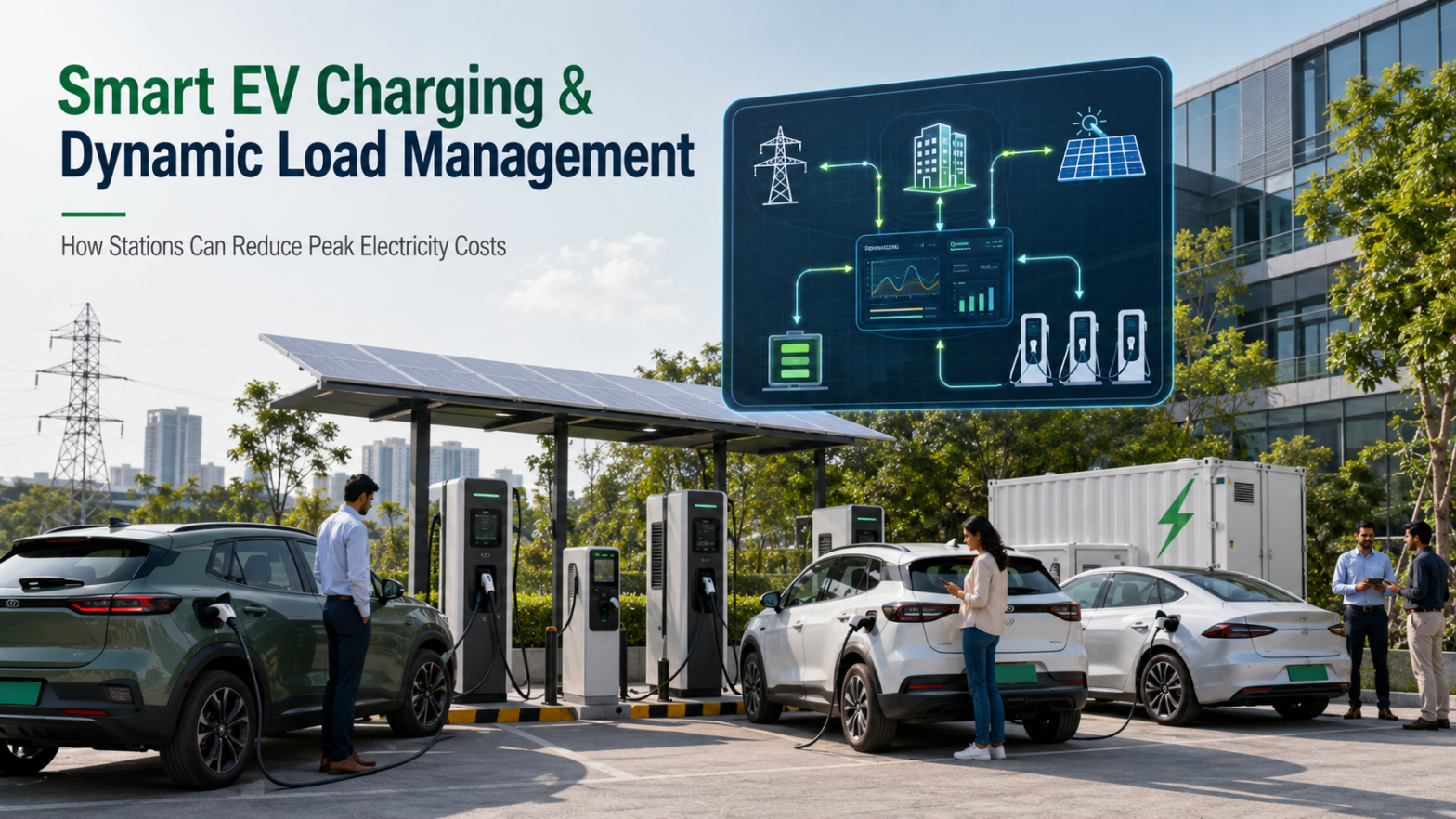
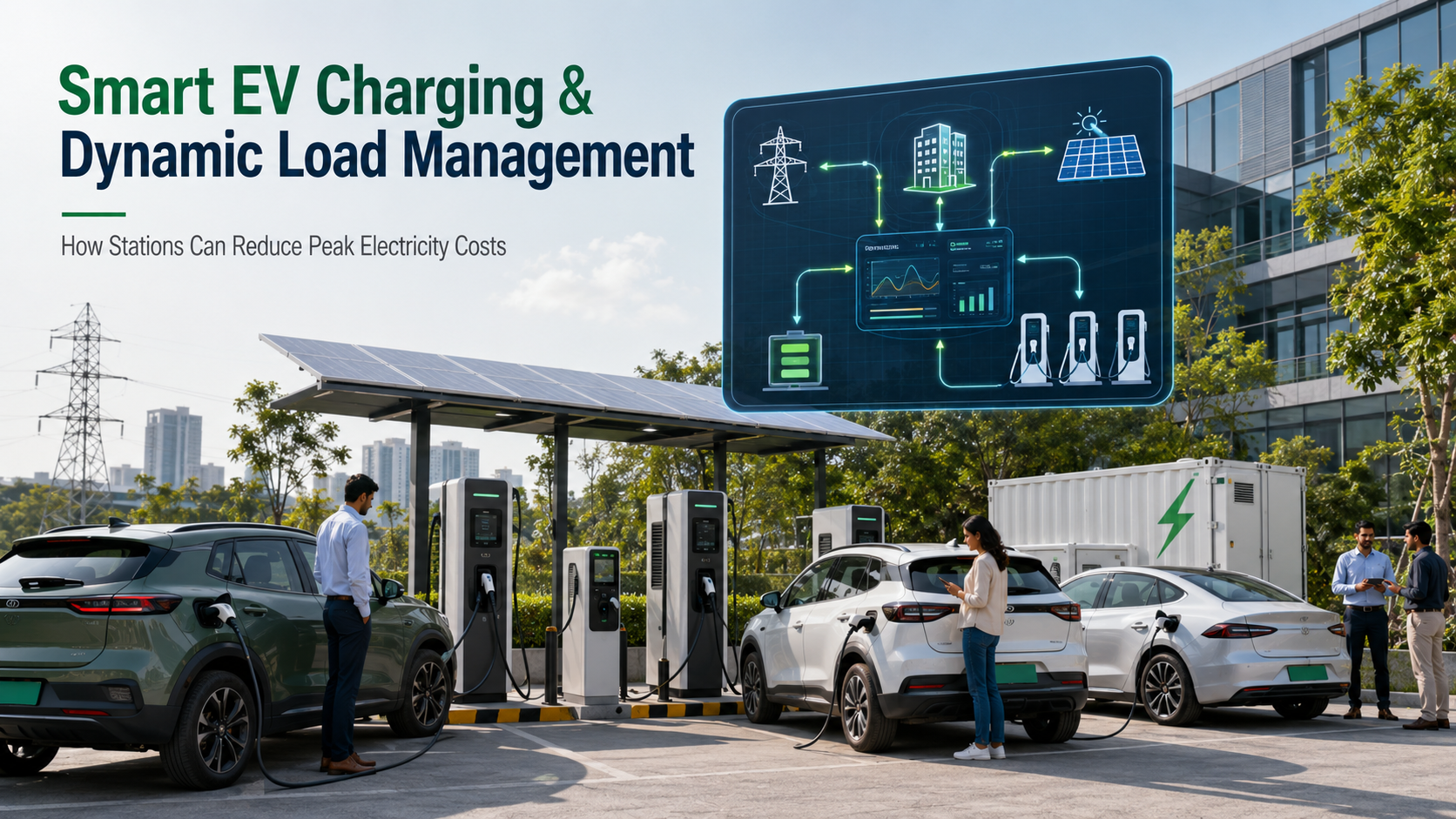
Instead of allowing every connected charger to continuously draw its maximum rated power, a smart charging system monitors the available electricity capacity and distributes power according to real-time site conditions.
This allows a charging station to serve multiple vehicles while using its available electrical infrastructure more efficiently.
What Is Smart EV Charging?
Smart EV charging is a controlled charging process in which connected chargers, electricity meters and software determine when and how much electricity should be supplied to each electric vehicle.
A conventional EV charger usually begins supplying electricity after the vehicle is connected and the charging session is authorised.
A smart charging system can also consider:
- Total electricity available at the property
- Current building electricity consumption
- Number of connected electric vehicles
- Maximum power accepted by each vehicle
- Charger capacity
- Electricity tariff periods
- Solar energy generation
- Battery storage availability
- Fleet departure schedules
- Customer charging priorities
- Transformer capacity
- Distribution grid instructions
The Ministry of Power defines smart charging as the optimisation of EV charging according to distribution-grid constraints, renewable-energy availability and customer preferences. The guidelines also recognise smart charging as a way to reduce transformer overloading and manage voltage fluctuations.
Smart charging does not necessarily mean that every electric vehicle will charge slowly. It means that the available electricity is distributed according to operational needs rather than being consumed without coordination.
What Is Dynamic Load Management?
Dynamic load management, also known as dynamic load balancing, continuously adjusts the power supplied to EV chargers according to the electricity being used by the rest of the property.
Consider a commercial building with a sanctioned electricity capacity of 200 kW.
During normal operating hours, the building may consume:
- 80 kW during low-demand periods
- 130 kW during average-demand periods
- 180 kW during peak-demand periods
Suppose the property installs four 22 kW EV chargers. Their combined maximum charging requirement would be:
4 chargers × 22 kW = 88 kW
Without load management, the maximum combined demand could become:
180 kW building load + 88 kW EV charging load = 268 kW
This would exceed the property’s available capacity of 200 kW.
A dynamic load management system continuously monitors the building’s electricity consumption and provides the chargers with only the remaining safe capacity.
When the building is consuming 180 kW, the chargers may collectively receive up to 20 kW. When the building’s demand falls to 120 kW, the charging system may increase the combined charger allocation to 80 kW.
This adjustment happens automatically. Staff members do not need to manually switch chargers on and off whenever the building’s electricity demand changes.
Static Load Balancing vs Dynamic Load Balancing
Static and dynamic load balancing both control charging power, but they work differently.
Static Load Balancing
Static load balancing assigns a fixed maximum capacity to the complete EV charging system.
For example, a commercial property may reserve 80 kW for four EV chargers. The combined charging load will never exceed 80 kW, even when the building has additional unused electricity capacity.
This system is relatively simple, but available electricity may remain unused during low-demand periods.
Dynamic Load Balancing
Dynamic load balancing measures the property’s total electricity consumption in real time.
The amount of power available for EV charging increases or decreases according to:
- Current building consumption
- Transformer loading
- Solar energy generation
- Battery storage output
- Number of active charging sessions
- Vehicle charging requirements
- Predefined electrical safety limits
Dynamic load balancing generally offers greater flexibility because the charging system can use more electricity whenever the property has spare capacity.
| Factor | Static Load Balancing | Dynamic Load Balancing |
|---|---|---|
| Charging limit | Fixed | Changes in real time |
| Building-load monitoring | Not always required | Continuously monitored |
| Use of spare capacity | Limited | More efficient |
| Complexity | Lower | Higher |
| Best suited for | Small and predictable installations | Multi-charger and variable-load locations |
| Solar integration | Limited | Easier to optimise |
| Expansion flexibility | Moderate | Higher |
Why Unmanaged EV Charging Can Become Expensive
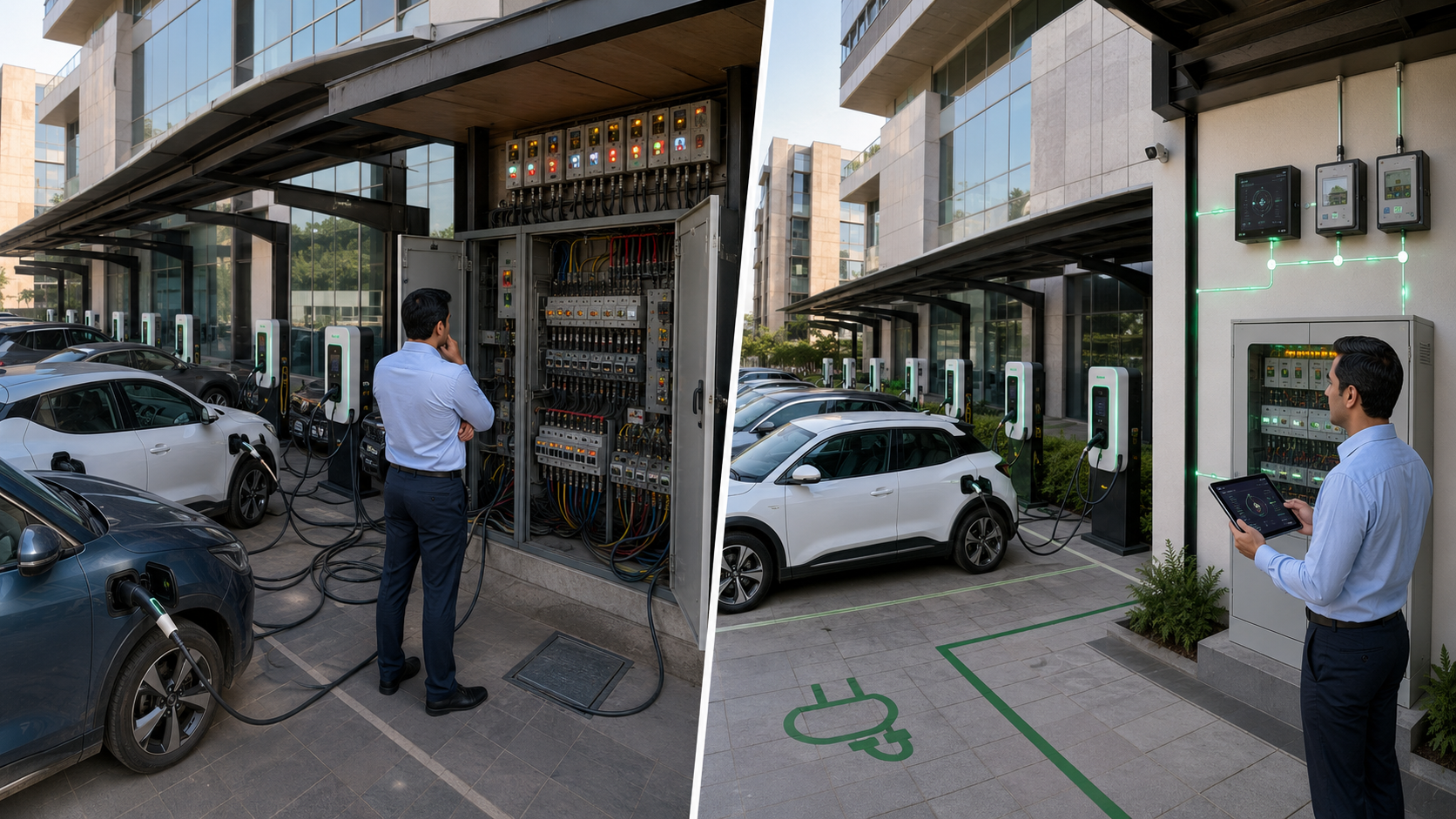
The rated power of an EV charger is not the only factor that determines the total project cost.
A charging station owner must also consider the electrical infrastructure required to safely supply that power.
An unmanaged charging installation may require:
- An increase in sanctioned load
- A new distribution transformer
- A larger main electrical panel
- Higher-capacity cables
- Additional circuit breakers and switchgear
- New protection systems
- More extensive civil work
- Utility network reinforcement
- A larger backup power system
For example, a public charging station with four 60 kW DC chargers has a combined charger rating of 240 kW.
However, the station may not need to continuously supply 240 kW. All four chargers may not be occupied simultaneously, and the connected vehicles may not accept their maximum charging power throughout the complete session.
A smart power management system can limit the entire charging site to an approved capacity and distribute that available electricity among active chargers.
Poorly optimised charging infrastructure can increase peak power demand, raise project costs and extend grid-connection timelines. Managed charging and better scheduling can reduce these pressures, particularly at large commercial and fleet-charging locations.
How Dynamic Load Management Works
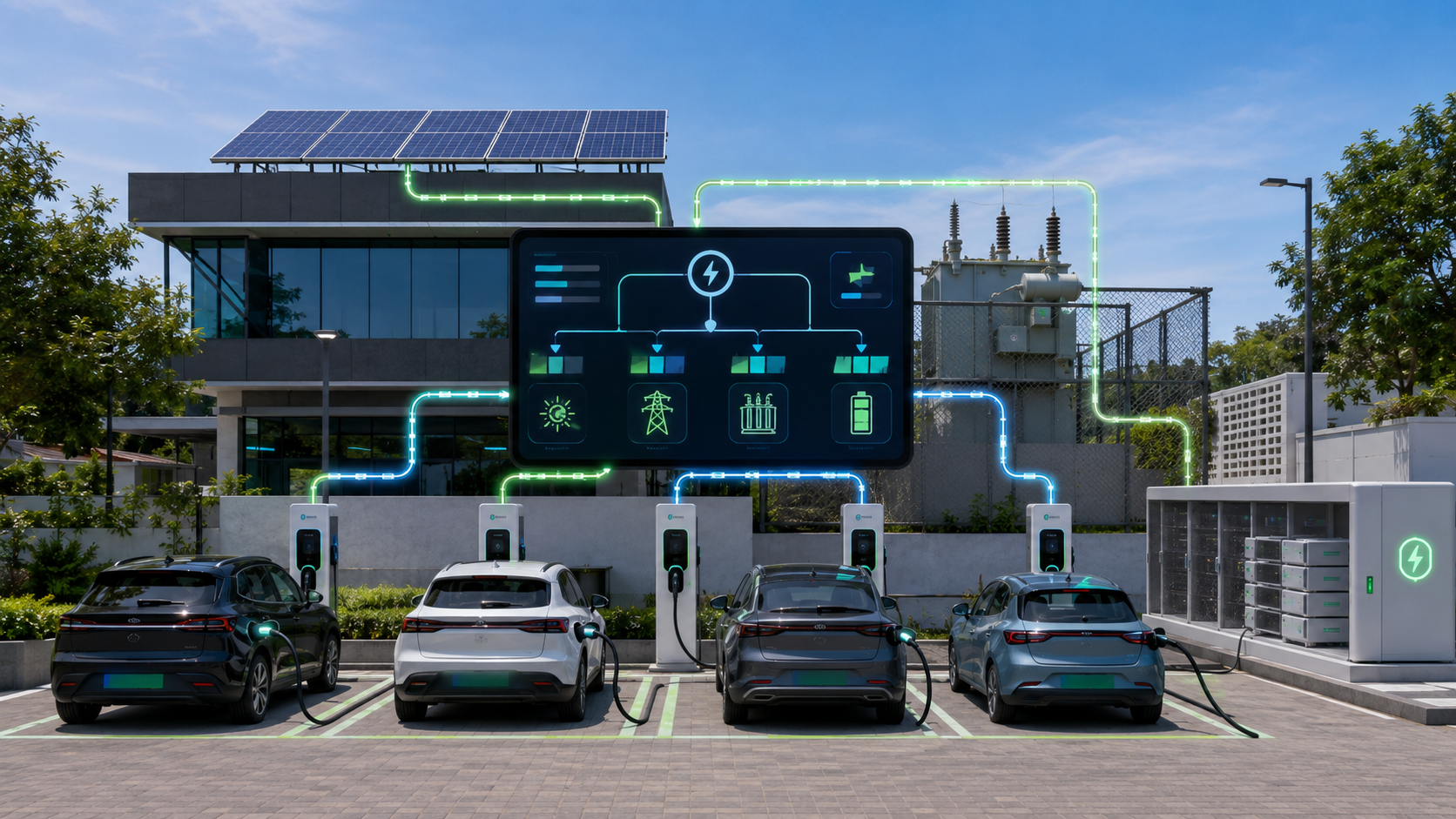
A dynamic load management system usually includes several connected components.
1. Smart Meter or Power Meter
A power meter continuously measures the electricity being consumed by the property.
Depending on the project, it may monitor:
- Total site consumption
- Individual EV charger consumption
- Transformer loading
- Building electricity demand
- Solar energy generation
- Battery storage activity
- Electricity imported from the grid
The Ministry of Power guidelines require separate metering arrangements for public EV charging stations so that electricity consumption and the applicable tariff can be measured accurately.
2. Charger Management System
The Charger Management System, or CMS, communicates with the individual EV chargers.
The platform may be used to:
- Start or stop charging sessions
- Adjust the power supplied by a charger
- Monitor charger availability
- Record electricity consumption
- Manage registered users
- Process digital payments
- Identify charger faults
- Generate operational reports
- Configure charging schedules
- Monitor charger uptime
3. Energy Management System
The Energy Management System receives information from the electricity meter, Charger Management System and other site equipment.
It calculates how much electricity is currently available and determines how that power should be distributed among the active chargers.
4. Networked EV Chargers
The chargers must be capable of receiving remote charging limits and scheduling instructions.
Compatible chargers may allow the system to:
- Increase charging power
- Reduce charging power
- Pause selected charging sessions
- Resume charging automatically
- Assign different priorities
- Share power between charging guns
5. Communication Network
The chargers, meters and management platform must be able to exchange information reliably.
India’s EV charging guidelines recommend open communication protocols such as OCPP, OCPI, UEI and Open Automated Demand Response. OCPP supports communication between EV charging equipment and the Charger Management System, while OCPI can support information exchange and roaming across charging networks.
6. Charging Control Rules
The charging station operator defines how the available electricity should be allocated.
Possible rules include:
- Equal power allocation
- First connected, first served
- Priority for fleet vehicles
- Priority for customers with reservations
- Minimum guaranteed charging power
- Higher power for vehicles departing soon
- Reduced charging during building peak hours
- Increased charging during solar hours
- Emergency power reduction
- Maximum site-demand control
Methods of Distributing Charging Power
A smart charging system can distribute electricity using several strategies.
Equal Power Sharing
The available electricity is divided equally among active chargers.
Suppose a station has 120 kW available and four vehicles are charging. Each charger may initially receive up to 30 kW.
When one vehicle disconnects, the available electricity can be redistributed among the remaining three chargers.
Priority-Based Charging
Some vehicles receive higher priority than others.
For example, a logistics depot may prioritise:
- Vehicles with earlier departure times
- Vehicles with a lower battery level
- Vehicles assigned to longer routes
- Emergency or essential vehicles
- Vehicles required for the next delivery shift
Lower-priority vehicles may continue charging at reduced power until additional capacity becomes available.
Sequential Charging
The system charges one group of vehicles before beginning another group.
Sequential charging may be suitable for:
- Residential parking areas
- Overnight fleet depots
- Employee parking
- Long-dwell commercial properties
- Educational institutions
Because the vehicles remain parked for several hours, every vehicle may not need to charge immediately.
Scheduled Charging
Charging sessions are shifted to selected periods according to electricity costs, solar generation or operating requirements.
The vehicles may remain connected throughout the day or night, but the system starts charging them only during the preferred period.
Minimum-Power Allocation
Every connected vehicle receives a minimum level of charging power.
The remaining capacity is then distributed according to the selected priority rules. This can prevent a low-priority vehicle from receiving no electricity for an extended period.
Example of Dynamic Power Distribution
Consider a charging station with:
- Four 60 kW DC chargers
- A combined charger rating of 240 kW
- A permitted charging-site limit of 150 kW
The system could distribute power in the following way:
| Number of Active Vehicles | Possible Power Allocation |
|---|---|
| One vehicle | Up to 60 kW |
| Two vehicles | Up to 60 kW each |
| Three vehicles | Up to 50 kW each |
| Four vehicles | Approximately 37.5 kW each |
The exact allocation can change according to the vehicle’s charging capability.
For example, when one vehicle can accept only 25 kW, the remaining available capacity can be reassigned to another compatible vehicle.
This is generally more efficient than permanently restricting every charger to the same low power level.
How Smart EV Charging Can Reduce Electricity Costs
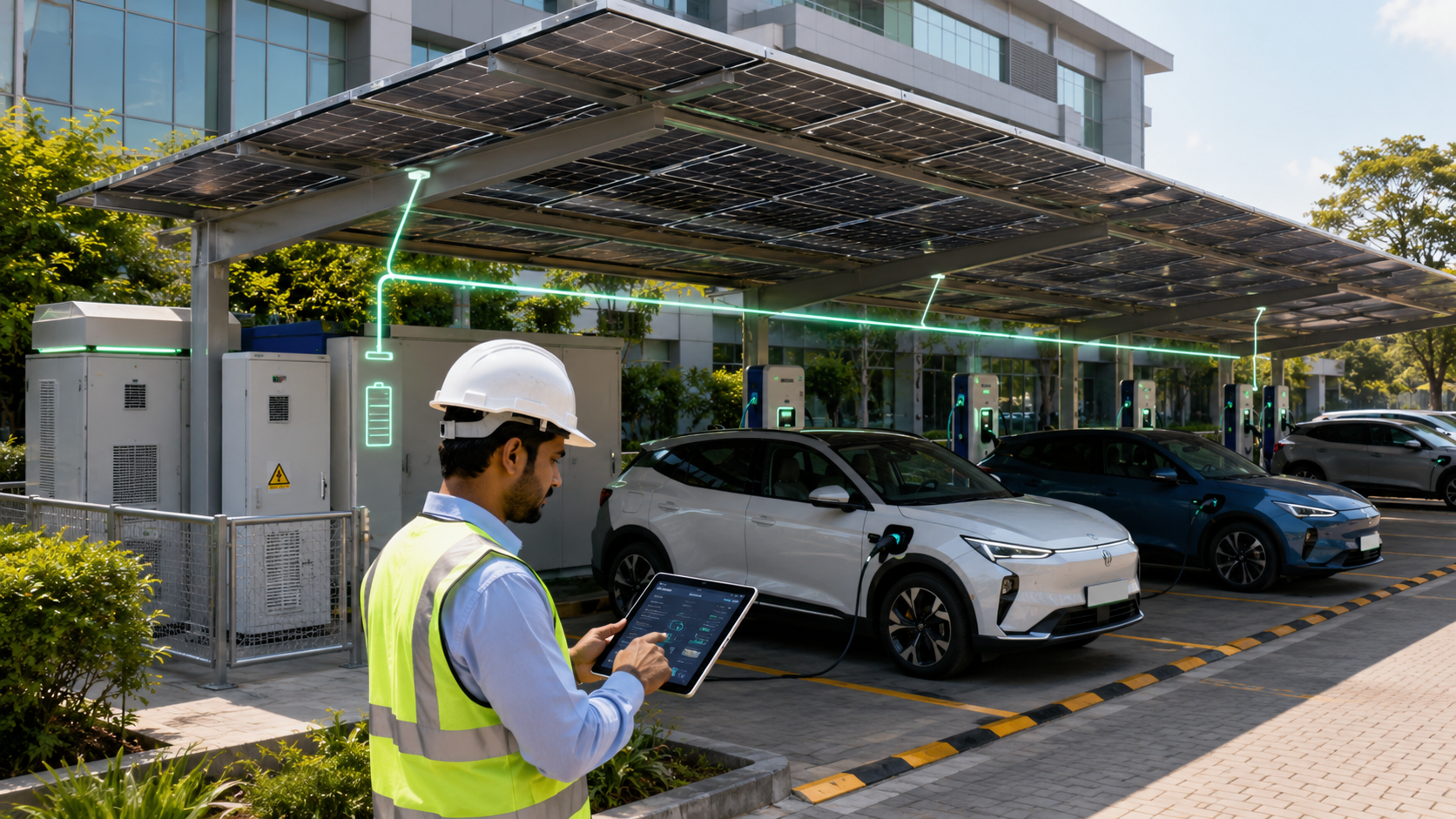
Smart charging can reduce operating and infrastructure costs in several ways.
Charging During Preferred Tariff Periods
Charging sessions can be scheduled during periods when the applicable electricity cost is lower.
Under the Ministry of Power’s EV Charging Infrastructure Guidelines 2024, electricity supplied to an EV charging station is set at 0.7 times the Average Cost of Supply during solar hours from 9:00 AM to 4:00 PM and 1.3 times the Average Cost of Supply during non-solar hours. The guideline applies until 31 March 2028, although actual billing and implementation should be confirmed with the relevant electricity distribution company and state regulator.
Charging operators can encourage solar-hour usage through:
- Lower customer charging rates
- Fleet charging schedules
- Promotional daytime pricing
- Charging reservations
- Solar-based automatic charging controls
Reducing Unnecessary Electrical Upgrades
Dynamic load management may allow a property to install several chargers without immediately increasing its maximum electricity connection.
This may reduce or postpone investment in:
- Transformer upgrades
- Main electrical panel replacement
- Higher-capacity cabling
- Additional switchgear
- Increased sanctioned load
A qualified electrical engineer should still determine whether the existing infrastructure can safely support the proposed charging installation.
Controlling Peak Electricity Demand
For an EV charging station installed behind an existing commercial or industrial connection, uncontrolled charging may increase the property’s maximum electricity demand.
The system can reduce EV charging power whenever the building’s total demand approaches a predefined limit.
Improving the Use of Solar Energy
When rooftop or carport solar panels generate electricity during the day, the system can increase the charging power supplied to connected vehicles.
When solar output falls because of clouds or evening conditions, the charging system can reduce the load or use electricity from the grid.
India’s EV charging guidelines permit charging stations to integrate solar energy and recognise solar carports combined with battery storage as an option for storing electricity and charging vehicles.
Improving Charger Utilisation
A site may be able to install more charging points while controlling their combined electricity demand.
Although every charger may not continuously operate at its maximum power, a larger number of available bays can serve more vehicles throughout the day.
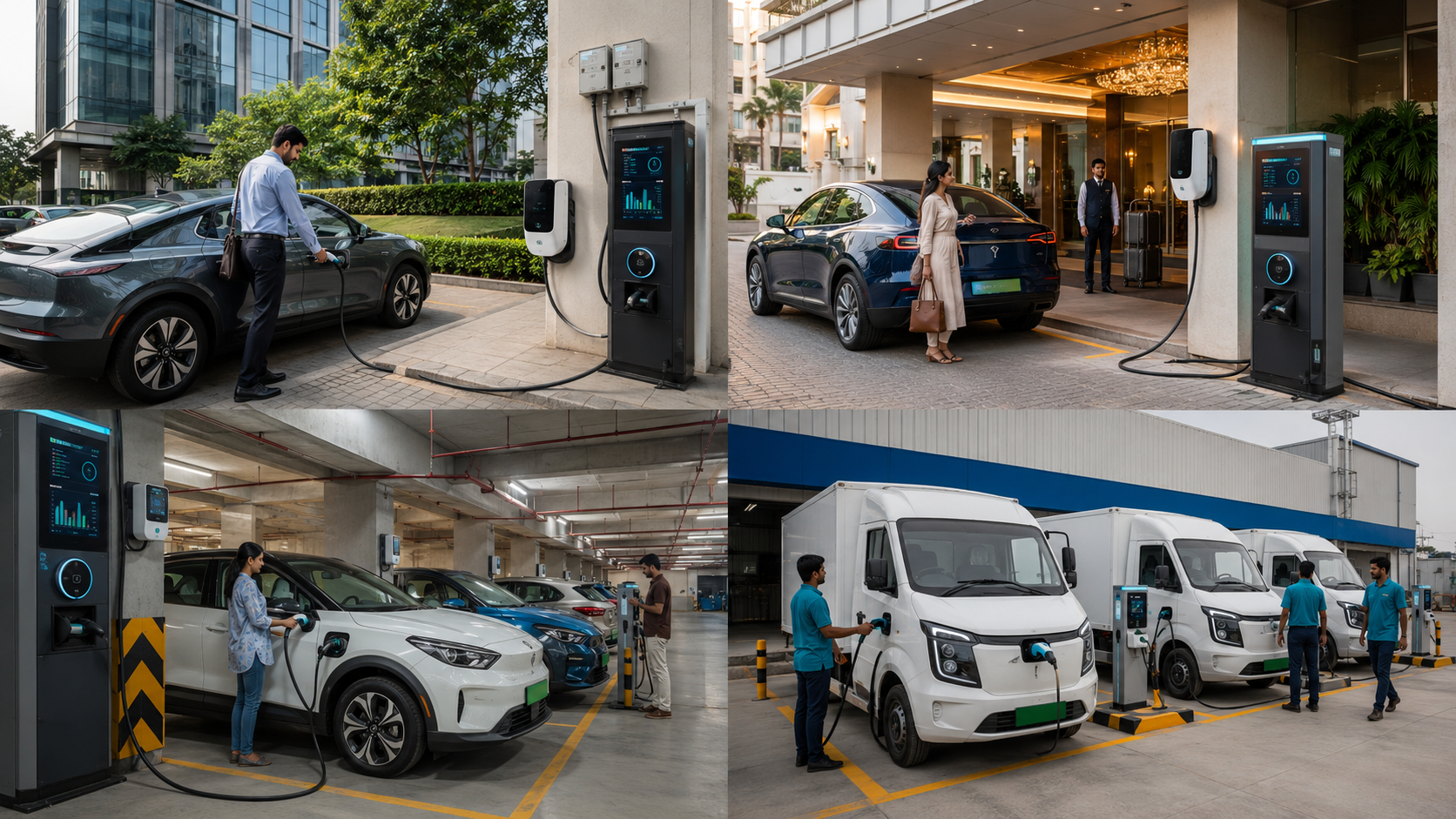
Smart Charging for Offices and Workplaces
Employee vehicles often remain parked for several hours.
This long parking duration allows the charging system to distribute electricity throughout the working day rather than charging every vehicle immediately at full power.
A workplace may use:
- Equal power sharing
- Employee charging schedules
- Visitor charging priority
- Department-based access
- Per-user energy limits
- Solar-hour charging
- Departure-time scheduling
For example, a vehicle connected at 9:00 AM and required at 6:00 PM may not need the full charger capacity throughout the day.
The Ministry of Power guidelines allow office and commercial building owners to use an existing electricity connection for employee charging or request a separate metered connection with an EV charging tariff.
Smart Charging for Hotels and Resorts
Hotel electricity consumption may vary significantly throughout the day.
Electricity demand may increase when:
- Air-conditioning systems are operating heavily
- Kitchen equipment is active
- Laundry facilities are being used
- A conference or wedding event is taking place
- Guest occupancy is high
A dynamic load management system can temporarily reduce EV charging power during these periods.
Charging power can increase again when the hotel’s electricity demand falls.
The system may also prioritise vehicles belonging to guests who are scheduled to leave earlier.
Smart Charging for Shopping Malls
Shopping malls use electricity for:
- Air conditioning
- Lighting
- Elevators
- Escalators
- Food courts
- Entertainment areas
- Retail operations
The electricity available for EV charging may change throughout the day.
Dynamic load management can coordinate EV charging with the mall’s real-time electricity consumption.
The charging operator may also use:
- Reservation-based charging
- Paid priority charging
- Time-based parking rules
- Minimum charging guarantees
- Solar canopy integration
- Customer loyalty programmes
Smart Charging for Residential Societies
Several residents may connect their electric vehicles after returning home in the evening.
This often happens when household electricity consumption is already high due to air conditioners, water heaters, kitchen appliances and other equipment.
A smart charging system can:
- Prevent simultaneous maximum-power charging
- Distribute electricity fairly
- Schedule charging overnight
- Record individual electricity consumption
- Generate resident-wise billing reports
- Prioritise vehicles according to departure time
- Control the complete society charging load
This can be safer and more manageable than allowing multiple unmanaged charging connections.
Smart Charging for Fleet and Logistics Depots
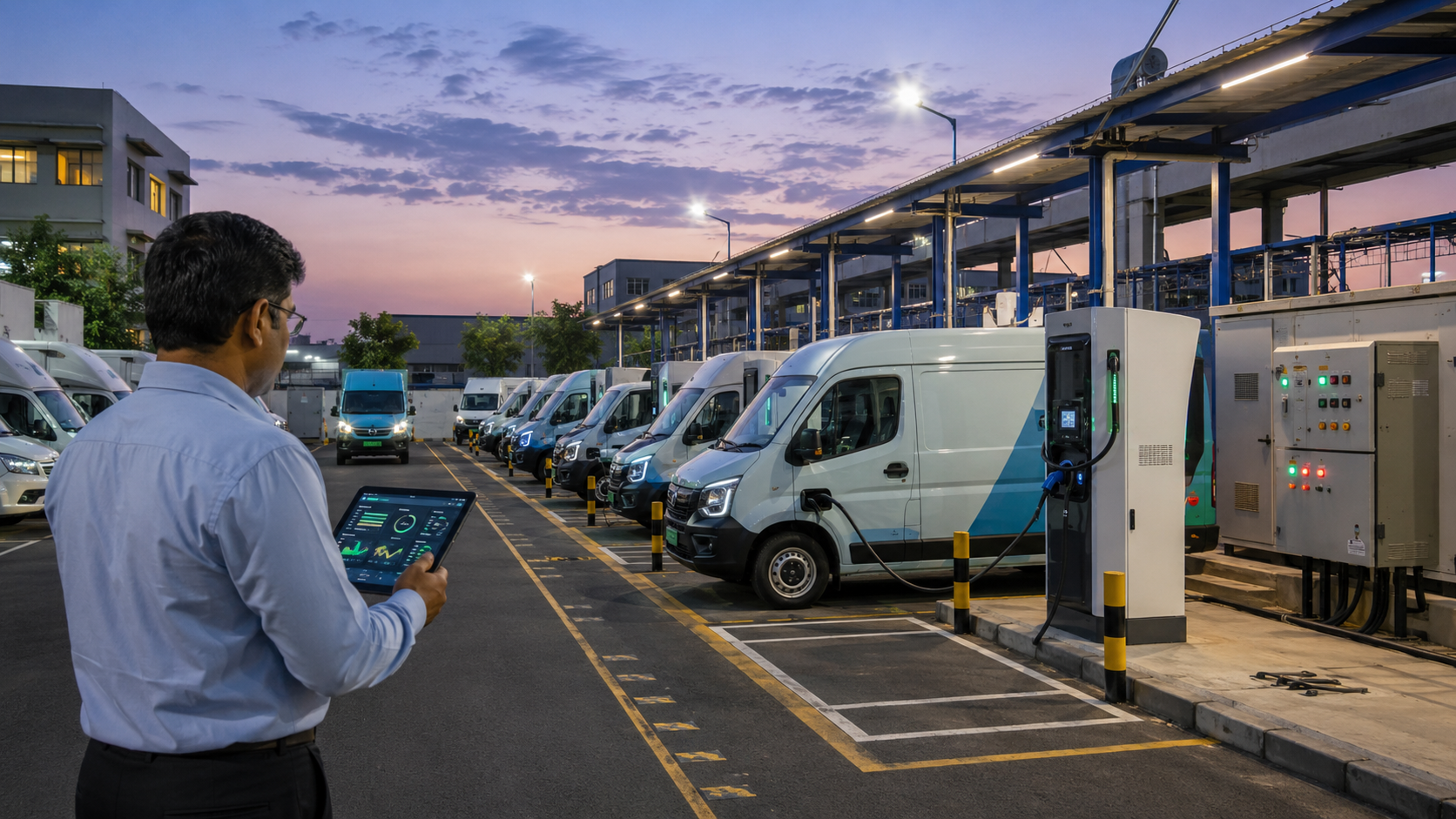
Fleet charging is one of the strongest applications of dynamic load management because the operator usually knows:
- Vehicle arrival times
- Vehicle departure times
- Planned route distances
- Current battery levels
- Required battery levels
- Vehicle priorities
- Available charging windows
Instead of charging every vehicle at maximum power, the system can create an automated charging schedule.
For example, a delivery vehicle leaving at 5:00 AM can receive priority over another vehicle scheduled to leave at 9:00 AM.
For electric bus and truck depots, integrated planning of routes, batteries, charger numbers and charging schedules can reduce peak demand and help avoid unnecessary grid-connection delays.
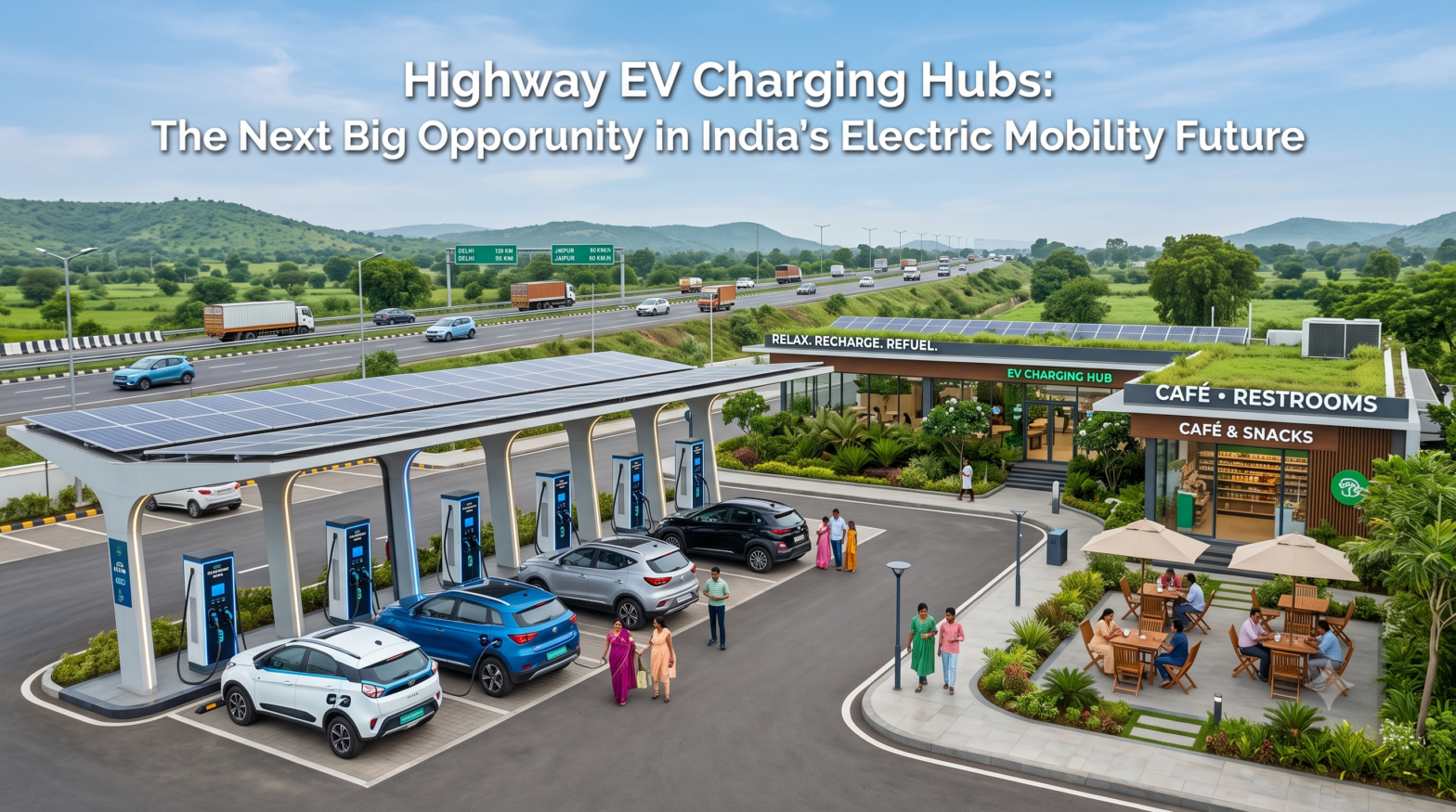
Smart Charging for Highway Stations
Highway charging stations have shorter customer dwell times and usually need to provide higher power.
Load management should not reduce charging speed so severely that it creates long queues or a poor customer experience.
A highway charging station may use:
- Power sharing between charging guns
- Priority for selected fast-charging sessions
- Battery storage for temporary peak support
- Charger limits based on vehicle compatibility
- Queue-management systems
- Charging reservations
- Real-time charger availability
The station should clearly communicate the expected charging speed because actual charging power may depend on:
- Vehicle charging capability
- Battery temperature
- Battery state of charge
- Charger availability
- Site electricity capacity
- Power sharing with another charging gun
Smart Charging vs Fast Charging
Smart charging and fast charging are not opposite technologies.
Fast charging describes the maximum amount of power a charger can deliver.
Smart charging describes how that power is controlled and distributed.
A 120 kW DC charger can be both fast and smart.
It may deliver close to its maximum capacity when sufficient electricity is available and automatically reduce its output when the site approaches its power limit.
Multiple fast chargers may also share one common power cabinet or a fixed site capacity.
Role of Battery Energy Storage
A Battery Energy Storage System can store electricity and supply it when EV charging demand increases.
Battery storage may be used to:
- Support temporary charging peaks
- Store excess solar electricity
- Reduce grid imports during selected periods
- Support a site with limited grid capacity
- Provide backup electricity for essential systems
- Improve the use of renewable energy
However, battery storage should not be added without a detailed technical and financial assessment.
The operator should consider:
- Battery storage capacity
- Battery power rating
- Charging and discharging efficiency
- Battery degradation
- Safety requirements
- Thermal management
- Replacement cost
- Software integration
- Space requirements
- Applicable regulations
Smart Charging vs Vehicle-to-Grid
Smart charging generally controls electricity flowing from the grid or site into the electric vehicle.
This is also called unidirectional smart charging or V1G.
Vehicle-to-Grid, or V2G, allows a compatible electric vehicle to send electricity back to the power grid.
A charging station can use smart charging without providing V2G.
V2G requires:
- A compatible electric vehicle
- A compatible bidirectional charger
- Suitable communication protocols
- Metering and settlement arrangements
- Regulatory support
- Grid-compliance controls
- Battery protection systems
The Ministry of Power guidelines encourage Charge Point Operators to maximise smart charging and allow V2G implementation according to the requirements of the relevant electricity distribution company. The International Energy Agency also describes V1G as the modulation of charging power to align demand with generation or reduce grid congestion.
Steps to Implement Dynamic Load Management
Step 1: Conduct an Electrical Load Study
Measure the property’s electricity consumption across different days and operating periods.
The assessment should identify:
- Existing connected load
- Sanctioned load
- Transformer rating
- Maximum recorded demand
- Daily demand profile
- Seasonal electricity demand
- Available spare capacity
- Main electrical panel capacity
- Cable and switchgear limitations
A single reading taken during a low-demand period is not sufficient for planning a large charging installation.
Step 2: Estimate EV Charging Demand
Determine:
- Expected number of vehicles per day
- Vehicle categories
- Average battery capacities
- Typical arrival times
- Parking duration
- Required charging speed
- Expected daily energy consumption
- Future expansion requirements
The charger plan should be based on actual operating requirements rather than simply selecting the highest-capacity chargers available.
Step 3: Define the Maximum Charging Limit
Set a safe maximum power limit for the complete charging system.
The limit should consider:
- Existing building consumption
- Transformer capacity
- Cable ratings
- Electrical panel capacity
- Utility requirements
- Future load growth
- Required safety margin
Step 4: Select Compatible EV Chargers
Confirm that the proposed chargers support:
- Remote power adjustment
- Dynamic load balancing
- Charging schedules
- Charger Management System connectivity
- Required communication protocols
- Energy metering
- User authentication
- Remote diagnostics
- Secure software updates
Step 5: Install Metering and Communication Equipment
The system requires accurate and timely electricity data.
Depending on the project, the installation may include:
- Main incomer meter
- Individual charger meters
- Transformer monitoring
- Solar-generation meter
- Battery storage meter
- Communication gateway
- Reliable wired or wireless internet
Step 6: Configure Charging Priorities
Define how the system should respond when the available electricity is limited.
Priority rules may be created for:
- Public charging customers
- Fleet vehicles
- Staff vehicles
- Visitors
- Reserved sessions
- Emergency vehicles
- Vehicles with early departure times
Step 7: Test Different Operating Conditions
The complete installation should be tested under different conditions, including:
- One charger operating
- All chargers operating
- Sudden building-load increase
- Internet connection failure
- Meter communication failure
- Charger disconnection
- Electricity outage and restart
- Solar-generation changes
- Battery storage operation
- Emergency shutdown
Step 8: Monitor and Improve Performance
The charging strategy should be reviewed using actual operational data.
A system configured for ten vehicles per day may need different charging rules when usage increases to fifty vehicles per day.
Features to Check Before Selecting a Smart Charging System
Charging station owners should confirm whether the proposed system supports:
- Dynamic site-load management
- Charger-to-charger power sharing
- Remote charging limits
- Priority-based charging
- Scheduled charging
- Solar integration
- Battery storage integration
- OCPP compatibility
- Energy-consumption reporting
- Multi-user billing
- Fleet departure scheduling
- Fault notifications
- Remote diagnostics
- User-access management
- Cybersecurity controls
- Offline charging rules
- Firmware and software updates
- Integration with multiple charger brands
The owner should also confirm whether the charging management platform creates a dependency on one charger manufacturer or can support equipment from different vendors.
Common Smart Charging Mistakes
Installing Chargers Before Conducting a Load Study
This can result in insufficient electrical capacity, project delays or unexpected infrastructure costs.
Assuming Charger Rating Equals Vehicle Demand
A vehicle may accept less power than the charger can supply, particularly when the battery is cold, nearly full or limited by the vehicle’s charging system.
Selecting Chargers Without Networking Capabilities
Chargers without remote communication and power-control capabilities may not support effective dynamic load management.
Ignoring Internet Reliability
The charging system should have safe fallback rules for situations in which communication with the management platform becomes temporarily unavailable.
Reducing Power Without Informing Customers
Customers may become dissatisfied when a high-capacity charger provides significantly lower power than expected.
Charging speed and power-sharing conditions should be communicated transparently.
Focusing Only on Present Demand
The electrical design, cable routes, parking layout and software platform should support future charger expansion wherever practical.
Ignoring Cybersecurity
Connected chargers should use secure communication, controlled access, strong authentication and properly managed software updates.
The Ministry of Power guidelines state that charging communication protocols must comply with applicable cybersecurity provisions.
Performance Indicators to Monitor
After implementation, the charging station operator should track:
- Maximum site electricity demand
- Total energy delivered
- Average charging power
- Charger utilisation rate
- Number of charging sessions
- Successful charging-session percentage
- Power curtailment duration
- Electricity cost per unit delivered
- Solar energy used for charging
- Transformer loading
- Customer waiting time
- Charger uptime
- Charging revenue
- Revenue per charging point
- Average session duration
These measurements help determine whether the load management strategy is controlling costs without creating a poor charging experience.
Is Dynamic Load Management Suitable for Every Charging Station?
Dynamic load management is particularly useful when:
- Multiple chargers share one electricity connection
- Available electrical capacity is limited
- Building electricity demand changes during the day
- Additional chargers may be installed later
- Solar panels are available
- Battery storage is being considered
- Fleet departure times can be scheduled
- Infrastructure upgrade costs are high
- Peak electricity demand must be controlled
A small site with one low-power charger may not require an advanced Energy Management System.
However, even smaller projects should consider future expansion. Installing compatible metering, cable routes and networked chargers at the beginning can simplify future upgrades.
Conclusion
As the number and capacity of EV chargers increase, electricity management will become as important as charger installation.
Smart EV charging and dynamic load management allow charging stations to distribute electricity according to real-time site capacity, vehicle requirements, tariff periods and renewable-energy availability.
A properly designed smart charging system can help a business:
- Avoid electrical overloading
- Reduce or postpone infrastructure upgrades
- Increase the number of available charging points
- Use solar electricity more effectively
- Control peak electricity demand
- Prioritise important vehicles
- Improve charging station operations
- Prepare for future expansion
The correct solution depends on the property’s electricity connection, charger capacity, vehicle usage pattern and expected future demand.
Before installing multiple EV chargers, the property should undergo a professional electrical load and site-feasibility assessment.
Planning a smart EV charging station for a commercial property, residential society, fleet depot or highway location? Contact Earthtron EV to evaluate your electrical capacity, charger requirements and dynamic load management options.