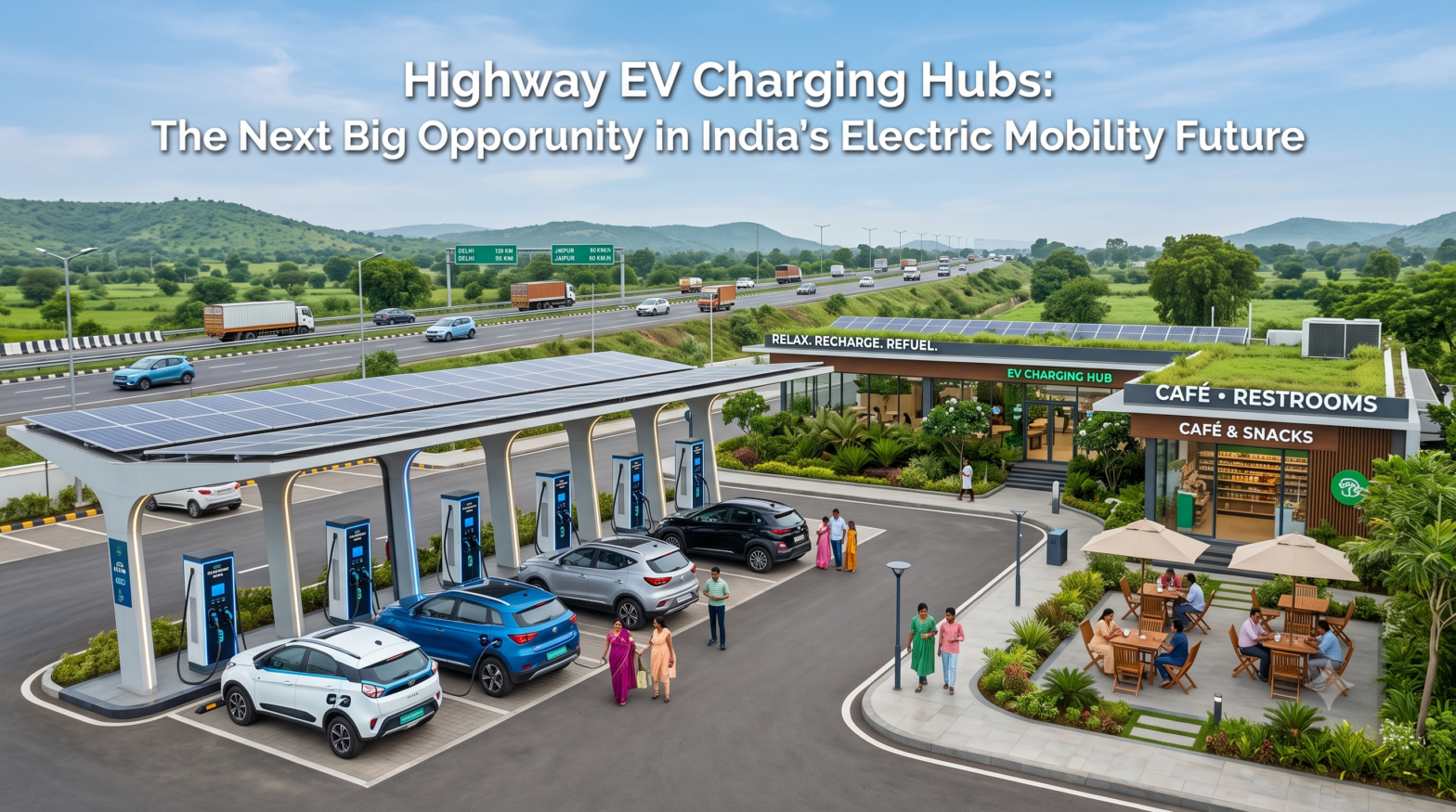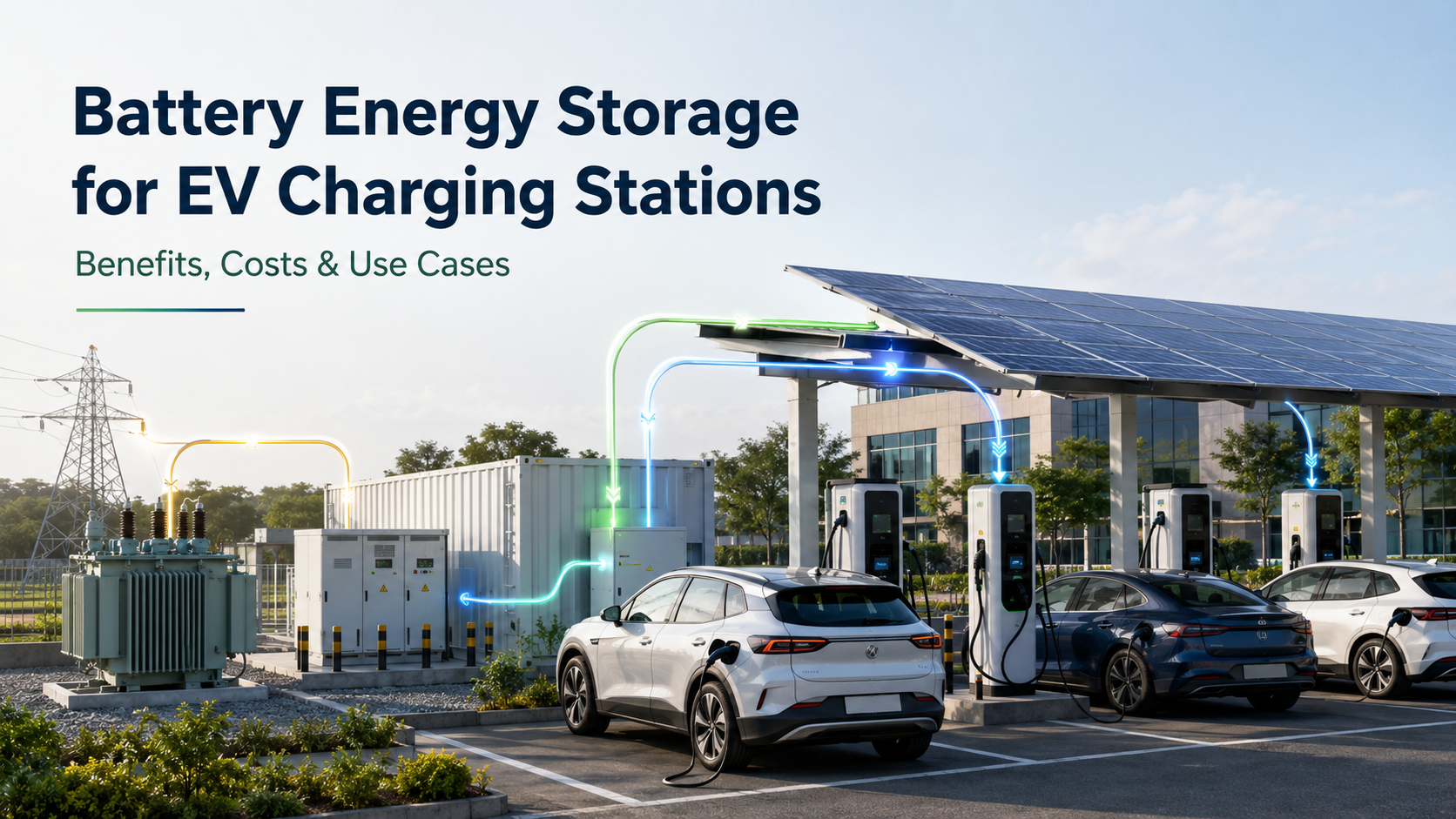
As electric vehicle adoption grows, charging stations are expected to serve more vehicles and provide faster charging speeds. However, installing high-capacity EV chargers can place significant pressure on the electricity connection available at a property.
A station with multiple DC fast chargers may require hundreds of kilowatts of power within a short period. In some locations, the existing transformer or distribution network may not be capable of providing this demand without costly upgrades.
A Battery Energy Storage System, or BESS, can help address this challenge.
A BESS stores electricity when power demand is low, renewable energy is available or electricity is less expensive. It can then supply the stored electricity when multiple EVs need to charge or when the charging station approaches its grid limit.
This arrangement is often called battery-buffered EV charging.
Battery storage does not eliminate the need for a safe and properly designed electricity connection. However, when it is correctly sized and integrated, it can reduce peak grid demand, improve solar energy utilisation and make high-power charging more practical at constrained locations.
The International Energy Agency notes that locating battery storage alongside charging hubs can ease grid connection requirements, reduce infrastructure costs and accelerate charging-station deployment.
What Is a Battery Energy Storage System?
A Battery Energy Storage System is a group of batteries and supporting equipment designed to store electrical energy and release it when required.
A complete commercial BESS usually includes:
- Battery cells and modules
- Battery racks
- Battery Management System
- Power Conversion System
- Energy Management System
- Cooling or thermal management
- Fire detection and suppression equipment
- Electrical protection systems
- Transformer and switchgear
- Metering equipment
- Communication systems
- Enclosure or container
- Monitoring software
The batteries store energy as direct current electricity. The Power Conversion System converts electricity between alternating current and direct current, depending on how the BESS is connected to the charging station.
The Energy Management System determines when the battery should:
- Charge from the electricity grid
- Charge from solar panels
- Supply power to EV chargers
- Maintain a reserve level
- Stop charging or discharging
- Respond to changes in site demand
How Battery-Buffered EV Charging Works
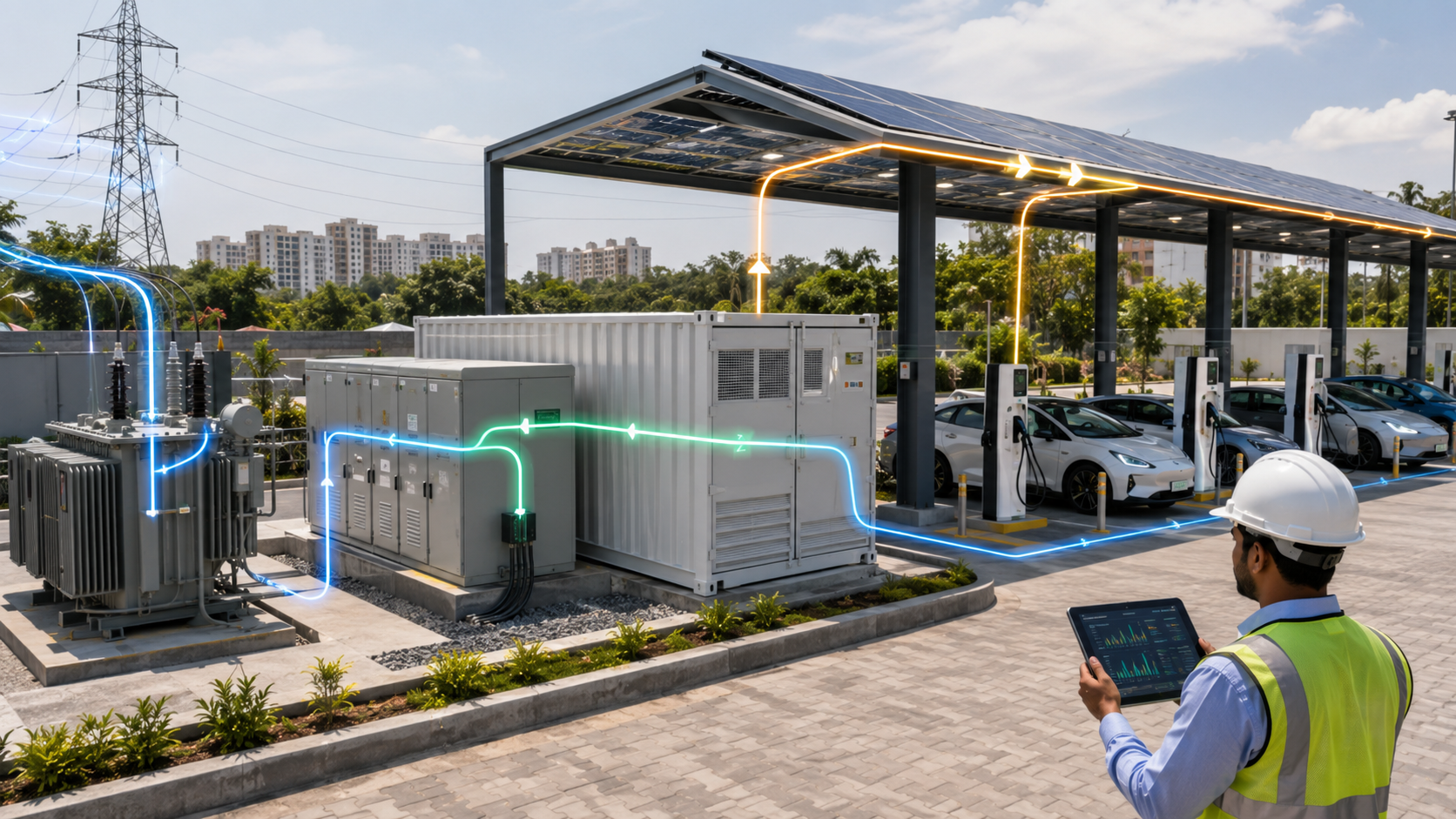
In a conventional charging station, electricity flows directly from the grid connection to the EV chargers.
When several fast chargers operate at the same time, the complete charging demand is placed on the grid connection.
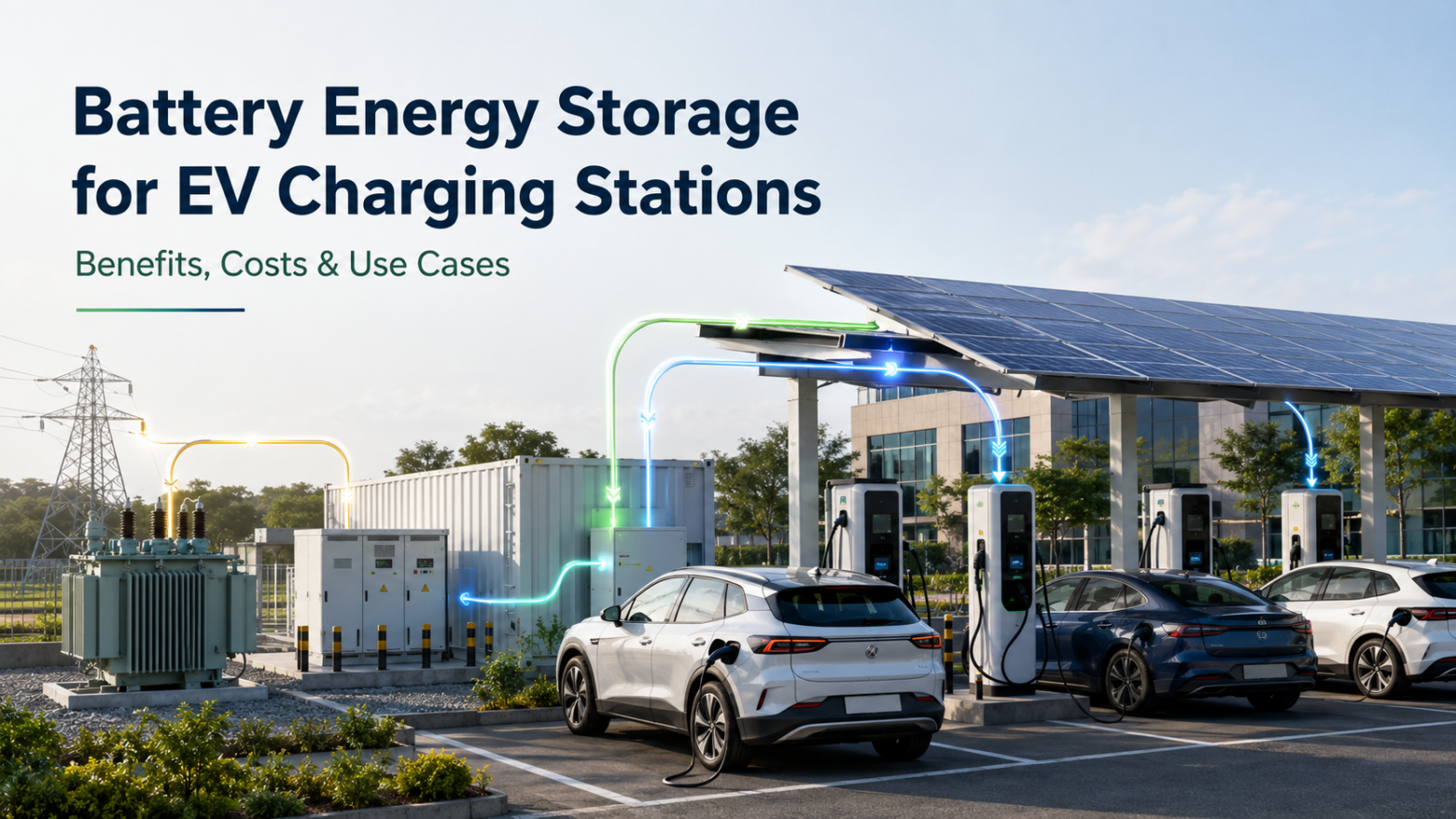
In a battery-buffered charging station, both the grid and BESS can supply electricity to the chargers.
For example, consider a site with:
- A 200 kW grid connection
- Four 100 kW DC fast chargers
- A BESS capable of supplying 200 kW
If all four chargers require high power simultaneously, the charging demand could approach 400 kW.
The grid may provide 200 kW, while the battery supplies the remaining 200 kW for a limited period.
When charging demand falls, the battery can recharge gradually from the grid or from on-site solar panels.
The BESS therefore acts as an electrical buffer between the available grid capacity and the temporary power required by the charging station.
Understanding BESS Power and Energy Ratings
Two measurements are particularly important when planning a BESS:
- Kilowatts
- Kilowatt-hours
These measurements describe different capabilities.
BESS Power Rating in Kilowatts
The power rating shows how much electricity the battery system can supply at one moment.
For example, a 200 kW BESS may provide up to 200 kW of power to the charging station, subject to its design and operating limits.
A higher power rating helps the BESS support:
- Multiple fast chargers
- Short periods of high demand
- Rapid changes in charging load
- High-power fleet charging
BESS Energy Capacity in Kilowatt-Hours
The energy capacity shows how long the battery can continue supplying electricity.
For example:
- A 200 kWh battery supplying 200 kW may theoretically operate for approximately one hour.
- The same battery supplying 100 kW may theoretically operate for approximately two hours.
The actual usable duration will be lower because of:
- Depth-of-discharge limits
- Conversion losses
- Battery reserve settings
- Temperature conditions
- Battery ageing
- Manufacturer operating limits
A BESS must therefore be selected using both its power rating and usable energy capacity.
Main Components of a BESS for EV Charging
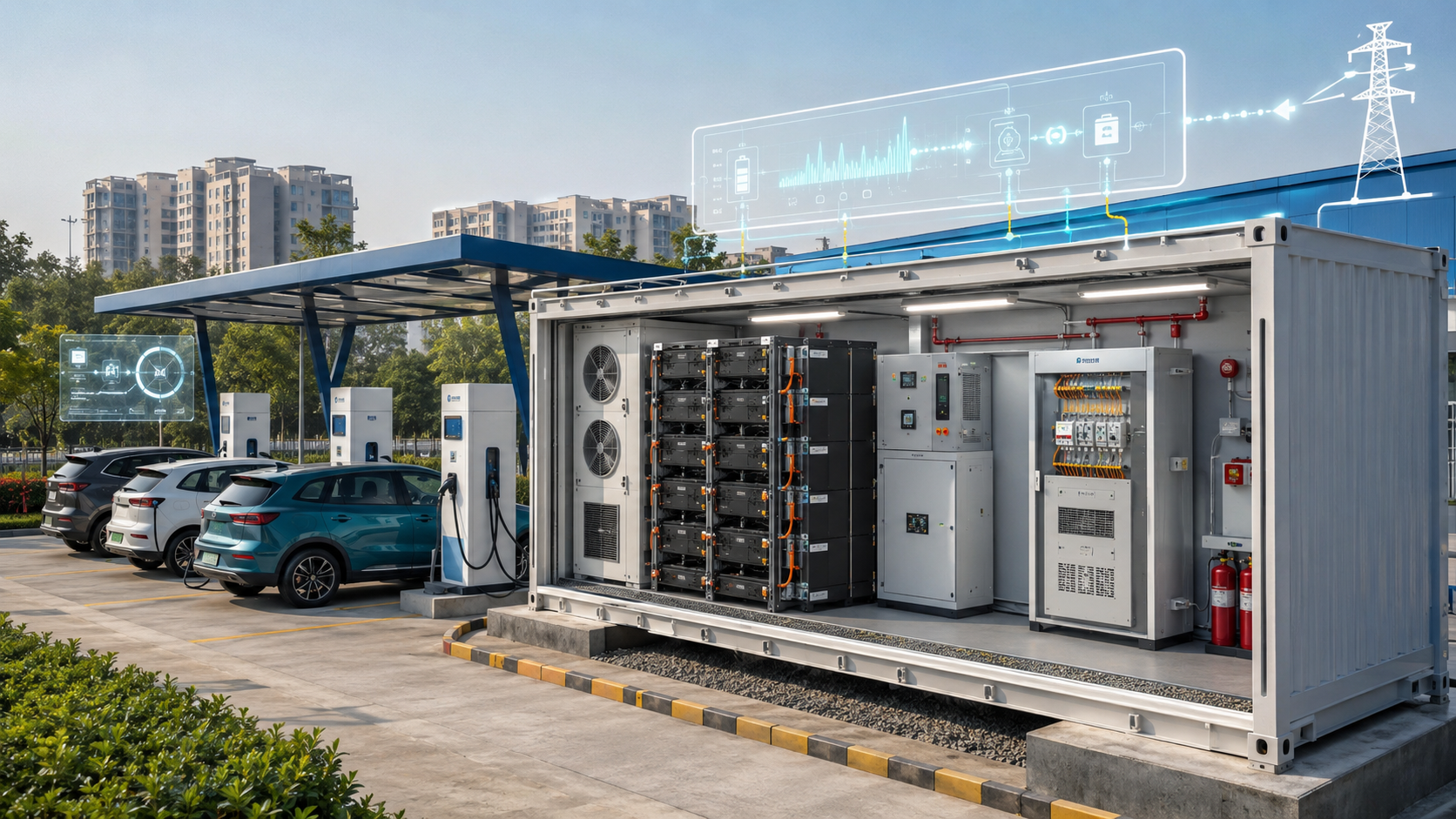
Battery Cells and Modules
Battery cells are assembled into modules, racks and larger battery enclosures.
Lithium-ion battery technologies are commonly used in commercial energy storage because they provide:
- High energy density
- Fast response
- Modular installation
- High charging and discharging efficiency
- Compatibility with digital control systems
The selected battery chemistry should be evaluated for safety, expected cycle life, operating temperature, discharge capability, cost and maintenance requirements.
Battery Management System
The Battery Management System, or BMS, monitors the condition of the battery.
It may track:
- Cell voltage
- Battery current
- Temperature
- State of charge
- State of health
- Charging limits
- Discharging limits
- Fault conditions
- Cell balancing
The BMS can disconnect or restrict the battery when unsafe operating conditions are detected.
Power Conversion System
The Power Conversion System, or PCS, manages the flow of electricity between the battery and the rest of the charging station.
It converts electricity between AC and DC and controls the charging or discharging power.
The PCS power rating affects how much electricity the BESS can deliver at one time.
Energy Management System
The Energy Management System, or EMS, controls the complete operating strategy.
It may use information from:
- EV chargers
- Smart meters
- Solar inverters
- Battery Management System
- Electricity grid
- Building electrical load
- Charger Management System
- Electricity tariff schedule
The EMS can decide when to store electricity and when to release it.
Thermal Management System
Battery performance and safety are affected by temperature.
Commercial BESS installations may use:
- Air cooling
- Liquid cooling
- Ventilation
- Temperature sensors
- Automated heating or cooling controls
Thermal management helps maintain the batteries within the recommended operating range.
Fire Detection and Protection
Battery energy storage requires dedicated safety planning.
A commercial installation may include:
- Smoke detection
- Gas detection
- Heat detection
- Automatic fire suppression
- Emergency isolation
- Ventilation
- Alarm systems
- Controlled access
- Remote fault monitoring
India has standards covering electrical energy storage system safety, while CEA regulations and safety guidance address electrical protection, fire detection, suppression and system inspection. Project owners should verify the latest applicable requirements before installation.
Benefits of BESS for EV Charging Stations
1. Reducing Peak Grid Demand
High-power charging demand may occur for only a small portion of the day.
Without storage, the site may need an electricity connection capable of supporting the maximum possible demand, even when that capacity is rarely used.
A BESS can supply part of the temporary peak demand.
This may help the charging station operate within a lower grid limit while still offering higher charging power during busy periods.
For example, a station may have:
- 250 kW available from the grid
- 450 kW of temporary charger demand
- 200 kW supplied by the BESS
The grid continues operating within its approved limit while the battery supports the additional charging requirement.
2. Reducing or Postponing Grid Upgrades
A large charging station may otherwise require:
- A new transformer
- Higher sanctioned load
- New high-tension cabling
- Larger electrical panels
- Additional switchgear
- Distribution network reinforcement
- Utility infrastructure upgrades
A correctly designed BESS may reduce or postpone some of these requirements.
However, the financial benefit should be confirmed through a comparison between:
- The cost of the required grid upgrade
- The total cost of the BESS
- Expected battery replacement or augmentation
- Operating and maintenance costs
- Expected station utilisation
Battery storage should not be selected automatically when a conventional grid upgrade is more economical.
3. Enabling Fast Charging at Grid-Constrained Locations
Some commercially attractive locations may not have enough electrical capacity for multiple DC fast chargers.
Examples include:
- Existing fuel stations
- Highway rest areas
- Rural charging locations
- Older commercial buildings
- Parking facilities
- Logistics depots
- Small industrial properties
- Remote tourist destinations
A BESS can gradually charge from the available connection and release high power when an EV arrives.
This allows a charger to temporarily deliver more power than the site can continuously draw from the grid.
4. Improving Solar Energy Utilisation
Solar generation and EV charging demand may not always occur at the same time.
For example, a solar canopy may generate the most electricity around midday, while the charging station may experience greater demand in the evening.
Without storage, unused solar electricity may be exported to the grid or curtailed, depending on the site’s connection and regulations.
A BESS can store part of this electricity and use it later for EV charging.
The Ministry of Power’s EV Charging Infrastructure Guidelines allow charging stations to integrate solar energy and battery storage, including solar carport arrangements.
5. Supporting Dynamic Load Management
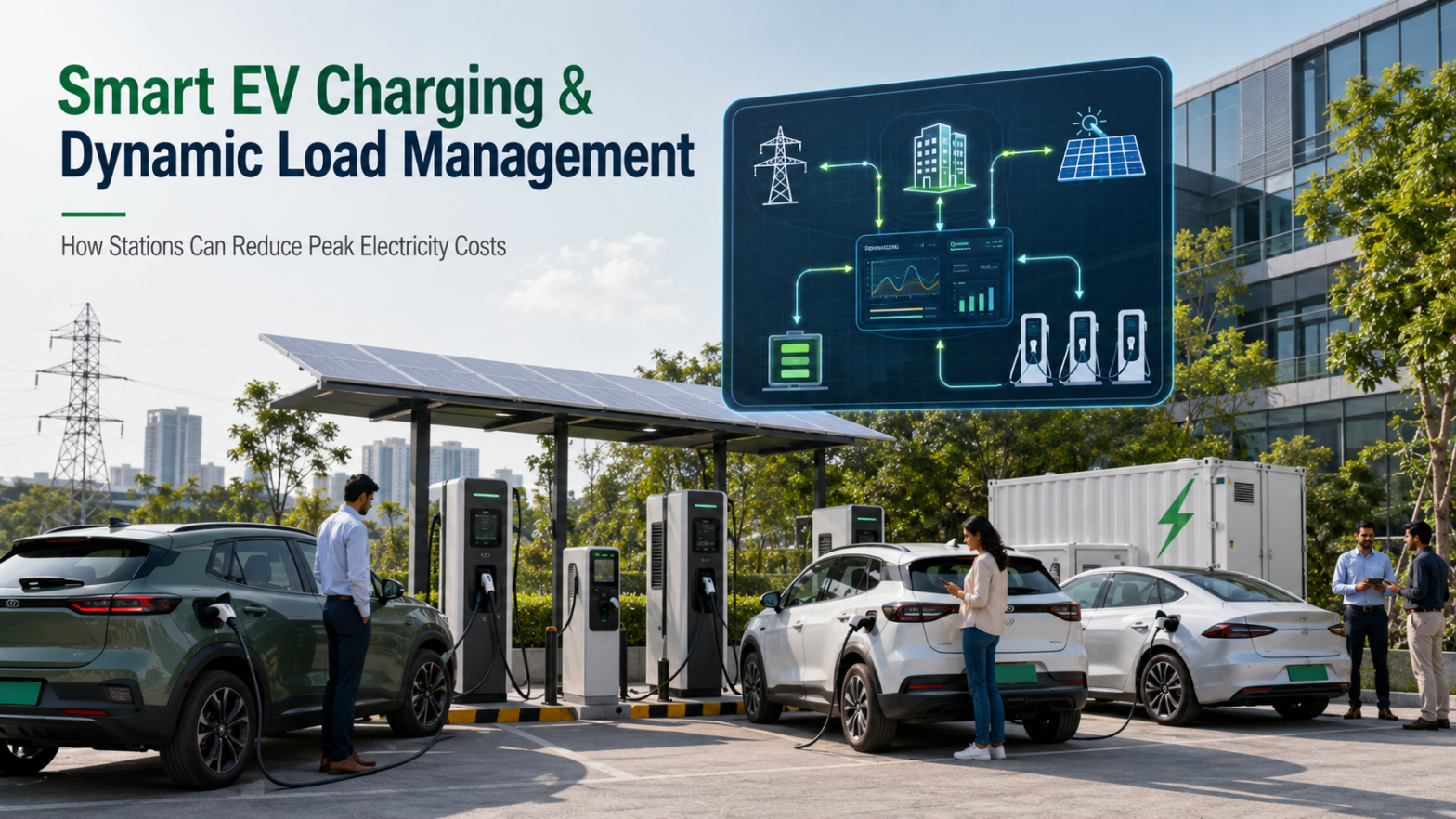
A BESS can work with a smart charging and dynamic load management system.
The system can coordinate:
- Building electricity demand
- Grid import
- Solar generation
- Battery charging
- Battery discharging
- EV charger output
- Fleet departure requirements
When building demand increases, the system may reduce charger power or discharge the battery.
When solar generation increases, it may charge the battery or increase EV charging power.
This integrated approach is generally more effective than operating the BESS and chargers independently.
6. Managing Electricity Costs
A BESS may charge during selected periods and discharge when the cost or demand is higher.
Potential savings can come from:
- Peak-demand reduction
- Better use of lower-cost electricity
- Increased solar self-consumption
- Reduced dependence on temporary grid upgrades
- Improved charging-station utilisation
The actual benefit depends on the site’s electricity tariff.
Not every Indian electricity connection includes the same:
- Energy charges
- Demand charges
- Time-of-day rates
- Solar export rates
- Fixed charges
- Penalties
The operator should analyse actual electricity bills and the applicable state tariff before estimating savings.
NREL analysis has found that energy storage can reduce demand-related charging costs, particularly for charging stations with short, high-power and relatively low-utilisation demand. It also identifies potential benefits when solar and storage operate together.
7. Improving Charging Station Resilience
A BESS may support selected station functions during a grid interruption.
Depending on its design, the system may provide electricity for:
- Charger control equipment
- Payment systems
- Network equipment
- Lighting
- Security systems
- Emergency communications
- Limited vehicle charging
A BESS should not be described as a complete backup system unless the equipment has been specifically designed for islanded operation.
Many grid-connected battery systems automatically shut down during a power outage unless they include:
- Backup-capable inverters
- Isolation equipment
- Dedicated critical-load circuits
- Suitable protection systems
- Approved operating controls
8. Supporting Future Charging Expansion
A modular BESS can sometimes be expanded as charging demand grows.
The initial project may begin with:
- Two fast chargers
- Limited battery capacity
- A moderate grid connection
Additional battery modules or power conversion equipment may later be installed to support more chargers.
Expansion capability must be confirmed during the initial design because not every system can be enlarged easily.
What Does a BESS for EV Charging Cost?
There is no single fixed price for installing battery storage at an EV charging station.
Two systems with the same battery capacity may have different project costs because of differences in:
- Power rating
- Battery chemistry
- Usable energy
- Warranty
- Cycle life
- Cooling system
- Fire-protection equipment
- Software
- Electrical integration
- Site conditions
- Transformer requirements
- Civil work
- Vendor support
The project should not be evaluated only using a battery price per kilowatt-hour.
Main BESS Cost Components

Battery Modules
The battery modules usually represent a major part of the equipment cost.
The price depends on:
- Battery chemistry
- Cell manufacturer
- Energy capacity
- Power capability
- Cycle-life warranty
- Operating temperature
- Depth of discharge
- Expected degradation
Power Conversion System
The PCS must be sized according to the required charging and discharging power.
A system designed to supply 500 kW for a short period will require different power equipment from a system that supplies 100 kW for several hours.
Battery Management and Energy Management Systems
The project may require software and controllers for:
- Battery monitoring
- Charger integration
- Grid import control
- Solar coordination
- Remote monitoring
- Alarm management
- Data reporting
- Load forecasting
Software licences, communication services and cloud platform fees may create recurring costs.
Container, Cooling and Fire Protection
Commercial BESS installations may require:
- Weather-protected enclosure
- Cooling equipment
- Ventilation
- Gas or smoke detection
- Fire suppression
- Emergency isolation
- Security and access control
These systems are essential parts of the project and should not be treated as optional accessories.
Electrical Infrastructure
Electrical costs may include:
- Transformer
- Switchgear
- Cables
- Protection devices
- Electrical panels
- Metering
- Earthing
- Lightning protection
- Grid synchronisation equipment
Civil and Site Development
The project may require:
- Concrete foundation
- Drainage
- Equipment fencing
- Crash barriers
- Cable trenches
- Access paths
- Equipment clearances
- Security arrangements
Installation and Commissioning
Installation costs may include:
- Transportation
- Equipment lifting
- Electrical installation
- Software configuration
- Testing
- Grid approval
- Commissioning
- Staff training
Operations and Maintenance
Ongoing costs may include:
- Preventive maintenance
- Cooling energy consumption
- Remote monitoring
- Software subscriptions
- Insurance
- Safety inspection
- Replacement parts
- Fire-system servicing
Battery Augmentation or Replacement
Battery capacity gradually declines with age and use.
The operator may need to:
- Add battery modules
- Replace degraded modules
- Replace the complete battery system
- Update the Power Conversion System
- Renew software or communication equipment
The financial model should include the expected cost of battery degradation and future augmentation.
How to Evaluate BESS Financial Feasibility
A BESS should be evaluated over its complete operating life rather than only by comparing its initial price.
The analysis should include:
Potential Financial Benefits
- Avoided transformer upgrade
- Avoided sanctioned-load increase
- Reduced maximum demand
- Lower electricity purchase cost
- Increased solar self-consumption
- Additional charging sessions
- Higher charger utilisation
- Faster charging capability
- Reduced station downtime
- Value of backup power
Project and Operating Costs
- BESS equipment
- Power Conversion System
- Electrical infrastructure
- Civil work
- Software
- Maintenance
- Insurance
- Energy losses
- Battery degradation
- Future augmentation
- Financing cost
- End-of-life handling
A simplified financial evaluation may use the following approach:
Total BESS value = avoided infrastructure cost + electricity savings + additional charging revenue + resilience value − installation cost − operating cost − degradation and replacement cost
Every major assumption should be supported by actual charging-demand and electricity-consumption data.
When Does BESS Make Financial Sense?
Battery storage may be commercially attractive when:
- Grid upgrades are extremely expensive
- Grid upgrades would take a long time
- Charging demand is high but occurs in short peaks
- The site has significant solar generation
- Electricity tariffs reward peak reduction
- Charger utilisation is expected to grow
- Fast charging generates additional revenue
- The property has limited electrical capacity
- Backup capability has commercial value
- The project can use the battery for multiple purposes
BESS may be less attractive when:
- A grid upgrade is affordable and readily available
- Charging demand is low and predictable
- Vehicles remain parked long enough for low-power charging
- Electricity tariffs provide little value for peak reduction
- Solar generation is limited
- The battery would remain unused for most of the day
- The site lacks space for a safe installation
How to Size a BESS for an EV Charging Station
A BESS should not be selected only according to the combined rating of all EV chargers.
The design must consider:
- Available grid capacity
- Number of chargers
- Charger power
- Expected simultaneous usage
- Vehicle charging curves
- Duration of peak charging demand
- Daily charging sessions
- Solar generation profile
- Required battery reserve
- Battery efficiency
- Depth of discharge
- Degradation
- Future expansion
Step 1: Determine Maximum Charger Demand
Suppose a station has four 120 kW chargers.
The theoretical combined charger capacity is:
4 × 120 kW = 480 kW
However, the actual maximum demand may be lower because:
- All chargers may not be occupied simultaneously
- Some vehicles may accept less than 120 kW
- Charging power falls as batteries approach a higher state of charge
- Dynamic load management may limit selected chargers
The operator should use realistic utilisation and vehicle data.
Step 2: Determine Available Grid Power
Assume the site can safely provide 250 kW for EV charging.
If the expected peak charging demand is 480 kW, the maximum temporary power deficit is:
480 kW − 250 kW = 230 kW
The BESS Power kW**
The BESS Power Conversion System may therefore need to supply approximately 230 kW, depending on the selected charging strategy.
Step 3: Estimate the Required Support Duration
Suppose the BESS must support the 230 kW deficit for 30 minutes.
The required delivered energy would be:
230 kW × 0.5 hour = 115 kWh
The nominal battery capacity would need to be higher than 115 kWh because the complete stored capacity may not be usable.
The design should account for:
- Conversion losses
- Minimum state-of-charge reserve
- Depth-of-discharge limit
- Battery degradation
- Temperature derating
- Future performance decline
An engineering assessment might therefore select a nominal capacity above the basic 115 kWh requirement.
This example is illustrative only. Real projects require charger-session data, electrical modelling and battery manufacturer specifications.
Step 4: Check Recharge Time
The BESS must have enough time and grid capacity to recharge before the next period of high charging demand.
A battery may perform well during the first busy charging period but become unavailable if another peak occurs before it has recharged.
The analysis should consider:
- Number of peak periods per day
- Time between charging peaks
- Grid power available for recharging
- Solar generation
- Minimum battery reserve
- Expected charging losses
Step 5: Account for Battery Degradation
A battery that meets the requirement when new may provide less usable energy after several years.
The initial design should account for the required capacity at the end of the planned operating period.
Possible approaches include:
- Installing additional capacity initially
- Adding battery modules later
- Limiting depth of discharge
- Maintaining a capacity reserve
- Including performance guarantees in the contract
BESS Use Cases for EV Charging Stations
Highway Fast-Charging Stations
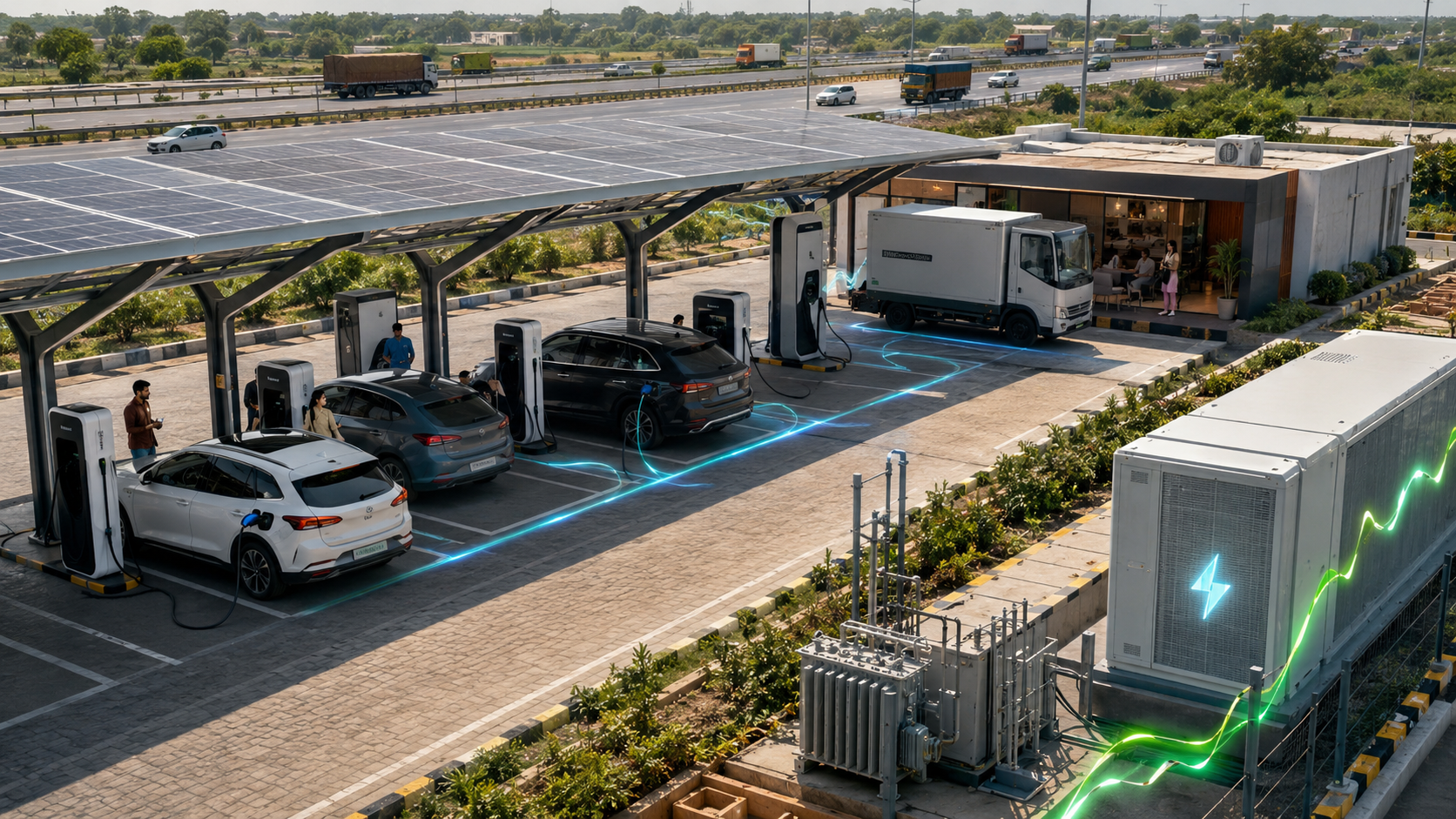
Highway locations often need high charging power because drivers expect short waiting times.
A BESS can:
- Support multiple fast chargers
- Reduce short periods of grid peak demand
- Store daytime solar electricity
- Help launch a station before a major grid upgrade is completed
- Support charging demand during holiday or weekend traffic peaks
The storage system must be sized for the number and duration of peak sessions. A small battery may become depleted quickly when vehicles arrive continuously.
Fuel Stations and Wayside Amenities
Existing fuel stations may have commercially attractive locations but limited spare electrical capacity.
Battery-buffered charging may allow the operator to install high-power EV chargers without immediately rebuilding the complete electrical connection.
The design must consider:
- Available land
- Electrical safety clearances
- Vehicle circulation
- Fire protection
- Charger accessibility
- Distance from fuel dispensing equipment
- Future charging expansion
Fleet and Logistics Depots
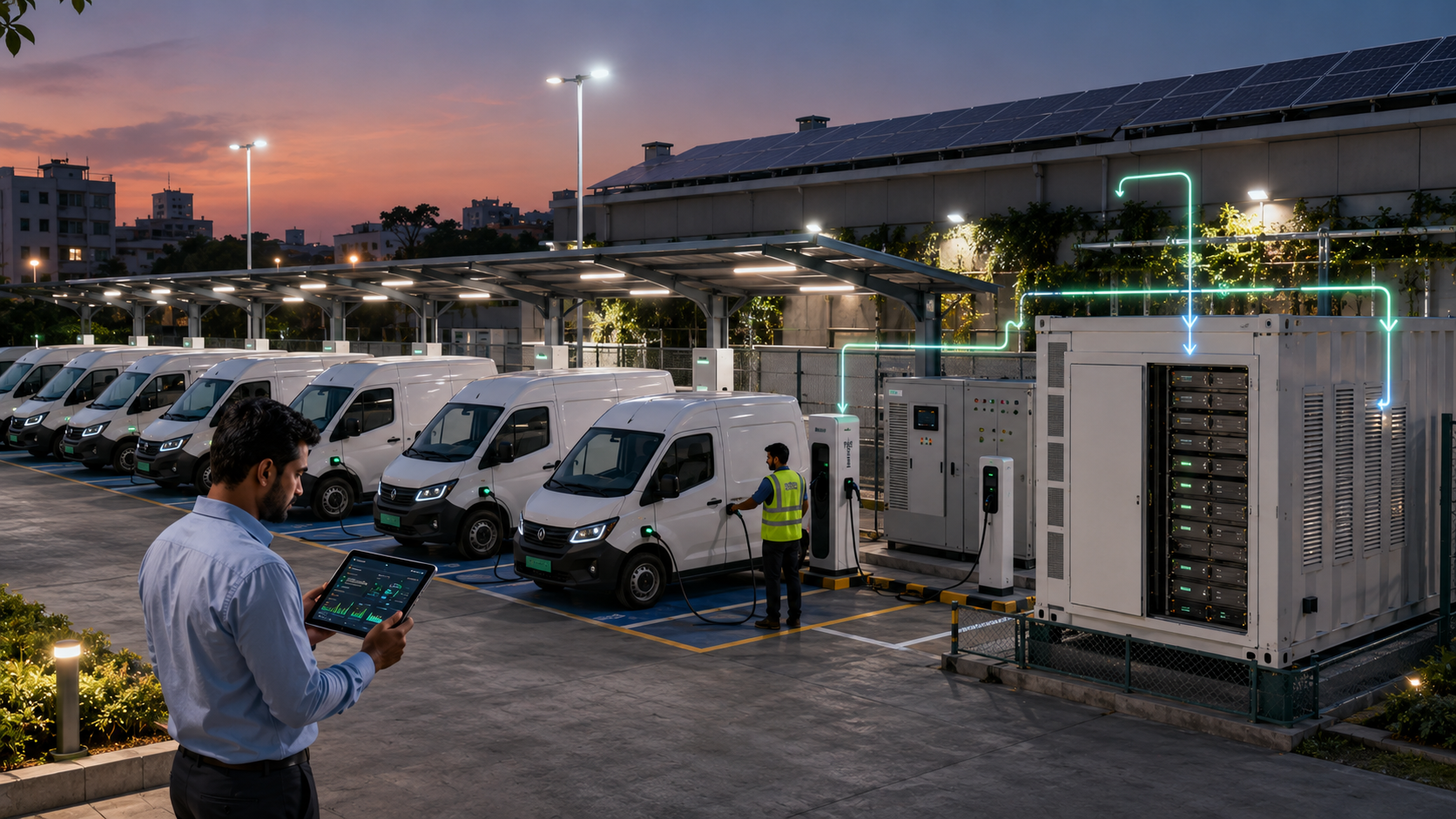
Electric delivery vehicles, taxis and commercial fleets may return to a depot within a similar time window.
A BESS can work with scheduled charging to:
- Reduce the evening charging peak
- Prioritise vehicles leaving early
- Support high-power opportunity charging
- Store solar energy generated during the day
- Reduce pressure on the depot transformer
- Support temporary demand during shift changes
For predictable overnight charging, smart scheduling may be more cost-effective than a large battery. The operator should compare both approaches.
Electric Bus Depots
Bus charging can create significant power demand because multiple high-capacity vehicles may need to be ready before the morning schedule.
A BESS can potentially support:
- Short high-power charging periods
- Opportunity charging
- Solar energy storage
- Transformer peak reduction
- Depot resilience
Bus-depot storage must be planned alongside:
- Route schedules
- Bus battery sizes
- Required state of charge
- Charger numbers
- Parking layout
- Grid capacity
- Charging windows
Offices and Commercial Properties
Office vehicles often remain parked for several hours, which makes lower-power managed charging practical.
A BESS may still be useful when:
- The building has rooftop solar
- Evening charging demand is expected
- The property has a strict electricity limit
- Visitor fast charging is provided
- A large number of employee chargers are installed
The operator should first evaluate whether dynamic load management alone can meet the requirement.
Shopping Malls and Hotels
Malls and hotels can experience variable building demand.
A BESS can help coordinate EV charging with:
- Air-conditioning demand
- Lighting
- Elevators
- Kitchens
- Events
- Solar generation
- Guest departure requirements
Storage may also allow the property to provide short-duration fast charging without allowing EV demand to exceed the building’s selected power limit.
Residential Communities
Residential EV charging demand often increases during the evening.
A BESS may store solar energy during the day and supply part of the evening charging demand.
However, residential vehicles usually remain parked overnight. Scheduled or dynamic charging may therefore be more economical than installing a large battery.
A feasibility study should compare:
- Managed overnight charging
- Additional transformer capacity
- Rooftop solar
- Battery storage
- Combination of these options
Remote and Rural Charging Locations
A remote location may have:
- Weak grid capacity
- Frequent voltage fluctuations
- Limited transformer capacity
- Strong solar potential
- Long grid-upgrade timelines
A solar-plus-storage charging system can improve charging availability at such sites.
However, it should be designed for seasonal weather, expected vehicle demand and multiple low-solar days.
BESS With Solar EV Charging
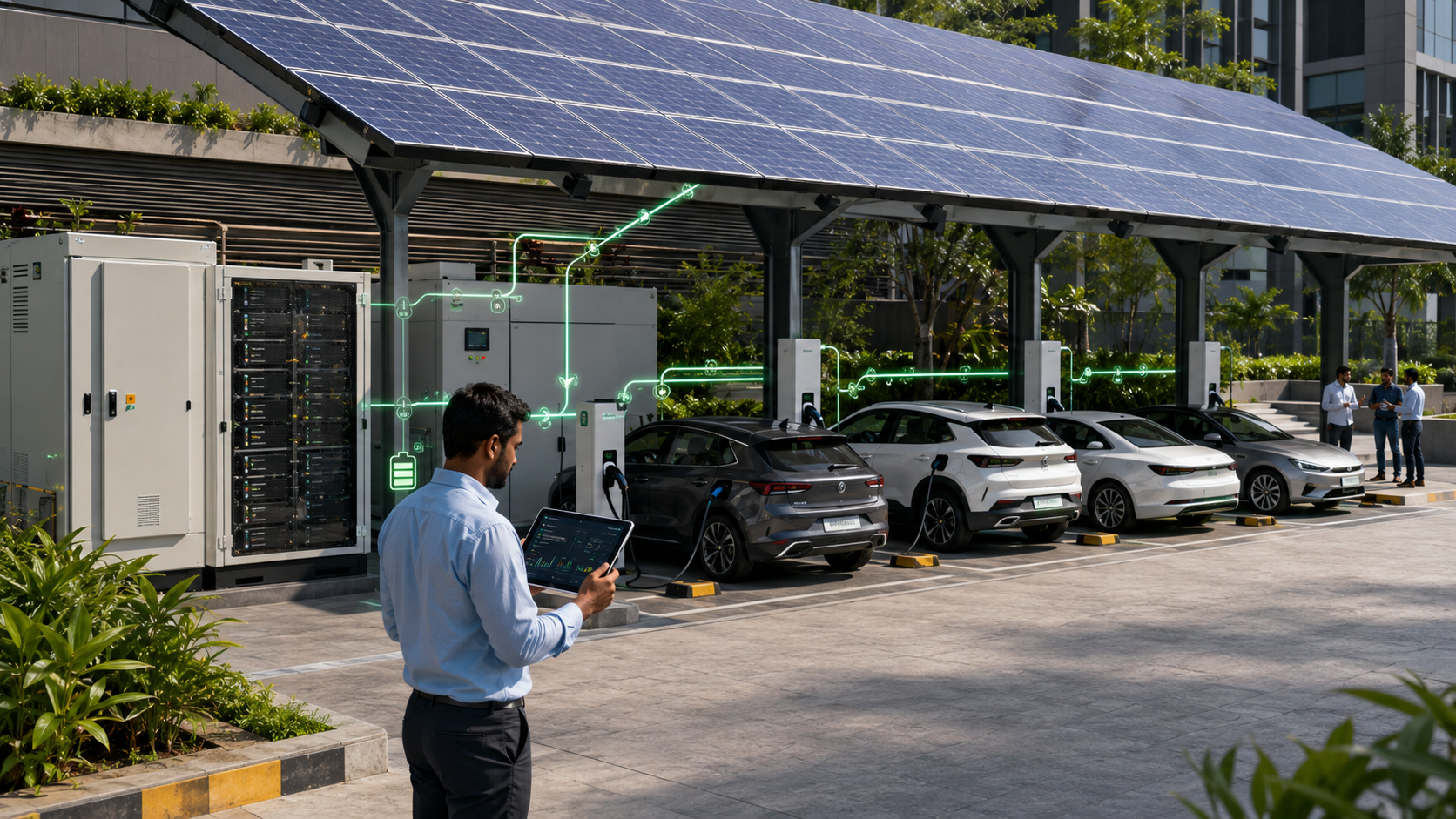
Solar panels and battery storage can complement each other.
During sunny periods, solar electricity can be used to:
- Supply active EV chargers
- Charge the BESS
- Support other site loads
- Export electricity where permitted
When solar generation falls, the BESS can release stored electricity to the chargers.
A solar-plus-storage system can improve the direct use of locally generated electricity, but its performance depends on:
- Solar system capacity
- Available roof or canopy area
- Weather
- Charging demand profile
- Battery capacity
- Grid connection
- Applicable export regulations
The solar system should not be promoted as providing completely free charging. The project still involves capital cost, maintenance, energy losses, battery degradation and grid electricity whenever solar generation is insufficient.
BESS vs Dynamic Load Management
Dynamic load management controls how available electricity is distributed.
A BESS provides additional electricity for a limited period.
A charging station may use either one or both systems.
Dynamic Load Management Is Often Suitable When:
- Vehicles have long parking durations
- Charging sessions can be scheduled
- Lower charging power is acceptable
- Site capacity is adequate when properly shared
- The operator wants to avoid battery investment
BESS May Be Suitable When:
- High charging power is commercially necessary
- Charging demand occurs in short peaks
- The grid connection is insufficient
- Solar energy needs to be shifted
- Charging power cannot be reduced significantly
- Grid upgrade costs are high
Combined System
The strongest configuration may combine:
- Dynamic load management
- Battery storage
- Solar energy
- Networked EV chargers
- Energy Management System
The system can first control charger demand and use the battery only when additional power is genuinely required.
This may reduce battery cycling and improve its operating life.
BESS vs Diesel Generator
A diesel generator is sometimes considered for backup or temporary high-power supply.
However, using diesel generation for routine EV charging can introduce:
- Fuel costs
- Local emissions
- Noise
- Regular maintenance
- Fuel storage
- Generator servicing
- Lower environmental benefit
- Restrictions on generator operation
A BESS produces no local exhaust emissions while operating, but it has a higher initial investment and limited stored energy.
The choice should consider:
- Required backup duration
- Frequency of use
- Site regulations
- Electricity availability
- Environmental goals
- Life-cycle cost
Safety Considerations
A BESS should be planned as dedicated electrical infrastructure rather than installed as a simple battery cabinet.
Important considerations include:
- Battery chemistry
- Certified equipment
- Correct system sizing
- Fire detection
- Automatic suppression
- Thermal management
- Ventilation
- Emergency shutdown
- Electrical isolation
- Earthing
- Lightning protection
- Flood protection
- Physical security
- Vehicle impact protection
- Safe maintenance access
- Remote fault monitoring
- Emergency response procedures
The system should be installed away from:
- Uncontrolled public access
- Flood-prone areas
- Combustible storage
- Obstructed ventilation
- Vehicle movement without barriers
- Heat sources
The project owner should obtain safety and technical approval from qualified professionals and verify applicable CEA, BIS, fire authority, distribution company and local building requirements.
Questions to Ask a BESS Vendor
Before selecting a system, the charging station owner should ask:
- What is the rated battery capacity?
- What is the usable battery capacity?
- What is the PCS power rating?
- What depth of discharge is permitted?
- What is the round-trip efficiency?
- What is the expected cycle life?
- What warranty applies?
- Is the warranty based on years, cycles or energy throughput?
- How much degradation is expected?
- Is capacity augmentation possible?
- Which battery chemistry is used?
- Which safety standards are followed?
- What fire detection and suppression systems are included?
- Does the system support solar integration?
- Can it communicate with the Charger Management System?
- Can it control grid import?
- Is remote monitoring included?
- What happens if internet connectivity fails?
- What maintenance is required?
- What spare parts are available in India?
- Who handles end-of-life batteries?
- What performance guarantees are provided?
Common BESS Planning Mistakes
Selecting Capacity Without Charging Data
A BESS should not be sized using charger ratings alone.
The owner should analyse:
- Number of sessions
- Arrival patterns
- Vehicle power acceptance
- Charging duration
- Peak demand
- Daily energy requirement
Ignoring the Difference Between kW and kWh
A large energy capacity with a low PCS rating may not provide enough instantaneous power.
A high-power system with very little energy capacity may become depleted too quickly.
Both ratings must match the use case.
Assuming the Battery Can Fully Replace the Grid
A BESS stores electricity; it does not generate unlimited energy.
The battery must recharge from:
- The electricity grid
- Solar panels
- Another power source
A small grid connection may be insufficient if daily charging demand is very high.
Ignoring Recharge Time
The battery must recharge before the next charging peak.
Repeated vehicle arrivals can deplete the system faster than it can recover.
Ignoring Degradation
The battery’s usable capacity will decline over time.
Financial and technical planning should include:
- Capacity loss
- Augmentation
- Module replacement
- End-of-life cost
Using Storage Where Smart Charging Would Be Enough
Many offices, residences and fleet depots can reduce peak demand by scheduling vehicles.
Installing a BESS without first evaluating load management may result in unnecessary investment.
Ignoring Safety and Site Layout
The BESS needs suitable space, protection, cooling, access and emergency planning.
It should not block:
- Vehicle movement
- Emergency access
- Charger parking bays
- Ventilation
- Maintenance routes
Choosing the Lowest Equipment Price
A low equipment price may exclude:
- Fire protection
- Cooling
- Installation
- Software
- Warranty support
- Maintenance
- Replacement parts
- Integration with EV chargers
The complete project scope should be compared.
Performance Indicators to Monitor
After commissioning, the operator should monitor:
- Battery state of charge
- Battery state of health
- Charging cycles
- Energy charged into the BESS
- Energy discharged from the BESS
- Round-trip efficiency
- Maximum discharge power
- Grid peak reduction
- Solar energy stored
- Solar energy used for EV charging
- Temperature
- Alarm history
- Battery downtime
- Charger sessions supported
- Electricity-cost savings
- Revenue enabled by the BESS
These measurements help determine whether the system is delivering the expected operational and financial benefits.
Is BESS Right for Your EV Charging Station?
A Battery Energy Storage System can be valuable, but it is not necessary for every charging location.
Before investing, the project owner should compare:
- Existing grid capacity
- Cost and timeline of a grid upgrade
- Expected charger demand
- Dynamic load management
- Solar generation
- Electricity tariff
- Required charging speed
- BESS life-cycle cost
- Battery degradation
- Future expansion
A properly designed BESS can help a charging station provide higher power, use renewable energy more effectively and reduce short-term stress on the grid.
A poorly sized system may increase project cost without creating meaningful savings.
Conclusion
Battery Energy Storage Systems can play an important role in the development of fast, reliable and grid-friendly EV charging infrastructure.
By storing electricity and releasing it during periods of high charging demand, a BESS can help charging station operators:
- Reduce peak grid demand
- Support high-power EV charging
- Improve solar energy utilisation
- Reduce or postpone selected grid upgrades
- Control electricity costs
- Support constrained charging locations
- Prepare for future expansion
- Improve operational resilience
The correct BESS size depends on both the amount of power required and the duration for which that power must be supplied.
Before selecting a system, charging station owners should conduct a detailed assessment of grid capacity, charging demand, electricity tariffs, solar generation, battery degradation and total life-cycle cost.
Planning an EV charging station with battery storage or solar integration? Contact Earthtron EV to evaluate your site capacity, charger demand and suitable energy storage configuration.