India’s transition towards electric mobility is creating new opportunities for EV charging station owners and investors. While charging fees remain the primary source of revenue, another potential income opportunity is attracting attention: carbon credits from EV charging stations.
With India’s Carbon Credit Trading Scheme (CCTS) establishing a domestic carbon market, businesses are exploring whether investments in cleaner transportation infrastructure could eventually generate tradable carbon credits.
However, an important question remains: can EV charging station owners in India actually earn money from carbon credits today?
The answer depends on project eligibility, approved carbon-credit methodologies, verified emission reductions and the evolving regulatory framework. Simply installing an EV charger does not automatically qualify a business to receive carbon credits.
Understanding these conditions is essential for entrepreneurs evaluating an EV charging station franchise or expanding an existing charging network.
What Are Carbon Credits and How Do They Work?
A carbon credit is a tradable unit associated with a quantified amount of greenhouse gas emissions reduced, removed or avoided. Typically, one carbon credit represents one metric tonne of carbon dioxide equivalent (tCO₂e).
Carbon credits create a financial incentive for eligible activities that reduce greenhouse gas emissions compared with an established baseline. For example, a renewable energy project may qualify for carbon credits when it demonstrates measurable and additional emission reductions under an approved methodology.
The process generally involves:
- Establishing a credible baseline for emissions.
- Implementing an eligible emission-reduction project.
- Measuring and documenting actual project emissions.
- Obtaining independent validation and verification.
- Receiving carbon credits after approval by the relevant programme.
- Selling eligible credits to buyers through an applicable market.
The principle is straightforward: verified climate benefits can potentially become tradable assets. However, not every environmentally beneficial activity automatically generates carbon credits. Projects must satisfy the specific rules of the carbon-credit programme.
Understanding India’s Carbon Credit Trading Scheme (CCTS)
India introduced the Carbon Credit Trading Scheme on 28 June 2023, with amendments in December 2023, to develop a domestic framework for greenhouse gas emission reductions and carbon-credit trading. The framework is administered by the Bureau of Energy Efficiency (BEE), with oversight from the National Steering Committee for the Indian Carbon Market.
India’s carbon market operates through two mechanisms.
1. Compliance Mechanism
The compliance mechanism applies to designated energy-intensive industries that must achieve specified greenhouse gas emission-intensity targets. Businesses performing better than their notified targets may qualify for Carbon Credit Certificates (CCCs). Businesses falling short of their obligations may need to purchase or surrender certificates in accordance with the scheme.
2. Offset Mechanism
The offset mechanism allows non-obligated entities to voluntarily register qualifying projects that reduce, remove or avoid greenhouse gas emissions. Projects must follow approved methodologies and undergo the required monitoring, validation and verification procedures before credits can be issued.
India’s offset framework includes sectors such as energy, industry, waste management, agriculture, forestry and transport. For EV charging businesses, the transport sector is particularly relevant. However, sector inclusion alone does not establish eligibility for an individual charging station.
As of the BEE approved-methodology list published on 7 July 2026, there was no dedicated approved methodology explicitly covering ordinary standalone EV charging station operations. EV charging station owners should not assume they can earn Indian Carbon Market credits merely by selling electricity to EV drivers.
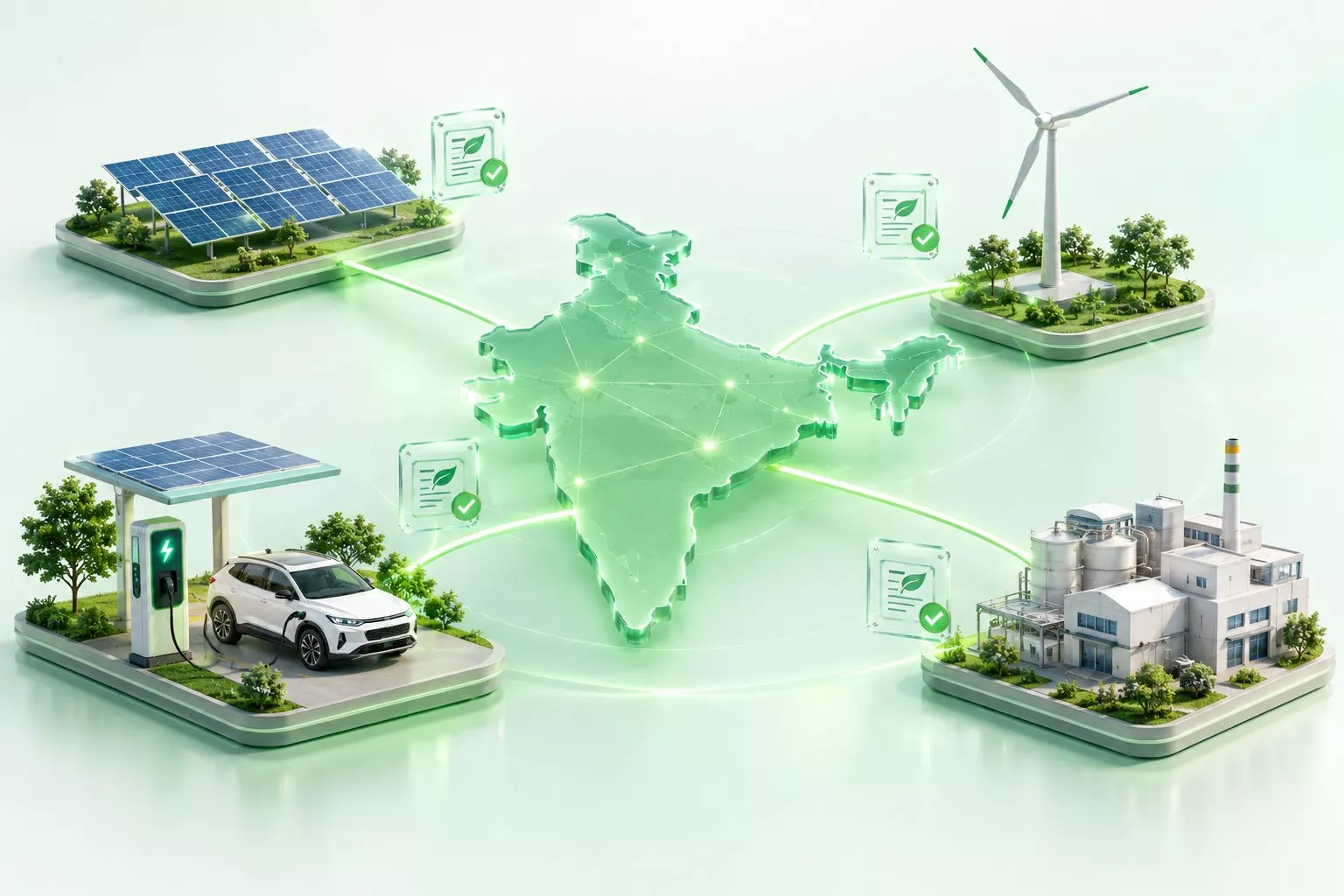
Can EV Charging Stations Generate Carbon Credits in India?
EV charging infrastructure supports the transition away from petrol and diesel vehicles, potentially contributing to lower transportation emissions. However, the environmental benefit of an EV charging station and its eligibility to generate carbon credits are two different things.
An EV charging station provides the electricity required to operate electric vehicles. Its potential contribution to emission reductions depends on several factors, including:
- The type of vehicles using the charging station.
- The amount of electricity delivered.
- The source and carbon intensity of that electricity.
- The emissions associated with the transport activity being displaced.
- Whether the emission reductions are additional and can be reliably attributed to an eligible project.
For example, a charging station powered partly by renewable energy may have a different emissions profile from a station relying entirely on grid electricity. Even where measurable reductions occur, a project must follow an approved methodology and satisfy carbon-credit programme requirements.
EV Charging Activities and Their Carbon Credit Potential
| Project type | Carbon credit outlook |
|---|---|
| Standard public EV charging station | No automatic entitlement to credits |
| Solar-powered EV charging station | May have opportunities through eligible renewable energy projects |
| EV charging for commercial fleets | Potential opportunity where an applicable transport methodology exists |
| Large charging network | May support project aggregation and stronger monitoring |
| EV charging station franchise | Eligibility depends on the actual project and carbon-credit programme |
Solar electricity generation may qualify under an applicable renewable energy methodology, subject to its eligibility conditions. That does not mean the charging activity itself earns a second carbon credit for the same environmental benefit. As India’s carbon market develops, new methodologies could create additional opportunities for charging infrastructure businesses.
How Much Carbon Credit Revenue Could an EV Charging Station Earn?
The potential revenue from carbon credits depends on verified emissions reductions, the number of eligible credits issued and the market price at which those credits can be sold.
Potential gross carbon credit revenue = Verified eligible carbon credits × Selling price per credit
For example, if an eligible project receives 100 carbon credits and sells them at an assumed price of ₹1,000 each, its gross carbon-credit revenue would be ₹1,00,000. This is a hypothetical example, not a current market quotation or an estimate of earnings from a typical EV charging station.
Example: A High-Usage EV Charging Station
| Parameter | Assumed value |
|---|---|
| Average charging sessions per day | 20 |
| Average electricity per session | 25 kWh |
| Total daily electricity delivered | 500 kWh |
| Annual electricity delivered | 1,82,500 kWh |
This charging data provides a useful starting point for environmental analysis. However, it cannot establish how many carbon credits the station might receive. A proper carbon-credit calculation would also need to consider baseline vehicle emissions, electricity-related emissions, project boundaries, additionality and the relevant programme’s accounting rules.
Charging station investors should avoid adding hypothetical carbon-credit earnings to their financial projections until eligibility and credit issuance can be established.
How EV Charging Station Owners Can Prepare for Future Carbon Credit Opportunities
Although direct carbon-credit revenue from ordinary charging operations is not currently established under a dedicated Indian Carbon Market methodology, station owners can prepare their businesses for future opportunities.
1. Maintain Accurate Charging Records
Digital charging infrastructure can record electricity consumption, session duration and equipment utilisation. Reliable records are important for understanding station performance and could support future emissions reporting. Station owners should maintain information such as electricity delivered, charger capacity, charging sessions, energy sources and operational uptime.
2. Explore Renewable Energy Integration
Integrating solar energy or other renewable electricity sources may help reduce a charging station’s carbon footprint. Renewable electricity generation may also have separate carbon-credit opportunities where an approved methodology applies. However, the project must meet its eligibility requirements, and environmental benefits must not be counted twice.
3. Use Smart Charging Management Software
Modern charging management systems provide data on charging activity, electricity consumption and operational performance. EV charging management software can help businesses monitor infrastructure. Accurate data can improve operational efficiency while supporting future sustainability reporting requirements.
4. Understand Carbon Credit Ownership
In a franchise-based charging business, the investor, station operator, electricity supplier and fleet customer may be different entities. Before participating in a carbon-credit programme, businesses should clarify who has the contractual right to claim and commercialise any eligible emission reductions. This helps prevent ownership disputes and duplicate environmental claims.
5. Monitor New Carbon Market Methodologies
The Indian carbon market is developing through approved methodologies, regulatory procedures and verification frameworks. Charging station owners can follow updates from the Bureau of Energy Efficiency to understand whether future methodologies create eligibility for EV charging infrastructure.
Can Solar-Powered EV Charging Stations Earn Carbon Credits?
Solar-powered EV charging stations present a potentially interesting opportunity because they combine renewable energy generation with electric mobility infrastructure. For example, a charging station with rooftop solar panels may reduce its reliance on grid electricity during daylight hours. This can offer operational benefits, including lower purchased electricity consumption under suitable conditions.
India’s offset mechanism includes an approved methodology for certain grid-connected renewable electricity generation projects. However, a solar installation at an EV charging station is not automatically eligible. Project eligibility depends on the detailed methodology, its applicability requirements, additionality assessment and verification procedures.
For investors, the most practical approach is to evaluate renewable energy integration primarily on electricity savings and operational benefits, while treating any potential carbon-credit revenue as a separate opportunity requiring assessment.
Challenges of Earning Carbon Credits from EV Charging Stations
Methodology availability: An EV charging activity must fit an approved carbon-credit methodology. A general environmental benefit is not sufficient.
Additionality: Projects generally need to demonstrate that the claimed emission reductions satisfy the programme’s additionality requirements.
Verification costs: Project validation, monitoring, verification and administration can create expenses that affect profitability.
Double counting: The same emission reduction must not be claimed or sold more than once.
Carbon credit prices: Credit prices may vary according to market conditions, project characteristics and applicable trading rules.
Project scale: Small charging stations may find the costs of carbon-credit development difficult to justify independently.
These factors make careful financial and regulatory assessment essential.
How EarthtronEV Supports the EV Charging Business Opportunity
As India’s electric mobility infrastructure expands, investors are increasingly exploring charging stations as a long-term infrastructure business. EarthtronEV provides EV charging infrastructure solutions, including DC fast charging stations, charging management software and franchise opportunities.
Through its Franchise-Owned, Company-Operated (FOCO) model, investors can own charging infrastructure while EarthtronEV manages station operations according to the franchise arrangement. The company’s charging network and software solutions help support monitoring, billing and operational management.
For prospective investors, the immediate business opportunity is based on electricity sales, charging demand, station utilisation and operating economics. Carbon-credit revenue should be considered a possible future benefit rather than a guaranteed component of franchise income.
Explore EV charging station business opportunities in India.
Explore the EarthtronEV EV charging station franchise model.
The Future of Carbon Credits and EV Charging in India
India’s carbon-market framework has created a foundation for incentivising verified greenhouse gas emission reductions. As charging infrastructure becomes more widespread, accurate electricity monitoring, renewable energy integration and transparent environmental reporting may become increasingly valuable.
Future developments could introduce clearer pathways for eligible electric mobility projects to participate in carbon-credit programmes. Large charging networks and commercial fleet projects may be particularly well placed to explore these opportunities because they can maintain detailed operational and energy-consumption records.
Nevertheless, future eligibility will depend on approved regulations and methodologies rather than the number of chargers installed. For EV charging investors, the strongest strategy is to build a commercially viable charging business while remaining prepared for emerging sustainability-linked opportunities.
Conclusion
Carbon credits from EV charging stations could become an additional revenue opportunity as India’s carbon market evolves. However, installing or operating an EV charger does not currently guarantee eligibility for carbon credits under the Carbon Credit Trading Scheme.
Station owners must distinguish between contributing to cleaner mobility and generating verified, tradable emission reductions. In the meantime, reliable charging infrastructure, high station utilisation, efficient operations and accurate energy monitoring remain the primary foundations of a sustainable EV charging business.
For investors planning to enter India’s growing electric mobility sector, EarthtronEV offers charging infrastructure and franchise solutions designed to support commercial EV charging operations. Explore EarthtronEV to learn more.
Sources and Regulatory References
Bureau of Energy Efficiency — Indian Carbon Market
Ministry of Power — Carbon Credit Trading Scheme, 2023, and amendments.