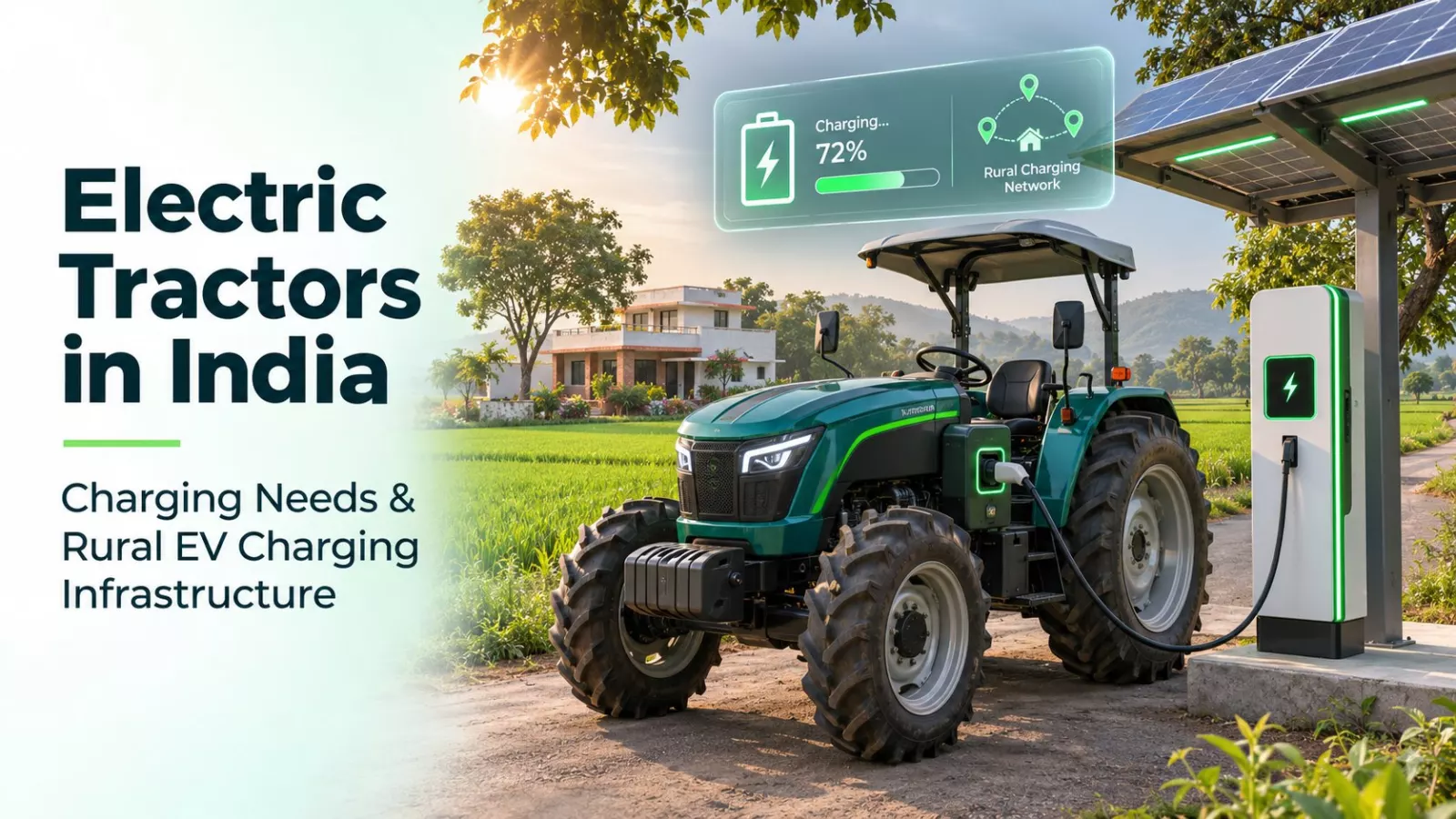
Quick Answer: Electric tractors use rechargeable batteries to power agricultural and utility operations without diesel combustion. Charging depends on battery capacity, workload, charger compatibility and the local electricity connection. Indian models illustrate capacities ranging from roughly 22 kWh to over 60 kWh, with model-specific AC and sometimes DC charging. Farm charging, community charging hubs, fleet depots and solar-assisted systems could support rural adoption—but electrical reliability, charging downtime and equipment economics must be assessed.
Can Electric Tractors Transform Indian Agriculture?
Tractors are central to Indian farming, from sowing and hauling to tilling and equipment operation. Diesel power has long dominated because of fast refuelling and established infrastructure. Electric tractors promise quieter operation, no tailpipe exhaust during use and fewer routine engine-related service requirements. Yet the key question for farmers is practical: how can a tractor be recharged without losing critical working hours?
Battery endurance, compatibility with charging equipment, agricultural power supply and station location shape the economics. Rural EV charging should be designed around actual farming operations, not simply copied from urban passenger-car networks.
What Are Electric Tractors and How Do They Work?
Electric tractors replace the diesel combustion engine with one or more electric motors powered by a rechargeable traction battery. The battery management system monitors temperature, voltage and operating limits; a motor controller regulates power delivery. Suitable transmissions, hydraulics and power take-off arrangements allow the tractor to perform agricultural tasks.
- Traction battery stores energy for propulsion and implements.
- Electric motor supplies rotational power.
- Battery Management System helps protect battery operation.
- Charging hardware accepts power from compatible infrastructure.
- Transmission and agricultural interfaces connect power to working equipment.
| Feature | Electric tractor | Diesel tractor |
|---|---|---|
| Energy source | Rechargeable battery | Diesel fuel |
| Exhaust during use | No tailpipe exhaust | Combustion exhaust |
| Energy replenishment | Charging time depends on supply | Usually rapid refuelling |
| Servicing | No engine oil or fuel-filter changes | Engine-related servicing |
| Working endurance | Battery and workload dependent | Fuel tank and workload dependent |
Electric Tractor Models and Battery Capacities in India
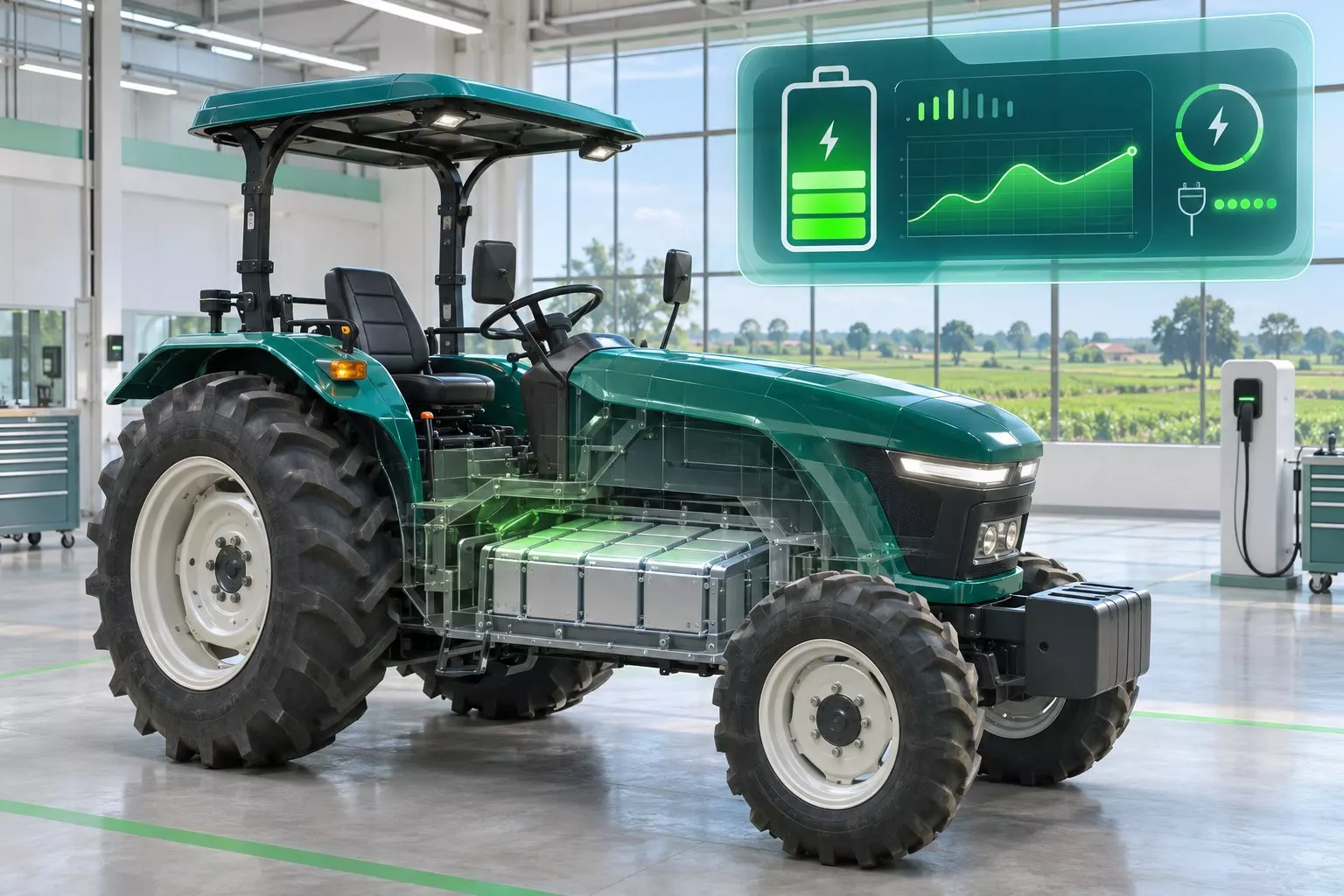
Electric tractor specifications vary substantially between models. A machine for transport or lighter utility operations may need a smaller battery than one expected to handle sustained high-draft tillage.
| Illustrative Indian model | Published battery capacity | Published charging options |
|---|---|---|
| Montra Electric E-27 | 22.37 kWh | Options vary; published 6.3 kW charger |
| AutoNxt X45C2 | 38.4 kWh | 6.6 kW / 13.2 kW AC variants |
| AutoNxt H55C2 | 63.89 kWh | 13.2 kW AC / 40 kW DC options |
Note: Specifications are manufacturer-published examples, not a claim of current availability at every dealership. Verify the exact vehicle variant and approved charger before purchase.
Why Battery Capacity Matters
Battery capacity measures stored energy in kWh. Operating time also depends on average load. For example, a hypothetical 40 kWh pack supplying an average 10 kW load has a simplified theoretical runtime of 4 hours; at a 20 kW average load the theoretical runtime is 2 hours. Usable energy limits, drivetrain and auxiliary consumption lower real-world results.
How Long Does It Take to Charge an Electric Tractor?
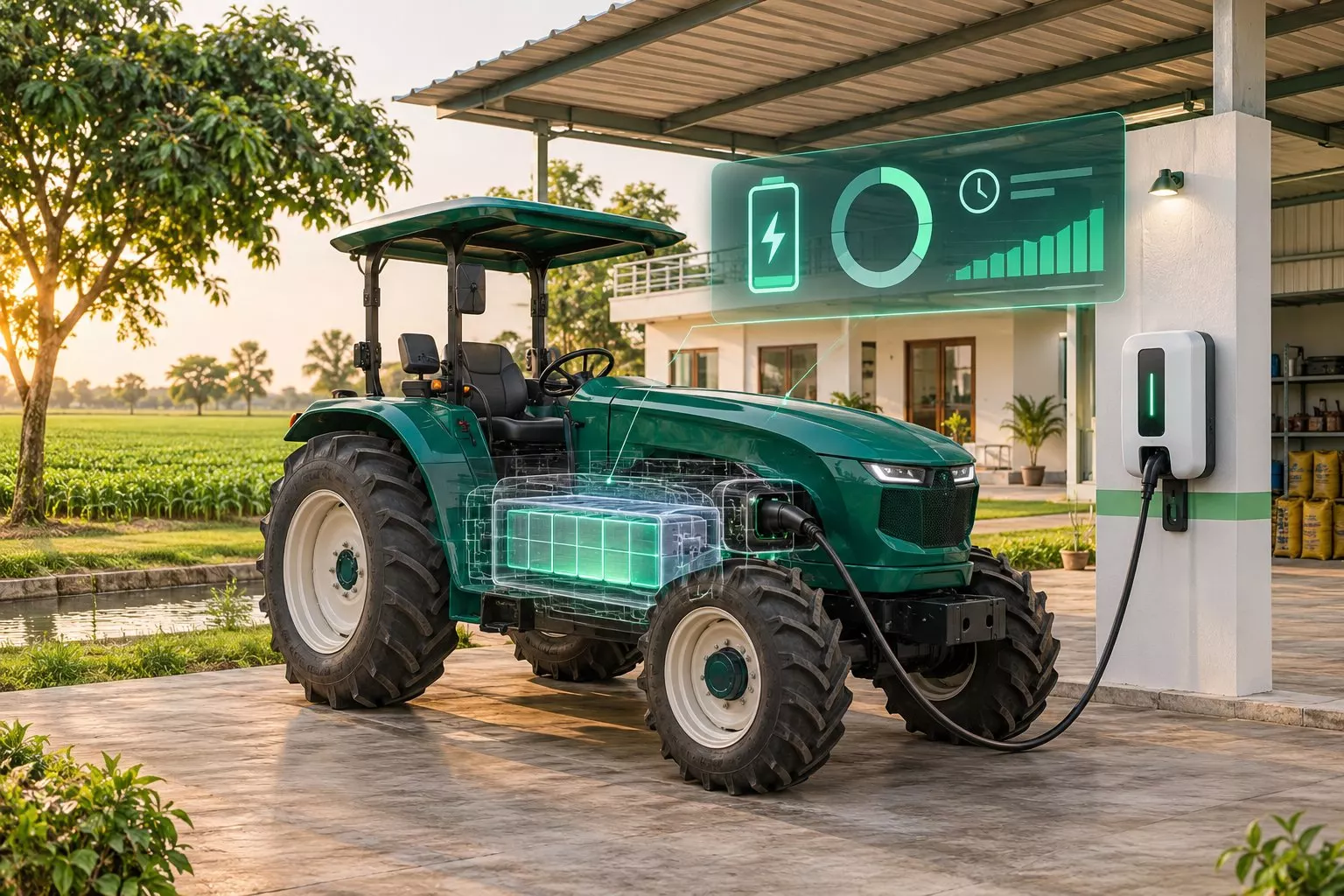
A tractor that can be charged overnight may fit a fixed daily routine. For time-sensitive operations, several hours of downtime can reduce productivity. Charging speed depends on the power a tractor can accept, not solely on the power printed on a charging station.
- Battery capacity and starting State of Charge
- Vehicle charger and connector compatibility
- Actual average charging power and available supply
- Battery temperature, charging taper and energy losses
Simplified calculation: charging time ≈ energy to be added (kWh) ÷ average power delivered (kW). The following hypothetical estimates assume 20% to 80% SoC and 85% effective charging efficiency.
| Battery size | 3.3 kW | 6.6 kW | 13.2 kW |
|---|---|---|---|
| 22 kWh | 4.7 h | 2.4 h | 1.2 h |
| 40 kWh | 8.6 h | 4.3 h | 2.1 h |
| 60 kWh | 12.8 h | 6.4 h | 3.2 h |
Important: These are illustrative arithmetic estimates. Not every electric tractor accepts these charger ratings or standard passenger-EV connectors. Tractor OEM charging approval is essential.
How Much Electricity Does an Electric Tractor Need?
Kilowatt-hours (kWh) are the units of energy required, while kilowatts (kW) measure the charging rate. If a 40 kWh battery charges from 20% to 100%, the battery receives approximately 32 kWh. At an illustrative charging efficiency of 90%, grid electricity consumption is around 35.6 kWh, or 35.6 electricity units.
| Illustrative tariff | Estimated cost for 35.6 kWh |
|---|---|
| ₹6/kWh | ₹214 |
| ₹8/kWh | ₹284 |
| ₹10/kWh | ₹356 |
These are example tariffs, not quotations. Agricultural electricity subsidies do not automatically authorize commercial EV charging: owners should check permitted use and tariff categories with their DISCOM.
Why Rural EV Charging Infrastructure Is Important
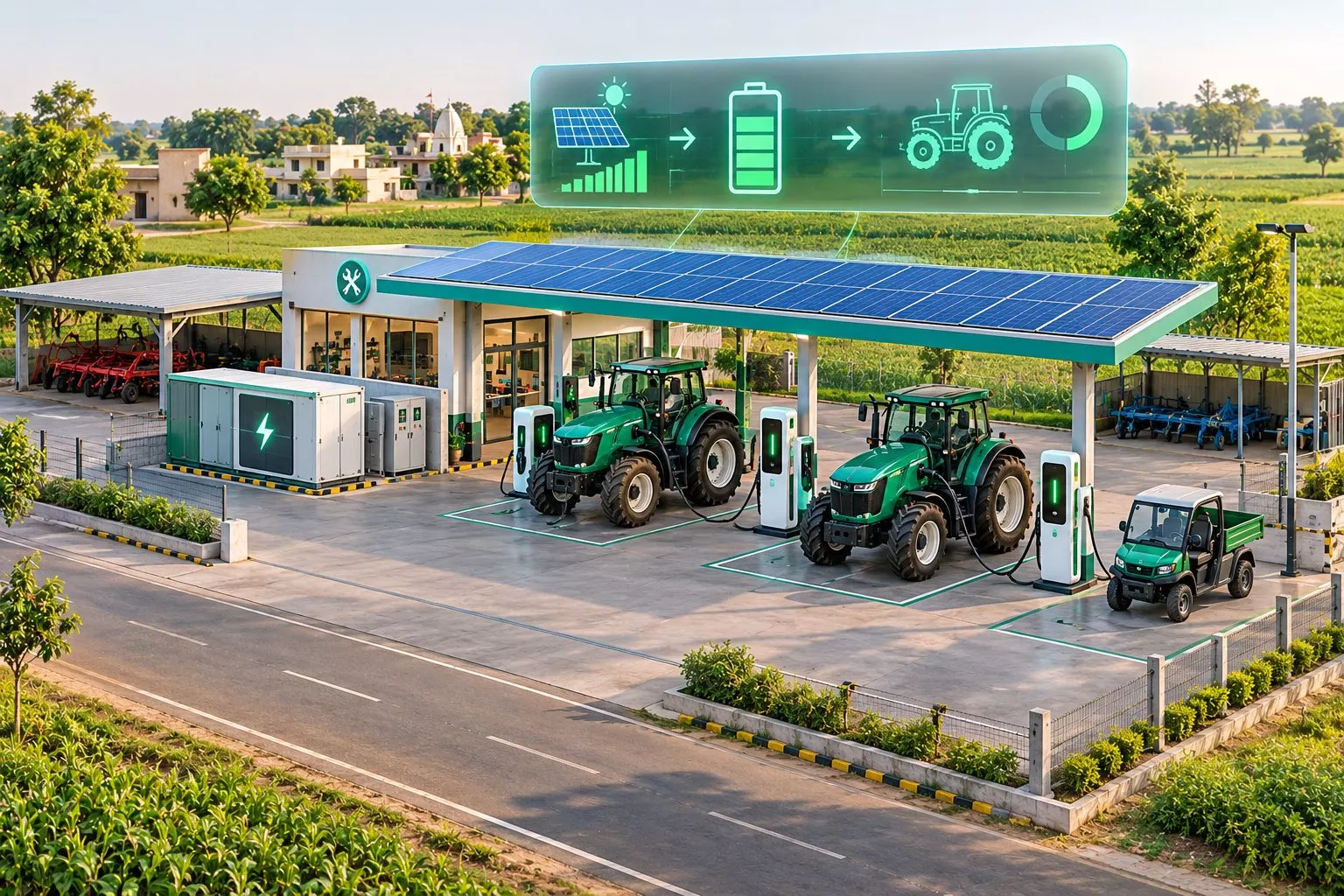
The location of a rural charger matters as much as its rated output. Tractors may operate far from urban public charging networks, on time-sensitive seasonal schedules. Effective infrastructure brings suitable charging close to fields, equipment stores, agricultural markets and fleet bases.
- Farm-based charging can support predictable overnight or between-shift sessions.
- Shared community charging hubs can serve multiple eligible users.
- Fleet depots can schedule equipment charging around planned work.
- Solar-assisted systems can supplement grid power when properly engineered.
Recent field research on electric tractors in Haryana has highlighted the gap between battery endurance under heavy agricultural loads and the longer operating duration of diesel tractors. This makes cluster-based charging, scheduling and matching the vehicle to the task particularly important.
Different Types of Rural Charging Infrastructure
Farm-Based Charging
A charger at a farmhouse, agricultural workshop or machinery shed can suit single-owner tractors that regularly return to the same base. Safety, electrical capacity and suitable parking for implements are key design criteria.
Community Charging Hubs
A cooperative, FPO or village service centre could host shared charging infrastructure. Clear access rules, metering and charging reservations would be needed to avoid scheduling conflicts.
Agricultural Fleet Charging
Custom Hiring Centres and rental operators could coordinate charging for multiple tractors through a depot. Fleet utilization data may make energy demand more predictable than sporadic public usage.
Solar-Assisted Charging
Solar PV generation can contribute energy during the day; a grid connection or battery storage may be necessary for predictable service. Solar power should not be assumed to meet instantaneous charging demand at all times.
Can Solar Power Charge Electric Tractors?
A solar-assisted system may include photovoltaic panels, inverters, switchgear, protective equipment, a metered connection, charging hardware and optional energy storage. A hypothetical 10 kW array producing four equivalent full-power hours might deliver about 40 kWh in a day before downstream system considerations. Actual energy varies by season, weather and system losses.
| Potential benefit | Design consideration |
|---|---|
| Daytime renewable energy | Output varies with sunlight and weather |
| Canopy and roof utilization | Structural and electrical design required |
| Lower purchased energy | Upfront capital and maintenance |
| Storage for flexibility | Battery storage raises total cost |
Challenges of Rural EV Charging Infrastructure
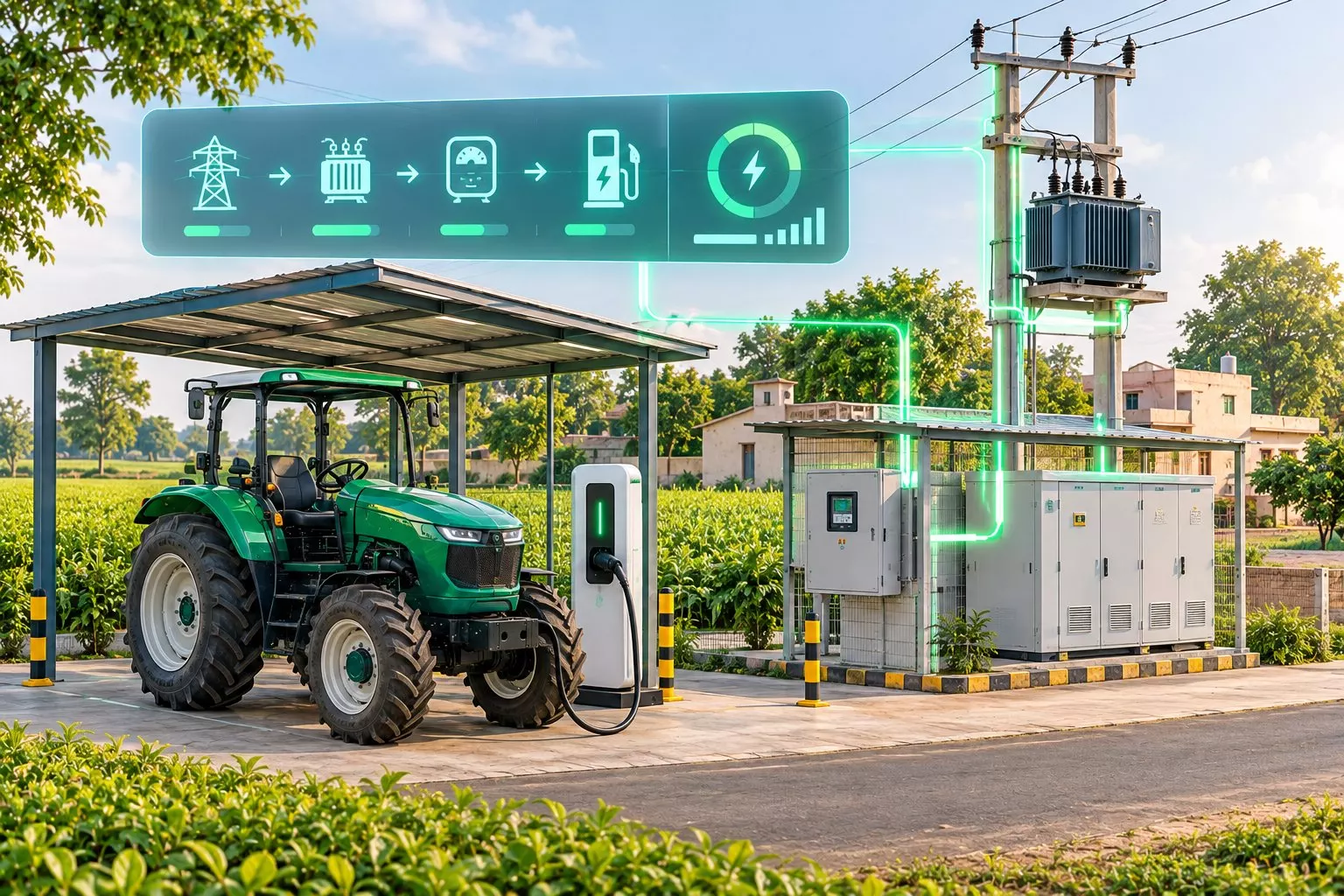
Unlike urban public EV networks, rural charging projects may need to address supply restrictions, transformer capacity, voltage fluctuations, long connection distances and lower early customer utilization. Dust, heat, monsoon exposure and the availability of qualified service support also affect operating costs.
- Confirm dependable connection capacity and permissible electricity use.
- Select weather-protected equipment and appropriate electrical protection.
- Verify physical manoeuvring space for tractors and implements.
- Plan for modest early usage and seasonal demand peaks.
- Ensure connector, voltage and protocol compatibility with target tractors.
Electric Tractor Charging vs Electric Car Charging
| Factor | Electric tractors | Electric passenger cars |
|---|---|---|
| Typical sites | Farm, depot, rural hub | Home, work, public charging |
| Primary duty | Traction and implements | Driving |
| Demand patterns | Seasonal, task-based | Commuting and travel |
| Connectors | May be model-specific | More broadly standardized |
| Planning challenge | Work continuity and rural supply | Travel and location coverage |
How Much Would a Rural Charging Hub Cost?
A credible cost estimate must be site-specific. Charger hardware is only one component; projects may also need a transformer or supply upgrade, switchgear, protective devices, trenching, cabling, civil work, space for agricultural machinery and software for billing or remote monitoring.
The business case is sensitive to utilization: multiple installed chargers do not guarantee adequate paid charging sessions. Calculate site demand, delivered kWh, tariffs, electricity expenses, maintenance, rent and financing before investing.
Government Policies and Electricity Connections
The Ministry of Power’s 2024 EV charging infrastructure guidelines provide an overarching framework for charging facilities. In general, establishing an EV charging station is treated as an unlicensed activity, but that does not waive electrical safety obligations, permissible connection-use conditions or other local approvals.
Subsidized agricultural electricity supply may be limited to specified uses. Commercial third-party charging should not begin without confirming the appropriate connection arrangements and tariffs with the state DISCOM. Subsidy eligibility also varies by scheme and state.
How EarthtronEV Can Support Rural EV Charging Development
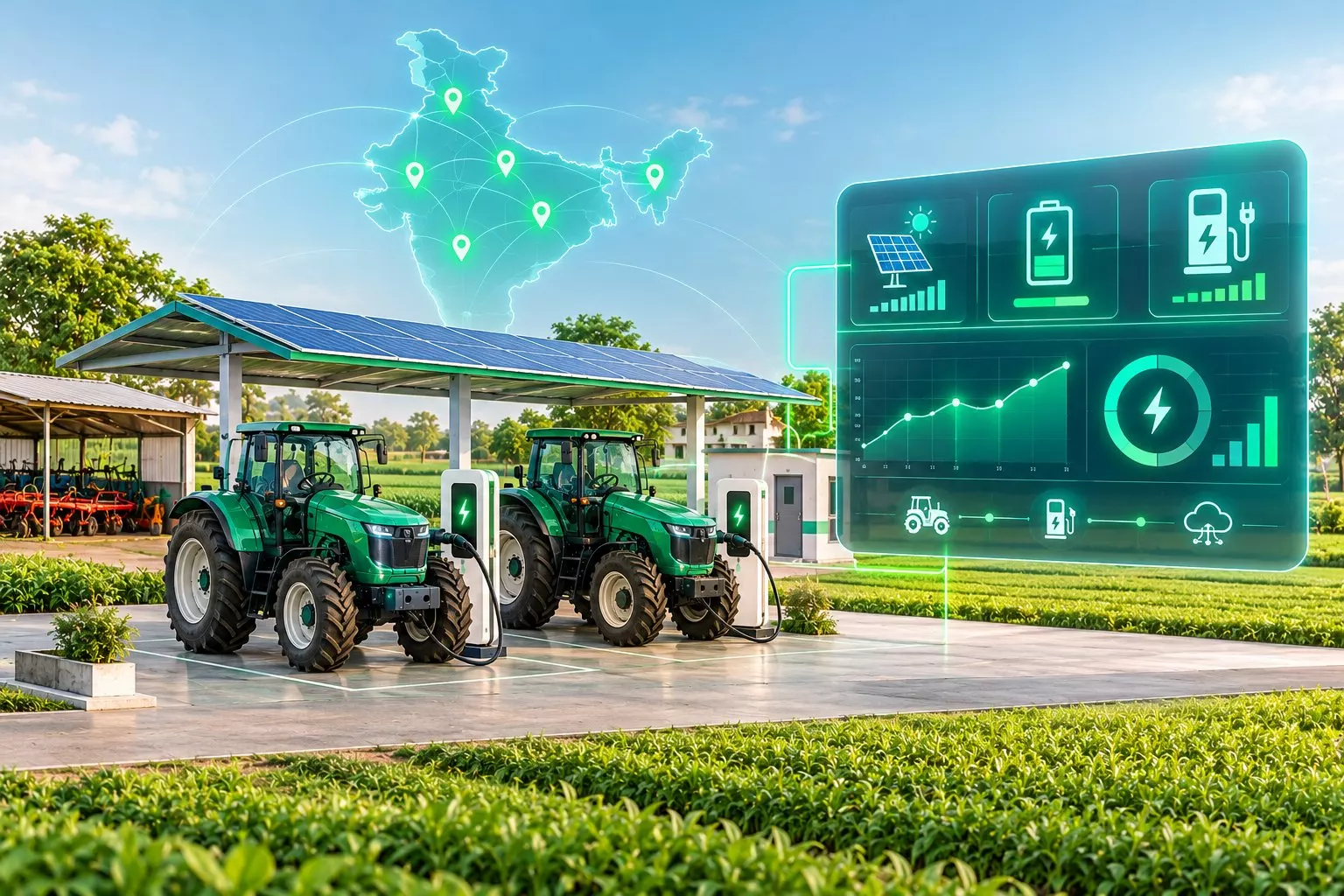
EarthtronEV provides AC and DC charging solutions, connected charging infrastructure and charge station management technology. These capabilities are relevant to the wider conversation about rural charging development, but tractor compatibility and rural project suitability must be validated for each vehicle and site.
A centralized charging management system can support status monitoring, session data and operational reporting where compatible hardware and communications exist. EarthtronEV also offers an EV charging station franchise model; an agricultural charging deployment would still need its own feasibility study, rather than assuming a standard passenger-EV franchise configuration is appropriate.
Rural EV Charging Business Opportunities
Potential EV charging station business models include charging at agricultural service centres, shared cooperative hubs, dedicated depots for tractor rental operators, and solar-assisted facilities where demand and supply conditions justify them. Non-farm utility or hauling duties may also become early use cases for electric agricultural vehicles.
The strongest starting point is a confirmed base of compatible electric tractors and a feasible electrical connection. An empty public charging hub built before local tractor adoption may be difficult to operate profitably.
The Future of Electric Tractors in India
Improved batteries, compatible higher-power charging, better fleet scheduling and distributed charging infrastructure could make electric tractors more practical in selected applications. Battery swapping may be relevant to certain future systems, but only where OEM designs and standards support it.
Agricultural charging infrastructure will likely evolve in stages, starting with predictable-use sites before more general public rural networks become commercially viable.
Conclusion
Electric tractors could reduce diesel reliance and support quieter, lower-tailpipe-emission agricultural operations. Their success, however, will depend on charging infrastructure that fits real farming schedules, electricity conditions and tractor-specific hardware requirements. Farm-based charging, community hubs, agricultural depots and solar-assisted systems each have a possible role, provided they are planned around verified demand and safe electrical installations.
EarthtronEV supports the broader transition toward connected electric mobility through charging equipment, management software and infrastructure operations. Explore EarthtronEV charging solutions and business opportunities in India.