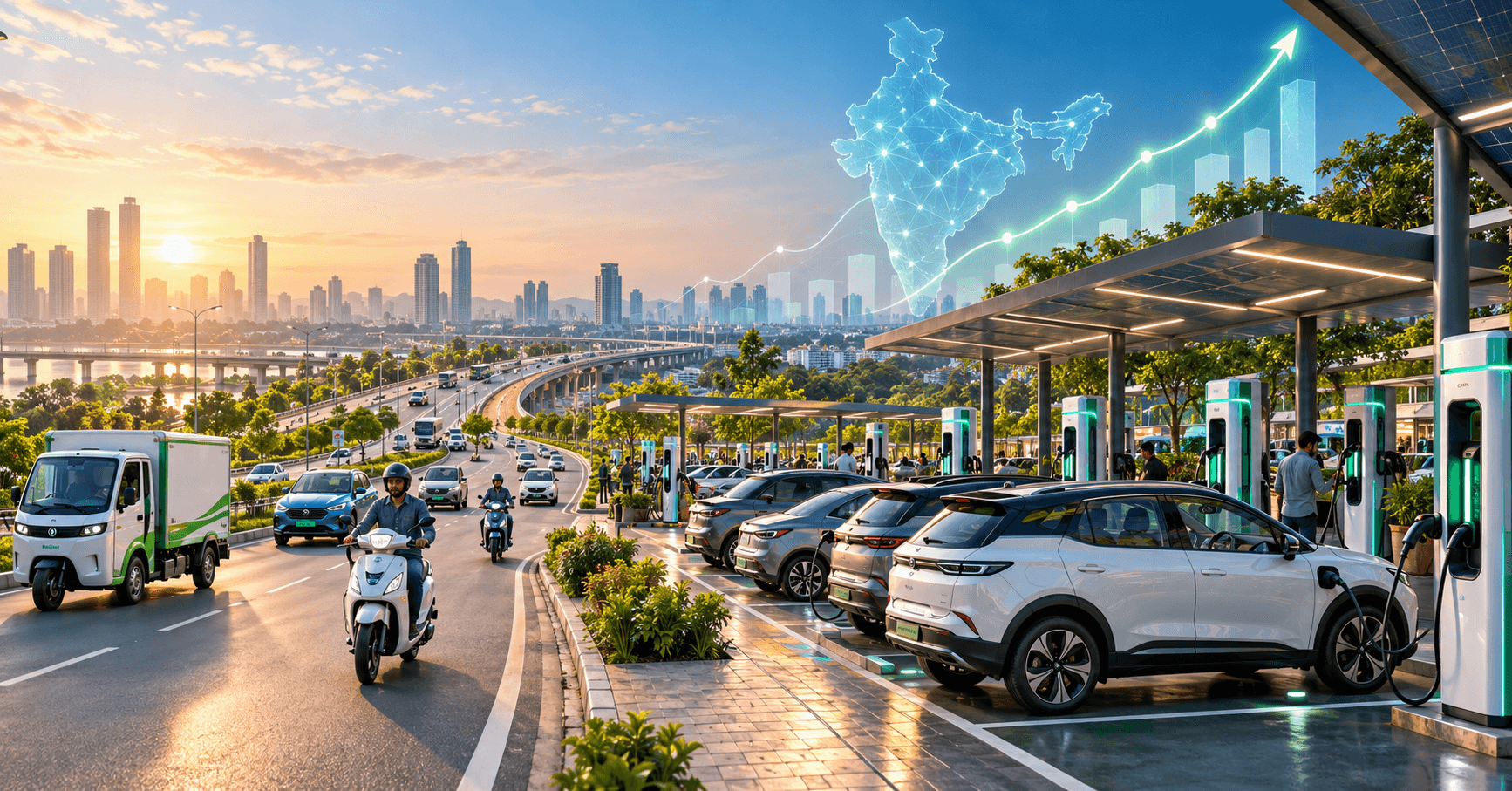
India’s EV adoption is accelerating. Vahan data shows a record 3,33,571 EVs registered in September 2026, with electric two-wheelers at 11.6% of sales and electric cars at roughly 8.3–8.5% of passenger vehicle sales. The public charging network has grown to 52,718 stations, but only 16,561 are DC fast chargers for cars, which works out to roughly one public charger for every 175–190 EVs. The biggest charging demand is building up on highways, in fleet hubs and in dense cities, and fast charging is where supply is thinnest.
The state of EV adoption in India, October 2026
India’s EV market has moved from early adopters to mainstream showrooms. September 2026 was the highest month in the past year, and the numbers below show how broad the growth is.
| Indicator | Latest figure | Source and date |
| Total EV registrations, Sep 2026 | 3,33,571 (highest monthly figure in the last 12 months) | Vahan via EVreporter, 2 Oct 2026 |
| EV registrations, Oct 2025–Sep 2026 | 32,18,989 | Vahan via EVreporter |
| Electric two-wheeler penetration, Sep 2026 | 11.6% (up from 10.7% in Aug) | Vahan via EVreporter |
| Electric car and cab penetration, Sep 2026 | 8.5% (up from 7.8% in Aug) | Vahan via EVreporter |
| Electric passenger vehicle registrations, Sep 2026 | 35,948, up 94% year on year (a record), 8.3% of the market | Vahan via Nuvama / Autocar Pro |
| Electric passenger vehicles, Apr–Sep 2026 | 1,91,751, up 89% year on year | Vahan via Nuvama / Autocar Pro |
| Electric two-wheelers, Jan–Sep 2026 | About 15.61 lakh, up around 62% | Vahan via Autopunditz |
| EVs registered in India | More than 1 crore by mid-2026 | Industry reports, Jul 2026 |
Figures differ slightly between trackers because Vahan data is revised after publication and each tracker defines categories differently. EVreporter figures exclude low-speed electric two-wheelers.
Five EV adoption trends reshaping demand
1. Electric cars are the fastest-growing segment
Electric passenger vehicle registrations rose 94% year on year in September 2026, according to Vahan data compiled by Nuvama. Tata Motors and Mahindra accounted for nearly 63% of registrations in the first half of FY27, but newer entrants are gaining ground. Kia’s registrations in April–September rose 219% to 4,134 units, and VinFast and Maruti Suzuki now appear in the monthly rankings. More models and more price points bring more car buyers, and car drivers need fast, public charging far more than two-wheeler riders do.
2. Two-wheelers remain the volume engine, even after subsidies ended
Electric two-wheelers made up about 62% of all EVs registered in 2026 so far, according to Flash Finance’s Vahan tracker. This is notable because PM E-DRIVE demand incentives for electric two-wheelers and three-wheelers ended on 31 March 2026. Penetration has kept climbing since, reaching 11.6% in September. That suggests buyers are choosing electric for running cost and product choice, not only for subsidy.
3. Commercial fleets are electrifying on predictable routes
In September 2026, electric three-wheeler goods sales were led by Bajaj Auto, Mahindra Last Mile Mobility and YC Electric. Under PM E-DRIVE, ₹4,391 crore is allocated for 14,028 electric buses. Fleets matter for charging because they run fixed routes and fixed schedules, which makes their energy use easy to forecast.
4. Adoption is concentrated in a few states
Uttar Pradesh is the largest EV market, with about 14.1% of national registrations in 2026 so far, ahead of Maharashtra and Karnataka. Charging demand will follow the same pattern: heavy in a few states and corridors, and thinner elsewhere.
5. Policy support is shifting from vehicles to infrastructure
The Government of India has extended PM E-DRIVE to 31 March 2028, with a total outlay of ₹10,900 crore. With e-2W and e-3W purchase incentives over, support continues for buses, trucks and charging. The scheme earmarks ₹2,000 crore for public charging: 22,100 fast chargers for four-wheelers, 1,800 for buses and 48,400 for two- and three-wheelers.
How much charging infrastructure does India have?
| Indicator | Latest figure |
| Public EV charging stations (government reply to Lok Sabha, reported July 2026) | 52,718, including 16,561 DC fast chargers for cars |
| Earlier ministry count (March 2026) | 27,737 installed, 22,753 operational (about 82%) |
| EVs per public charger | Roughly 175–190, against an international benchmark of about 6–20 |
| Stations delivered under FAME-II | 9,583 (as of 1 July 2026) |
| PM E-DRIVE charging sanctioned | 6,562 chargers worth ₹688.84 crore, with no expenditure yet as of August 2026 |
| 2030 requirement (ORF estimate) | About 13.2 lakh public chargers for 30% EV penetration |
| 2030 requirement (EarthtronEV) | At least 5,00,000 charging points |
The two station counts (27,737 and 52,718) come from different reporting dates and counting bases. 2030 estimates vary widely because they rest on different assumptions about vehicle mix, charger power and utilisation.
The takeaway is a gap between registrations, which are growing at 50–95% a year in key segments, and deployed fast-charging capacity. The public programme has approved chargers, but at the last government update none of the PM E-DRIVE charging funds had been spent. In practice, private and franchise-funded stations are filling the gap.
What EV adoption means for charging demand
Different vehicles create very different charging needs. This is how EarthtronEV reads the demand by segment, using the market data above.
| Segment | Adoption signal | What charging demand looks like | Best-fit infrastructure |
| Two-wheelers | 11.6% penetration; 15.61 lakh sold Jan–Sep | Many small, frequent top-ups, mostly at home or work; public demand from apartment residents and delivery riders | AC chargers, compact DC hubs (40 kW) |
| Cars and cabs | 8.3–8.5% penetration; registrations up 94% | Longer sessions, fast charging on highways and in cities; cab fleets run at high utilisation | 60 kW to 240 kW DC |
| Three-wheelers | Goods segment led by Bajaj, Mahindra, YC Electric | Predictable daily routes; hub and depot charging | AC and 40–60 kW DC at hubs |
| Buses and trucks | 14,028 e-buses funded under PM E-DRIVE | Depot and ultra-fast charging, large and scheduled energy loads | 360 kW to 480 kW DC |
Five implications for charging demand
- Fast charging, not just more chargers. India has 16,561 public DC fast chargers for cars against more than a crore EVs on the road, and car registrations are nearly doubling every year. Demand for DC fast charging is rising faster than supply.
- Demand is uneven. It clusters along highways, in large metros and around fleet hubs, and in states such as Uttar Pradesh, Maharashtra and Karnataka. Where a charger is placed will matter as much as how many are built.
- Reliability is part of capacity. With about 82% of stations operational in the March 2026 count, a charger that is offline adds nothing for the driver. Uptime, payment and roaming will decide which networks win repeat drivers.
- Policy tailwinds are real, but execution lags. The government has sanctioned 6,562 chargers, but deployment was still pending in August 2026. Private capital is likely to keep carrying much of the build-out.
- Utilisation will separate good sites from average ones. Rising EV numbers do not lift every charger equally. A station near steady traffic, dwell time and reliable power will outperform one that is merely located near EVs.
Where charging demand is likely to be strongest
- Highway corridors and fuel forecourts: long-distance drivers need fast, dependable charging, as seen in the highway stations
- Fleet and cab hubs: predictable, high-volume demand. See fleet charging.
- Malls, hotels and corporate campuses: long dwell times suit AC and mid-power DC charging.
- Bus and truck depots: large, scheduled loads that need ultra-fast DC chargers.
- Dense residential areas: apartment residents without home charging rely on shared AC charging.
What to watch next
- PM E-DRIVE deployment: whether the sanctioned 6,562 chargers are installed and whether fund utilisation picks up before the scheme’s March 2028 end date.
- Monthly Vahan data: whether electric car penetration holds above 8% and two-wheelers hold above 11% through the festive season.
- Charger uptime and payments: proposals for unified, tap-and-pay style payments could make existing stations far more usable.
- Grid connection and tariffs: power availability and electricity costs strongly affect station economics and speed of rollout.
What this means for investors and businesses
Rising adoption creates demand, but returns depend on execution: site, tariff, utilisation and operating cost. EarthtronEV’s franchise programme follows a Franchise-Owned, Company-Operated (FOCO) model. You fund the station, and EarthtronEV handles site assessment, installation, operations, billing and maintenance. Full setup costs published by EarthtronEV range from about ₹10–14 lakh for a 40 kW charger to ₹1 crore or more for a 480 kW depot setup, and returns are settled monthly. Returns are not guaranteed.
Test your own site with the EarthtronEV Revenue Calculator, explore the franchise programme, or read the PM E-DRIVE subsidy guide.
The bottom line
India’s EV market is growing across every major segment, with cars and two-wheelers both setting new highs in 2026. Public charging has expanded, but fast-charging capacity, uptime and coverage still trail adoption. For drivers, that means planning routes. For investors, it means the opportunity is real, but it rewards careful site selection over simple optimism.
Frequently asked questions
How many EVs were registered in India in September 2026?
India registered 3,33,571 EVs in September 2026, the highest monthly figure in the past 12 months, according to Vahan data compiled by EVreporter.
What is India’s EV penetration in 2026?
In September 2026, electric two-wheelers were 11.6% of two-wheeler registrations, and electric cars and cabs were about 8.3–8.5% of passenger vehicle registrations, depending on the tracker.
How many public EV charging stations does India have?
A government reply reported in July 2026 put the number at 52,718 public charging stations, including 16,561 DC fast chargers for cars. An earlier March 2026 ministry count showed 27,737 installed, so figures depend on the reporting date and counting basis.
Is India’s EV charging infrastructure enough?
Not yet. India has roughly one public charger for every 175–190 EVs, compared with an international benchmark of about 1 per 6–20, and fast-charging capacity is the biggest gap.
How many chargers does India need by 2030?
Estimates vary by assumption. ORF estimates about 13.2 lakh public chargers for 30% EV penetration, while EarthtronEV states a need for at least 5,00,000 charging points.
What is PM E-DRIVE’s role in EV charging?
PM E-DRIVE is a ₹10,900 crore scheme extended to March 2028. It earmarks ₹2,000 crore for public charging, including 22,100 fast chargers for four-wheelers, 1,800 for buses and 48,400 for two- and three-wheelers.
Which segment will drive charging demand the most?
Two-wheelers drive volume, but cars, cabs, fleets and commercial vehicles drive the demand for public and fast charging because their energy needs per vehicle are higher.
Is an EV charging station a good investment?
It can be, but returns depend on location, utilisation, tariff and operating costs, and are not guaranteed. A site-specific projection is the best place to start.
Ready to explore EV charging as a business?
Write to the franchise team at franchise@earthtronev.com or visit the EarthtronEV franchise page to request a site-specific projection.
Disclaimer: General information only, not financial advice. Market data is based on Vahan-derived reports and public sources as of early October 2026 and is subject to revision. Charging returns depend on location, utilisation, tariffs, taxes and financing, and are not guaranteed.