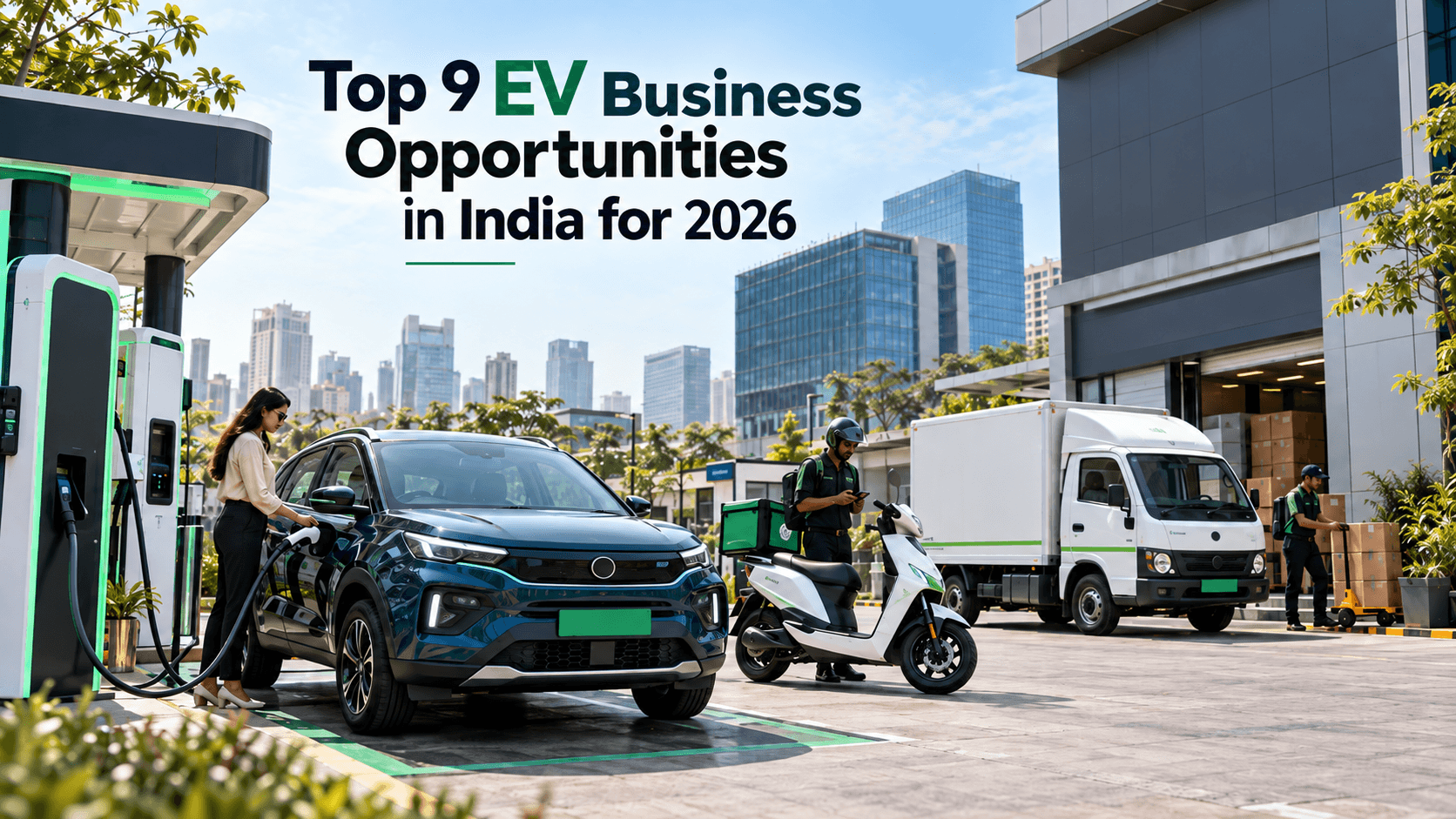
Quick Answer: India’s EV industry is no longer only about manufacturing or selling electric vehicles. In 2026, entrepreneurs can participate through EV charging infrastructure, battery swapping, battery and component manufacturing, battery recycling, EV financing and leasing, fleet electrification, EV servicing and retrofitting, charging software, and vehicle retail.
India sold approximately 2.66 million EVs in FY2025–26, representing about 8.62% of total automotive sales. Two- and three-wheelers accounted for nearly 87% of EV volumes, showing that the opportunity extends well beyond electric passenger cars.
The right EV business depends on your available capital, technical expertise, operating involvement, location, and appetite for risk.
A few years ago, entering India’s EV sector largely meant selling vehicles or setting up a service business.
That is changing.
As EV adoption grows, businesses are being created around the entire ecosystem — charging vehicles, swapping and recycling batteries, financing purchases, electrifying fleets, supplying components, maintaining vehicles, and building software to operate charging networks.
Here are nine EV business opportunities worth understanding in 2026.
Why EV Business Opportunities Are Expanding Beyond Vehicle Sales
Three major developments are broadening the opportunity.
First, EV adoption continues to grow. India recorded around 2.66 million EV sales in FY26, up from approximately 2.05 million in FY25. EVs accounted for about 8.62% of automotive sales during the year.
Second, charging infrastructure still needs significant expansion. Industry estimates cited by IBEF indicate that India may require at least 1.32 million charging stations by 2030, implying more than 4,00,000 additional installations annually to meet projected demand.
Third, government policy increasingly supports the broader EV ecosystem rather than only vehicle purchases.
The Government of India’s PM E-DRIVE scheme was introduced with an initial outlay of ₹10,900 crore and includes support for EV adoption, buses, trucks, ambulances, testing infrastructure and charging infrastructure. The scheme has subsequently been extended through 31 March 2028 for most applicable segments, although individual segment timelines can differ.
An allocation of ₹2,000 crore has been made specifically for public EV charging infrastructure under PM E-DRIVE.
Together, these trends are creating opportunities at several levels of the EV value chain.
The 9 EV Business Opportunities to Know in 2026
1. EV Charging Infrastructure and Franchise Networks
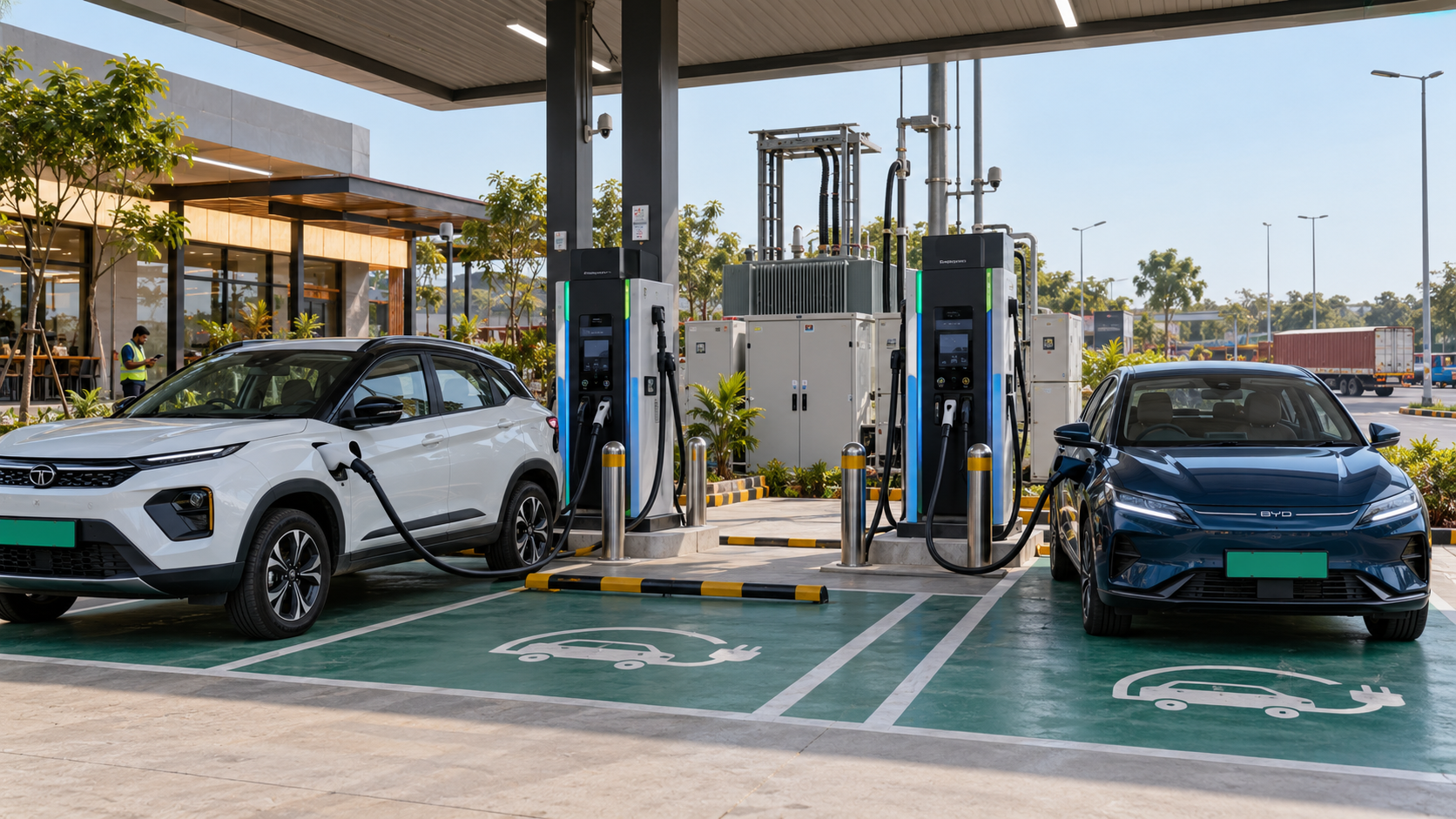
EV charging is one of the most visible ways to participate in the EV ecosystem without manufacturing vehicles.
Potential locations include:
- Highways and expressways
- Fuel stations
- Hotels and restaurants
- Shopping centres
- Commercial properties
- Corporate offices
- Residential developments
- Fleet hubs
- Logistics centres
- Public parking facilities
Commercial models can vary considerably.
An investor may independently purchase and operate chargers, partner with a charge point operator, lease space to an operator, or participate through a franchise model.
In a Franchise-Owned, Company-Operated (FOCO) structure, for example, the franchise partner typically provides the investment while the charging company handles much of the technical and operating work.
The economics of a charging station depend heavily on:
- Location quality
- EV traffic
- Charger utilisation
- Electricity availability
- Charger capacity
- Charging sessions
- Energy delivered
- Uptime
- Operating costs
This means installing the largest possible charger does not automatically create the strongest business.
EarthtronEV’s own charging-business guidance similarly emphasises utilisation, site demand, charger configuration and operating economics rather than charger count alone.
How EarthtronEV fits
EarthtronEV operates commercial EV charging projects and a franchise-led charging model.
Its current offering includes services such as:
- Site survey and feasibility assessment
- Charger selection
- Electrical planning
- Installation and commissioning
- Charging-management software
- Remote monitoring
- Operations and maintenance
- Billing and station management
EarthtronEV’s published commercial-project information shows deployments across office, IT park and commercial charging use cases, while its main website describes operational support from site selection through installation and maintenance.
For entrepreneurs who want exposure to EV infrastructure but do not want to personally manage chargers, software and day-to-day maintenance, an operator-supported model can therefore be worth evaluating.
However, potential investors should still assess location demand, agreement terms, costs and expected utilisation before investing.
2. Battery Swapping and Battery-as-a-Service
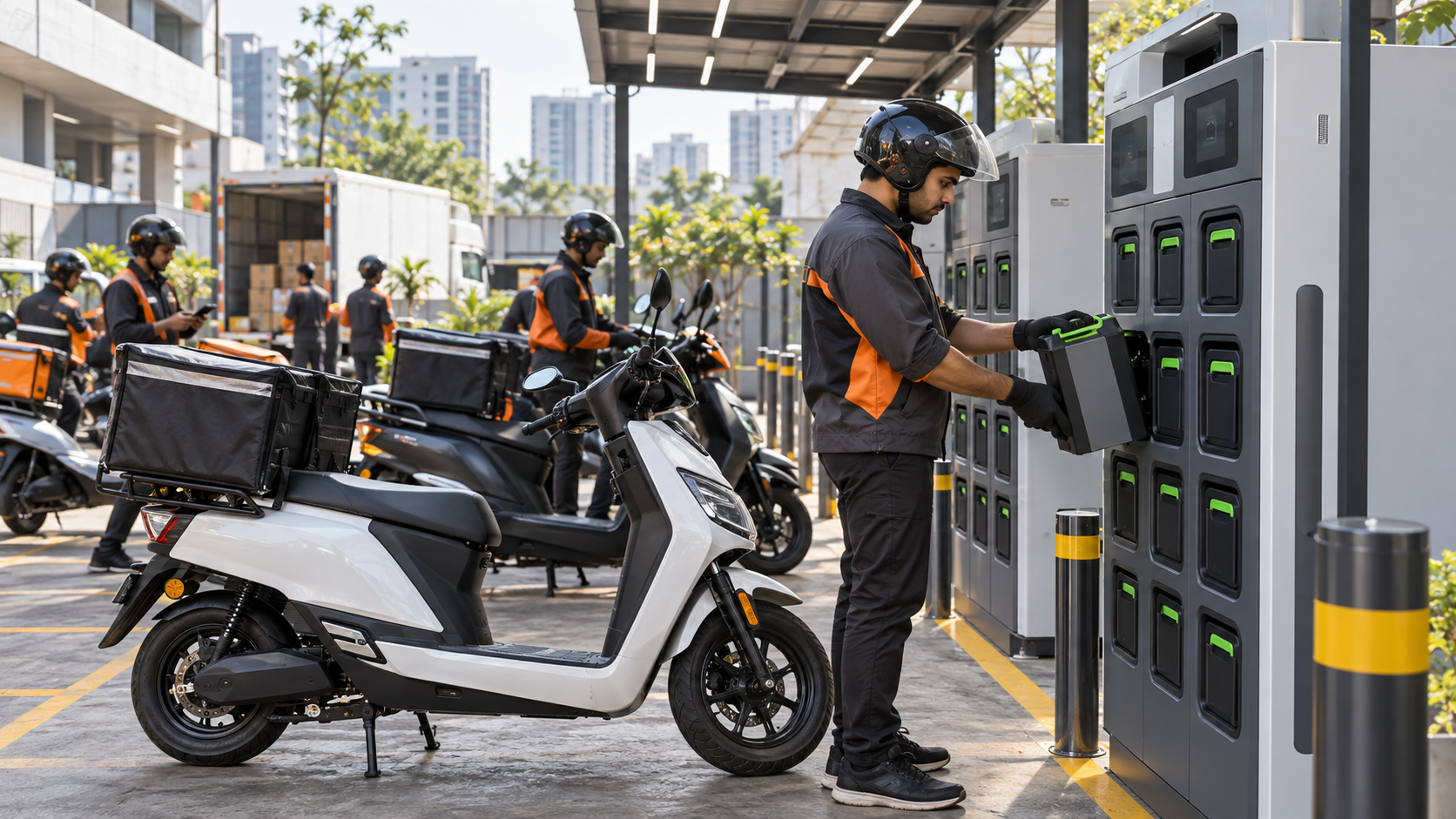
Battery swapping solves a different problem from conventional EV charging.
Instead of waiting for a depleted battery to recharge, the user exchanges it for a charged battery.
This can be particularly useful for high-utilisation electric two- and three-wheelers used in:
- Last-mile delivery
- E-rickshaw operations
- Ride-hailing
- Commercial fleets
- Urban logistics
India’s battery-swapping sector is already substantial.
A June 2026 report from CEEW, the India Battery Swapping Association and CII states that India has more than 20 operational battery-swapping companies, over 3,000 swapping stations, more than 250,000 EVs served, and over 350,000 batteries in circulation.
Battery-as-a-Service can also separate battery ownership from vehicle ownership, potentially reducing the upfront vehicle cost.
However, this is generally a more operationally complex business than investing in a single charging point.
Challenges include:
- Battery standardisation
- Inventory management
- Battery health monitoring
- Station density
- Safety
- Financing
- Interoperability between manufacturers
The 2026 CEEW report specifically identifies regulatory harmonisation, financing, safety standards and interoperability among the barriers still facing large-scale battery swapping.
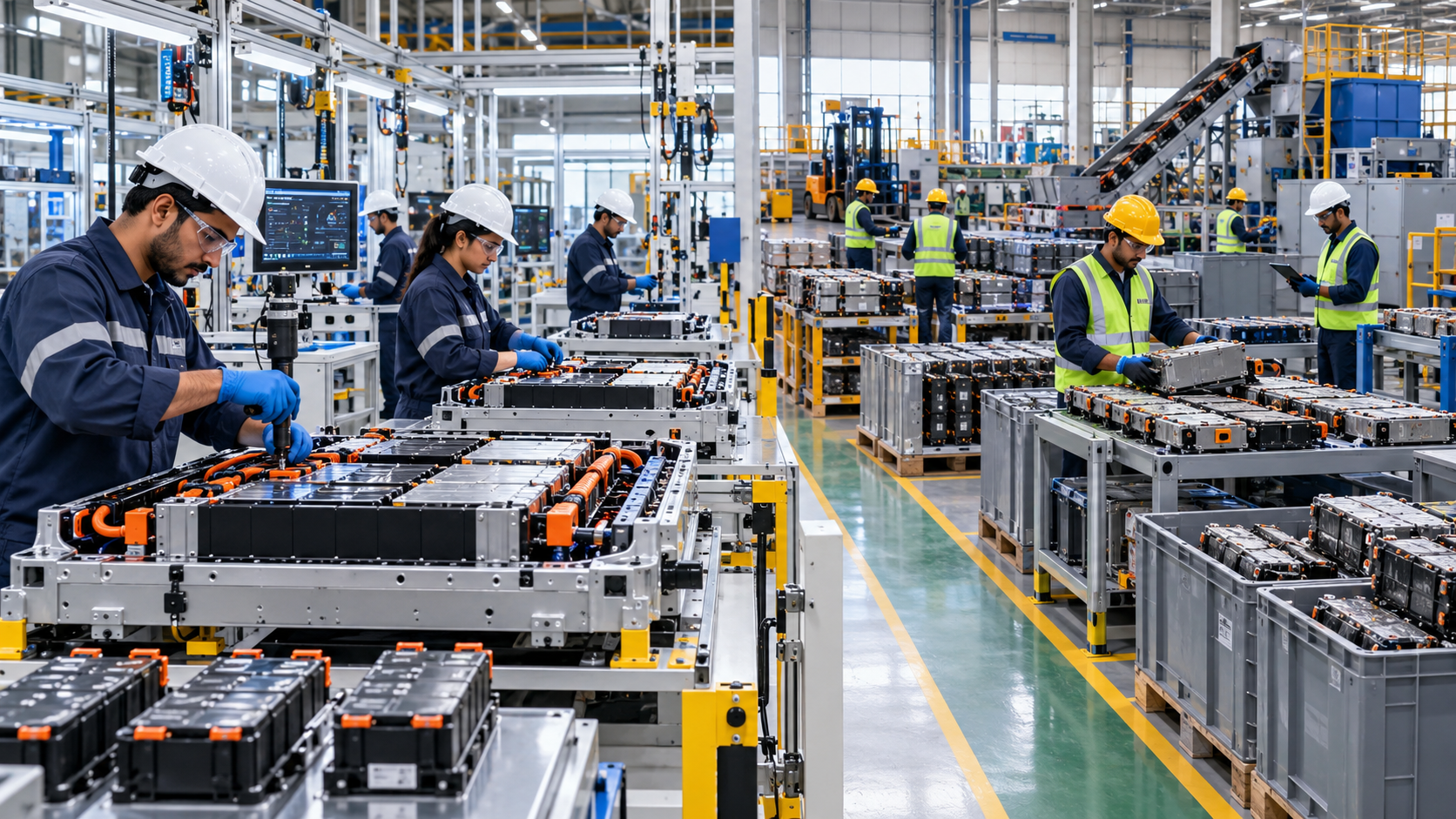
3. EV Battery and Component Manufacturing
Another opportunity lies upstream in the supply chain.
EVs require specialised:
- Battery cells
- Battery packs
- Battery-management systems
- Electric motors
- Controllers
- Power electronics
- Charging components
- Thermal-management systems
- Connectors and electrical components
India is actively encouraging greater domestic production of advanced battery technology.
The Government of India’s Production Linked Incentive scheme for Advanced Chemistry Cell battery storage has an outlay of ₹18,100 crore and is intended to build large-scale domestic ACC and battery-manufacturing capabilities.
The scheme requires increasing levels of domestic value addition, reflecting the broader push to reduce reliance on imported battery technology and develop a deeper domestic supply chain.
Large-scale cell manufacturing requires substantial capital and technical capability.
However, smaller businesses may find opportunities in:
- Battery-pack assembly
- Battery enclosures
- Wiring and connectors
- Thermal management
- Chargers
- Power electronics
- Testing equipment
- EV-specific accessories and components
This segment is better suited to entrepreneurs with manufacturing, electronics or automotive supply-chain experience.
4. Battery Recycling and Second-Life Applications
Every EV battery eventually reaches a point where it is no longer suitable for its original automotive application.
That creates two potential business areas:
Battery recycling, where valuable materials are recovered.
And:
Second-life applications, where batteries that retain usable capacity are repurposed for less demanding applications such as stationary energy storage.
India’s Battery Waste Management Rules place Extended Producer Responsibility obligations on battery producers and establish recycling and refurbishment requirements covering EV batteries as well as other battery types.
Materials that can potentially be recovered from battery recycling include:
- Lithium
- Nickel
- Cobalt
- Copper
- Aluminium
- Other reusable battery materials
This opportunity requires more technical expertise, regulatory compliance and capital than many EV retail or service businesses.
But as the installed EV base grows and older batteries begin reaching end-of-life, recycling and refurbishment are likely to become increasingly important parts of the ecosystem.
5. EV Financing and Leasing

The upfront cost of an EV can still be a barrier for individuals and commercial operators.
This creates opportunities for:
- Vehicle loans
- Fleet financing
- Leasing
- Battery financing
- Subscription models
- Equipment finance
- Charger finance
NITI Aayog and Rocky Mountain Institute projections cited by IBEF estimate that India’s EV finance market could reach approximately ₹3.7 lakh crore by 2030.
For commercial EVs, financing can be especially important because operators may evaluate the vehicle in terms of:
- Monthly repayment
- Energy cost
- Vehicle utilisation
- Maintenance
- Daily earnings
- Total cost of ownership
This creates opportunities for banks, NBFCs, leasing businesses and fintech platforms that understand EV asset values and operating economics.
However, financing is highly specialised and requires strong expertise in credit risk, asset valuation and collections.
6. Fleet Electrification and Last-Mile Delivery
Delivery fleets, logistics operators, taxi businesses and corporate fleets can have very different EV requirements from private vehicle owners.
Their priorities often include:
- High daily utilisation
- Predictable operating cost
- Charging availability
- Minimal downtime
- Fleet tracking
- Route optimisation
- Driver management
This has created room for businesses that help companies transition fleets from internal-combustion vehicles to electric vehicles.
Possible business models include:
- EV fleet leasing
- Fleet-as-a-Service
- Electric delivery fleets
- Managed charging
- Dedicated fleet charging hubs
- Vehicle and battery subscriptions
- Driver-plus-vehicle services
Fleet businesses can also combine several parts of the EV ecosystem.
For example, one operator might lease electric vehicles, provide charging and manage the vehicles through fleet software.
Because vehicle utilisation is high, fleet electrification can also create consistent demand for charging infrastructure.
7. EV Spare Parts, Servicing and Retrofitting
More EVs on the road also means greater demand for specialist service capability.
Electric vehicles have fewer traditional engine components than ICE vehicles, but they still require specialised knowledge of:
- High-voltage systems
- Battery packs
- Battery-management systems
- Electric motors
- Power electronics
- Charging systems
- Cooling systems
- Diagnostics
- Software
This creates opportunities for:
- Independent EV workshops
- Authorised service centres
- EV diagnostics
- Spare-parts distribution
- Battery repair
- Charger servicing
- Technician training
Retrofitting is another specialised segment in which approved vehicle platforms may be converted from conventional powertrains to electric systems, subject to applicable automotive regulations and approvals.
Compared with battery manufacturing or large infrastructure projects, EV servicing can have a lower entry barrier.
However, technical training and safety procedures are critical because EV high-voltage systems require different expertise from conventional vehicle repair.
8. Charging and Fleet Management Software
Not every EV business requires physical infrastructure.
As charging networks expand, operators need software to control and monitor chargers.
A charging-management platform can handle:
- Charger status
- Remote monitoring
- User authentication
- Billing
- Payments
- Session history
- Fault alerts
- Energy consumption
- Load management
- Pricing
- Reporting
- Roaming integrations
Fleet businesses similarly need software for:
- Route planning
- Vehicle availability
- Charging schedules
- Battery status
- Driver behaviour
- Energy consumption
- Maintenance
This creates opportunities for software companies, SaaS providers and technology founders.
The business requires less physical infrastructure than owning charging stations, but it requires strong software engineering, interoperability, cyber-security and integration capability.
Protocols such as OCPP and OCPI are particularly important in commercial charging because they allow charging hardware and network platforms to communicate across systems.
9. EV Dealerships and Retail
Traditional EV retail remains an opportunity, particularly as more electric two-wheelers, three-wheelers and passenger vehicles enter the market.
Possible models include:
- Vehicle dealership
- Multi-brand EV showroom
- Commercial EV dealership
- Electric two-wheeler retail
- E-rickshaw distribution
- EV accessories
- Charging equipment sales
However, vehicle retail is becoming only one part of the broader EV ecosystem.
A dealership may strengthen its proposition by combining vehicle sales with:
- Financing
- Leasing
- Charging access
- Insurance
- Service packages
- Fleet partnerships
- Accessories
Entrepreneurs considering this model should evaluate local demand, OEM support, dealership margins, service requirements and competitive density rather than assuming EV-market growth will automatically produce strong retail economics.
Where EV Activity Is Concentrated in India
EV adoption varies significantly between states.
According to CY2025 vehicle-registration data cited by IBEF, the highest EV penetration rates were recorded in:
- Tripura — 18.38%
- Assam — 14.30%
- Delhi — 13.89%
- Kerala — 11.34%
- Goa — 10.76%
These figures should not be interpreted as a simple ranking of where to start an EV business.
Different businesses need different demand signals.
For example:
A battery-swapping business may care more about electric two- and three-wheeler density.
A DC fast-charging station may care more about highway traffic, electric-car movement and fleet demand.
A service centre may benefit from a large installed base of EVs.
A fleet charging hub may depend primarily on commercial fleet contracts rather than general consumer adoption.
The individual location and target customer therefore matter more than the state-wide EV penetration figure alone.
Matching the EV Opportunity to Your Capital and Skills
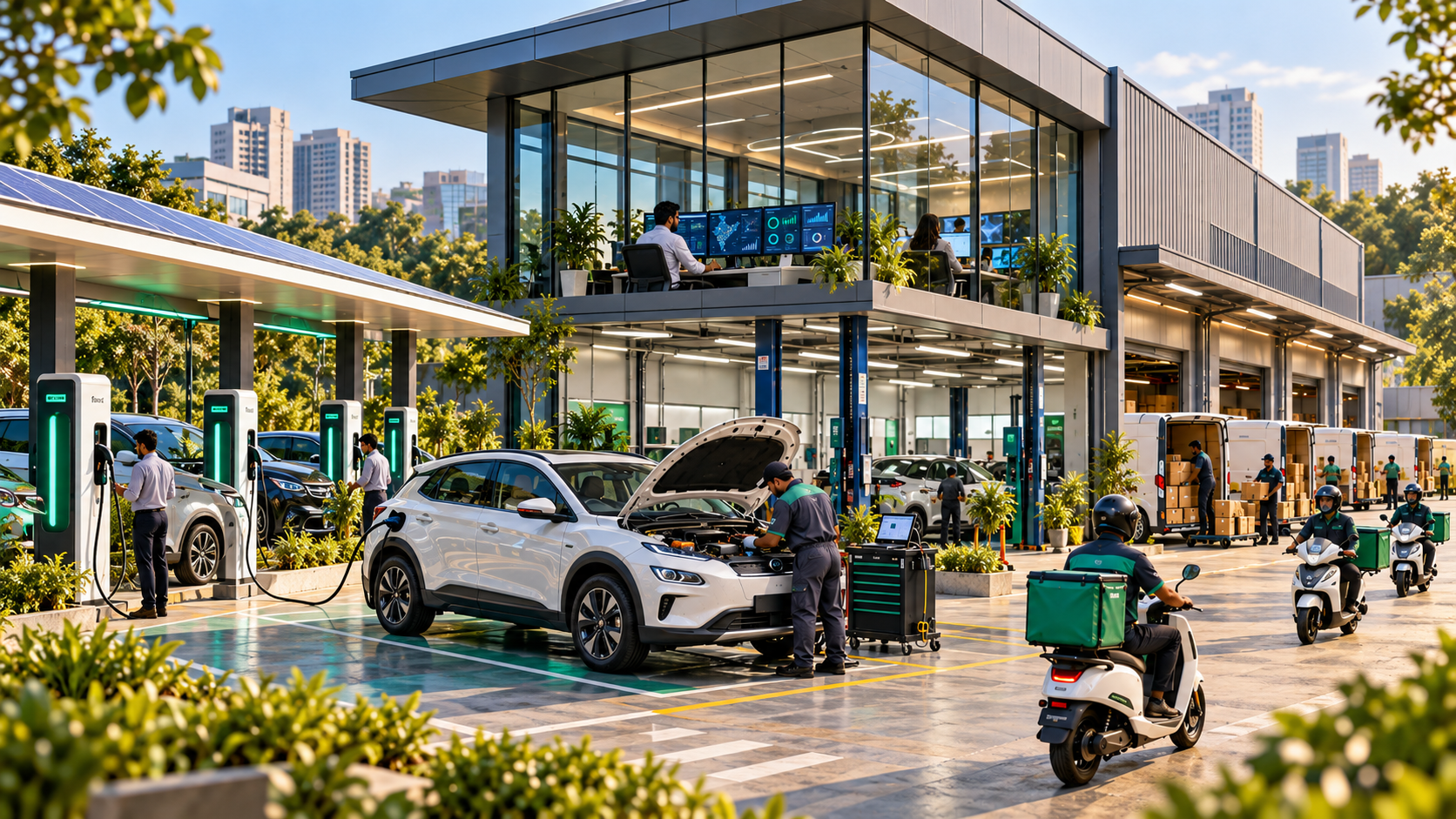
Different EV businesses require very different capabilities.
| Opportunity | Capital Requirement | Technical Requirement | Operational Involvement |
|---|---|---|---|
| EV charging franchise | Medium | Low–Medium | Low–Medium depending on model |
| Independent charging station | Medium–High | Medium | Medium–High |
| Battery swapping | Medium–High | Medium–High | High |
| Battery/component manufacturing | High | High | High |
| Battery recycling | High | High | High |
| EV financing/leasing | Medium–High | Financial expertise | Medium–High |
| Fleet electrification | High | Medium | High |
| EV servicing/spare parts | Low–Medium | Medium–High | High |
| Charging/fleet software | Low–Medium | High | Medium |
| EV dealership | Medium | Low–Medium | High |
The table is a general planning framework rather than a fixed investment guide.
Actual capital requirements can vary dramatically by location, business scale, asset ownership and operating model.
A software startup and a battery-cell manufacturing facility may both operate in the EV industry, but their capital, staffing and regulatory requirements are completely different.
Which EV Business Opportunity Is Best for a First-Time Entrepreneur?
There is no single EV business that is right for every entrepreneur.
A useful way to narrow the options is to ask what you already have.
If you have commercial land or parking:
EV charging may be worth evaluating.
If you understand logistics or fleet operations:
Fleet electrification, managed charging or battery swapping may be more relevant.
If you have automotive service experience:
EV repair, diagnostics or spare parts could be a more natural entry point.
If your background is software:
Charging-management or fleet-management technology may provide a lower-asset route into the industry.
If you have manufacturing capability:
Components, batteries, power electronics and related supply-chain opportunities may fit better.
If your strength is finance:
EV lending, leasing and equipment finance may be more appropriate.
The strongest opportunity is usually one that combines growing EV demand with capabilities you already understand.
Why EV Charging Remains Relevant for Small and Mid-Sized Investors
Among the nine categories, EV charging is unusual because it can range from a relatively small commercial installation to a large highway or fleet-charging hub.
India’s estimated requirement for at least 1.32 million charging stations by 2030 indicates that charging infrastructure will need to expand alongside EV adoption.
At the same time, charging economics remain highly location-dependent.
A station with strong utilisation and reliable uptime can behave very differently from the same charger installed at a weak site.
For potential franchise investors, the important questions therefore include:
- Who evaluates the site?
- What charger capacity is actually needed?
- What electrical upgrades are required?
- Who operates the station?
- Who handles maintenance?
- How is utilisation measured?
- How are commercial settlements calculated?
EarthtronEV currently positions its network around franchise partnerships, commercial charging projects and managed charging infrastructure, with support covering site selection, installation, software and maintenance.
Investors should still request a site-specific proposal and review the commercial agreement before making an investment.
FAQs
Which EV business opportunity requires the lowest investment in India?
There is no universal lowest-cost option because investment depends on scale.
Software services, EV diagnostics, spare-parts businesses and some dealership or charging partnerships can generally be started with less capital than battery manufacturing, recycling plants, fleet ownership or large charging hubs.
Is EV charging a good business opportunity in India in 2026?
EV charging is a growing infrastructure requirement, but the performance of an individual station depends on utilisation, location, charger type, electricity infrastructure, uptime and commercial terms.
India may require at least 1.32 million charging stations by 2030, but that does not mean every charging location will automatically be profitable.
Is battery swapping a good EV business?
Battery swapping can be particularly useful for high-utilisation two- and three-wheelers.
India already has more than 3,000 swapping stations serving more than 250,000 EVs, according to the 2026 CEEW–IBSA–CII report. However, businesses must consider interoperability, battery inventory, safety, regulation and network density.
Do I need an engineering background to start an EV business?
Not necessarily.
Franchise investing, vehicle retail, financing and some fleet businesses do not require the owner personally to be an engineer.
Businesses such as battery manufacturing, recycling, retrofitting, charger engineering and advanced EV servicing require much stronger technical capability.
Which Indian states have the highest EV penetration?
For CY2025, IBEF reports Tripura at 18.38%, Assam at 14.30%, Delhi at 13.89%, Kerala at 11.34% and Goa at 10.76%.
However, the best state for a business depends on the type of EV activity and the specific local market.
Is government support available for EV businesses?
Several government initiatives support different parts of the EV ecosystem.
PM E-DRIVE supports electric mobility and includes ₹2,000 crore allocated for public charging infrastructure, while the Advanced Chemistry Cell PLI scheme has an ₹18,100 crore outlay to support domestic battery manufacturing. Eligibility and access depend on the specific scheme and business model.
What is the best EV business for someone who already owns commercial property?
EV charging is one option worth evaluating because an existing property may already provide parking and customer or vehicle traffic.
The final decision should depend on EV demand, parking duration, electrical capacity, accessibility and expected charger utilisation.
Conclusion
India’s EV transition is creating businesses far beyond vehicle manufacturing and dealerships.
The ecosystem now includes:
- EV charging
- Battery swapping
- Battery and component manufacturing
- Battery recycling
- Financing and leasing
- Fleet electrification
- Servicing and spare parts
- Charging software
- Vehicle retail
India’s 2.66 million EV sales in FY26 and the continuing need for charging and supporting infrastructure show how quickly this ecosystem is developing.
But EV growth alone does not make every business model attractive in every market.
Before choosing an opportunity, evaluate:
Capital requirement + technical capability + local demand + competition + regulation + operating complexity.
For investors specifically interested in EV charging infrastructure, an operator-supported model such as EarthtronEV’s franchise and commercial charging programmes can provide a route into the sector without requiring the investor to build the complete charging technology and operating stack independently.
The key is to choose the EV opportunity that matches both the market demand and the resources you can realistically bring to it.