Quick Answer
The break-even period of an EV charging franchise cannot be calculated from the investment amount alone.
It depends on several factors, including:
- Total initial investment
- Charger capacity
- Number of charging sessions
- Energy delivered
- Charger utilization
- Station uptime
- Operating costs
- Location quality
- Commercial settlement structure
EarthtronEV currently lists its EV charging franchise investment from ₹18 lakh onwards, with a 60 kW DC charging setup at ₹18 lakh and a 120 kW setup at ₹30 lakh.
However, two charging stations with the same investment can have very different break-even timelines if their utilization, location, and operating performance are different.
Understanding the relationship between cost, revenue, utilization, and net cash flow is therefore more useful than relying on a fixed ROI or universal payback period.
What Does Break-Even Mean for an EV Charging Station?
Break-even is the point at which the cumulative net income generated by a charging station equals the original capital invested.
In simple terms:
Break-Even Period = Initial Investment ÷ Average Net Cash Flow
For example, two EV charging stations may each require ₹18 lakh to set up.
If one station consistently receives more charging sessions and generates higher net cash flow, it may recover its initial investment sooner.
The other station may take longer if charger utilization remains low.
This is why break-even should always be calculated using location-specific operating assumptions.
Understanding the Initial EV Charging Franchise Cost
The first step in any break-even calculation is determining the actual project cost.
EarthtronEV currently lists the following franchise investment structure:
| Configuration | Current Investment |
|---|---|
| Minimum franchise investment | ₹18 lakh onwards |
| 60 kW DC charging setup | ₹18 lakh |
| 120 kW charging setup | ₹30 lakh |
| Minimum space required | Approx. 150 sq. ft. |
The final project cost may vary depending on location, charger capacity, sanctioned electrical load, cabling, transformer requirements, and additional site infrastructure.
This means investors should use the final project quotation, rather than only the advertised starting investment, when calculating break-even.
What Costs Are Involved in an EV Charging Station?
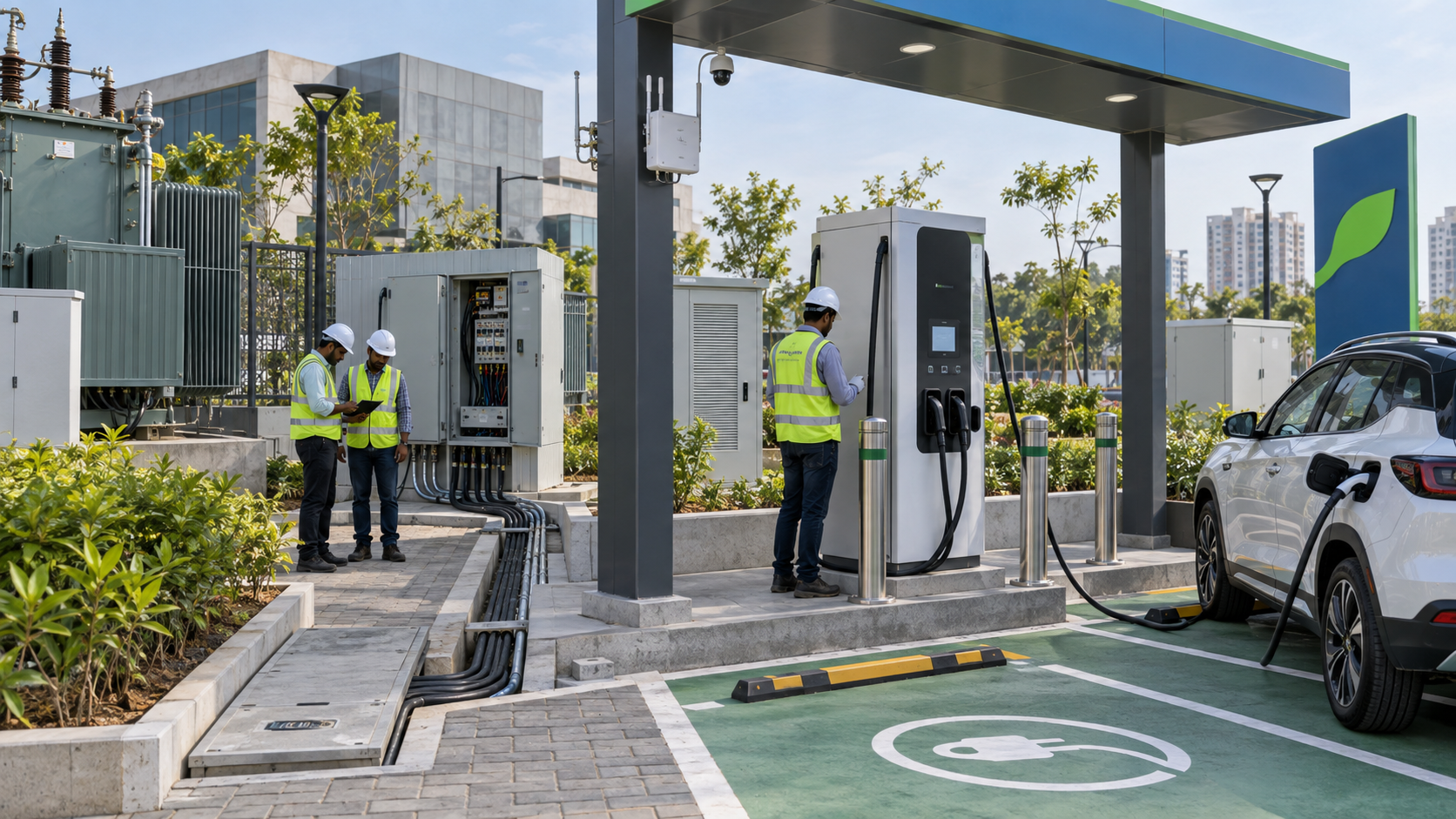
An EV charging station can involve several cost components.
Charger Equipment
The charger itself is one of the main capital expenses.
Higher-capacity DC chargers generally require greater investment than lower-power charging equipment.
However, charger capacity should be selected according to expected demand rather than assuming a more powerful charger will automatically produce better returns.
Electrical Infrastructure
Electrical infrastructure can significantly affect project cost.
Depending on the location, requirements may include:
- Sanctioned load enhancement
- Transformer capacity
- Cabling
- Electrical panels
- Metering
- Safety equipment
- Power connection upgrades
A location with suitable existing infrastructure may require less additional work than a site that needs major electrical upgrades.
Civil and Site Work
Site preparation may include:
- Charger foundations
- Parking bays
- Road markings
- Canopy installation
- Signage
- Bollards
- Lighting
- Safety barriers
These requirements vary from site to site.
Software and Connectivity
Modern charging stations generally require network connectivity and software for:
- Charger monitoring
- Payment processing
- User authentication
- Session tracking
- Billing
- Remote diagnostics
Operations and Maintenance
Ongoing station operation can include:
- Electricity
- Maintenance
- Network costs
- Payment processing
- Staff
- Customer support
- Marketing
- Repairs
Under EarthtronEV’s current published franchise model, operating expenditure, staffing, and marketing are stated to be managed by EarthtronEV.
Investors should still confirm the exact terms in the final franchise agreement.
How Does an EV Charging Station Generate Revenue?
Charging-station revenue generally comes from energy delivered to EV users.
A simplified calculation is:
Charging Revenue = Energy Delivered × Effective Charging Price
However, actual station revenue depends on much more than charger capacity.
Important factors include:
- Number of charging sessions
- Average energy delivered per session
- Charger uptime
- Vehicle compatibility
- Charging speed
- Pricing
- Customer demand
- Time of day
- Station accessibility
A high-power charger does not automatically produce high revenue.
It must actually be used.
Why Charger Utilization Is So Important
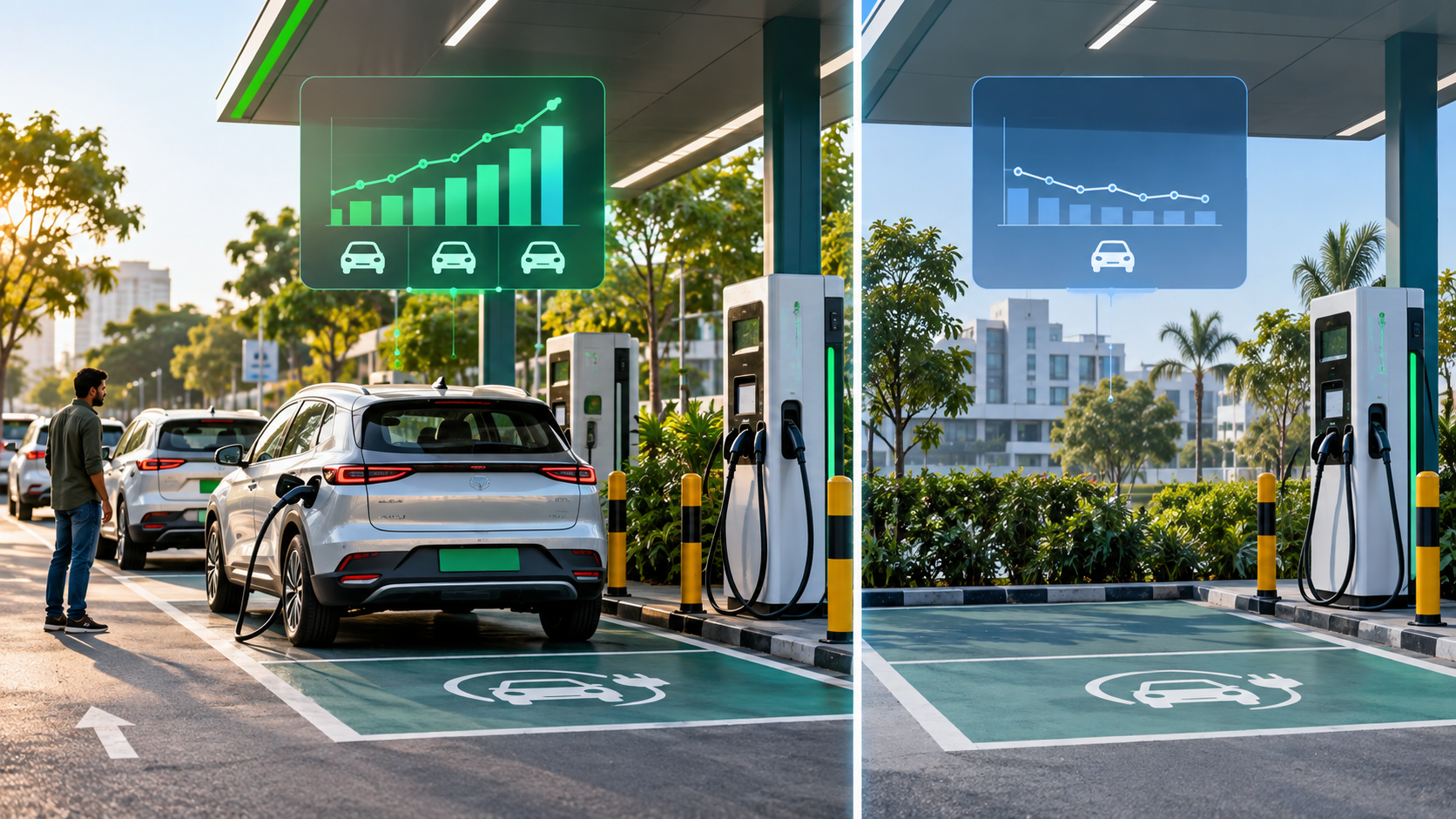
Utilization is one of the most important factors affecting EV charging economics.
Imagine two identical 60 kW chargers.
One charger is located near a busy highway route with regular EV movement.
The other is installed at a location with limited EV traffic.
Both chargers have the same capacity and similar installation cost.
However, the first charger may complete significantly more charging sessions.
This can result in very different commercial performance.
The key question is therefore not simply:
“How powerful is the charger?”
A better question is:
“How often will the charger actually be used?”
Gross Revenue Is Not the Same as Investor Income
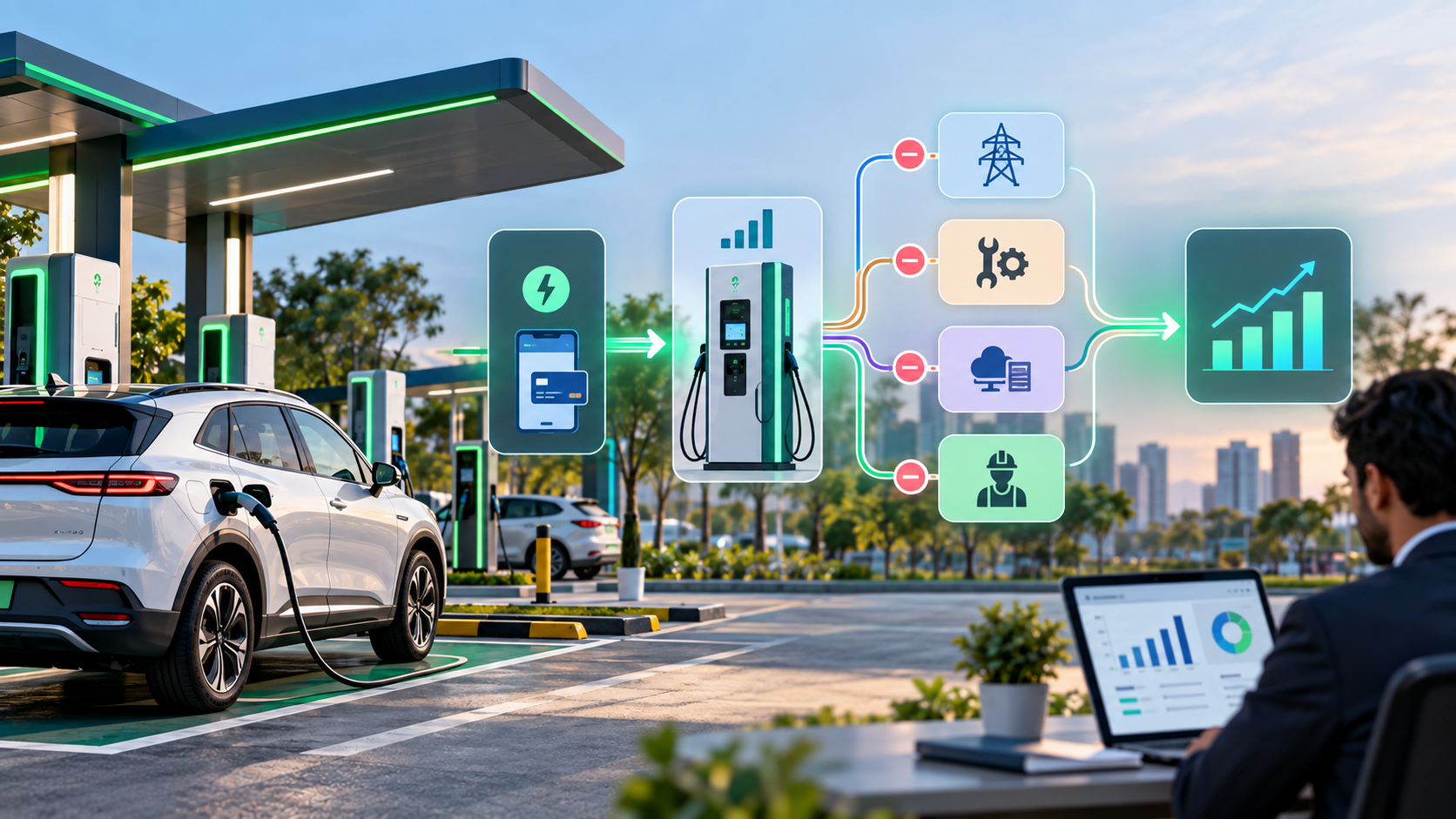
This distinction is important when calculating break-even.
Suppose a charging station generates a certain amount of charging revenue during a month.
That amount should not automatically be considered the franchise investor’s profit.
Depending on the business structure, revenue may need to account for:
- Electricity expenses
- Operator charges
- Taxes
- Payment processing
- Maintenance
- Software expenses
- Site costs
- Other commercial deductions
In a managed franchise model, the investor’s actual income may instead depend on the commercial settlement terms agreed with the operator.
Therefore, break-even calculations should use:
Net cash flow received by the investor
rather than:
Gross charging revenue
A Better Way to Calculate EV Charging Break-Even
Instead of starting with an assumed ROI percentage, calculate the economics step by step.
Step 1: Determine Total Investment
Use the complete project cost, including any site-specific electrical or infrastructure requirements.
Step 2: Estimate Charging Demand
Evaluate the expected number of EV users around the site.
Consider:
- Local EV ownership
- Highway EV traffic
- Fleet demand
- Office traffic
- Commercial activity
- Residential demand
Step 3: Estimate Charging Sessions
Estimate how many successful sessions the station could realistically complete per day.
Avoid using total road traffic as a direct substitute for EV charging demand.
Step 4: Estimate Energy Delivered
Different EVs may consume different amounts of energy during each session.
The average energy delivered per session influences charging revenue.
Step 5: Account for Uptime
A charger cannot generate revenue while it is unavailable.
Software faults, network issues, maintenance, damaged connectors, or electrical problems can reduce station uptime.
Step 6: Account for Costs or Settlement Deductions
Calculate the amount that actually remains after applicable costs and commercial deductions.
Step 7: Calculate Break-Even
Once expected net cash flow is known:
Break-Even Period = Total Investment ÷ Net Cash Flow
Illustrative Break-Even Example
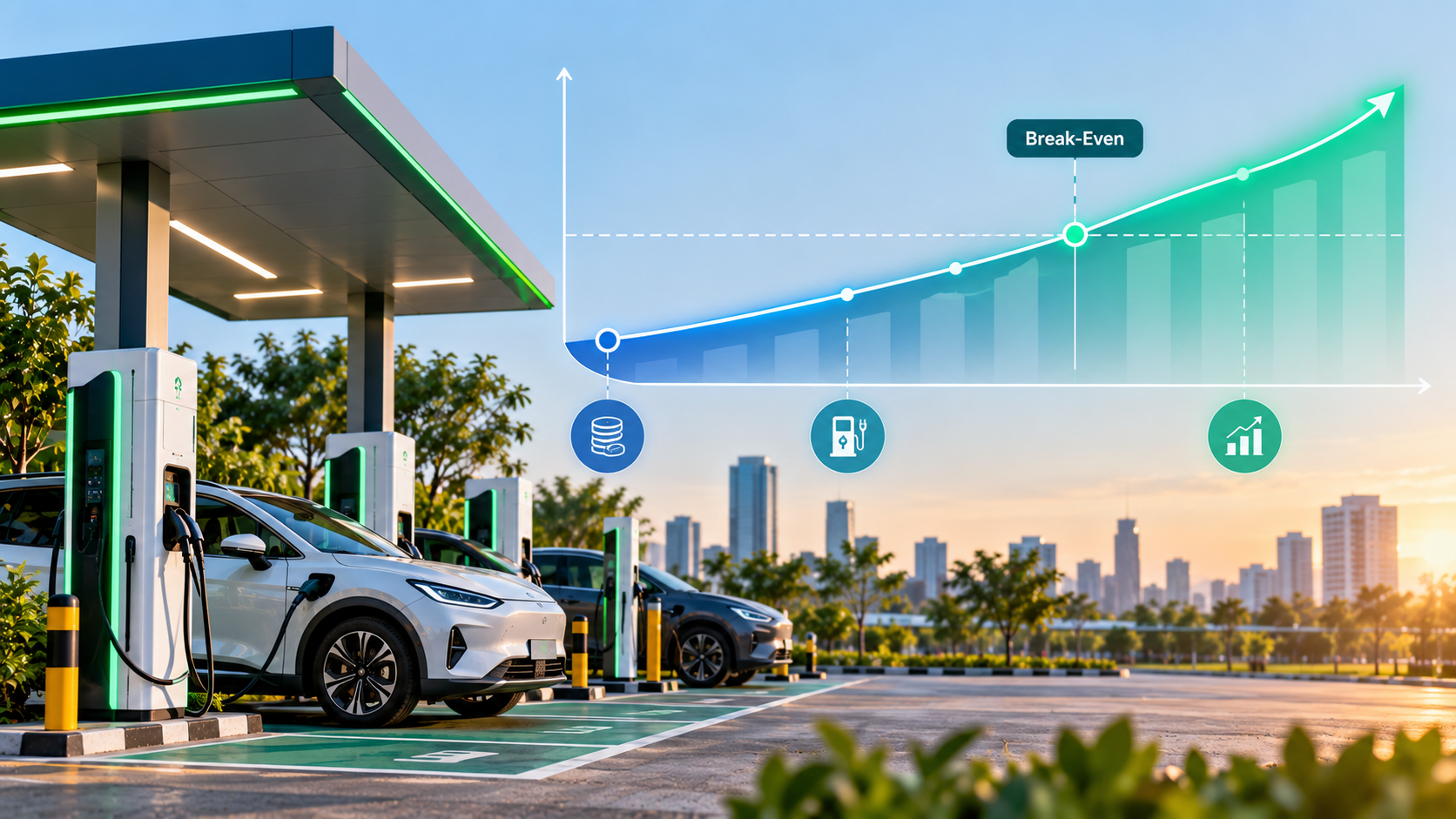
Consider an EV charging franchise with an initial investment of ₹18 lakh.
The table below shows how different hypothetical monthly net cash-flow levels would mathematically affect the simple payback period.
| Illustrative Monthly Net Cash Flow | Simple Payback Period |
|---|---|
| ₹30,000 | 60 months |
| ₹40,000 | 45 months |
| ₹50,000 | 36 months |
| ₹60,000 | 30 months |
| ₹75,000 | 24 months |
These numbers are illustrations only.
They are not guaranteed EarthtronEV revenues, returns, or franchise projections.
Actual monthly income may be higher or lower depending on station utilization, site demand, commercial terms, uptime, and other factors.
The example simply shows why the break-even timeline changes significantly when net cash flow changes.
Why Two ₹18 Lakh Charging Stations Can Perform Differently
Consider two stations with similar equipment and investment.
Station A
The station is located near a busy intercity corridor.
It has:
- Easy highway access
- Strong EV movement
- Nearby restaurants
- Good visibility
- Reliable power
- Limited charging competition
Station B
The second station has:
- Low EV traffic
- Poor visibility
- Difficult entry and exit
- Limited amenities
- Several competing chargers nearby
Even if both stations cost ₹18 lakh, their utilization can be very different.
The stronger site may complete more sessions and generate more net cash flow.
This is why location quality can have a major impact on break-even.
How Location Affects Revenue and Payback
Highway Locations
Highway users often need faster charging during intercity journeys.
Important factors include:
- EV traffic
- Road visibility
- Easy access
- High electrical capacity
- Parking
- Restaurants
- Cafes
- Washrooms
- Waiting facilities
A highway with heavy general traffic is not automatically a good EV charging location.
Actual EV movement matters.
Commercial and City Locations
Potential locations include:
- Offices
- Malls
- Hotels
- Hospitals
- Business centres
- Public parking areas
Vehicles often remain parked longer at these locations.
This can affect both charger type and charging behaviour.
Fleet Locations
Fleet-based charging can provide a different demand pattern.
Examples include:
- Taxi fleets
- Delivery vehicles
- Logistics operators
- Employee transport fleets
If fleet vehicles return to the same location regularly, charging demand can sometimes be planned more predictably.
Residential Locations
Residential charging typically involves longer parking periods.
Demand depends heavily on:
- Number of EV owners
- Shared parking
- Home-charging availability
- Residential electricity infrastructure
The charging model may therefore differ significantly from highway fast charging.
60 kW vs 120 kW: Does More Power Mean More Revenue?
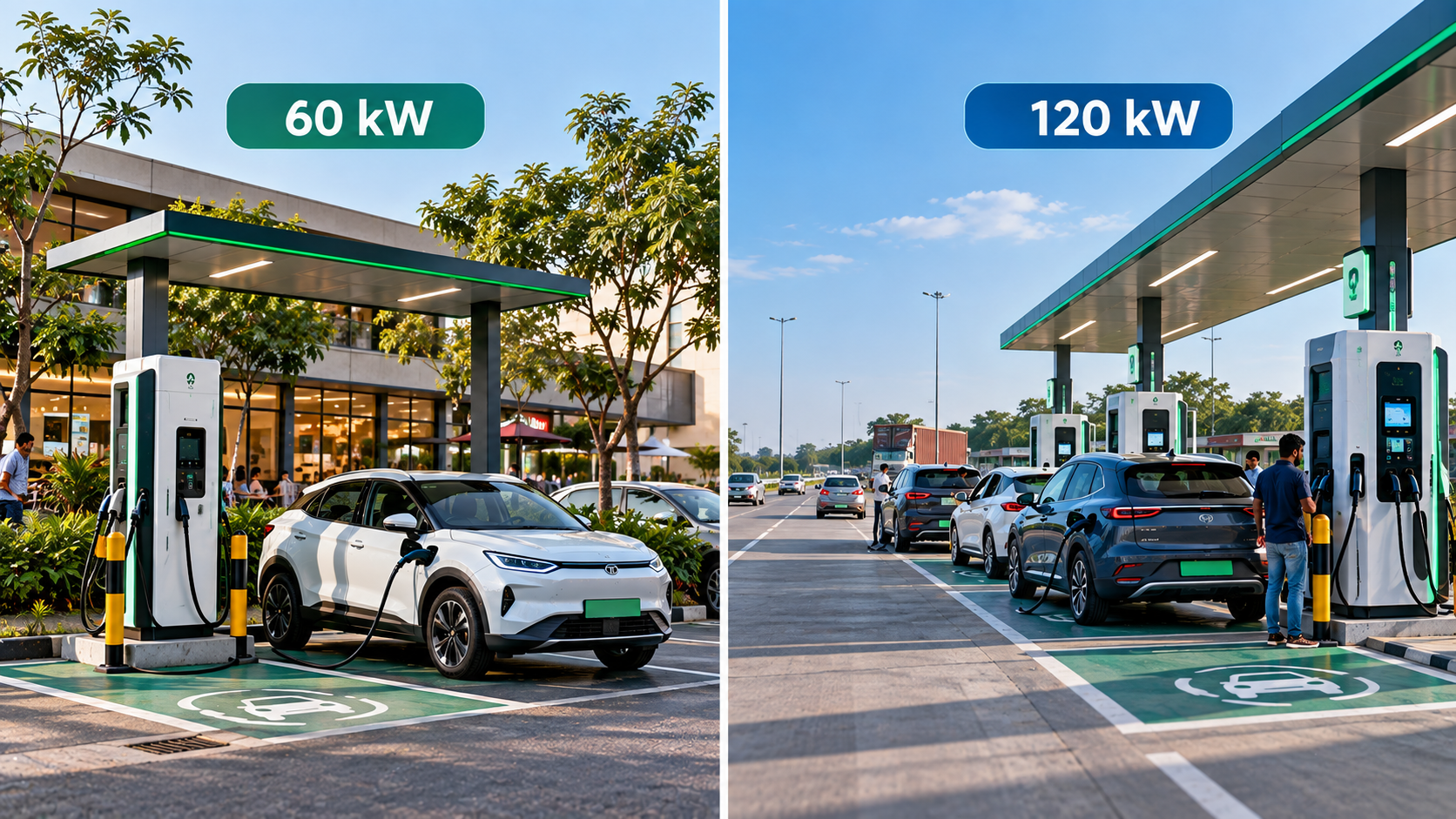
Not automatically.
EarthtronEV currently lists:
- 60 kW DC setup: ₹18 lakh
- 120 kW setup: ₹30 lakh
A 120 kW charger can theoretically deliver energy faster than a 60 kW charger.
However, real charging speed can depend on:
- Vehicle charging capability
- Battery state of charge
- Battery temperature
- Charger sharing
- Power availability
More importantly, there must be enough customer demand to use the higher capacity.
A 120 kW charger that remains unused for long periods may not outperform a well-utilized 60 kW charger.
The higher investment should therefore be justified by actual site demand.
What Can Shorten the Break-Even Timeline?
Several factors can improve EV charging station economics.
Strong Location
Sites with meaningful EV demand may produce more charging sessions.
Higher Utilization
More successful charging activity generally improves revenue potential.
Strong Charger Uptime
Reliable equipment provides more opportunities to complete charging sessions.
Correct Charger Capacity
Matching charger capacity to actual demand helps avoid unnecessary capital expenditure.
Fleet or Repeat Customers
Regular users can provide more consistent demand than relying entirely on occasional walk-in users.
Efficient Operations
Controlling operating costs can improve the amount of revenue that becomes net cash flow.
None of these factors guarantees a particular break-even period.
They simply influence station economics.
What Can Make Break-Even Take Longer?
Low Utilization
A charger cannot generate meaningful revenue while it sits idle.
Higher Infrastructure Cost
Unexpected transformer or electrical work can increase the initial investment.
Charger Downtime
Hardware, connectivity, software, or maintenance problems can reduce available charging hours.
Wrong Charger Capacity
Installing equipment that does not match actual demand can create unnecessary capital costs.
Increasing Competition
New charging stations near the location can affect customer demand.
Slow EV Adoption
Local EV ownership may grow slower than initially expected.
Difficult Access
Drivers may avoid stations that require inconvenient detours or complicated entry and exit.
Why Uptime Matters to EV Charging Revenue
A good location can still underperform if chargers are frequently unavailable.
Possible downtime causes include:
- Hardware faults
- Payment failures
- Internet connectivity problems
- Software errors
- Connector damage
- Electrical faults
- Delayed maintenance
If customers repeatedly find a charger unavailable, they may switch to another charging station.
Maintaining charger reliability is therefore important for both revenue and customer retention.
Revenue Per Charger Matters More Than Network Size
A company may operate a large charging network, but total charger count does not automatically tell an investor how one franchise station will perform.
Location-specific performance metrics are more useful.
These can include:
- Energy delivered per charger
- Successful charging sessions
- Charger utilization
- Charger uptime
- Repeat customers
- Gross revenue
- Operating cost
- Net investor settlement
Investors should focus on the performance of the proposed site rather than only the total size of the operator’s charging network.
Should You Calculate Break-Even From a Fixed ROI?
A fixed ROI percentage can look simple, but it may hide the assumptions behind the calculation.
A more transparent method is:
Investment → Location Demand → Charger Utilization → Revenue → Costs → Net Cash Flow → Break-Even
If a charging operator provides an ROI or payback projection, investors should ask what assumptions support it.
Important assumptions include:
- Expected daily sessions
- Energy delivered
- Charger uptime
- Charging price
- Electricity expense
- Operating costs
- Settlement structure
This allows the investor to understand what needs to happen for the projection to be achieved.
Does Government Support Reduce Franchise Cost?
The Government of India has allocated ₹2,000 crore under PM E-DRIVE for public EV charging infrastructure.
However, an individual franchise investor should not automatically deduct government support from the project cost.
Scheme support depends on factors such as:
- Project category
- Eligible entity
- Location
- Nodal agency
- Approval process
- Scheme conditions
Government support should therefore be included in an investment calculation only after eligibility and approval are confirmed.
Questions Investors Should Ask Before Signing
Before investing in an EV charging franchise, ask for a location-specific commercial proposal.
Important questions include:
- What is the total investment?
- What charger capacity will be installed?
- What electrical infrastructure is required?
- Who pays for installation?
- Who manages the station?
- Who handles maintenance?
- How are settlements calculated?
- What assumptions are used in the revenue projection?
- What uptime is expected?
- What happens during equipment downtime?
- What is the agreement duration?
- What are the renewal conditions?
- What are the exit terms?
Understanding these details helps investors evaluate the project more realistically.
Break-Even Can Change Over Time
A break-even estimate is not necessarily permanent.
A new charging station may initially experience low utilization.
Demand may increase later as:
- More EVs enter the local market
- Customers discover the station
- Fleet operators begin using it
- Nearby commercial activity expands
- EV adoption grows
However, new competition can also appear.
Road patterns, electricity costs, customer behaviour, and local development can change.
For this reason, investors should periodically recalculate break-even using actual operating data.
Frequently Asked Questions
What is the current EarthtronEV EV charging franchise investment?
EarthtronEV currently lists its franchise investment from ₹18 lakh onwards.
A 60 kW DC charging setup is currently listed at ₹18 lakh, while a 120 kW setup is listed at ₹30 lakh.
How long does an EV charging station take to break even?
There is no universal break-even period.
The timeline depends on total investment, charger utilization, number of sessions, energy delivered, operating costs, station uptime, and commercial settlement terms.
Does a DC fast charger always break even faster?
No.
A higher-capacity DC charger can deliver more energy when demand exists, but it also requires more investment.
A well-utilized lower-capacity charger may perform better than an expensive fast charger with low utilization.
Is charging revenue the same as investor income?
No.
Gross charging revenue may need to account for electricity, operating costs, taxes, commercial deductions, maintenance, or operator settlement terms.
Break-even should therefore be based on the investor’s actual net cash flow.
Does a 120 kW charger earn twice as much as a 60 kW charger?
Not necessarily.
Actual revenue depends on utilization and charging demand.
Higher capacity only provides value when sufficient customer demand exists to use it.
Can government subsidy reduce the investment?
Government EV charging support is subject to scheme eligibility, approved entities, location categories, and other conditions.
Investors should not treat a subsidy as guaranteed until approval is confirmed.
Conclusion
The investment cost of an EV charging franchise is relatively easy to identify.
The more difficult question is how quickly that investment can be recovered.
EarthtronEV currently lists its franchise investment from ₹18 lakh onwards, including a 60 kW DC setup at ₹18 lakh and a 120 kW setup at ₹30 lakh.
However, investment cost alone does not determine break-even.
The timeline depends on:
- Location
- Charger utilization
- Energy delivered
- Charging sessions
- Uptime
- Operating costs
- Commercial settlement structure
Investors should therefore avoid assuming that every EV charging station will recover its investment within the same number of years.
A better approach is to evaluate the proposed location, estimate realistic charging demand, understand the complete cost structure, and calculate break-even using expected net cash flow rather than gross revenue or a generic ROI percentage.
For an EV charging franchise investor, a location-specific financial assessment provides a much clearer view of commercial viability than a universal payback claim.