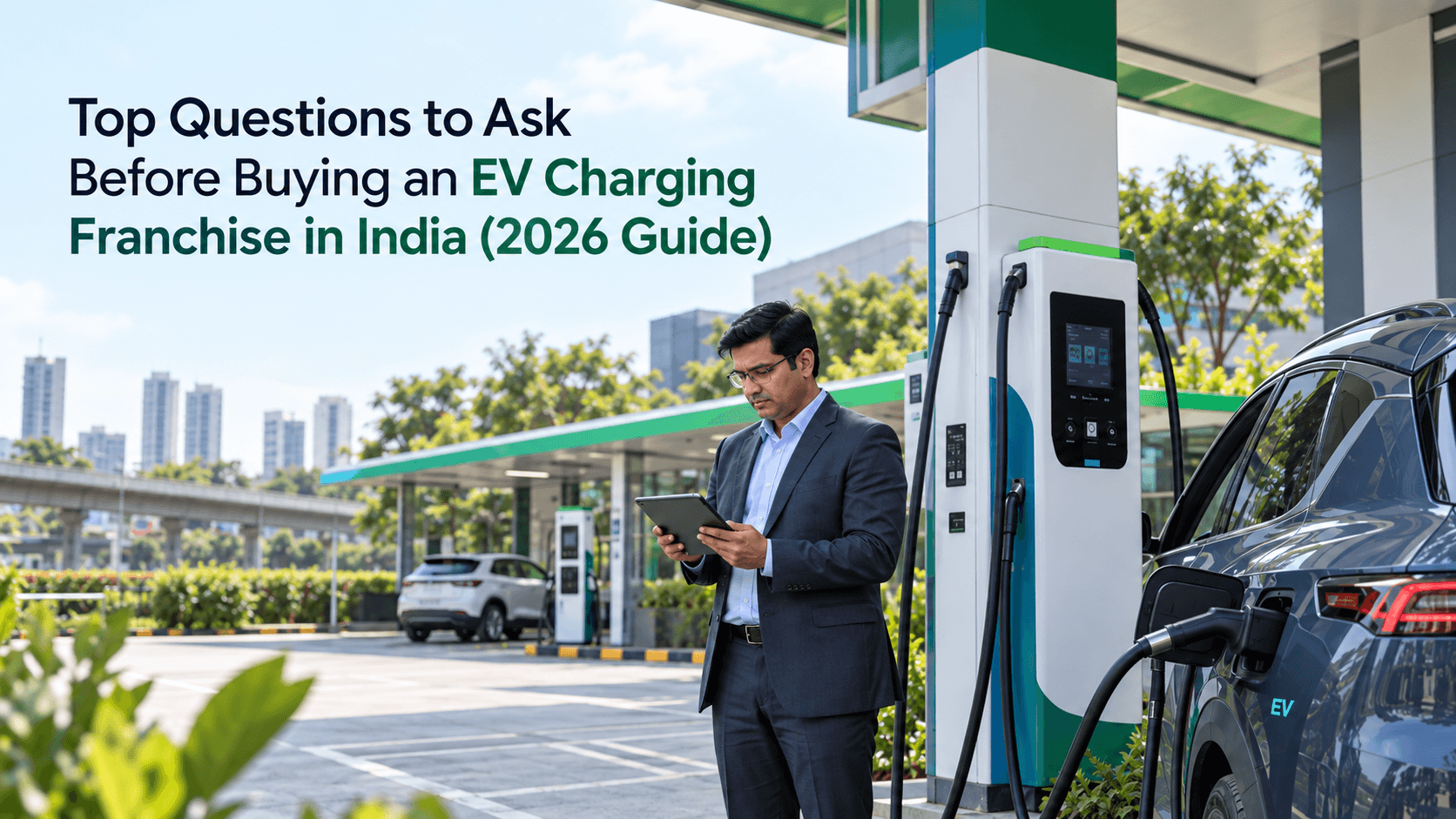
Quick Answer: Before buying an EV charging franchise in India, do not evaluate the opportunity only by the advertised investment or charger capacity. Ask who operates the station, what the complete project cost includes, how the location is selected, who pays operating expenses, how settlements are calculated, what happens during downtime, and what your exit rights are.
For EarthtronEV specifically, the company currently lists its EV charging franchise investment from ₹18 lakh onwards, with a 60 kW DC charging setup at ₹18 lakh and a 120 kW setup at ₹30 lakh. A minimum area of approximately 150 sq. ft. is listed for a standard franchise setup. Final project cost can change with location, power availability, sanctioned load, transformer requirements and other site infrastructure.
Buying an EV charging franchise is not the same as buying a charger.
You are entering a commercial arrangement involving hardware, land, electricity infrastructure, charging software, operations, maintenance, customer demand and a long-term agreement.
That means the most useful question is not:
“How much does the franchise cost?”
It is:
“What exactly am I buying, who is responsible for what, and what needs to happen for the station to perform commercially?”
Use the questions below before making a final investment decision.
Part 1: Questions Every EV Charging Franchise Buyer Should Ask
Question 1: Who is the company behind the franchise?
Start with the legal entity, not the marketing name.
EarthtronEV’s published Terms and Privacy Policy state that the EarthtronEV platform is owned, managed and operated by Electrecharge Solutions Private Limited.
Before paying a booking amount or signing an agreement:
- Verify the legal entity on the Ministry of Corporate Affairs portal
- Confirm the company name on the franchise agreement
- Verify the registered office details
- Check GST and other applicable business registrations
- Confirm where payments will be made
- Ensure the bank account belongs to the contractual entity
- Ask who will legally own the charging equipment
What to ask:
“Which legal entity will sign my agreement, receive my investment and be responsible for operating my station?”
Question 2: Does the company have an operating charging network?
A franchise should have more than a website and charger catalogue.
EarthtronEV currently publishes charging locations including Delhi, Noida, Gurugram, Ghaziabad, Faridabad, Rohtak, Murthal Highway and Shimla, while its website describes a wider network of charging points across India.
However, prospective investors should verify operating performance rather than relying only on network-size claims.
Ask for:
- Current live charging-station locations
- Stations operating under the same franchise model you are considering
- Charger capacity at each relevant location
- Station uptime
- Monthly charging sessions
- Energy delivered
- Utilisation data
- Examples of comparable locations
Where practical, visit at least one live station.
What to ask:
“Can you show me an operating franchise station similar to the one being proposed for me?”
Question 3: What is the total investment — not just the headline price?
This is one of the most important questions.
EarthtronEV’s current 2026 franchise cost guide lists:
| Configuration | Current Published Investment |
|---|---|
| Minimum franchise investment | ₹18 lakh onwards |
| 60 kW DC charging setup | ₹18 lakh |
| 120 kW charging setup | ₹30 lakh |
| Minimum space | Approx. 150 sq. ft. |
The ₹18 lakh 60 kW configuration is described as a complete installation including connection and setup. However, EarthtronEV also states that final project cost may change according to site conditions and electrical infrastructure.
Possible additional requirements can include:
- Transformer work
- Additional cabling
- Sanctioned-load enhancement
- Site-specific civil work
- Electrical panels
- Safety infrastructure
- Land-related expenses
- Additional parking development
Do not calculate your project economics from an advertisement alone.
What to ask:
“Please give me the final all-inclusive project quotation for my specific site in writing.”
Question 4: What exactly is included in the franchise package?
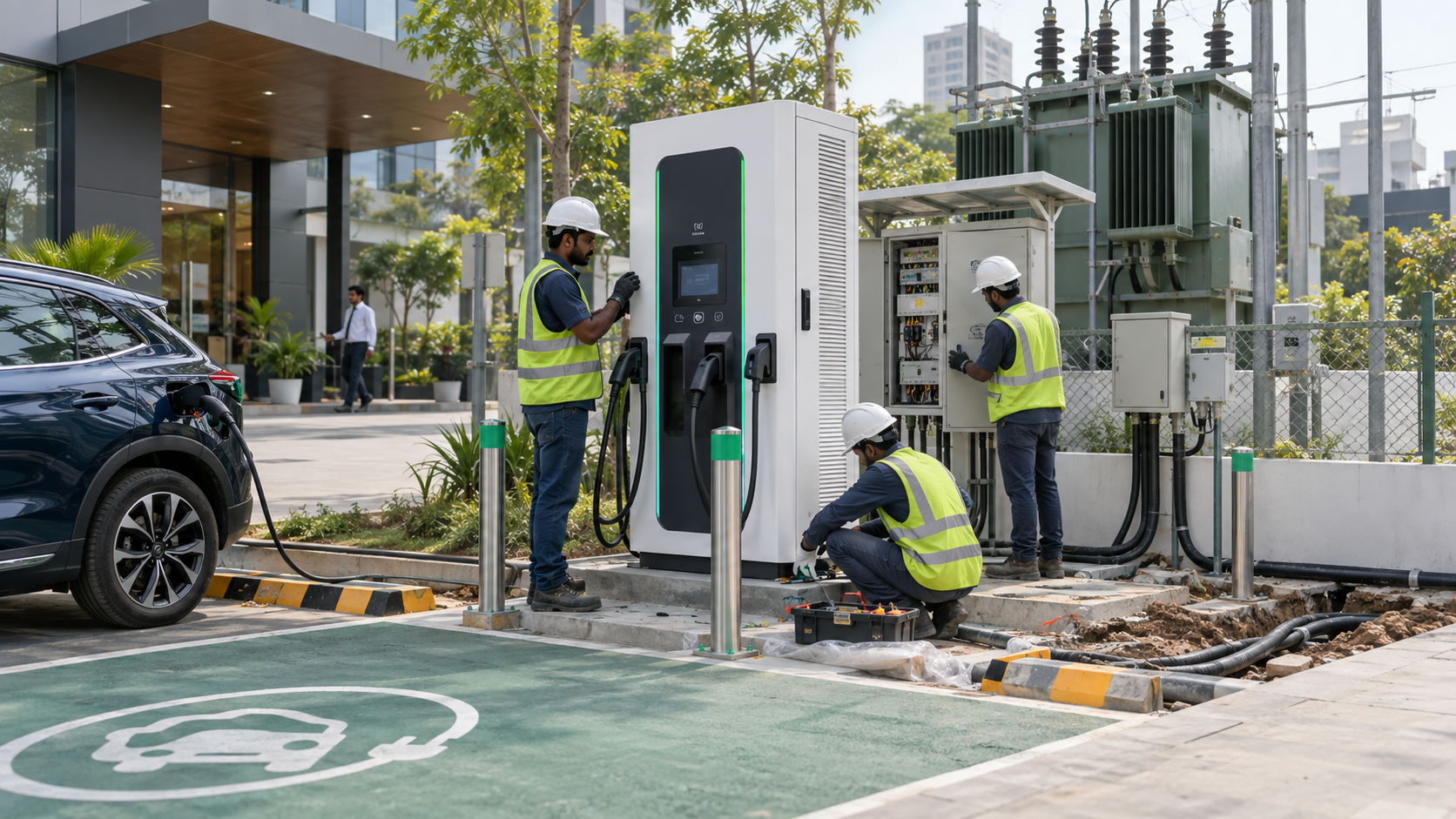
An EV charging project involves much more than the charging machine.
EarthtronEV’s current published franchise information states that its model can include support for equipment installation, licensing and approvals, marketing, station operations, automated billing and settlements.
Your written quotation should clarify whether the price includes:
- EV charger
- Charger installation
- Electrical connection
- Transformer, where required
- Cabling
- Electrical panels
- Earthing
- Civil foundation
- Parking-bay preparation
- Canopy
- Branding and signage
- Fire-safety equipment
- CCTV/security equipment
- Internet/network connectivity
- Charging-management software
- Testing and commissioning
- Applicable approvals
- Initial maintenance
- Taxes
Do not rely on phrases such as “complete setup” without getting a line-item scope.
What to ask:
“What could I still be required to pay for after paying the quoted franchise amount?”
Question 5: Who pays the ongoing operating costs?
Initial CAPEX is only part of the economics.
Potential ongoing costs in an EV charging business can include:
- Electricity
- Site rent
- Maintenance
- Replacement parts
- Software
- Connectivity
- Payment processing
- Insurance
- Customer support
- Security
- Staffing
- Marketing
- Taxes
EarthtronEV’s current franchise-cost material states that operating expenditure, marketing and staffing are covered by EarthtronEV under its franchise model.
Still, the final franchise agreement should define exactly what “operating expenditure” includes.
In particular, ask how electricity expenses, payment-gateway deductions, insurance, taxes, equipment replacement and exceptional repairs are treated.
What to ask:
“Which operating expenses can ever be deducted from my settlement?”
Question 6: How will I actually earn money?
Charging-station revenue and investor income are not necessarily the same thing.
The station may generate revenue from charging sessions, but your actual commercial settlement depends on the agreed business model.
EarthtronEV’s recent 2026 guidance emphasizes that EV charging economics depend on factors such as:
- Charging sessions
- Energy delivered
- Charger utilisation
- Station uptime
- Location
- Operating costs
- Commercial settlement structure
Before investing, understand:
- How the investor’s settlement is calculated
- Whether payment is fixed or performance-linked
- What deductions apply
- Whether electricity cost is deducted first
- How taxes are treated
- Settlement frequency
- Whether you can verify the underlying charging data
What to ask:
“Show me the exact formula used to calculate my monthly settlement.”
Question 7: What return can I realistically expect?
Do not make the decision using a headline ROI percentage alone.
Two charging stations with the same ₹18 lakh investment can have completely different financial outcomes.
The main reason is utilisation.
A station receiving regular charging sessions and delivering more energy can recover capital faster than another station with weak EV traffic.
A simple planning formula is:
Break-Even Period = Total Initial Investment ÷ Average Net Cash Flow
But the calculation is useful only if the expected net cash flow is realistic.
Ask for a location-specific projection showing:
- Expected sessions per day
- Expected kWh delivered
- Assumed charging tariff
- Electricity cost
- Applicable deductions
- Expected uptime
- Expected utilisation
- Net investor settlement
EarthtronEV’s current break-even guidance similarly cautions against assuming one universal payback period for every station.
What to ask:
“What assumptions have you used to calculate the financial projection for my site?”
Question 8: How is the location selected?
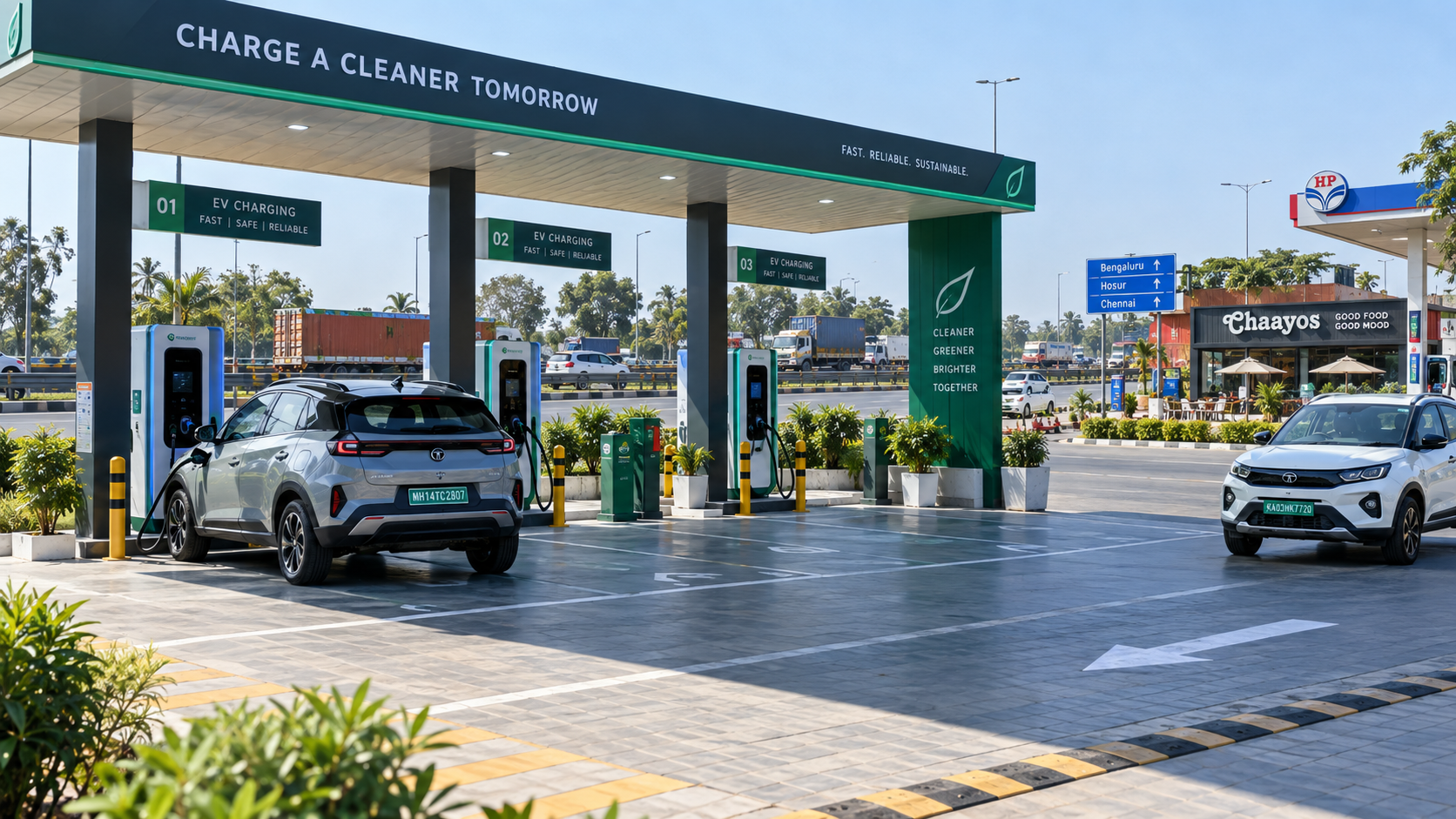
In EV charging, a good charger at a poor location can still be a poor investment.
The proposed site should be assessed for:
- Existing EV traffic
- Future EV demand
- Road visibility
- Accessibility
- Parking
- Vehicle dwell time
- Nearby charging stations
- Highway connectivity
- Commercial activity
- Fleet demand
- Electricity availability
Potential locations can include:
- Highways and expressways
- Fuel stations
- Hotels and restaurants
- Malls and retail centres
- Business districts
- Corporate campuses
- Fleet hubs
- Logistics areas
- Public parking
- Residential clusters
EarthtronEV’s current material states that location, demand, power availability, parking and expected utilisation should be evaluated before selecting charger capacity.
What to ask:
“Can I see the site-feasibility and demand assessment before committing my investment?”
Question 9: What if I do not own land?
You do not necessarily have to purchase land just to explore an EV charging franchise.
EarthtronEV currently states that the minimum area for its standard franchise setup is approximately 150 sq. ft., which may be owned or leased, and that the company may identify or provide a suitable location in eligible cases.
If the location is not yours, clarify:
- Who signs the lease
- Lease duration
- Rent escalation
- Security deposit
- Who pays rent
- Whether the franchise agreement and lease end at the same time
- What happens if the property owner terminates the lease
- Who owns installed electrical infrastructure
What to ask:
“What happens to my franchise investment if the site lease ends before the franchise agreement?”
Question 10: Should I choose a 60 kW or 120 kW charger?
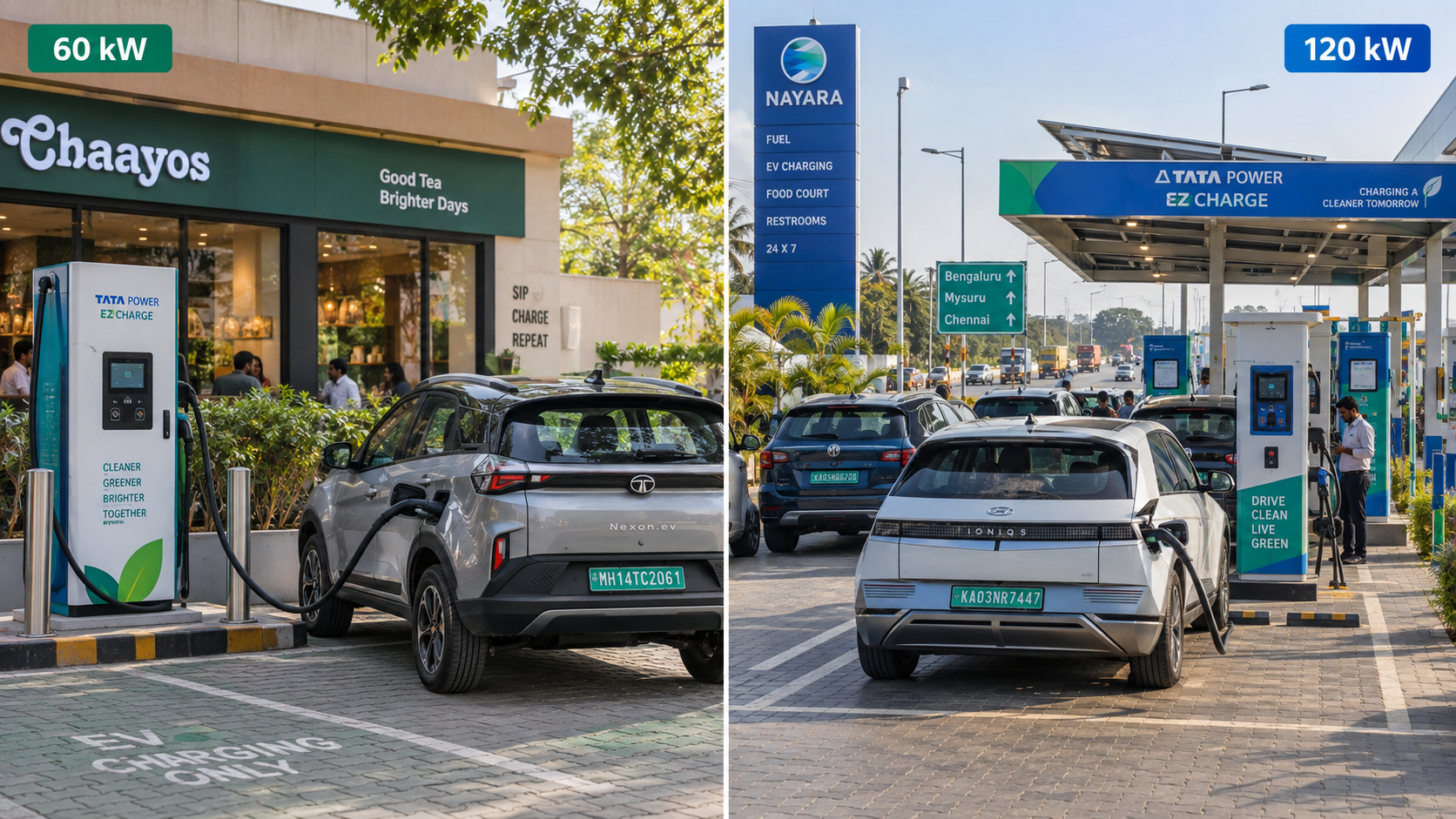
More power does not automatically mean more profit.
EarthtronEV currently lists:
- 60 kW DC setup — ₹18 lakh
- 120 kW setup — ₹30 lakh
A 120 kW charger can charge compatible vehicles faster, but it costs more and requires the location to generate enough charging demand to use that capacity.
Charger selection should consider:
- EV traffic
- Types of EVs using the site
- Vehicle charging capability
- Dwell time
- Available electrical load
- Number of charging sessions
- Expected utilisation
A well-utilised 60 kW charger can make more commercial sense than an underused 120 kW station.
What to ask:
“What demand data justifies the charger capacity being proposed for this location?”
Question 11: What hardware, software and charging standards are used?
Commercial EV charging is both a hardware and software business.
EarthtronEV’s current DC charger information states that its DC charger range is BIS certified, ARAI aligned and OCPP compliant, using CCS2 for DC charging. Its charging platform supports OCPP 1.6 and OCPP 2.0.1, while OCPI 2.2 supports network interoperability and roaming.
Important capabilities to ask about include:
- Remote charger monitoring
- Fault alerts
- Remote restart
- Energy metering
- Charging-session history
- User authentication
- Payment integration
- Smart charging
- Firmware updates
- Load management
- Billing
- Performance reporting
Do not evaluate the technology only by the maximum kW printed on the charger.
What to ask:
“Will I have access to live station-performance and charging-session data?”
Question 12: Who is responsible when the charger goes offline?
A charger cannot generate charging revenue while it is unavailable.
Ask the franchisor to explain:
- Preventive maintenance schedule
- Remote monitoring
- Fault-response process
- On-site technician support
- Spare-parts availability
- Service response time
- Warranty
- Equipment replacement
- Treatment of prolonged downtime
EarthtronEV’s CSMS currently advertises remote monitoring, charger-status visibility, diagnostics and 24/7 monitoring/support capabilities.
Technology is useful, but your commercial agreement should still explain who carries the financial responsibility for prolonged outages.
What to ask:
“What happens to my settlement if the charger is unavailable for an extended period?”
Question 13: Is my territory protected?
Location demand can be affected if several chargers open within a small area.
Before investing, ask whether:
- Your site has any exclusivity radius
- EarthtronEV can open another franchise nearby
- Other partner stations can be installed within the same catchment
- Territory protection exists in writing
- Protection changes if utilisation is low
Never assume exclusivity because a sales conversation refers to a “territory”.
What to ask:
“Does my agreement provide any written geographic protection?”
Question 14: What are the term, renewal, transfer and exit conditions?
Investors often focus heavily on joining a franchise and not enough on leaving it.
Before signing, clarify:
- Agreement duration
- Renewal process
- Renewal charges
- Termination conditions
- Notice periods
- Transfer rights
- Sale of franchise rights
- Treatment of equipment after termination
- Treatment of land and electrical infrastructure
- Outstanding settlements at exit
- Refundability of payments
- Dispute-resolution mechanism
Have the final agreement reviewed by an independent legal professional before committing funds.
What to ask:
“If I want to exit after a few years, what exactly can I transfer or recover?”
Question 15: Can I get a government subsidy under PM E-DRIVE?
Do not automatically deduct a government subsidy from your proposed project cost.
The Government of India’s PM E-DRIVE programme includes ₹2,000 crore for public EV charging infrastructure.
However, Ministry of Heavy Industries information states that entities eligible to submit proposals and receive subsidy funding include Government of India ministries, CPSEs/autonomous bodies, States and Union Territories and their PSUs, typically through nodal agencies. Private entities can still set up and operate EV charging stations, but a private franchise investor should not assume direct subsidy eligibility without an approved programme structure.
Eligibility can depend on:
- Location category
- Government/nodal agency
- Procurement structure
- Infrastructure type
- Approved project
- Applicable scheme guidelines
What to ask:
“Is any subsidy included in this quotation, and can you show me the written approval supporting it?”
Part 2: Questions Prospective Investors Commonly Ask Online
What is the minimum investment for an EarthtronEV franchise in 2026?
EarthtronEV currently lists its franchise investment at ₹18 lakh onwards.
Its current published pricing lists:
- 60 kW DC setup: ₹18 lakh
- 120 kW setup: ₹30 lakh
- Minimum space: approximately 150 sq. ft.
Final cost may increase where a location requires additional electrical or site infrastructure.
Is ₹18 lakh the complete final cost?
It is EarthtronEV’s current published starting point for a standard 60 kW setup including connection and installation.
However, site-specific requirements can affect the final cost.
These may include transformer upgrades, additional electrical load, cabling, civil work or other infrastructure.
Always request a final location-specific quotation before investing.
How much can I earn per month?
There is no single monthly-income figure that applies to every EV charging franchise.
Performance depends on:
- Number of charging sessions
- Energy delivered
- Utilisation
- Uptime
- Location quality
- Electricity economics
- Commercial settlement terms
Ask for a site-specific projection rather than relying on a generic income claim.
What is the break-even period?
There is no universal break-even period.
A useful formula is:
Break-Even Period = Initial Investment ÷ Average Net Cash Flow
But the net cash-flow assumption must reflect actual expected utilisation, deductions and operating economics.
A high-utilisation station may recover investment faster than a low-utilisation station even if both use identical chargers.
Is a 120 kW charger better than a 60 kW charger?
Not automatically.
A 120 kW charger provides greater charging capacity but also requires higher investment.
If the location cannot generate sufficient demand, much of that capacity may remain unused.
Select charger capacity based on demand rather than simply choosing the largest available charger.
Do I need my own land?
Not necessarily.
EarthtronEV currently states that approximately 150 sq. ft. is required for a standard franchise setup and that the space may be owned or leased. It also states that it may assist with or provide locations in eligible cases.
Land arrangements should be confirmed in writing for the specific project.
Is an EV charging franchise passive income?
An operator-supported franchise can reduce the day-to-day workload for an investor, but “passive” should not be confused with “guaranteed”.
EarthtronEV’s current model places several responsibilities — including installation support, operations, billing, marketing and settlements — with the company.
The investor should still review:
- Performance
- Settlement statements
- Utilisation
- Agreement compliance
- Site viability
Every infrastructure investment carries operational and demand risk.
Can EV charging franchises work in Tier 2 and Tier 3 cities?
Potentially, but the city label alone should not determine the investment.
A Tier 2 or Tier 3 location can work where there is real demand from:
- Private EV owners
- Electric taxis
- Delivery fleets
- Intercity travel
- Tourism
- Commercial fleets
A strong highway or fleet location in a smaller city can have a very different demand profile from a poorly located site in a metro.
Evaluate the individual location first.
What are the biggest risks in an EV charging franchise?
Key risks include:
- Low charger utilisation
- Weak EV traffic
- Poor location
- Oversized charger capacity
- Electrical-infrastructure cost overruns
- Equipment downtime
- Commercial competition
- Unclear settlement terms
- Lease or land issues
- Slower-than-expected demand growth
The best protection is due diligence before signing rather than trying to fix a weak location after installation.
Should I compare a franchise with setting up my own EV charging station?
Yes.
An independent setup gives you greater control but also places more responsibilities on you.
You may have to independently manage:
- Land
- Charger sourcing
- Electrical infrastructure
- Software
- Payment systems
- Installation
- Maintenance
- Marketing
- Operations
- Customer support
Under an operator-supported franchise structure, several of these activities can be centralized.
The right comparison is therefore not simply:
Independent charger price vs franchise price
It is:
Total project cost + operating responsibility + risk + commercial structure.
A Simple Due-Diligence Checklist Before You Pay
Before making an EV charging franchise payment, make sure you have:
- Legal company details
- Final project quotation
- Site-feasibility report
- Electrical-load assessment
- Charger specification
- Complete list of inclusions and exclusions
- Operating-cost responsibility
- Settlement formula
- Location/lease terms
- Maintenance responsibility
- Downtime policy
- Territory terms
- Agreement duration
- Renewal terms
- Exit and transfer conditions
- Subsidy documentation, where applicable
- Projected utilisation assumptions
- Access to station-performance data
If an important commercial promise is not written into the agreement or an official annexure, do not assume it is guaranteed.
Conclusion: Ask, Verify, Then Invest
An EV charging franchise can provide a structured way to participate in India’s growing EV infrastructure ecosystem, especially for investors who do not want to independently build the hardware, software and operating systems required for a charging network.
But the investment amount alone does not determine whether a station will perform well.
EarthtronEV currently lists its franchise investment from ₹18 lakh onwards, including a 60 kW DC configuration at ₹18 lakh and a 120 kW configuration at ₹30 lakh.
The more important questions are:
Where will the charger be installed?
How much real EV demand exists there?
Who pays the operating costs?
How is your settlement calculated?
What happens during downtime?
What rights do you have if you want to exit?
Treat the franchise agreement, final project quotation and site-specific feasibility assessment as the primary documents for your decision.
Ask questions. Get the answers in writing. Verify the assumptions.
Then decide whether the proposed charging station makes commercial sense for you.