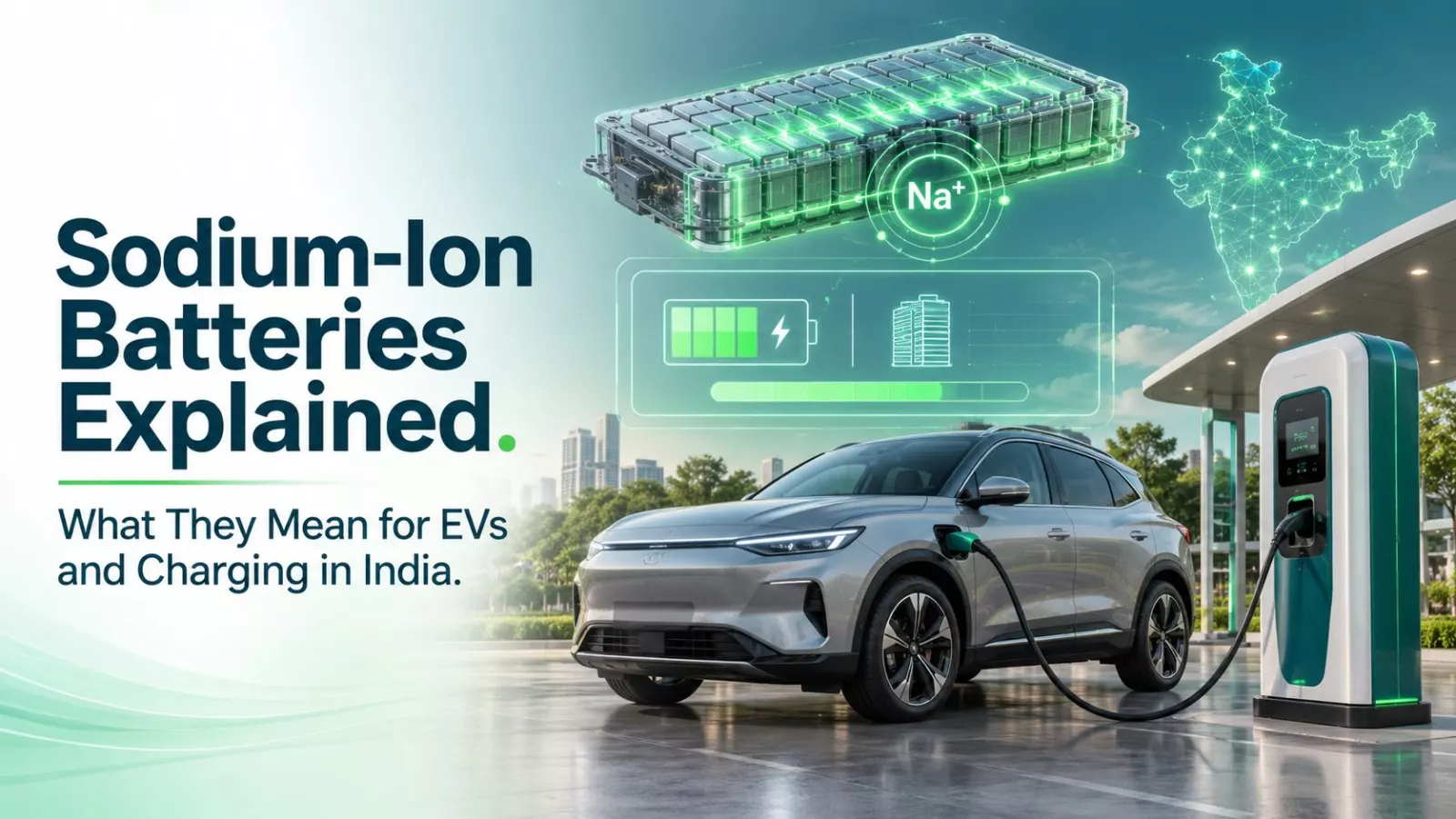
Quick Answer: Sodium-ion batteries are rechargeable batteries that use sodium ions rather than lithium ions to store and release electrical energy. Sodium resources are abundant, and certain designs reduce reliance on lithium and graphite. However, sodium-ion cells generally have lower energy density than leading lithium-ion cells today, potentially limiting driving range for the same battery weight. In India, promising uses include affordable urban EVs, two- and three-wheelers, and stationary energy storage supporting EV charging stations. Commercial adoption is growing, but lithium-ion remains dominant.
Could Sodium-Ion Batteries Change India’s EV Industry?
Electric cars, two-wheelers, three-wheelers, buses and fleets are expanding across India, driving demand for batteries and reliable charging infrastructure. Most EVs today depend on lithium-ion technology, but concerns about raw-material price volatility, supply concentration and affordability are encouraging alternative chemistries. Sodium-ion technology offers a way to diversify materials while potentially addressing applications that do not require maximum range.
This technology is not an automatic replacement for lithium-ion. Its value depends on battery design, performance, production scale and vehicle use. For India, sodium-ion development could affect EV affordability, manufacturing opportunities, charging equipment compatibility and renewable energy storage.
What Are Sodium-Ion Batteries?
Sodium-ion batteries use the movement of sodium ions between two electrodes to store and release energy. Their basic charging and discharging process resembles lithium-ion batteries, but the active materials and operating characteristics differ.
Main components of a sodium-ion battery
- Cathode: sodium-based layered oxides, Prussian blue analogues or polyanionic materials.
- Anode: often hard carbon designed to store sodium ions.
- Electrolyte: enables ion movement between electrodes.
- Separator: electrically separates electrodes while allowing ions to pass.
- Current collectors: carry electrical current.
- Battery Management System (BMS): monitors voltage, temperature and current.
How the battery works
During charging, energy moves sodium ions toward the anode through the electrolyte. During discharge, this process reverses and electricity powers the vehicle or electrical load. A sodium-ion pack must be specifically engineered for its voltage limits, management system and intended application; it cannot simply replace a lithium-ion pack in every existing EV.
Sodium-Ion vs. Lithium-Ion Batteries: What Is the Difference?
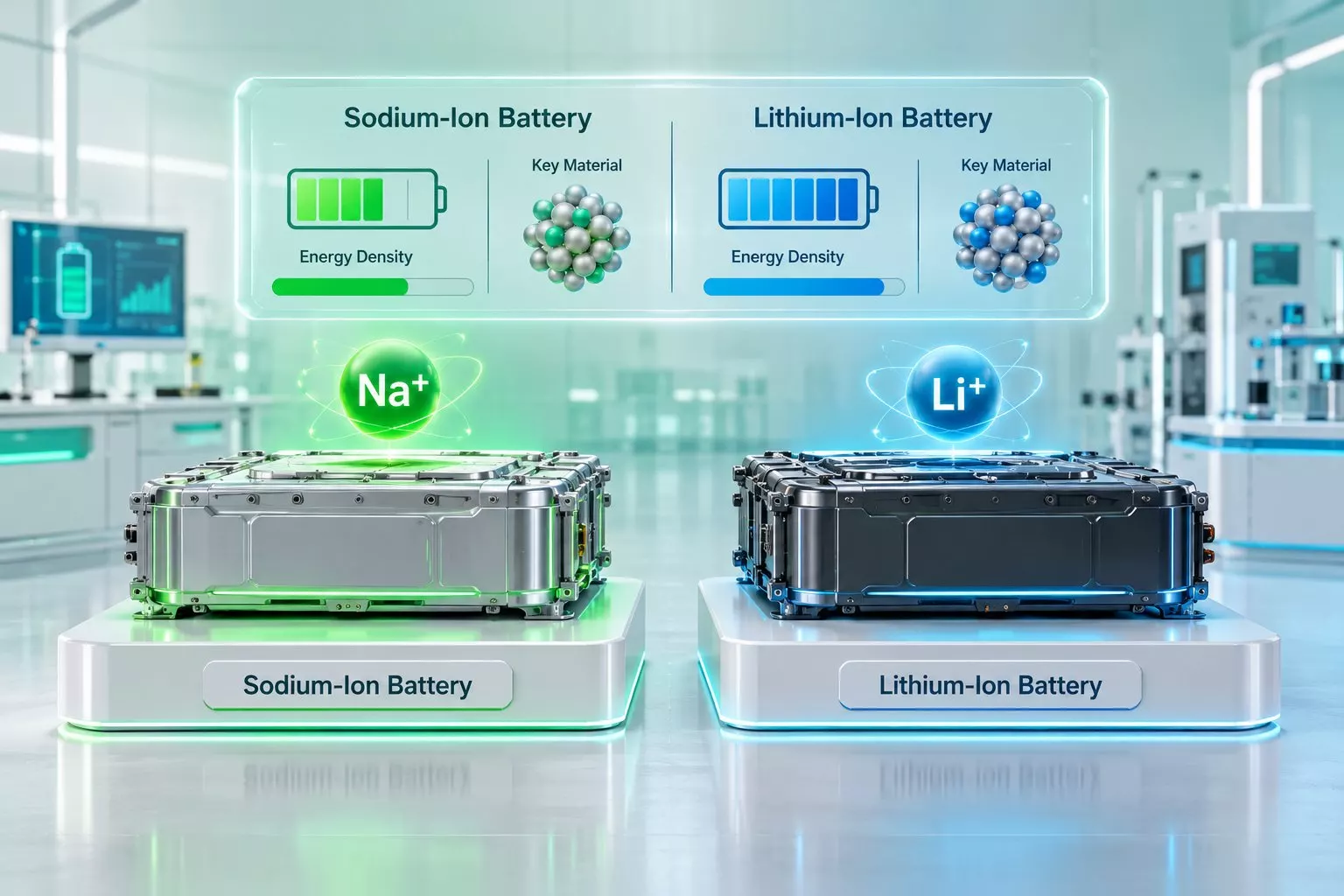
Lithium-ion currently benefits from mature manufacturing and higher typical cell energy density. Sodium-ion offers abundant raw materials and potential advantages in selected operating conditions and supply chains.
| Feature | Sodium-ion | Lithium-ion |
|---|---|---|
| Charge carrier | Sodium ions | Lithium ions |
| Energy density | Generally lower today | Generally higher |
| Raw materials | Sodium-based compounds | Lithium-based compounds |
| Cold performance | Promising in some designs | Chemistry-dependent |
| Manufacturing | Emerging and scaling | Globally established |
| Charging speed | Cell- and BMS-specific | Cell- and BMS-specific |
| EV applications | Urban/short-range potential | Broad applications |
| Stationary storage | Promising | Widely deployed |
Energy density comparison
IEA analysis has cited representative leading cell figures around 175 Wh/kg for sodium-ion, 205 Wh/kg for recent LFP and 265 Wh/kg for NMC cells. These are cell-level figures, not guarantees for every product or pack. Lower energy density can mean more battery weight for the same energy and may influence payload, efficiency and range.
Why Are Sodium-Ion Batteries Becoming Popular?
Abundant sodium resources
Sodium is widely available, potentially lowering exposure to concentrated lithium supply chains. Nonetheless, sodium batteries still require high-quality processed materials and industrial manufacturing infrastructure.
Materials and supply chain diversification
Some sodium-ion chemistries can avoid lithium, graphite and cobalt, although particular designs may still rely on other important materials, including nickel or manganese.
Potential cost benefits
Raw materials can be inexpensive, but finished-battery costs also depend on cell yields, production scale, energy density and suppliers. Low sodium cost alone does not prove the battery pack is cheaper.
Cold weather performance and new markets
Certain advanced sodium-ion designs demonstrate favorable performance at low temperatures. Short-range city EVs, two-wheelers, three-wheelers and stationary storage are possible early markets.
Can Sodium-Ion Batteries Make EVs Cheaper in India?
A battery is a significant part of EV manufacturing cost. Lower-cost materials and supply-chain diversification could help, especially in segments where maximum driving range is not essential. Some sodium-ion designs can use aluminium current collectors in ways that reduce copper requirements.
However, LFP batteries already benefit from mature global manufacturing, and sodium-ion production remains smaller. More weight for equivalent energy storage may offset some savings. As of 2026, sodium-ion has not demonstrated a universal commercial cost advantage over established LFP technology. Affordability must be assessed for each product and application.
How Fast Can Sodium-Ion Batteries Charge?
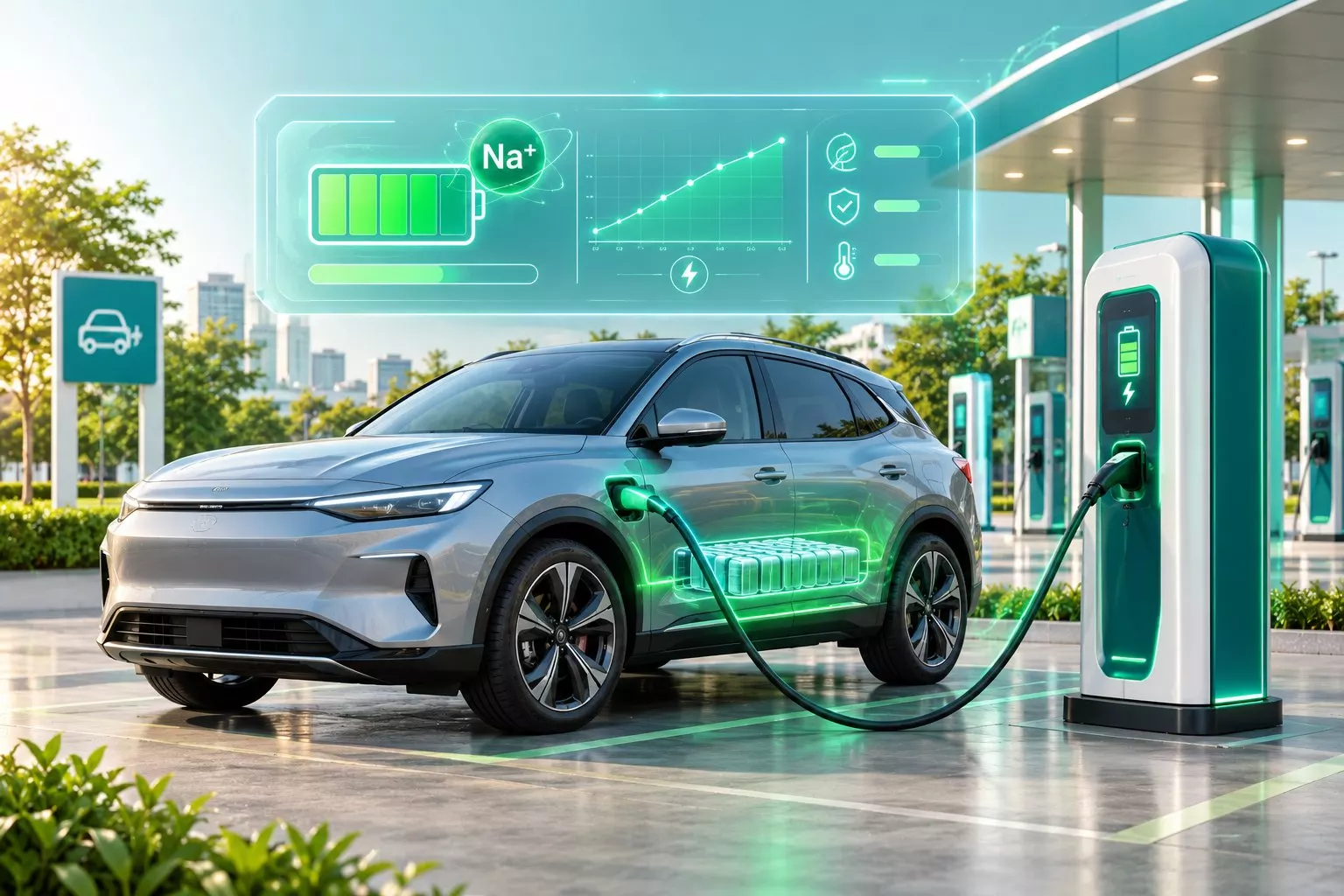
Charging performance depends on electrode chemistry, pack design, temperature, BMS limits, State of Charge and charger output. There is no single universal sodium-ion charging speed, and faster charging than lithium-ion is not guaranteed.
How to estimate charging time
Estimated charging time (hours) ≈ energy added (kWh) ÷ average accepted charging power (kW). For a hypothetical 30 kWh EV charging from 20% to 80%, the battery receives about 18 kWh. At an average of 15 kW, this is about 72 minutes, before additional losses or charging-power changes.
| Battery capacity | 7 kW average | 15 kW average | 30 kW average |
|---|---|---|---|
| 20 kWh | 1 hr 43 min | 48 min | 24 min |
| 30 kWh | 2 hr 34 min | 72 min | 36 min |
| 40 kWh | 3 hr 26 min | 96 min | 48 min |
Illustrative 20–80% times only; not manufacturer specifications. A given vehicle may not support these power levels.
Are Sodium-Ion Batteries Safer Than Lithium-Ion Batteries?
Some sodium-ion designs offer favorable thermal and electrochemical characteristics, but it is incorrect to call the entire chemistry fireproof or immune to thermal runaway. Cell design, electrolyte, manufacturing quality, pack protection and usage all affect safety.
Short circuits, damage, overcharging and extreme temperatures can create hazards for rechargeable batteries of many chemistries. The BMS monitors operating conditions and can reduce charging power or interrupt a session. Buyers should look for vehicle- and pack-level testing and relevant certifications rather than relying on broad claims about chemistry.
How Do Sodium-Ion Batteries Perform in Indian Weather?
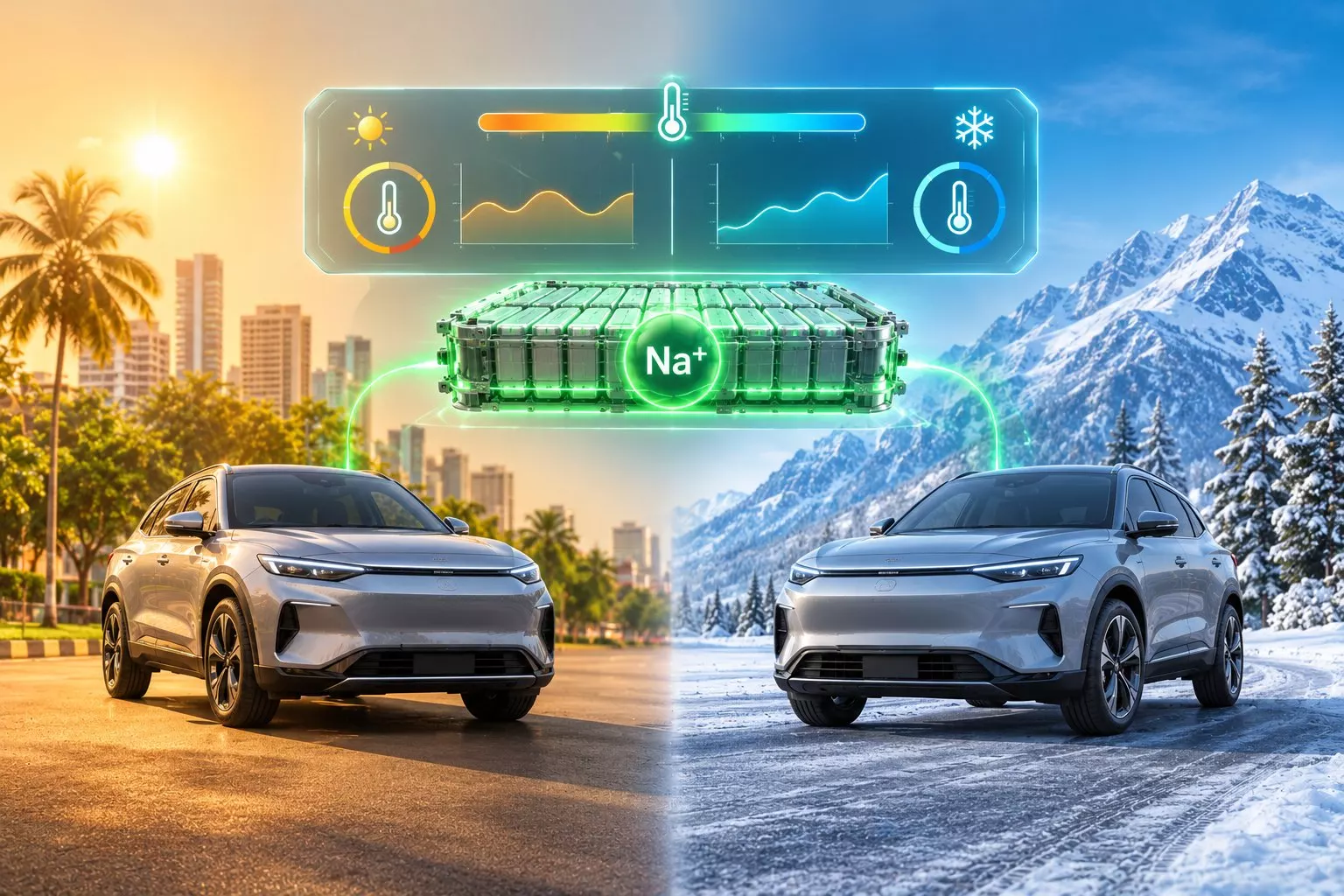
Cold-weather potential
Some recent advanced sodium-ion designs have shown strong capacity retention at very low temperatures, which could be useful in Himalayan regions. Such findings apply to specific designs and should not be treated as a guarantee for every sodium-ion pack.
Extreme summer heat
Tolerance to temperature does not mean protection from ageing. Prolonged heat can still affect cell performance and durability. India’s hot summers make thermal monitoring and approved charging limits essential irrespective of chemistry.
Thermal management still matters
Vehicles require appropriate software, cooling or heating arrangements, voltage and current monitoring, and charger controls. Drivers should follow manufacturer guidance rather than assuming sodium-ion chemistry removes the need for thermal management.
Which Electric Vehicles Could Use Sodium-Ion Batteries in India?
Two-wheelers and three-wheelers
Electric scooters and cargo or passenger three-wheelers may be promising if their desired range, size, operating cost and service life align with the technology. Predictable city routes can make lower energy density more acceptable.
Compact cars and light commercial vehicles
Urban passenger cars, delivery vehicles and campus utility fleets could use sodium-ion batteries if the overall vehicle delivers enough practical range and a competitive total cost of ownership.
Heavy vehicles
Long-range buses and heavy trucks need significant energy capacity. Lower sodium-ion energy density can make these applications harder, although specialized short-route vehicles may be feasible.
The likely future is a mix of battery chemistries serving different use cases rather than sodium-ion completely replacing lithium-ion.
Sodium-Ion Battery Technology Developments in India
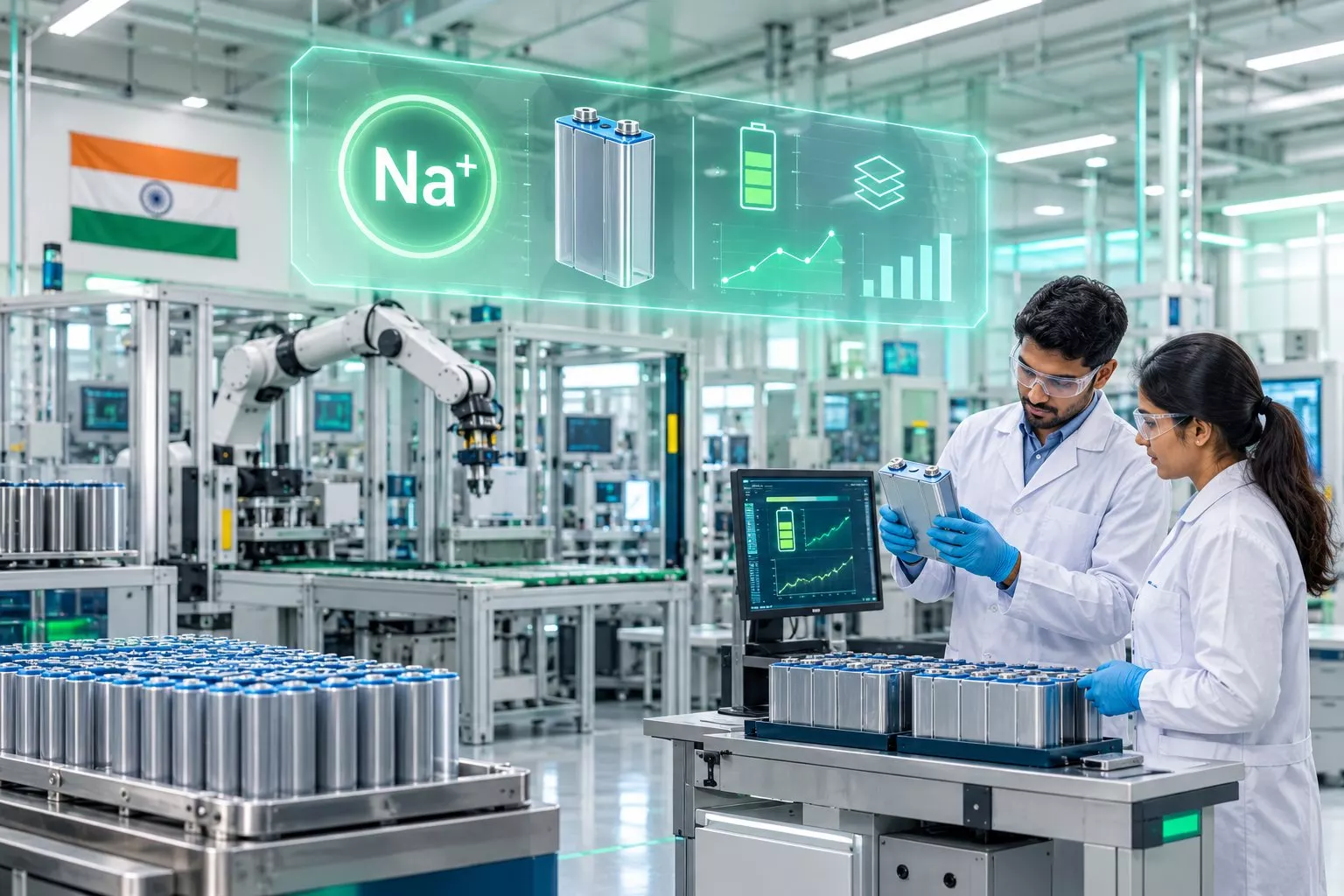
KPIT Technologies and Trentar Energy Solutions
In February 2025, KPIT Technologies announced a collaboration with Trentar Energy Solutions to support commercialization of KPIT’s sodium-ion technology. Reported charging and cycle-life characteristics relate to its specific development program and cannot be generalized to all sodium-ion batteries.
Government-supported research
In December 2025, India’s Department of Science and Technology announced an agreement involving ARCI and Voltasun Technologies to develop and evaluate sodium-ion pouch cells, using sodium vanadium phosphate cathode materials.
Supply chain research
In March 2026, the Council on Energy, Environment and Water published analysis of potential Indian sodium-ion supply chains, manufacturing capabilities and research opportunities. These activities are encouraging, but R&D projects and commercialization announcements are not equal to widely available sodium-ion EVs.
What Do Sodium-Ion Batteries Mean for EV Charging Stations?
EV charging stations mainly interact with vehicles through electrical parameters, physical connectors and communication standards, rather than the label of the cell chemistry. A sodium-ion EV could use conventional charging infrastructure if the vehicle is engineered to support that interface and its BMS manages battery limits.
AC charging
The onboard vehicle charger converts compatible AC supply into battery charging power. Its output and controls must match the vehicle’s electrical architecture.
DC fast charging
The external DC charger and vehicle exchange required operating parameters through a supported communication protocol. The car controls accepted voltage and current within approved limits.
Will today’s EV chargers become obsolete?
Not necessarily. Interoperable Type 2 and CCS2 charging equipment may support future sodium-ion vehicles designed around these interfaces. But compatibility is not automatic and must be confirmed for each vehicle and charger pairing.
How Sodium-Ion Batteries Could Support Charging Stations Through Energy Storage
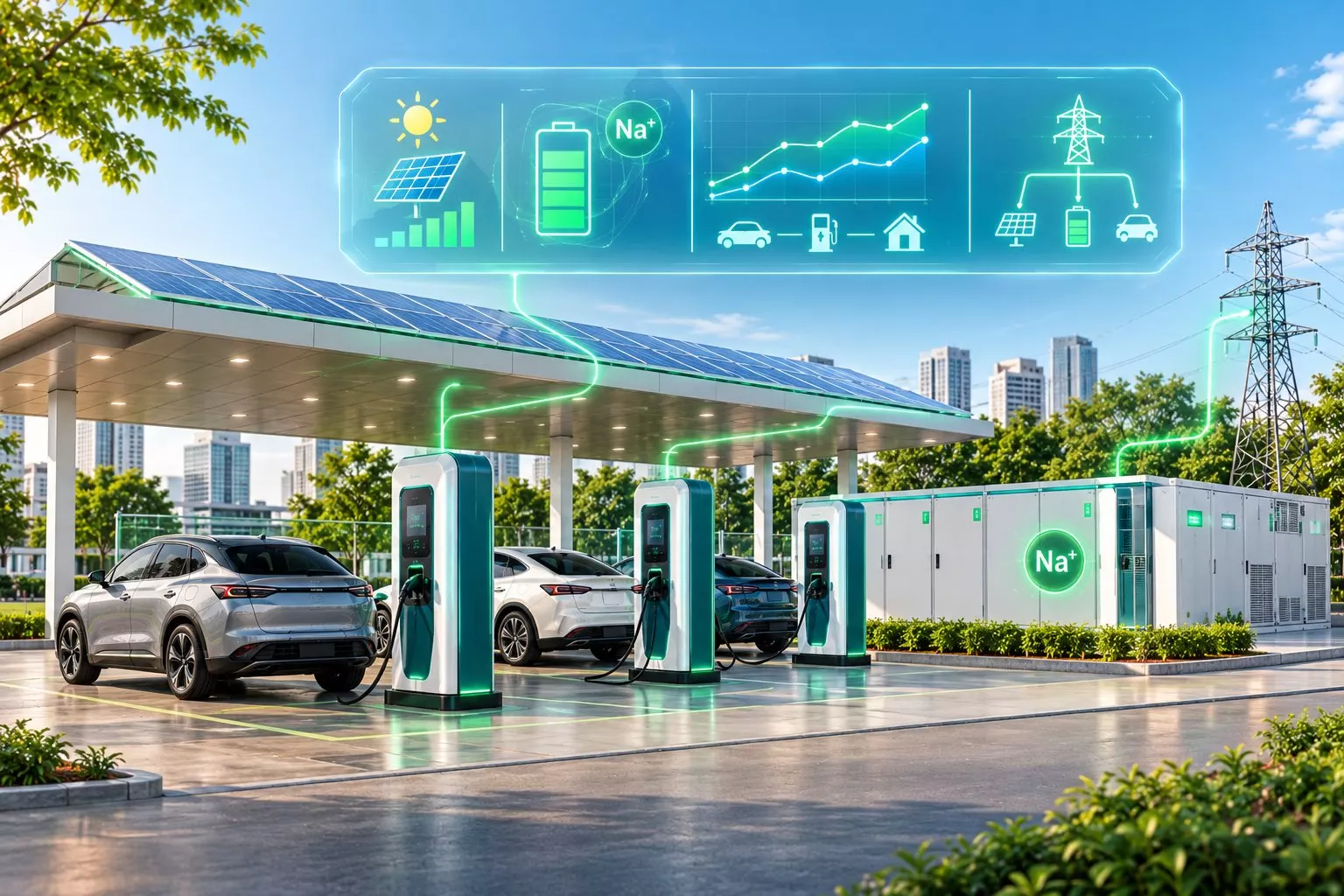
Stationary energy storage is a particularly promising application because pack weight and size are often less restrictive than in vehicles. A Battery Energy Storage System (BESS) can help coordinate energy demand, store some solar generation and supplement grid power during peak loads.
Potential benefits
- Peak demand management: stored energy can contribute during periods of high charging demand.
- Solar integration: daytime generation may be stored for use later.
- Managing grid constraints: storage can supplement available grid power for limited periods.
- Resilience: a properly designed system may support selected loads during outages.
Illustrative charging hub example
A charging site with a 60 kW DC charger and 40 kW available grid power could, in a properly engineered scenario, obtain an additional 20 kW from storage for a limited period. Supplying 20 kW for one hour requires 20 kWh before conversion losses and usable-capacity limitations. This example is not approval to operate beyond sanctioned supply limits without technical and regulatory assessment.
Does Sodium-Ion Technology Change EV Charging Electricity Requirements?
The energy required for a charging session (see how much power is required for EV charging) largely depends on usable battery capacity and the amount of charge being added, not simply the chemistry name. A 40 kWh sodium-ion battery and a 40 kWh lithium-ion battery each require about 40 kWh delivered to the pack for an idealized empty-to-full charge, although actual losses differ.
For a hypothetical 40 kWh EV charging from 20% to 80%, the battery needs 24 kWh. Assuming 90% overall charging efficiency, electricity from supply is about 26.7 kWh.
| Illustrative electricity tariff | Approximate session cost |
|---|---|
| ₹8/kWh | ₹214 |
| ₹10/kWh | ₹267 |
| ₹12/kWh | ₹320 |
| ₹15/kWh | ₹400 |
Actual customer charging prices depend on local tariffs, station fees, taxes and equipment performance.
Challenges of Sodium-Ion Adoption in India
Energy density and vehicle design
Lower energy density can require a larger or heavier pack for comparable capacity, affecting range and payload.
Manufacturing capacity and component supply
Sodium-ion factory capacity and specialized suppliers remain much smaller than the established lithium-ion industry. Scaling production requires consistent cathodes, hard carbon, electrolytes, qualified manufacturing and testing.
Costs, validation and recycling
Commercial competitiveness depends on full pack costs, cycle life and reliability—not raw sodium prices alone. Extensive real-world testing, end-of-life collection and recycling systems must continue to develop.
How EarthtronEV Fits Into the Future of Battery Technology
As automakers introduce more chemistries, flexible and interoperable charging infrastructure becomes increasingly important. EarthtronEV provides AC and DC charging solutions and connected management software for the Indian EV ecosystem.
Charging compatibility
Compatible Type 2 AC and CCS2 DC solutions can potentially support vehicles using multiple battery chemistries, provided their interfaces and communication requirements match. Future sodium-ion vehicle support should be verified individually.
Charge Station Management System
EarthtronEV’s CSMS supports monitoring, charging session analytics, billing and load management. These network capabilities remain relevant as vehicle battery technology evolves.
Learn more about the EarthtronEV Charge Station Management System.
Franchise opportunities
EarthtronEV also offers a Franchise-Owned, Company-Operated model for eligible charging infrastructure investments. Charging network returns depend on site location, utilization, energy costs and operating agreements rather than any assumed sodium-ion adoption.
Explore the EV charging station franchise in India.
The Future of Sodium-Ion Batteries in India
Future progress may include affordable urban vehicles, growing Indian manufacturing, mixed-chemistry battery architectures, more stationary storage, and improved performance in cold climates. At the same time, manufacturers must overcome energy-density, cost and scale barriers.
The most realistic outlook is a diversified battery ecosystem: lithium-ion remains important for high-energy vehicles while sodium-ion may serve specialized transport and energy-storage applications.
Conclusion
Sodium-ion batteries are an important emerging alternative for electric mobility and stationary energy storage. Their sodium-based chemistry offers opportunities to diversify supply chains and reduce dependence on certain materials, while advanced designs show promise in particular temperature conditions and lower-range applications.
Nonetheless, they are not yet a universal substitute for lithium-ion batteries. Lower energy density, limited industrial scale and developing supply chains must improve before broad adoption. For India, the potential lies in matching the chemistry to appropriate vehicle and storage uses, alongside domestic research and manufacturing.
Future sodium-ion EVs may share AC and DC charging infrastructure when built to compatible standards; sodium-ion stationary storage could also support solar-assisted charging hubs. Reliable, interoperable charging networks will remain essential regardless of battery chemistry. EarthtronEV contributes through connected EV charging equipment, charging management technology and network development.
Learn more about EarthtronEV.