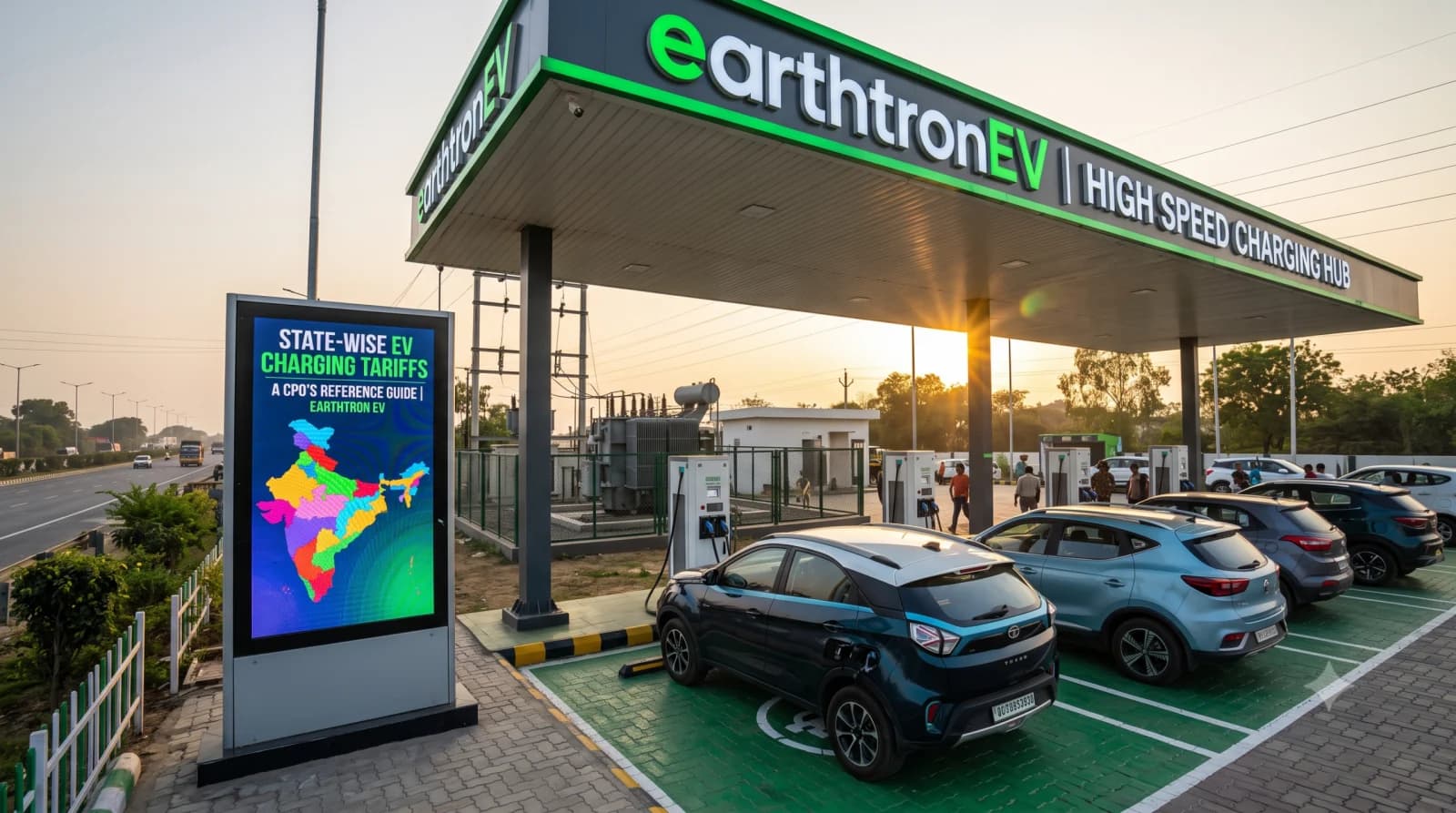
Quick Answer: The profitability of an EV charging station in India relies entirely on state DISCOM tariffs. Commercial EV electricity tariffs range from as low as ₹4.50/kWh in Delhi to as high as ₹10.70/kWh in Karnataka. To maximize Charge Point Operator (CPO) margins, the Ministry of Power mandates a single-part tariff and offers a 20% cost reduction on the Average Cost of Supply (ACoS) during daytime solar hours (9 AM to 4 PM).
Ministry of Power (MoP) Guidelines for EV Tariffs (2024–2025)
To accelerate infrastructure deployment, the Government of India has established national guidelines. For commercial CPOs and our Earthtron EV franchise partners, the latest actionable directives include:- Single-Part Tariff Mandate: EV tariffs are structured as single-part (energy charges only), capping or waiving fixed monthly demand charges (₹/kVA) to protect low-utilization stations.
- Time of Day (ToD) Pricing Multipliers: To align EV charging with renewable generation, DISCOMs bill at 0.8x the Average Cost of Supply (ACoS) during solar hours (9:00 AM to 4:00 PM) and 1.2x the ACoS during non-solar evening hours.
- Hard Tariff Ceilings: The MoP has specified a ceiling limit of ₹10.00 per unit for DC Fast Charging during solar hours, and ₹12.00 per unit during non-solar hours. For slow AC charging, ceilings sit at ₹2.50 and ₹3.50 respectively.
- Open Access Acceleration: Charging hubs requiring over 1MW capacity can procure green energy via Open Access within a 15-day approval window.
State-by-State PCS Electricity Tariffs
Despite federal guidelines, per-unit costs vary wildly across state borders. Below is the reference data for dedicated EV meter tariffs (excluding local duties and ToD variations) across key Indian markets.| State | EV PCS Tariff (₹ / kWh) | Strategic Implication for CPOs & Franchisees |
|---|---|---|
| Delhi | ₹4.50 – ₹5.00 | Heavily subsidized LT EV tariff; highly lucrative for high-density urban clustering and fleet operations. |
| Uttar Pradesh | ₹7.30 | Favorable for dense highway corridors (like the Noida-Agra expressways). |
| Haryana | ₹7.40 | Strong unit economics for NCR borders, Gurgaon corporate hubs, and high-traffic routes. |
| Maharashtra | ₹7.50 | Moderate base rate; owners must actively manage aggressive ToD peak surcharges during evenings. |
| Tamil Nadu | ₹7.60 | Competitive base rate combined with rapidly growing EV penetration in the south. |
| Rajasthan | ₹8.80 | Approaching upper limits; margins tighten on DC fast chargers requiring high volume. |
| Telangana | ₹9.50 | High input costs; requires premium retail pricing to maintain target ROI. |
| Karnataka | ₹10.70 | Highest in India; CPOs must maximize utilization rates and throughput to offset low margins. |
Operational Strategies for Maximizing ROI
“Profitability in the EV charging business isn’t just about foot traffic; it’s about grid strategy. By leveraging Time-of-Day pricing and smartly arbitrating between HT and LT lines, our franchise partners are cutting operating expenses by up to 18%.” — Leadership Team, Earthtron EV
1. HT vs. LT Connection Arbitration
For highway hubs requiring 120kW to 240kW of total capacity, transitioning from Low Tension (LT) to High Tension (HT) lines (11kV or 33kV) is standard practice. While HT connections demand higher upfront CapEx for dedicated transformers, they unlock lower per-unit HT tariffs and reduce grid-drop issues.2. Time of Day (ToD) Margin Optimization
The 9:00 AM to 4:00 PM solar window provides a 20% cost reduction. Franchise owners can translate this into dynamic consumer pricing via the Earthtron EV network app—offering discounted retail charging during midday to drive utilization up, while maintaining standard retail rates during evening peak hours.3. Partnering with an Experienced Network
Setting up a profitable station requires more than hardware. By partnering with Earthtron EV, franchisees get end-to-end support—from site feasibility and grid connection to 24/7 software management.EV Charging Tariff by State (₹ / kWh)
Frequently Asked Questions (FAQs)
What is the single-part tariff for EV charging in India?
A single-part tariff means EV charging station operators are only billed for the actual energy consumed (₹ per kWh), completely waiving the fixed monthly demand charges (₹ per kVA or kW) that standard commercial connections require.
How does Time of Day (ToD) pricing affect EV charging stations?
Under MoP guidelines, public charging stations receive electricity at 0.8 times the Average Cost of Supply (a 20% discount) during solar hours (9 AM to 4 PM), and are billed at 1.2 times the Average Cost of Supply (a 20% premium) during non-solar hours.
Which state is most profitable for starting an EV charging business?
States with low base electricity tariffs and high EV adoption are the most profitable. Delhi (₹4.50/kWh), Uttar Pradesh (₹7.30/kWh), and Haryana (₹7.40/kWh) currently offer some of the strongest unit economics for fast-charging CPOs.