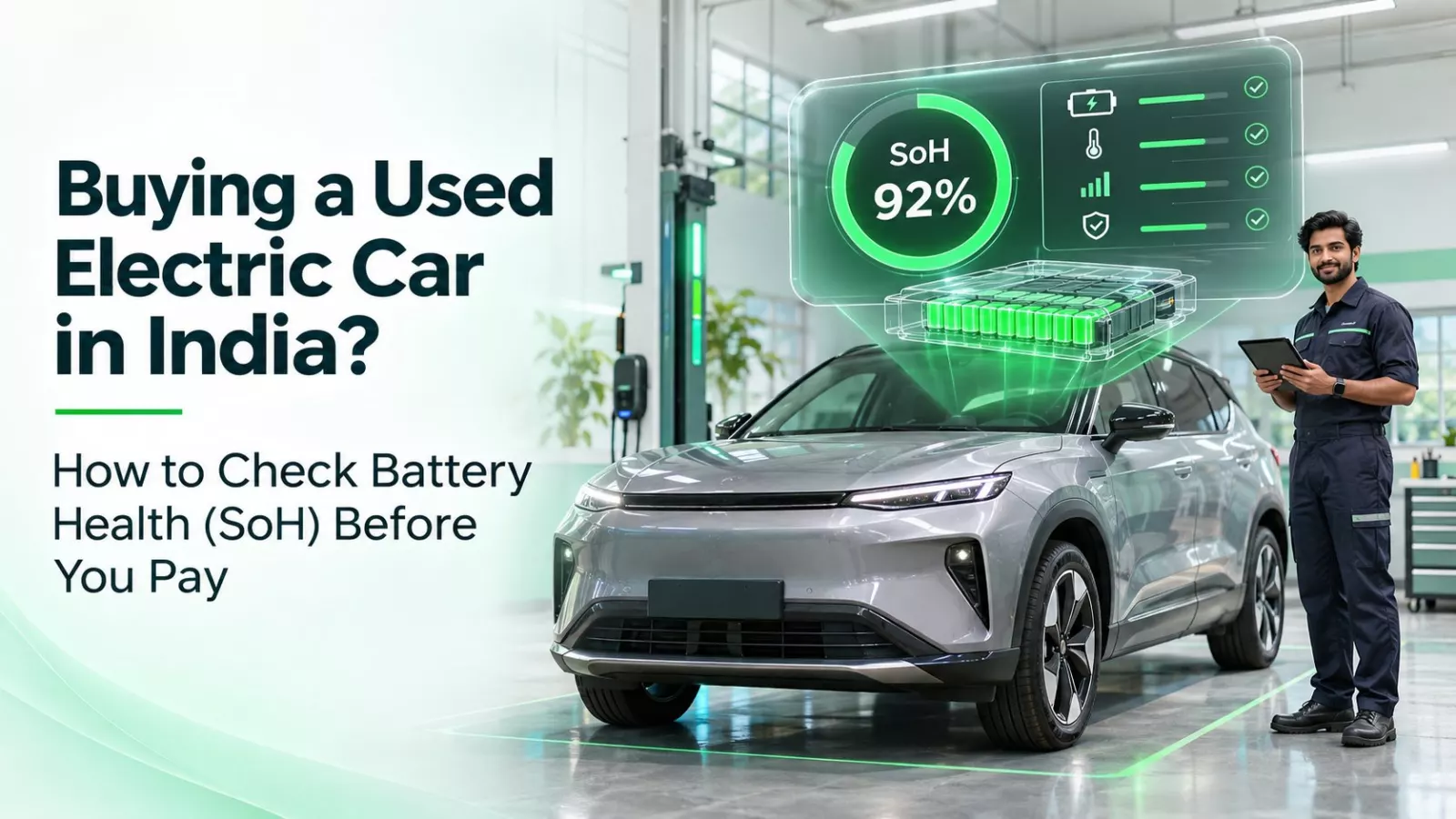
Quick Answer: Before buying a used electric car, request a battery diagnostic report from an authorised service centre, review the vehicle’s State of Health (SoH), test its real-world driving performance, check for high-voltage battery fault codes and verify warranty transfer conditions. SoH represents the battery’s remaining condition relative to when new, but readings and methodologies vary by manufacturer. The dashboard’s estimated driving range is not a substitute for a battery diagnostic test.
Why Battery Health Matters When Buying a Used Electric Car
A second-hand electric car can make EV ownership more accessible in India. Yet an attractive price and clean bodywork do not tell the whole story. Unlike a conventional car, an EV relies on a high-voltage traction battery that stores the energy used for driving. Its condition affects usable range, charging experience, resale value and the risk of future repairs.
Lithium-ion batteries naturally age with time and use. Before you pay for a used EV, it is worth examining how the battery has aged rather than relying on the seller’s claimed range or the charge percentage shown on the screen. This guide explains practical steps that a buyer can take, what warning signs to look for and how to interpret the results responsibly.
What Is Battery State of Health (SoH) in an Electric Vehicle?
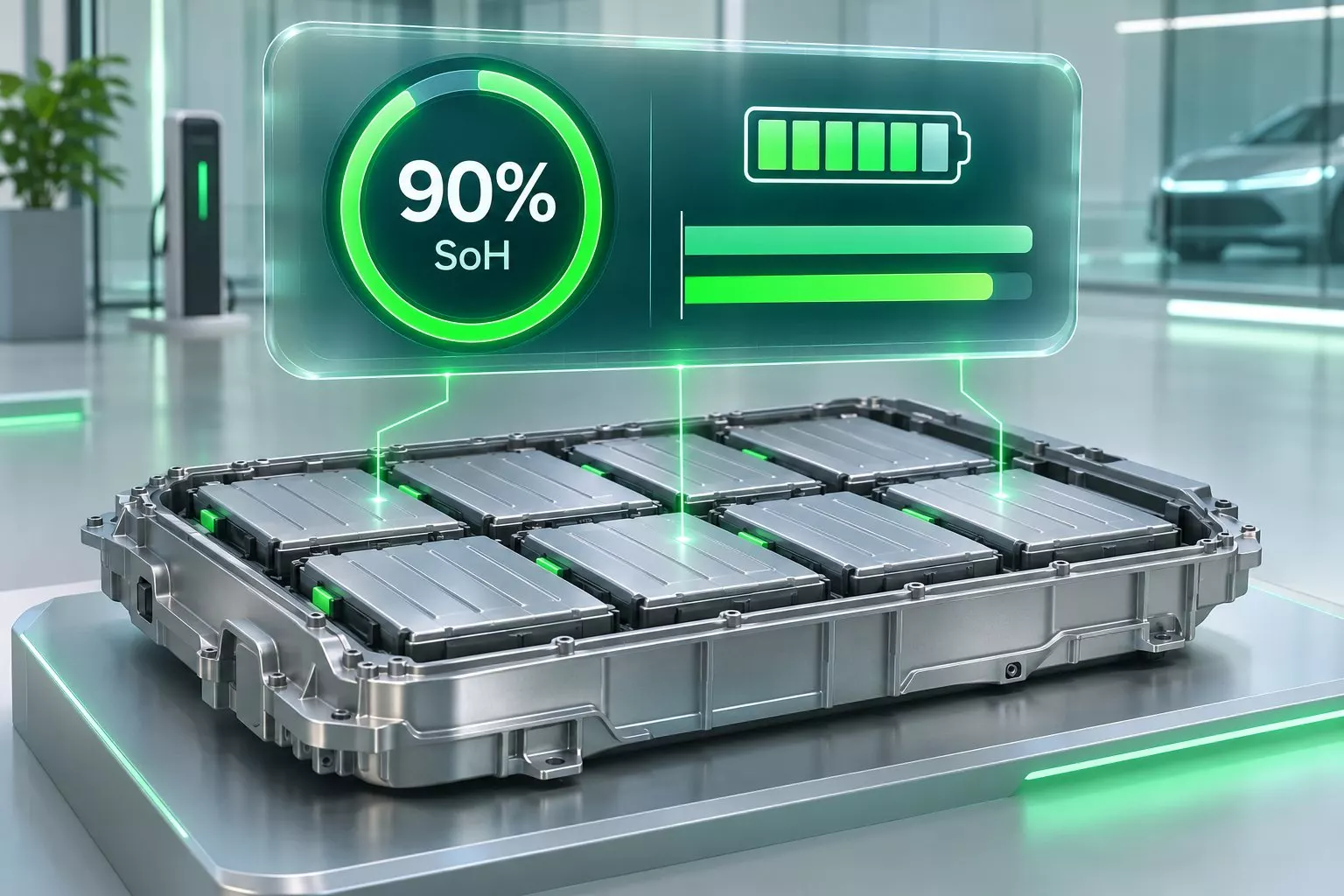
State of Health (SoH) expresses an estimate of the battery’s condition compared with its original condition. In a simplified capacity-based approach, SoH is current usable capacity divided by original usable capacity, multiplied by 100. For example, a 40 kWh battery that now delivers 36 kWh of comparable usable capacity would have an estimated capacity SoH of 90%.
Battery SoH (%) = (Current battery capacity / Original battery capacity) × 100
Manufacturers may calculate reported SoH using different internal models and may consider resistance and other parameters. A displayed percentage is therefore not always equivalent to an independent laboratory capacity test.
State of Health versus State of Charge
| Measure | SoH | SoC |
|---|---|---|
| Meaning | Long-term battery condition | Present charge level |
| Example | 90% SoH | 80% SoC |
| Main use | Evaluate capacity degradation | Estimate current available energy |
A vehicle can be charged to 100% SoC even though the battery has only 85% SoH. Fully charged means full relative to its present capacity, not necessarily its capacity when new.
Why Battery Health Is Important When Buying a Used EV
Battery condition contributes to the vehicle’s practical driving range. Degradation reduces the energy that can be stored, though actual driving range also depends on temperature, traffic, speed, air conditioning, tyres and road conditions. A battery report can be particularly valuable when comparing cars of similar age and mileage.
Battery health may influence resale value and potential long-term ownership costs. A vehicle with verified diagnostics, complete service history and transferable warranty coverage can present less uncertainty than one with missing records or unresolved battery faults. Charging limitations can also be related to vehicle software, thermal management or the charger, so avoid diagnosing degradation from charging speed alone.
What Is a Good Battery SoH Percentage for a Used Electric Car?
There is no universal SoH percentage that automatically makes a used EV a good or bad purchase. The following ranges are an illustrative screening tool, not an official grading standard.
| Reported SoH | General interpretation | Suggested action |
|---|---|---|
| 95–100% | Very high capacity retention | Confirm diagnostic credibility |
| 90–94% | Strong retention | Review remaining warranty |
| 85–89% | Moderate degradation | Compare range, age and price |
| 80–84% | Noticeable loss | Assess driving needs carefully |
| 70–79% | Substantial degradation | Obtain specialist assessment |
| Below 70% | Significant loss | Consider only with full evaluation |
A driver with short daily journeys may find a lower-SoH vehicle suitable at the right price, while a buyer taking regular long trips may require more capacity. Some battery warranties reference a minimum capacity retention threshold of about 70%, but conditions differ by manufacturer and model. Warranty eligibility must be verified individually.
How to Check Battery Health Before Buying a Used Electric Car
Method 1: Authorised service centre diagnostic report
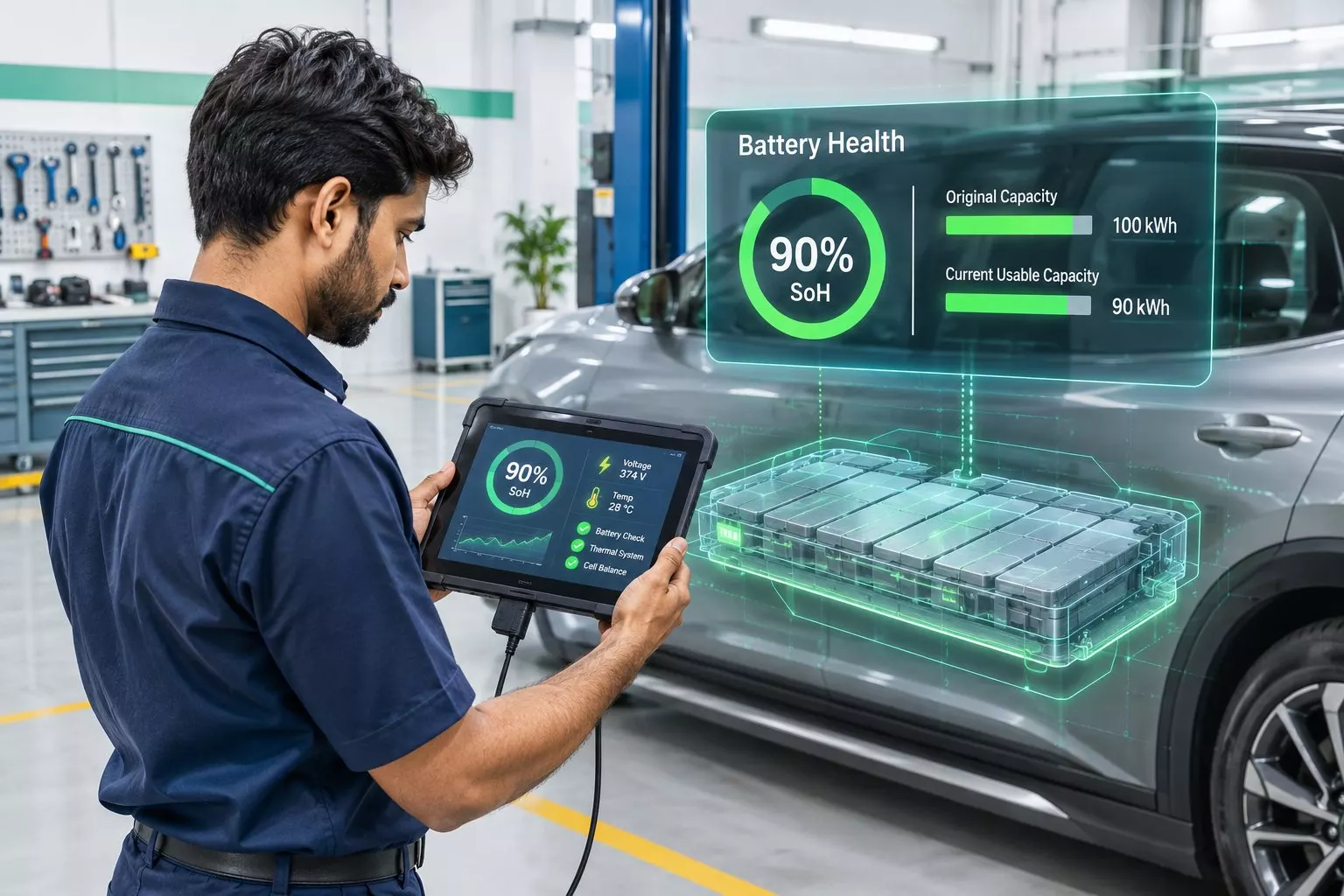
Ask the seller for a battery inspection at an authorised service centre, preferably before making a non-refundable payment. Depending on the vehicle, the workshop may access BMS data, the estimated SoH, cell or module imbalance indicators, battery temperatures, fault codes and charging-related diagnostics. Request written findings tied to the vehicle identification number (VIN). Not every manufacturer provides the same style of SoH certificate.
Method 2: Compatible diagnostic scanner
Some vehicles expose EV-specific battery data through a compatible diagnostic tool. A generic petrol-car OBD reader may not support the necessary manufacturer-specific information. Have an experienced EV technician interpret the data; scanner readings may repeat the battery management system’s estimate rather than measure capacity independently.
Method 3: Real-world range test
- Agree on a starting charge percentage and document it.
- Drive a representative route in normal traffic and temperature conditions.
- Record distance travelled and indicated battery percentage used.
- Compare with realistic expectations for the same model and usage conditions.
An estimate based on percentage consumed is only a rough driving-range check. It is not a valid standalone SoH measurement. The car’s dashboard estimated range is influenced by recent driving behaviour and should not be divided by the advertised range to certify battery health.
Method 4: Controlled usable-capacity test
If results are inconsistent or the car is expensive, inquire about a professional controlled capacity assessment using approved equipment and procedures. Energy delivered by a charger is not identical to battery energy stored because charging losses and auxiliary loads affect readings.
Signs That a Used EV Battery May Have Problems
- Significantly lower real-world range than comparable vehicles in similar conditions.
- Unexpected large jumps in the displayed battery percentage.
- Repeated battery, temperature, charging or drivetrain warning messages.
- Recurring charging interruptions on multiple compatible chargers.
- Unusual and repeated power restrictions under normal operating conditions.
- Evidence of damage, corrosion or water exposure near the battery enclosure.
These warning signs do not prove that the battery itself is defective. They indicate that a qualified technician should investigate. Never open a high-voltage battery pack or handle its internal wiring yourself.
How Charging Habits Affect EV Battery Health
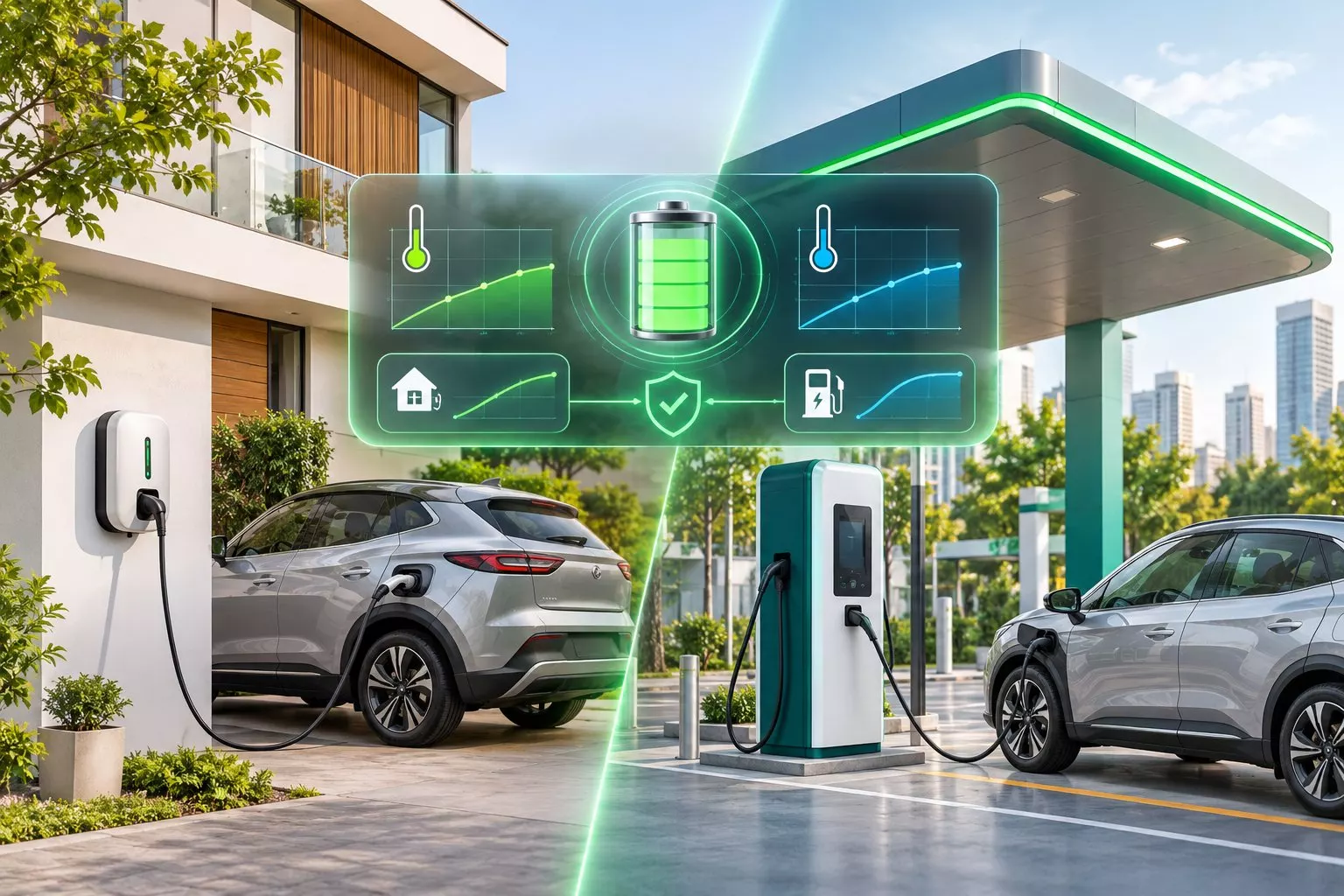
A battery’s life is affected by time, temperature, depth of discharge, operating patterns and cell chemistry. Frequent DC fast charging under demanding thermal conditions can contribute to ageing, but modern EVs manage charging power and temperature to protect the battery. A vehicle that has used fast chargers is not automatically in poor condition.
Extended exposure to heat, long storage periods at a very high charge state and extremely low charge conditions may influence ageing. Recommended charging practices vary by manufacturer and battery chemistry. Service records and measured battery condition are more useful than assumptions about one charging habit.
How to Check Battery Warranty on a Second-Hand EV in India
Check the original registration date, VIN, model-specific warranty document, kilometre cap, capacity-retention threshold, exclusions and whether the warranty transfers to a new owner. Ask about any past pack or module replacements and retain the service records.
An advertised “lifetime battery warranty” may apply only to the first eligible owner, with different limits for subsequent owners. For example, published Tata Passenger Electric Mobility terms for certain qualifying models specify separate second-owner coverage. Verify current terms for the exact variant directly with the manufacturer rather than generalising from another model.
Does Battery SoH Affect the Resale Value of an Electric Car?
Imagine two four-year-old electric SUVs, both with 45,000 km on the odometer. One has a verified 93% SoH and documented warranty coverage; the other reports 78% SoH with unclear transfer status. Even if the latter is cheaper, its value depends on the remaining practical range, diagnostics, repair risk and intended use.
| Factor | Used EV A | Used EV B |
|---|---|---|
| Age | 4 years | 4 years |
| Mileage | 45,000 km | 45,000 km |
| Illustrative SoH | 93% | 78% |
| Warranty | Verified | Not yet verified |
| Illustrative asking price | ₹8.5 lakh | ₹7.5 lakh |
The figures above are hypothetical, not market valuations. The best purchase combines suitable usable range, verified health and a fair total ownership cost—not merely the lowest price or highest SoH number.
How Much Does Battery Degradation Affect Driving Range?
In a simplified model, a car delivering 300 km under specific conditions when new could deliver about 270 km with 90% of the original usable capacity, or 240 km with 80% capacity, assuming all other factors remain equal. Actual range may differ because vehicle systems, driving behaviour and battery temperature are not constant.
| Illustrative SoH | Proportional range example |
|---|---|
| 100% | 300 km |
| 95% | 285 km |
| 90% | 270 km |
| 85% | 255 km |
| 80% | 240 km |
| 75% | 225 km |
| 70% | 210 km |
These values illustrate the capacity-to-range concept only and are not model-specific predictions or diagnostic thresholds.
Should You Buy a Used EV With Less Than 80% SoH?
Possibly—but only after a detailed review. Consider daily kilometres, access to charging, battery faults, warranty transfer, repair estimates and the discount compared with healthier examples. For a short urban commute, an older EV with reduced range might remain practical. For frequent highway trips, limited battery capacity may be inconvenient.
A seller’s refusal to permit diagnostic testing is a reason for caution. If the battery condition appears uncertain, request an authorised inspection before committing funds.
Check Both AC and DC Charging Before Buying
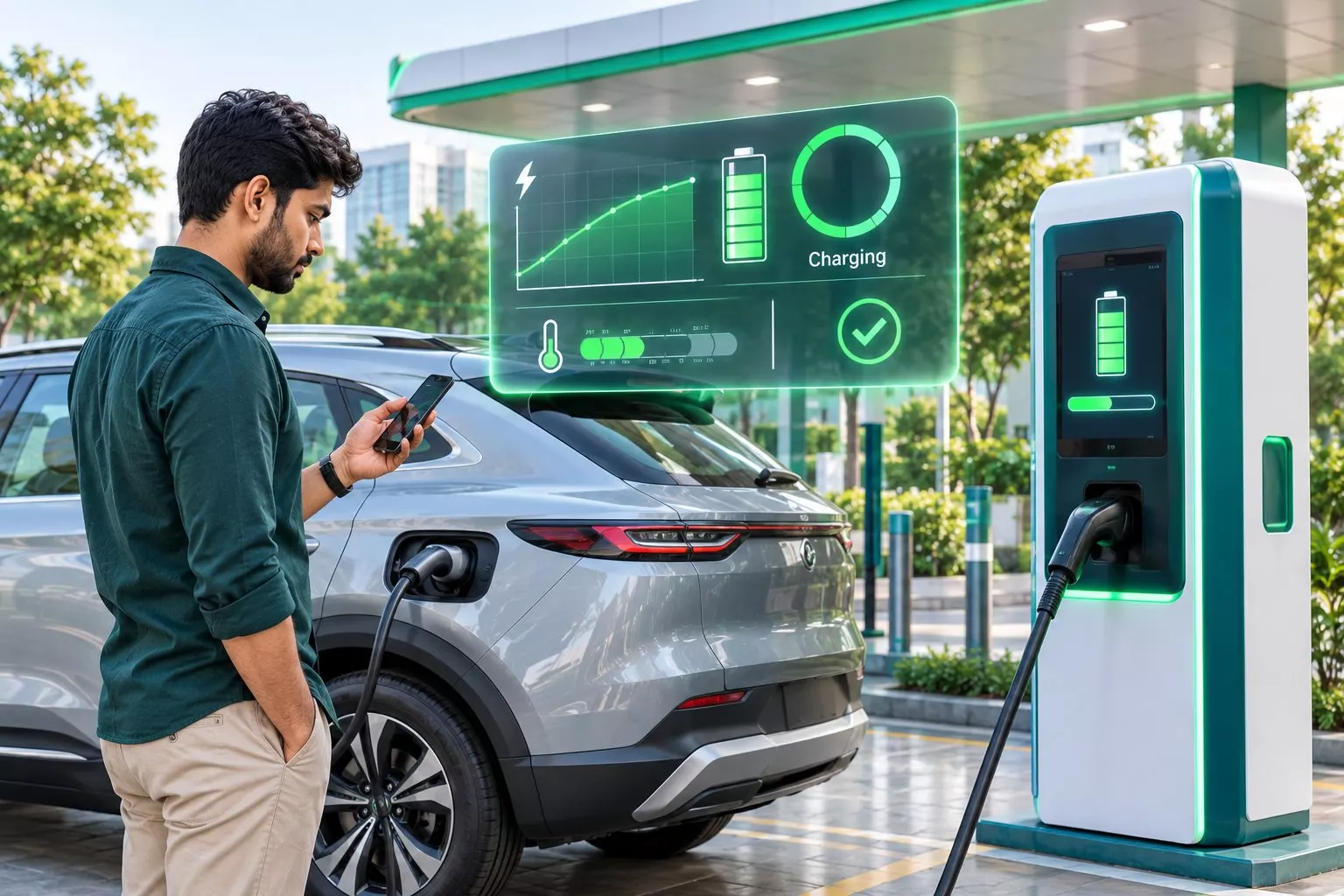
Test AC charging using compatible equipment and look for session faults or interruptions. Where the vehicle supports DC charging, try a compatible functioning public DC fast charger and confirm that the session starts and completes normally. Charging power is affected by battery temperature, state of charge and charger capability, so do not treat a single slow session as proof of degradation.
Reliable charging access also matters after the purchase. EarthtronEV offers connected charging infrastructure; readers can learn more in its guide on how much power is required for EV charging.
Additional Checks Before Purchasing a Second-Hand EV in India
- Verify complete service and software update history.
- Check accident, underbody and flood-damage history.
- Match vehicle registration details and VIN.
- Check insurance records and remaining loan or hypothecation status.
- Review battery replacement documentation if any.
- Confirm included charge cables and accessories work properly.
Used Electric Car Battery Health Checklist Before Payment
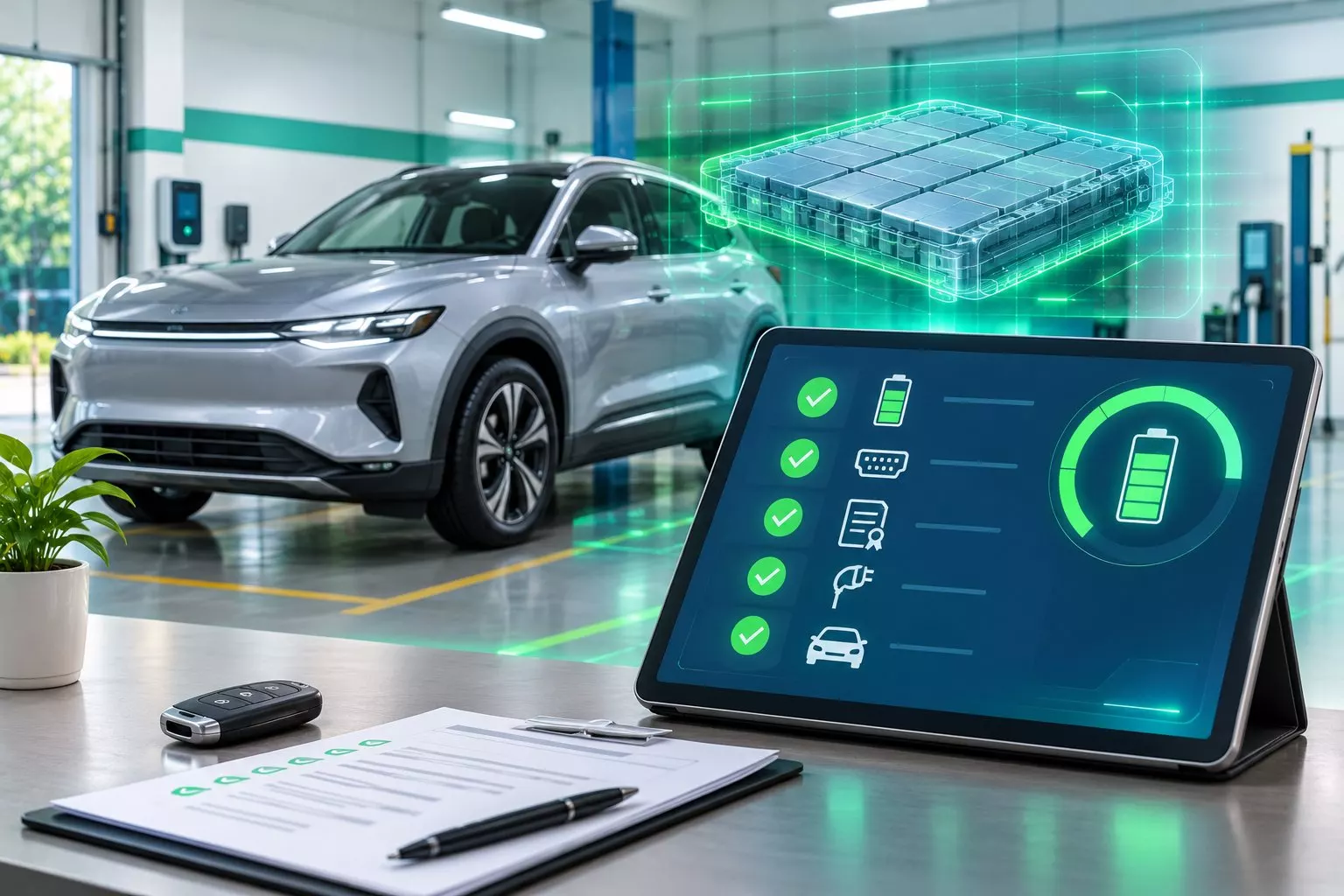
☐ Obtain authorised service battery diagnostics
☐ Verify SoH reading against the correct VIN
☐ Check battery and charging fault codes
☐ Complete a real-world range test
☐ Test supported AC and DC charging
☐ Confirm transferable battery warranty
☐ Review battery replacement and service records
☐ Inspect for accident and water damage
☐ Verify registration, insurance and financing
☐ Compare asking price with battery condition
The inspection should be completed before non-refundable payment. A written report and complete documentation can reduce uncertainty, although no inspection can eliminate all future repair risk.
The Role of Reliable EV Charging Infrastructure in Used EV Ownership
Choosing a used EV involves more than battery diagnostics. Check whether compatible home, workplace and public chargers are accessible along regular routes. EarthtronEV provides AC and DC charging infrastructure, charge station management solutions and an EV charging station franchise model in India.
Learn more about the EV charging station franchise in India or visit the EarthtronEV homepage.
Conclusion
A used electric car can be an economical entry into electric mobility, but battery health deserves careful investigation. SoH is a helpful indicator of remaining battery condition, not a complete measure of vehicle quality. Combine authorised diagnostics, real-world driving tests, charging-system checks, maintenance records and battery warranty verification before paying.
A slightly older vehicle with documented battery condition may provide better value than an attractive-looking car with unresolved battery questions. For everyday ownership, access to dependable charging facilities is equally important. EarthtronEV supports this ecosystem through EV charging infrastructure and connected charging solutions.