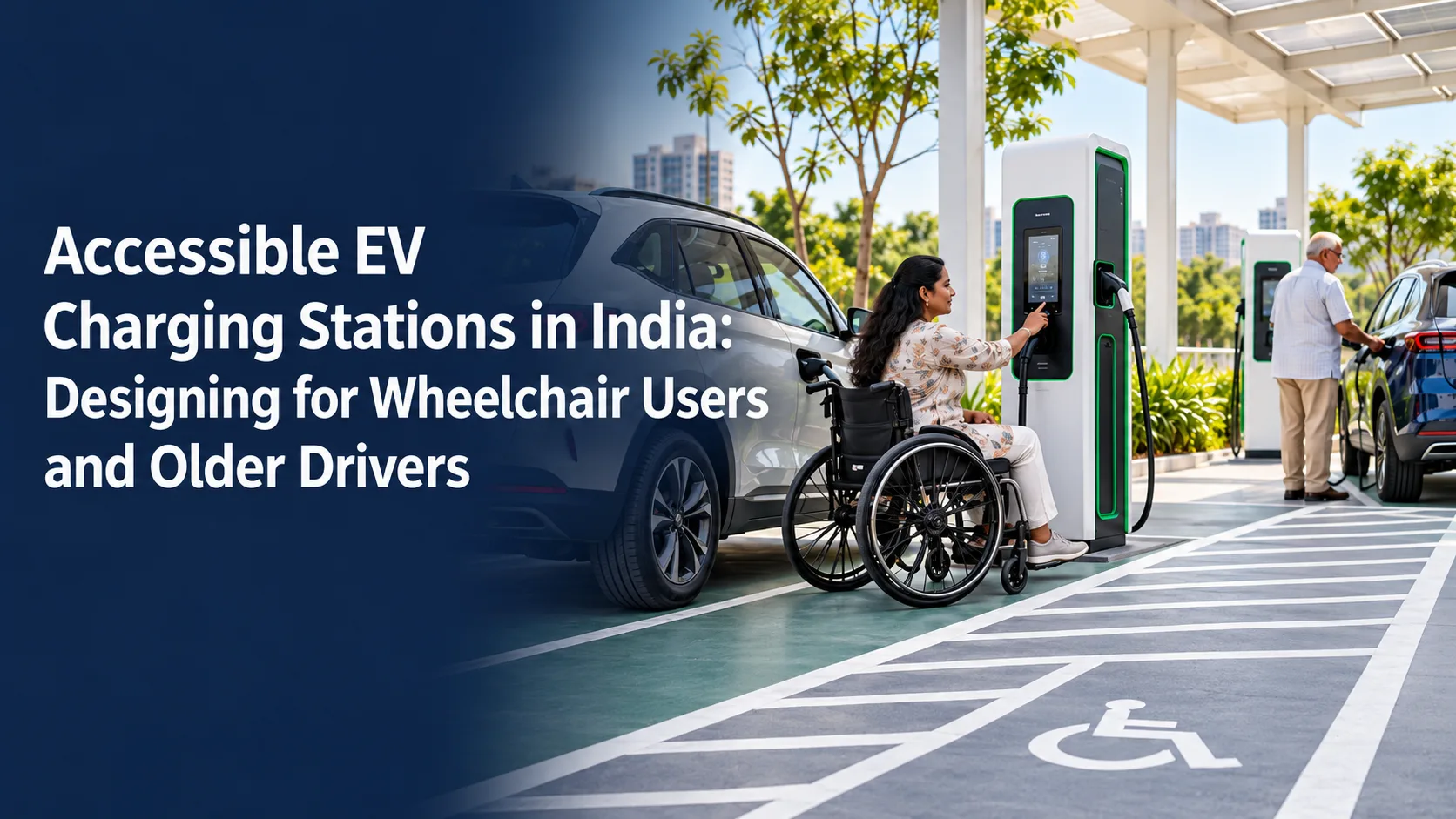
A charging station can be operational and still be difficult for someone to use.
A wheelchair user may find the charger behind a raised kerb. A driver with limited grip strength may struggle to release the connector. Someone with reduced vision may be unable to read the screen in bright sunlight.
These barriers affect whether a person can complete a charging session independently.
Accessible EV charging therefore involves the whole experience: finding a suitable station, parking, reaching the equipment, connecting the vehicle, paying and leaving.
For India’s charging infrastructure developers, considering these steps during design can help avoid installations that require expensive changes later.
What Does Accessible EV Charging Mean?
An accessible charging station enables people with different mobility, sensory and communication needs to use its facilities.
Wheelchair access is one part of the task. Other considerations include limited reach, reduced hand strength, difficulty standing for long periods, low vision and hearing loss.
Older drivers do not all have the same needs, and disability should not be assumed from age. The aim is to provide choices and remove avoidable obstacles.
A useful design question is:
Can the intended user complete the charging journey without encountering a physical or digital barrier?
That question should guide equipment selection, site layout and daily operations.
What Does Recent Research Show?
In May 2026, the Research Institute for Disabled Consumers published findings from a London charging-accessibility study.
Its work included a survey of 486 disabled people, focus groups and contributions to an audit of more than 2,000 chargepoints.
Participants highlighted cable handling, component positioning and level access. They also wanted clearer information to judge whether a location would meet their needs.
These are UK findings, not measurements of Indian charging stations. However, they provide useful questions for Indian developers to investigate with local users.
The lesson is that charger availability and charger usability need to be assessed separately.
Start With the Complete Journey
Before drawing individual charging bays, map the steps a customer will take.
| Stage | Question for the design team |
|---|---|
| Before arrival | Can the customer find reliable accessibility information? |
| Entering the site | Is the route clearly identified and usable? |
| Parking | Is there space to exit and use mobility equipment? |
| Approaching the charger | Can the user reach it without a step or obstruction? |
| Connecting | Can the cable and connector be handled comfortably? |
| Starting and paying | Are the controls and payment process usable? |
| Waiting | Can the customer reach available amenities? |
| Finishing | Can they disconnect, return the cable and leave? |
Reviewing this sequence can reveal problems that an equipment specification alone will miss.
For example, an accessible control panel offers limited benefit if a parked vehicle blocks the approach to it.
Design the Bay Around People and Vehicles
The U.S. Access Board’s EV charging design recommendations discuss access aisles, clear ground space, reachable controls and connections to accessible routes.
They also recognise that vehicle charging inlets appear in different positions. This matters when deciding where to place the charger and how people will move around a parked car.
For an Indian project, test the proposed layout with representative vehicles and mobility devices. Examine door opening, wheelchair movement, connector access and the route to nearby facilities.
Protective bollards and wheel stops should be positioned so they protect equipment without blocking the user’s approach.
These international recommendations are useful technical references; their dimensions and legal provisions should not be presented as Indian requirements.
Evaluate Cable Handling Before Selecting Equipment
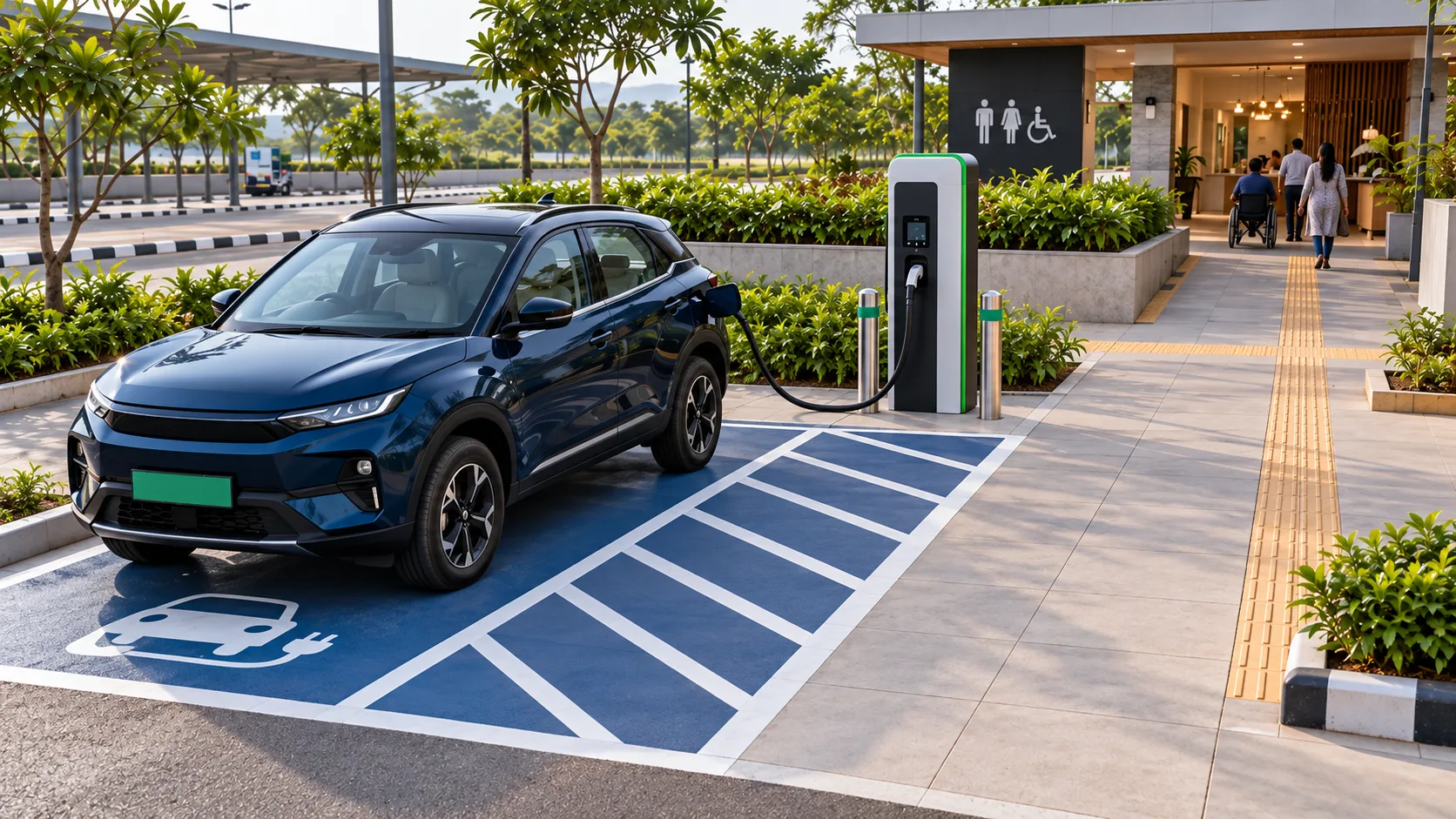
A cable can reach the vehicle yet still be difficult to use.
Its weight, stiffness, resting position and connector release mechanism all influence the effort needed to complete a session.
The Motability Foundation’s accessible charging programme draws on research into barriers faced by disabled people and supported the development of the UK’s PAS 1899 charging accessibility standard.
For procurement, request a practical equipment demonstration rather than relying only on a product photograph.
Ask participants to:
- Remove the connector from its holder.
- Move it towards different vehicle inlet positions.
- Insert and release it.
- Return it to the holder.
Where cable supports are proposed, test the complete movement. A support mechanism may reduce lifting effort but introduce resistance or limit reach.
Record where users encounter difficulty and ask suppliers to demonstrate improvements.
Make Instructions and Payment Easier to Use
Physical access does not guarantee that a customer can start charging.
As a practical design brief, consider the following features:
Readable information: Use clear wording, strong visual contrast and a layout that remains legible under expected lighting conditions.
Clear session status: Explain whether the charger is ready, authorising payment, charging or waiting for another action.
Useful error messages: State what the customer can do next instead of displaying only an unexplained code.
Accessible digital journeys: Test websites and apps with assistive technologies, including screen readers and enlarged text.
Payment choices: Evaluate an accessible alternative when a customer cannot complete an app-only process.
Reachable assistance: Make the support channel and charger identification easy to locate.
These features should be tested together. A usable payment terminal cannot compensate for an inaccessible connector, and a clear app cannot remove a blocked path.
Apply Indian Accessibility Guidance to the Project
India’s Department of Empowerment of Persons with Disabilities publishes the Ministry of Housing and Urban Affairs’ Harmonised Guidelines and Standards for Universal Accessibility in India 2021.
Project teams should use relevant Indian guidance and verify applicable requirements with their accessibility and design professionals.
International EV-specific references can help identify additional issues, but they do not replace the Indian framework or project-specific approvals.
The review should cover the installed environment, not just the charger’s brochure. Civil works, surfaces, approach routes, controls, lighting and amenities all affect the result.
Avoid describing a station as fully accessible solely because it includes a ramp or a wheelchair symbol.
Publish Information Customers Can Use
A general “accessible” label may not tell someone whether a location suits their particular requirements.
Building on the information gaps identified in the RiDC research, operators can publish practical details such as:
- Photographs showing the bay and charger approach.
- Whether the route includes steps or kerbs.
- Connector types and cable arrangements.
- Available payment methods.
- Site access hours.
- Assistance arrangements.
- Accessibility information for toilets or other amenities.
Keep this information specific and current.
For example, “step-free route from charging bay to café entrance” is more useful than a broad claim that leaves the customer guessing what was assessed.
Test With Disabled People and Older Drivers
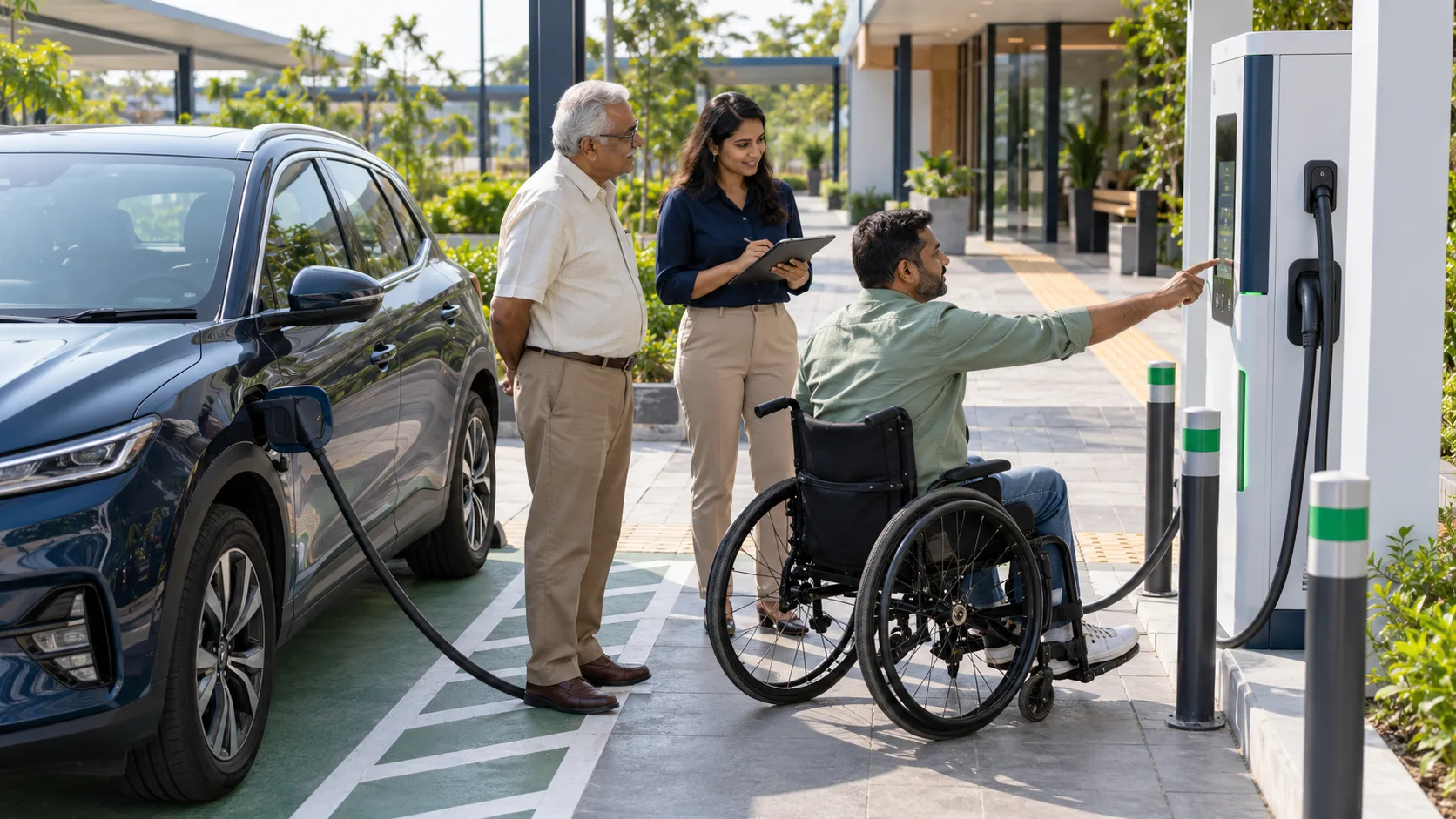
User involvement should begin while layout and equipment decisions can still change.
Invite participants with different access needs. One wheelchair user cannot represent every wheelchair user, and a single successful session does not establish universal usability.
A practical trial should include arrival, parking, connection, payment, error recovery and departure.
Record:
- Which steps participants complete independently.
- Where they request assistance.
- Whether the difficulty relates to equipment, layout or instructions.
- What changes they suggest.
- Whether those changes resolve the issue when retested.
Obtain permission before recording participants, and compensate people appropriately for their time and expertise.
The purpose is to improve the design through observed use, not to collect a promotional endorsement.
Keep Accessibility Working After Opening
Accessibility can deteriorate even when the original layout was carefully planned.
A temporary sign may obstruct an access aisle. A cable support may fail. A payment-screen update may make text harder to read.
Operators should include accessibility in routine site inspections and software reviews.
A suggested operating checklist is:
| Area | Routine check |
|---|---|
| Bay and access space | Clear of parked vehicles, storage and temporary obstructions |
| Surface and route | Free from damage or conditions that obstruct movement |
| Connector and cable | Holder, release mechanism and support system working |
| Interface | Instructions, status information and payment functioning |
| Lighting | Equipment and approach routes adequately illuminated |
| Support | Contact details current and assistance requests handled |
| Online information | Photographs and access details reflect the site |
EarthtronEV’s EV charging station maintenance guide provides related operational context.
Support staff should also ask what assistance the customer wants rather than making assumptions about their abilities.
Conclusion
Accessible EV charging stations in India need coordinated attention to parking, movement, equipment handling, information and payment.
The strongest approach combines relevant Indian guidance, useful international research and direct testing with people who have different access needs.
For developers, accessibility belongs in the initial design brief. For operators, it remains an ongoing responsibility through maintenance, accurate information and responsive support.
To discuss charging infrastructure requirements for your location, contact EarthtronEV.