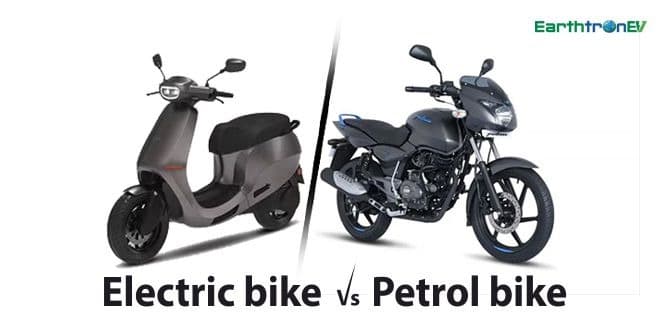
An electric bike or scooter usually costs more to buy than a comparable petrol bike, but it is far cheaper to run: roughly ₹0.25–0.35 per km charging at home, versus about ₹1.6–2.3 per km for a petrol bike. It also needs less maintenance — no engine oil, spark plugs or clutch. A petrol bike still wins on refuelling speed, long-distance range and a wider used-bike market. For daily city riding of 30–50 km, an electric two-wheeler usually works out cheaper within a few years.
Last updated: September 2026. Costs are indicative; your numbers depend on the model, fuel price and electricity tariff.
Electric Bike vs Petrol Bike: Quick Comparison
| Electric bike / scooter | Petrol bike / scooter | |
|---|---|---|
| Running cost | About ₹0.25–0.35 per km (home charging) | About ₹1.6–2.3 per km |
| Maintenance | Low — no engine oil, filters, spark plugs or clutch | Regular oil changes, tune-ups and more wearing parts |
| Refuelling | 2–6 hours at home; faster on some fast chargers | A few minutes at any petrol pump |
| Range | Typically about 80–150 km per charge | Typically 200+ km per tank |
| Ride | Instant torque, quiet, no gear changes | Familiar feel and sound; gears on motorcycles |
| Purchase price | Usually higher, partly offset by state subsidies and tax waivers | Usually lower upfront |
| Emissions | Zero tailpipe emissions | Tailpipe emissions and noise |
Running Cost Calculation
Petrol bike: at a mileage of 45–60 km per litre and a petrol price of about ₹95–105 per litre, fuel costs roughly ₹1.6–2.3 per km.
Electric bike: most electric two-wheelers cover about 25–35 km per kWh. At a home tariff of about ₹8 per unit, that is roughly ₹0.25–0.35 per km.
For a rider covering 1,000 km a month, that is about ₹1,600–2,300 on petrol versus about ₹250–350 on electricity — a saving of roughly ₹1,300–2,000 a month, before counting lower maintenance.
Advantages of an Electric Bike
- Much lower running and maintenance costs.
- Convenient home charging — start each day with a full battery.
- Smooth, quiet, gear-free riding with quick acceleration in traffic.
- State benefits such as subsidies and road-tax waivers in many states — see electric scooter subsidies in 2026.
- Future-proof in some cities: Delhi, for example, will register only new electric two-wheelers from 1 April 2028.
Advantages of a Petrol Bike
- Lower purchase price for comparable models.
- Quick refuelling and longer range — better for frequent long trips.
- Widespread service network and a well-established resale market.
Which Should You Buy?
- Choose electric if you ride mostly in the city, cover a predictable daily distance and can charge at home or work.
- Choose petrol if you regularly ride long distances without charging stops, or cannot charge where you park.
Charging an Electric Two-Wheeler
Most riders charge at home from a regular socket with the supplied charger. Public charging for two-wheelers is growing, including fast-charging networks for specific brands and shared charging at offices and societies. EarthtronEV installs two-wheeler charging for delivery hubs, residential societies and public parking — see EV charging stations for e-bikes.
Related Reading
- Is There a Government Subsidy on Electric Scooters in 2026?
- L3 E-Rickshaw vs L5 Electric Three-Wheeler: Differences, Rules and Subsidies
- EV Charger and Connector Types in India: Type 2, CCS2, Bharat and More
Frequently Asked Questions
Is an electric bike cheaper than a petrol bike?
To run, yes — roughly ₹0.25–0.35 per km versus ₹1.6–2.3 per km for petrol, plus lower maintenance. The purchase price is usually higher, but for regular city riders the running-cost savings typically make up the difference within a few years.
How many km does an electric bike run on one charge?
Most electric scooters and bikes cover about 80–150 km per charge in real-world riding, depending on the battery size, speed and load.
How much electricity does an electric scooter use to charge?
A typical 2.5–4 kWh battery needs about 3–4.5 units for a full charge, costing roughly ₹22–35 at ₹8 per unit.
Do electric bikes need maintenance?
Less than petrol bikes. There is no engine oil, filters or clutch to service, but tyres, brakes and suspension still need regular checks.