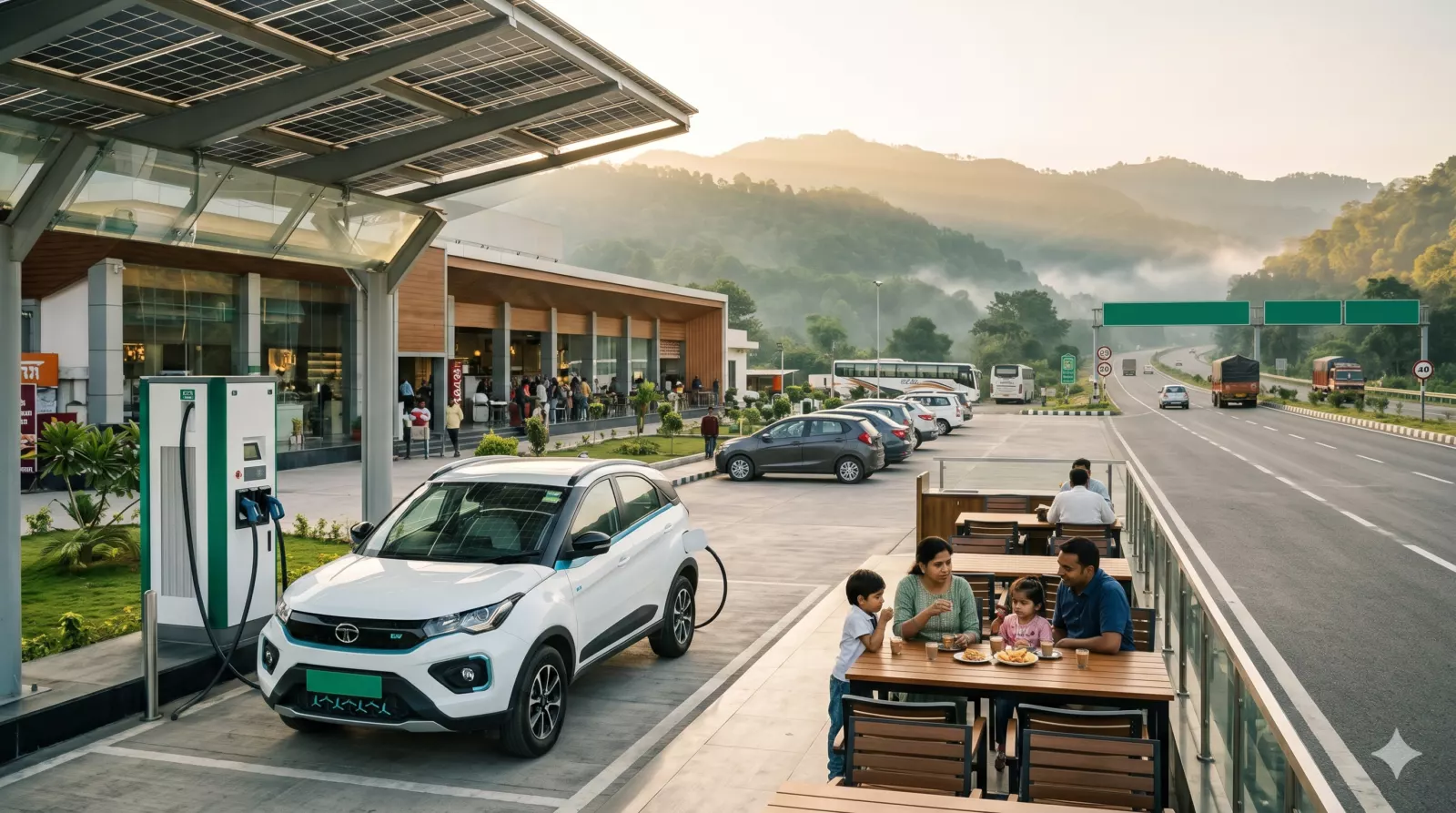
Quick Answer: Planning a highway road trip from Delhi-NCR in an electric car in 2027 is effortless when you match your route to 60 kW–240 kW CCS2 DC fast-charging corridors. A 30 to 45 kWh EV (240–340 km real-world highway range) easily covers Delhi to Agra (230 km), Delhi to Chandigarh (250 km via NH-44 Murthal), and Delhi to Jaipur (270 km via NH-48 Gurugram) with a single 25-to-35-minute meal-break top-up from 20% to 80%, while Delhi to Shimla (350 km) requires two planned DC fast-charging stops to account for the 25%–30% uphill mountain battery consumption between Kalka and Shimla.
How Highway Speed & Hill Climbs Affect Real-World EV Range in India
In city traffic between 30 and 50 km/h, electric cars constantly recover energy through regenerative braking whenever you slow down. On open national expressways like NH-44, NH-48, and the Yamuna Expressway—or on steep mountain climbs toward Himachal Pradesh and Uttarakhand—aerodynamic drag and elevation gain change your energy consumption.
Before setting off from EV charging stations in Delhi with a 100% battery, keep three real-world highway rules in mind:
- The 85–95 km/h Cruising Sweet Spot: Driving a compact or mid-size electric SUV at a steady 85–95 km/h delivers roughly 75% to 80% of its ARAI/MIDC claimed range (around 6.5–7.2 km per kWh). Pushing cruising speed to 110–120 km/h increases wind resistance exponentially, dropping efficiency by 18% to 25%.
- Uphill vs Downhill Mountain Math: Climbing from the plains (300 metres elevation at Chandigarh/Pinjore) to Shimla (2,200+ metres) increases battery consumption by 25% to 35% per km. However, on the return descent, regenerative braking recovers 15% to 25% of battery charge while keeping your wheel brakes cool.
- The 20% to 80% DC Fast-Charging Rule: On a 60 kW to 120 kW CCS2 charger, an EV charges fastest between 10% and 80% State of Charge (SoC). Above 80%, the Battery Management System (BMS) tapers current to protect cell health—meaning two short 25-minute stops are much faster than waiting 60+ minutes for a 100% highway charge.
Top 5 Highway EV Road Trip Routes from Delhi-NCR (2027 Comparison Matrix)
The table below summarises total one-way distance, real-world energy required (kWh), recommended DC fast-charging hubs, and charging stop duration for India’s most popular weekend and intercity corridors out of Delhi-NCR:
| Highway Route (One-Way) | Distance & Highway | Energy Used (Mid-Size EV) | Recommended Charging Strategy (30–45 kWh EV) | Recommended Charging Strategy (50–65+ kWh EV) |
|---|---|---|---|---|
| 1. Delhi to Chandigarh | ~250 km (NH-44 GT Road) | 34 – 38 kWh | 1 stop (20–30 min) at Murthal / Karnal corridor | Non-stop (or 15-min coffee top-up at Murthal) |
| 2. Delhi to Shimla & Theog | ~350 km (NH-44 & NH-5) | 52 – 58 kWh (incl. hill climb) | 2 stops: Murthal (NH-44) + Zirakpur/Dharampur before ascent | 1 stop before Kalka climb + destination charge in Shimla |
| 3. Delhi to Jaipur | ~270 km (NH-48 / NE-4) | 37 – 42 kWh | 1 stop (25–30 min) at Gurugram / Behror / Neemrana | Non-stop with 15%–20% buffer on arrival |
| 4. Delhi to Agra | ~230 km (NH-19 / Yamuna Exp.) | 32 – 36 kWh | 1 stop (20 min) at Faridabad (NH-19) or Jewar/Mathura | Non-stop door-to-door on a 100% home departure |
| 5. Delhi to Rohtak & Hisar | ~75 km / ~170 km (NH-9) | 11 kWh / 25 kWh | Rohtak round-trip (150 km) on 1 charge; top up on NH-9 Rohtak for Hisar | Easy round-trip to Rohtak; non-stop to Hisar |
Route-by-Route Fast-Charging Breakdown & Stop Planner
1. Delhi to Chandigarh via NH-44 (250 km): The Murthal Paratha & Charge Stop
NH-44 (Grand Trunk Road) is North India’s busiest electric mobility corridor. Leaving Delhi, Noida, or Ghaziabad with 90%–100% battery, most families naturally stop 50 to 60 km out at Murthal for breakfast or lunch. Plugging into our EV charging station on Murthal Highway (NH-44) while you dine tops your battery back up to 85%–95%, giving you more than enough range to reach Chandigarh or Mohali with 25%+ buffer remaining.
2. Delhi to Shimla & Theog via NH-44 and NH-5 (350 km): Conquering the Mountain Climb
Driving an electric car to the hills requires one golden rule: never start the Kalka–Solan–Shimla mountain climb below 65% battery. The 90 km uphill stretch from Pinjore to Shimla gains nearly 1,900 metres in elevation and consumes roughly 18 to 22 kWh in a compact SUV (equivalent to 135–150 km of flat-highway driving).
- Leg 1 (Delhi to Murthal / Ambala): Top up along NH-44 at Murthal during your meal break.
- Leg 2 (Foothills Top-Up): Top up to 80%–85% near Chandigarh/Zirakpur or Dharampur before climbing into Himachal.
- Leg 3 (Arrival in Shimla / Theog): Once in the hills, recharge easily at our EV charging stations in Shimla (including Hotel Exotica in Theog for travellers heading toward Narkanda and Kufri). On your return drive down from Shimla to Kalka, start with 75%–80% max so your battery has headroom to absorb regenerative braking energy on the descent.
3. Delhi to Jaipur via Gurugram & NH-48 (270 km)
Whether you take NH-48 through Gurugram, Manesar, and Behror or connect via the Sohna alignment, departing South or West Delhi with 100% charge gets a 40–55 kWh EV comfortably to Jaipur with one 20-minute comfort break. Drivers starting from Noida, Ghaziabad, or East Delhi with partial battery can top up on a 60 kW to 120 kW CCS2 charger at our EV charging stations in Gurugram (located at Omaxe Gurgaon Mall on Sohna Road Sector 49, SPR Sector 70, and Cyber Park Sector 39) before merging onto the highway.
4. Delhi to Agra via NH-19 Faridabad or Yamuna Expressway (230 km)
At ~230 km, Delhi to Agra is a single-charge drive for 45+ kWh EVs (such as the Tata Nexon EV 45, Curvv EV, MG Windsor EV Pro, and Hyundai Creta Electric) when cruising at 90 km/h. If you are driving a 24–35 kWh city EV or departing South Delhi/NCR without a full charge, EarthtronEV’s high-power 120 kW DC fast charger on NH-19 in Faridabad gives you a rapid 20-minute boost before you hit the highway.
Real-World Highway Range & DC Fast-Charging Time for Popular Indian EVs (2027)
Brochure MIDC/ARAI figures test cars at lower average speeds. Use this realistic highway table (cruising at 85–95 km/h with AC on) to plan your charging intervals:
| EV Model & Battery Pack | Claimed Range | Realistic Highway Range (100%→10%) | Safe Highway Leg Between Stops | 20%→80% Time on 60–120 kW DC Charger |
|---|---|---|---|---|
| Tata Tiago EV (24 kWh) | 285 km | 165 – 180 km | 130 – 150 km | ~45 – 50 mins |
| Tata Punch EV (30 / 40 kWh) | 365 / 468 km | 210 – 285 km | 175 – 240 km | ~26 – 40 mins |
| MG Windsor EV (38 / 52.9 kWh) | 332 / 449 km | 235 – 330 km | 195 – 280 km | ~35 – 45 mins |
| Tata Nexon EV (45 kWh) | 489 km | 295 – 325 km | 245 – 275 km | ~35 – 40 mins |
| Hyundai Creta Electric (42 / 51.4 kWh) | 420 / 510 km | 275 – 350 km | 230 – 300 km | ~35 – 45 mins |
| Tata Curvv EV (55 kWh) | 502 km | 340 – 375 km | 285 – 320 km | ~35 – 40 mins |
| Maruti Suzuki e Vitara (49 / 61 kWh) | 440 / 543 km | 310 – 390 km | 260 – 330 km | ~35 – 45 mins |
Want to compare how 30 kW, 60 kW, and 120 kW+ chargers affect your stop duration—or check ex-showroom prices across these models? Read our full electric car charging time in India (AC vs DC) guide and our comparison of the 10 best electric cars under ₹20 lakh in India.
6 Golden Rules for a Stress-Free Highway EV Road Trip in 2027
- Leave Home at 100% SoC on AC Power: Charge your car to 100% overnight on your home wallbox so your first highway leg gives you maximum buffer—and your cheapest per-km energy rate (₹1.05–₹1.30/km).
- Check Live Charger Status Before Exiting the Highway: Never rely on static map pins alone. Open the EarthtronEV app before your exit to confirm live CCS2 connector availability and kW output across all EarthtronEV charging station locations in Delhi NCR and highways.
- Time Your Charge With Meal Breaks (Not Fuel-Stop Habits): Instead of treating a charging stop like a 5-minute petrol refill, plug in at a highway dhaba, food court, or hotel where your family already spends 30 to 40 minutes ordering food and using washrooms.
- Keep UPI & App Wallet Ready: Public highway chargers in India are unmanned and digital. You can review our quick guide on how to pay for EV charging in India using apps, QR codes, and UPI before your first trip.
- Maintain Correct Cold Tyre Pressure (35–38 PSI): Under-inflated tyres increase rolling resistance on expressways and can reduce your highway range by 5% to 8%.
- Unplug at 80% When Others Are Waiting: Charging from 80% to 100% on a DC fast charger takes nearly as long as 20% to 80%. Unplugging at 80% gets you back on the highway faster and keeps bays free for fellow travellers.
Why Highway Dhabas, Hotels & Fuel Stations Are Installing Fast Chargers in 2027
Every weekend, thousands of high-spending EV families driving from Delhi-NCR to Chandigarh, Shimla, Jaipur, Agra, and Rishikesh choose their breakfast and lunch stops based on a single filter: Does this restaurant or hotel have a working 60 kW to 120 kW CCS2 fast charger?
For highway property owners, dhabas, resorts, and wayside amenities, hosting a fast-charging station creates two revenue streams at once: direct per-kWh charging income plus 30 to 45 minutes of guaranteed food, beverage, and room spending from every EV that pulls in. Through our EarthtronEV charging station franchise partner programme (starting from ₹10 lakh under a Franchise-Owned, Company-Operated model), EarthtronEV handles site assessment, DISCOM approvals, installation, app listing, and 24/7 maintenance with monthly revenue settlements.
Frequently Asked Questions (FAQs)
1. Can I drive an electric car from Delhi to Shimla in 2027?
Yes. The 350 km drive from Delhi to Shimla via NH-44 and NH-5 is easily doable in any modern electric car with a 30 kWh or larger battery. Plan a breakfast top-up on NH-44 (such as Murthal), top up to 80%–85% near Chandigarh/Zirakpur before starting the Kalka–Shimla mountain climb, and use destination charging in Shimla or Theog.
2. How many charging stops are needed from Delhi to Chandigarh by electric car?
For electric cars with a 50+ kWh battery (such as the Tata Curvv EV, MG Windsor EV Pro, Hyundai Creta Electric, or Maruti e Vitara), Delhi to Chandigarh (~250 km) can be driven non-stop on a 100% departure charge. For 30 to 45 kWh EVs (such as the Punch EV or Nexon EV), one 20-to-30-minute DC fast-charging stop on NH-44 at Murthal or Karnal is all you need.
3. How much range does an electric car lose at highway speeds of 100–120 km/h?
Cruising at 85–95 km/h delivers optimal highway efficiency (roughly 75%–80% of ARAI/MIDC claimed range). Increasing cruising speed from 90 km/h to 115–120 km/h on expressways increases aerodynamic drag and reduces real-world range by 18% to 25%.
4. Does an electric car lose battery faster when driving uphill to hill stations?
Yes, climbing steep mountain gradients (such as Kalka to Shimla or Dehradun to Mussoorie) uses 25% to 35% more energy per km than flat highway driving. However, on the downhill return trip, regenerative braking recharges the battery and recovers 15% to 25% of that energy while reducing brake wear.
5. Which connector is used for highway fast charging in India?
Almost all modern electric cars in India—including models from Tata, MG, Mahindra, Hyundai, Maruti Suzuki, Kia, and BYD—use the CCS2 (Combined Charging System 2) connector for DC fast charging on highways, and the Type 2 connector for AC charging at homes and hotels.
6. How much does it cost to charge an electric car on Indian highways in 2027?
Public DC fast charging on Indian highways typically costs ₹18 to ₹24 per kWh (plus GST). For a 45 kWh electric SUV topping up from 20% to 80% (~27 kWh added), a highway fast-charging session costs roughly ₹500 to ₹650, working out to ₹2.65–₹3.25 per km—still less than half the fuel cost of a petrol SUV.