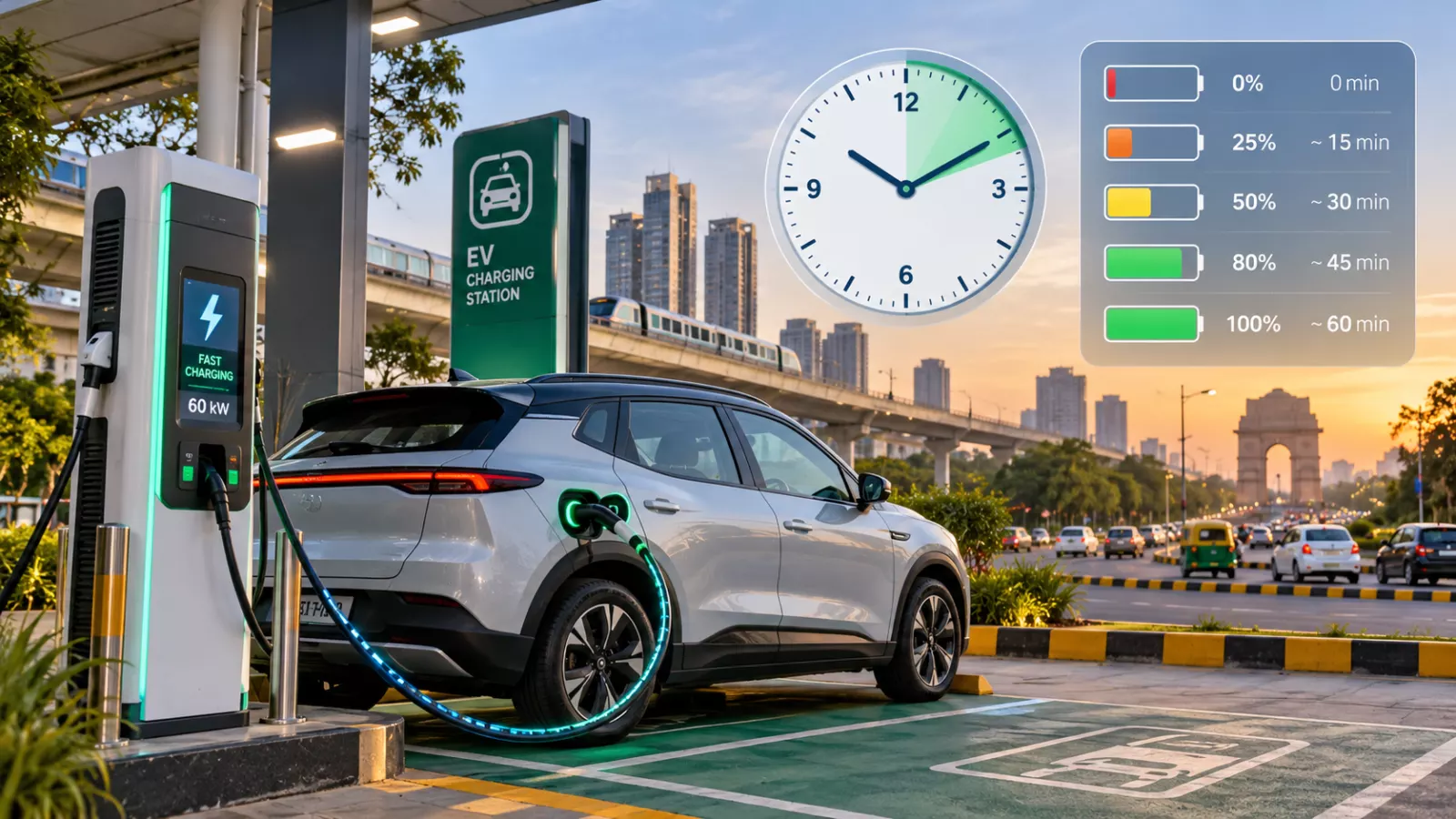
Quick Answer: Electric car charging time in India ranges from 30 to 60 minutes (10% to 80%) on a 30 kW to 60 kW DC fast charger, 4 to 7 hours (0% to 100%) on a 7.2 kW AC home or workplace wallbox, and 12 to 16 hours on a standard 15A (3.3 kW) household socket. Ultra-fast highway chargers rated at 120 kW to 150+ kW can top up compatible high-voltage EVs from 10% to 80% in 20 to 30 minutes.
If you are buying your first electric car—or planning to install a commercial charger at your property—the most common question is simple: how long does it actually take to charge an EV in Indian conditions? Brochure numbers often quote ideal laboratory speeds, but real-world charging time depends on your battery capacity (kWh), the charger’s kilowatt (kW) output, your car’s onboard charging limit, and the 80% battery tapering curve.
This guide breaks down real-world electric car charging time in India across every charger level, compares 30 kW vs 60 kW DC fast charging time for popular Indian EVs, and explains how drivers and station hosts can match charger speed to actual stop durations.
How Long Does It Take to Charge an EV in India? (By Charger Level)
Short answer: You can estimate charging time using a simple formula: Charging Time (Hours) = Battery Capacity Added (kWh) ÷ Effective Charger Power (kW), plus roughly 10% to 15% for heat and conversion losses.
In India, electric car charging falls into four practical tiers across residential setups and public EV charging stations:
| Charger Level | Power Output | Connector Type | Time to Charge a 45 kWh EV | Range Added in 30 Mins | Best Suited For |
|---|---|---|---|---|---|
| Level 1: 15A Home Socket (AC) | 2.5 – 3.3 kW | 3-Pin Plug / Bharat AC-001 | 14 – 16 hours (10%–100%) | ~10 – 12 km | Overnight backup charging at home |
| Level 2: Fast AC Wallbox | 7.2 – 22 kW | Type 2 AC | 6 – 6.5 hours at 7.2 kW (0%–100%) | ~25 – 30 km | Home garages, apartments, offices, hotels |
| Level 3: Standard DC Fast Charger | 30 – 60 kW | CCS2 DC | 40 – 60 mins (10%–80%) | ~110 – 180 km | City commercial hubs, restaurants, malls |
| Level 3: High-Power DC Hub | 120 – 360 kW | CCS2 Dual-Gun DC | 20 – 35 mins (10%–80%, car dependent) | ~200 – 300+ km | National highways, intercity corridors, fleets |
For a deeper look at plug compatibility across two-wheelers, three-wheelers, and four-wheelers, see our guide on types of EV chargers and connectors in India.
Real-World Electric Car Charging Time for Popular Indian EVs (2026)
Short answer: Compact city EVs (19.2–24 kWh) take roughly 2.6 to 3.6 hours on a 7.2 kW AC charger and ~58 minutes on DC fast charging, while mid-size and large electric SUVs (45–79 kWh) take 6.5 to 11.7 hours on AC and 20 to 56 minutes (10% to 80%) on a compatible DC fast charger.
Based on published manufacturer specifications and commuter benchmarks from Tata Power and CarDekho, here is how India’s bestselling electric cars compare:
| Electric Car Model | Battery Capacity | 15A Socket (3.3 kW AC) | 7.2 / 7.4 kW AC Wallbox | DC Fast Charging Time (10%–80%) |
|---|---|---|---|---|
| Tata Tiago EV (Medium Range) | 19.2 kWh | ~6 hrs 54 mins (10%–100%) | ~2 hrs 36 mins (10%–100%) | ~58 mins (@ 50 kW DC) |
| Tata Tiago EV (Long Range) | 24 kWh | ~8 hrs 40 mins (10%–100%) | ~3 hrs 36 mins (10%–100%) | ~58 mins (@ 50 kW DC) |
| Tata Nexon EV (45) | 45 kWh | ~15 hrs (10%–100%) | ~6 hrs 30 mins (0%–100%) | ~40 – 56 mins (@ 50–60 kW DC) |
| Hyundai Kona Electric | 39.2 kWh | ~13 – 14 hrs (0%–100%) | ~6 hrs 10 mins (0%–100%) | ~57 mins (@ 50 kW DC) |
| MG ZS EV | 50.3 kWh | ~16 – 18 hrs (0%–100%) | ~8.5 – 9 hrs (0%–100% @ 7.4 kW) | ~40 – 60 mins (@ 50–76 kW DC) |
| Mahindra BE 6 / XEV 9e | 59 kWh / 79 kWh | 18 – 24+ hrs | ~8.7 hrs (59 kWh) / ~11.7 hrs (79 kWh) | ~20 mins (@ 140 kW+ DC) / ~45–60 mins (@ 60 kW DC) |
30 kW vs 60 kW Charging Time: What Is the Real Difference?
Short answer: A 60 kW DC fast charger cuts 10% to 80% charging time nearly in half compared to a 30 kW DC charger—if the car’s battery management system (BMS) accepts 50–60 kW or more, or if two cars are charging simultaneously on a dual-gun unit.
1. Single-Vehicle Charging Speed
- On a 30 kW DC charger: Delivering ~28 kW after conversion losses takes roughly 65 to 75 minutes to add 32–35 kWh (10% to 80% on a 45–50 kWh SUV).
- On a 60 kW DC charger: Vehicles that accept 50–76 kW peak DC input complete the same 10% to 80% session in 38 to 50 minutes—the exact length of a meal stop at our EV charging station on Murthal Highway (NH-44).
2. Why Entry-Level EVs Charge at the Same Speed on Both
Every electric car has a maximum DC acceptance rate set by its battery chemistry and thermal management system (MG Motor India). For example, a Tata Tiago EV caps its DC input below 25–30 kW. Plugging a Tiago EV into a 60 kW or 150 kW charger will still take roughly 58 minutes from 10% to 80% because the car limits the power flow.
3. Dual-Gun Load Splitting at Busy Stations
On a dual-gun 60 kW DC fast charger, two electric cars can plug in at the same time and draw 30 kW each without waiting in line.
5 Real-World Factors That Slow Down EV Charging Time in India
1. The 80% Battery Tapering Curve
DC fast charging runs at peak power between 10% and 80%, then throttles down sharply for the final 20% to prevent cell overheating and preserve long-term battery health.
2. Indian Summer Heat and Thermal Throttling
When ambient temperatures cross 40°C–45°C across North and Central India, the car’s BMS diverts power to liquid cooling loops and reduces charging current to protect the cells.
3. Onboard Charger (OBC) Limits on AC Charging
When you use AC EV chargers (3.3–22 kW), the car’s internal onboard charger converts AC to DC. A car with a 7.2 kW onboard charger plugged into a 22 kW AC unit will still charge at 7.2 kW.
4. Grid Voltage Drops and Shared Site Loads
Simultaneous site demand can lower output unless the location uses dynamic load management for EV charging.
5. Running Cabin AC While Fast Charging
Keeping the air conditioning running inside the cabin during a summer highway stop draws 1.5 to 3 kW continuously, adding 5 to 8 minutes to a fast-charging session.
How Charging Time Affects Charging Cost (Home vs Public Stations)
According to 2026 charging cost benchmarks (VIDA) and state electricity regulatory tariff orders, here is how speed and cost trade off for a 45 kWh electric SUV (~320 km real-world range):
| Charging Method | Typical Tariff (₹/kWh) | Full Charge Cost (45 kWh + 10% Loss) | Running Cost Per Km | Time Required |
|---|---|---|---|---|
| Home AC Charging (Domestic / EV Meter) | ₹4.50 – ₹9.00 / kWh | ₹225 – ₹445 | ₹0.70 – ₹1.40 / km | 6.5 – 15 hours |
| Public AC Charging (7.2 – 22 kW) | ₹8.00 – ₹15.00 / kWh | ₹395 – ₹740 | ₹1.25 – ₹2.30 / km | 4 – 6.5 hours |
| Public DC Fast Charging (30 – 120 kW) | ₹15.00 – ₹25.00 / kWh | ₹740 – ₹1,235 (₹520–₹865 for 10%–80%) | ₹2.30 – ₹3.85 / km | 30 – 55 minutes (10%–80%) |
| Comparable Petrol SUV (13 km/l @ ₹95–₹105/l) | N/A (Petrol) | ~₹2,300 – ₹2,600 for 320 km | ₹7.30 – ₹8.10 / km | 5 minutes refuel |
Read our complete guide to electricity tariffs for EV charging by state in India (2026) for state-by-state DISCOM rates.
For Property Owners & Franchise Investors: Matching Charger Speed to Customer Dwell Time
India’s public charging network crossed 29,151 stations by December 2025 (VIDA), and the Ministry of Heavy Industries has allocated ₹2,000 crore for public charging infrastructure under the ₹10,900 crore PM E-DRIVE scheme (with ₹851 crore approved for 8,147 public chargers as of September 2026). Yet India still needs at least 5,00,000 public charging points by 2030.
When planning an EV charging station franchise with EarthtronEV, match the charger rating to how long drivers naturally park at your site:
- Offices, Hotels & Residential Societies (2 to 8+ hours dwell time): 7.4 kW to 22 kW AC Smart Chargers.
- Roadside Restaurants, Dhabas & Retail Markets (30 to 60 minutes dwell time): 40 kW DC setup (₹10L–₹14L full setup cost, ~100–150 sq ft) or 60 kW DC setup (₹14L–₹20L full setup cost, ~150–200 sq ft).
- National Highways & Fleet Corridors (15 to 35 minutes dwell time): 150 kW to 240 kW DC hubs (₹28L–₹75L full setup cost) across corridors like EV charging stations in Gurugram, EV charging stations in Noida, and NH-44.
Model your site’s payback timeline using the EarthtronEV Revenue Calculator.
Practical Tips to Reduce Your EV Charging Time
- Stop DC fast charging at 80%: Saves 25 to 35 minutes on highway stops.
- Upgrade from a 15A socket to a 7.2 kW wallbox at home: Cuts overnight recharge time from 15 hours to 6 hours.
- Plug in while the battery is warm: Helps DC fast chargers reach peak kW output faster.
- Check connector kW ratings on the app before arriving: Select a 60 kW or 120 kW CCS2 bay via the EarthtronEV app.
Frequently Asked Questions (FAQs)
How long does it take to charge an electric car in India?
Charging an electric car in India takes 30 to 60 minutes (10% to 80%) using a 30 kW to 60 kW public DC fast charger, 4 to 7 hours (0% to 100%) using a 7.2 kW AC home wallbox, and 12 to 16 hours using a standard 15A (3.3 kW) domestic wall socket.
What is the difference between 30 kW and 60 kW charging time?
For a 45–50 kWh electric SUV (such as the Tata Nexon EV 45 or MG ZS EV), a 30 kW DC charger takes about 65 to 75 minutes to charge from 10% to 80%, whereas a 60 kW DC charger completes the same 10% to 80% charge in 38 to 50 minutes, provided the car supports 50 kW+ DC input.
Why does EV fast charging slow down after 80%?
EV batteries slow down after 80% state of charge because the vehicle’s Battery Management System (BMS) reduces electrical current (tapering) to prevent cell overheating and lithium plating.
Can I charge my electric car in 15 minutes in India?
Newer electric SUVs with high-power DC acceptance (such as the Mahindra BE 6 and XEV 9e) can charge from 10% to 80% in roughly 20 minutes on a 140 kW+ DC fast charger, or add 100+ km of range in 10 to 15 minutes.
Does fast charging every day damage an electric car battery?
Occasional highway DC fast charging has minimal impact on modern liquid-cooled EV batteries, though AC charging at home or work is recommended for routine daily commutes.
Which DC charger capacity is best for a small commercial EV charging franchise?
For restaurants, retail hubs, and cab-aggregator stands where drivers spend 30 to 60 minutes, a 40 kW or 60 kW CCS2 DC fast charger (requiring 100–200 sq ft and ₹10–20 lakh total setup investment under EarthtronEV’s FOCO model) offers the best balance between fast turnaround and setup cost.