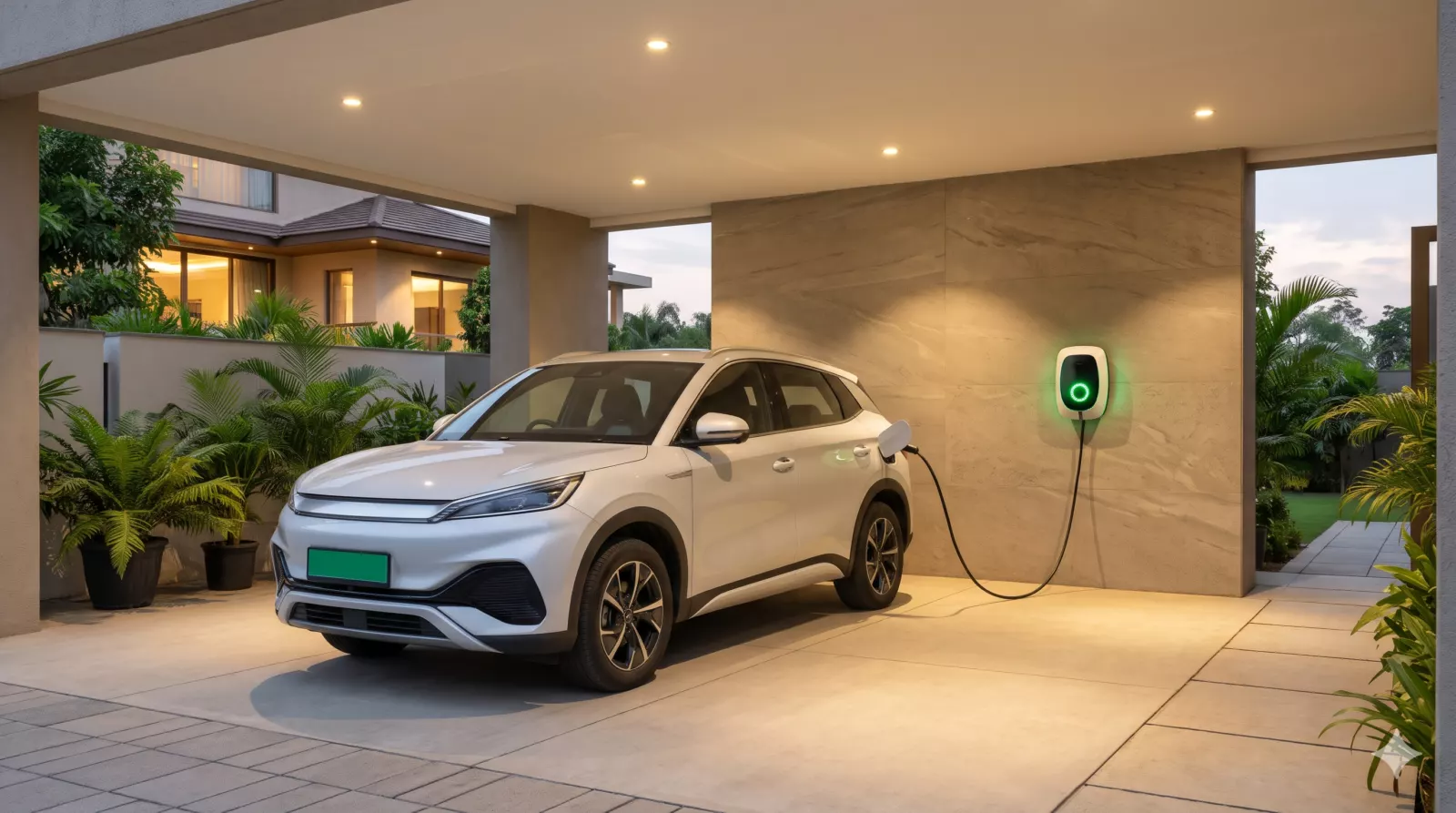
Quick Answer: In India in 2027, a 3.3 kW AC charger runs on a standard single-phase (230V, 15A/16A) domestic connection and adds 18 to 22 km of range per hour (10 to 17 hours for a 10–100% charge on a 35–55 kWh battery), making it ideal for daily drives under 60 km and existing 3–5 kW home meters. A 7.2 kW / 7.4 kW Type-2 smart wallbox requires a 7–8 kW sanctioned load (single-phase 32A or three-phase supply), adds 40 to 48 km of range per hour, and finishes a 10–100% overnight charge in 5 to 8 hours for 40–60 kWh EVs. An 11 kW three-phase (415V, 16A per phase) smart wallbox adds 60 to 75 km of range per hour and charges large 59–79 kWh batteries in 5.5 to 7.5 hours, but only delivers 11 kW to EVs fitted with an 11 kW three-phase onboard charger (such as the Mahindra BE 6, Mahindra XEV 9e, Hyundai Creta Electric 11 kW variant, BYD Atto 3, and BYD Seal).
3.3 kW vs 7.2 kW / 7.4 kW vs 11 kW Home EV Charger: 2027 Master Comparison Table
Whether you are taking delivery of a Tata Nexon EV, Punch EV, Curvv EV, MG Windsor EV, Hyundai Creta Electric, Maruti Suzuki e Vitara, or Mahindra BE 6 / XEV 9e in 2027, choosing the right home AC charger determines whether your car tops up effortlessly overnight or leaves you waiting on domestic sockets. When comparing AC smart EV chargers from 3.3 kW to 22 kW, note that 7.2 kW and 7.4 kW refer to the exact same 32-Amp single-phase Type-2 wallbox—at 225V it delivers 7.2 kW, and at India’s nominal 230V it delivers 7.36–7.4 kW.
| Specification / Parameter | 3.3 kW AC Home Charger | 7.2 kW / 7.4 kW AC Wallbox | 11 kW AC Smart Wallbox |
|---|---|---|---|
| Connector Type | 16A 3-Pin Industrial Socket or Type-2 Plug | Type-2 (IEC 62196-2) Tethered Gun | Type-2 (IEC 62196-2) Tethered Gun |
| Electrical Supply & Voltage | Single-Phase (230V AC) | Single-Phase (230V AC) (often on a 3-Phase meter) | Three-Phase (415V AC) |
| Rated Current Draw | 14.5A – 16A (Single Phase) | 32A (Single Phase) | 16A per phase across 3 Phases |
| Real-World Power Delivered to Battery (After ~90% OBC Efficiency) | ~2.9 – 3.0 kW | ~6.5 – 6.7 kW | ~9.8 – 10.0 kW |
| Units Added to Battery Per Hour | ~3.0 kWh / hour | ~6.6 kWh / hour | ~10.0 kWh / hour |
| Real-World Range Added Per Hour | 18 – 22 km / hour | 40 – 48 km / hour | 60 – 75 km / hour |
| 10% to 100% Charge Time (40 kWh Battery) | ~12.0 hours | ~5.5 hours | ~3.6 hours (if car supports 11 kW OBC) |
| 10% to 100% Charge Time (60 kWh Battery) | ~18.0 hours | ~8.2 hours | ~5.4 hours (if car supports 11 kW OBC) |
| 10% to 100% Charge Time (79 kWh Battery) | ~23.5 hours | ~10.8 hours | ~7.1 hours |
| Minimum Recommended Home Sanctioned Load | 3 kW – 5 kW | 7 kW – 10 kW | 10 kW – 15 kW (3-Phase mandatory) |
| Recommended Copper Cable Size (Up to 30m Run) | 3-Core x 4.0 sq mm (or 6.0 sq mm armoured) | 3-Core x 6.0 sq mm to 10.0 sq mm armoured | 5-Core x 6.0 sq mm armoured |
| MCB & RCCB Protection Rating | 20A Curve-C MCB + 25A/30mA Type-A/B RCCB | 40A Curve-C DP MCB + 40A/30mA Type-B RCCB | 25A Curve-C 4-Pole MCB + 25A/30mA 4P Type-B RCCB |
| Typical Total Hardware + Standard Wiring Cost (2027) | ₹9,000 – ₹18,000 (often bundled free with EV) | ₹32,000 – ₹52,000 | ₹42,000 – ₹68,000 |
The Golden Rule of AC Charging: Why Your Car’s Onboard Charger (OBC) Decides Your Speed
The single biggest mistake first-time EV buyers make when researching electric car charging time in India is assuming that buying a higher-kilowatt wallbox automatically makes any electric car charge faster.
In AC home charging, the wallbox on your parking pillar is technically an EVSE (Electric Vehicle Supply Equipment)—a smart safety controller, energy meter, and power relay. The actual AC-to-DC conversion happens inside your car’s Onboard Charger (OBC). Therefore, your actual charging speed is always governed by whichever is lower:
Actual AC Charging Power (kW) = MIN(Wallbox Power Rating, Vehicle Onboard Charger Limit, Home Phase Availability)
- Scenario A (Car Limited to 3.3 kW OBC): If you own a base/mid variant of an entry-level EV with a 3.3 kW onboard charger and plug it into a 7.4 kW or 11 kW wallbox, the car will still draw only 3.3 kW.
- Scenario B (Car Limited to 7.2 kW Single-Phase OBC): If your EV has a 7.2 kW single-phase onboard charger (such as most variants of the Tata Nexon EV, Tata Curvv EV, and MG Windsor EV) and you plug it into an 11 kW three-phase wallbox, the car uses only one of the three phases at 16A (230V × 16A = ~3.6 kW)—unless the wallbox is a 22 kW 3-phase unit (which supplies 32A per phase, allowing a single-phase 7.2 kW car to draw its full 7.2 kW on Phase 1) or a dedicated 7.4 kW 32A single-phase wallbox.
- Scenario C (Car Equipped with an 11 kW Three-Phase OBC): If your EV features an 11 kW 3-phase onboard charger (such as the Mahindra BE 6, Mahindra XEV 9e, Hyundai Creta Electric 11 kW option, or BYD Atto 3 / Seal), an 11 kW 3-phase wallbox unlocks the full 11 kW charging rate, filling even a massive 59–79 kWh battery pack in a single night.
Car-Wise Home Charging Time & Max AC Support in India (2027 Models)
Whether you are shopping among the best electric cars under ₹20 lakh in India or upgrading to one of the top electric SUVs under ₹30 lakh in India, checking your exact variant’s onboard AC charger rating before ordering wallbox hardware saves tens of thousands of rupees. The table below compares real-world 10% to 100% home charging times across India’s most popular 2027 electric cars:
| EV Model (2027 India Lineup) | Battery Capacity | Max Onboard AC Charger (OBC) Support | 10–100% Time on 3.3 kW Charger | 10–100% Time on 7.2 / 7.4 kW Charger | 10–100% Time on 11 kW 3-Phase Charger | Recommended Home Charger |
|---|---|---|---|---|---|---|
| Tata Tiago EV / Tigor EV | 19.2 – 24 kWh | 3.3 kW (MR) / 7.2 kW (LR) | 6.0 – 7.5 hrs | 3.2 hrs (LR 7.2 kW OBC) | Same as 3.3 / 3.6 kW (1-Phase OBC) | 3.3 kW (or 7.2 kW if driving 120+ km/day) |
| Tata Punch EV (MR & LR) | 25 – 35 kWh | 3.3 kW / 7.2 kW | 7.8 – 10.8 hrs | 3.5 – 4.9 hrs | Same as 1-Phase OBC limit | 3.3 kW (<60 km/day) or 7.4 kW (>70 km/day) |
| MG Windsor EV (38 kWh & 52.9 kWh Pro) | 38 – 52.9 kWh | 3.3 kW / 7.4 kW | 11.5 – 16.0 hrs | 5.2 – 7.3 hrs | Same as 1-Phase OBC limit | 7.4 kW Smart Wallbox |
| Tata Nexon EV (30 & 45 kWh) | 30 – 45 kWh | 7.2 kW (1-Phase) | 9.2 – 13.8 hrs | 4.3 – 6.4 hrs | Same as 1-Phase OBC limit | 7.4 kW Smart Wallbox (or 3.3 kW for light use) |
| Tata Curvv EV (45 & 55 kWh) | 45 – 55 kWh | 7.2 kW (1-Phase) | 13.8 – 16.8 hrs | 6.4 – 7.8 hrs | Same as 1-Phase OBC limit | 7.4 kW Smart Wallbox |
| Hyundai Creta Electric (42 & 51.4 kWh) | 42 – 51.4 kWh | 11 kW (3-Phase Smart Wallbox) | 12.8 – 15.6 hrs | 5.8 – 7.1 hrs | 3.9 – 4.7 hrs | 11 kW 3-Phase (if 3-phase home meter) or 7.4 kW |
| Maruti Suzuki e Vitara (49 & 61 kWh) | 49 – 61 kWh | 7.2 kW / 11 kW (Variant-dependent) | 15.0 – 18.5 hrs | 6.8 – 8.5 hrs | 4.5 – 5.6 hrs (on 11 kW OBC) | 7.4 kW or 11 kW Smart Wallbox |
| Mahindra BE 6 & XEV 9e (59 & 79 kWh) | 59 – 79 kWh | 7.2 kW (1-Phase) / 11 kW (3-Phase) | 18.0 – 24.0 hrs | 8.2 – 11.0 hrs | 5.5 – 7.3 hrs | 11 kW 3-Phase Smart Wallbox (Essential for 79 kWh) |
| BYD Atto 3 / eMAX 7 / Seal | 50 – 82.5 kWh | 7.2 kW / 11 kW | 15.2 – 25.0 hrs | 7.0 – 11.4 hrs | 4.8 – 7.5 hrs (on 11 kW OBC) | 7.4 kW or 11 kW Smart Wallbox |
Single-Phase vs Three-Phase DISCOM Sanctioned Load Requirements in India
Before mounting a wallbox in your garage or apartment stilt slot, you must check the Sanctioned Load (in kW or kVA) and Phase Supply (1-Phase vs 3-Phase) printed on your monthly electricity bill. For a complete foundational breakdown of residential electrical math, read our dedicated guide on how much power is required for EV charging in India.
- Single-Phase Supply Limits across Indian DISCOMs (3 kW to 5 kW / 7 kW): Most state electricity distribution companies (BSES/TPDDL in Delhi, UPPCL in Noida/Ghaziabad, DHBVN in Gurugram, MSEDCL in Maharashtra, BESCOM in Karnataka, and TANGEDCO in Tamil Nadu) supply Single-Phase (230V) up to a sanctioned load of 5 kW (or up to 7 kW in select circles). Anything above 5–7 kW automatically requires a Three-Phase (415V, 4-wire) meter.
- Running a 3.3 kW Charger on Your Existing Home Meter: A 3.3 kW charger pulls roughly 3.0–3.2 kW (14–15 Amps)—similar to two 1.5-ton split air conditioners or an instant water geyser. If your home already has a 4 kW or 5 kW single-phase meter and you charge after 11:00 PM when kitchen appliances and geysers are off, you typically do not need any sanctioned load enhancement.
- Sanctioned Load Required for a 7.2 kW / 7.4 kW Wallbox: Because a 7.4 kW wallbox continuously draws 32 Amps on a single phase (~7.2 to 7.4 kW) for 5 to 8 hours straight, running it alongside overnight air conditioners (1.5–2.5 kW) and refrigerators on a 4 kW or 5 kW meter will trigger Maximum Demand Indicator (MDI) penalties or trip your smart meter relay. You should either enhance your domestic sanctioned load to 8 kW – 10 kW (Three-Phase), apply for a separate Dedicated Domestic EV Sub-Meter / Green EV Tariff Meter (7.5 kW to 11 kW), or use a wallbox with dynamic load management (DLM) for EV charging via a clamp-on CT (Current Transformer) sensor on your incoming main wire, which automatically throttles EV charging down from 32A (7.4 kW) to 16A (3.6 kW) or 10A (2.3 kW) whenever your household air conditioners spike.
- Sanctioned Load Required for an 11 kW Three-Phase Wallbox: An 11 kW wallbox strictly requires a Three-Phase (415V) connection with a total sanctioned load of 10 kW to 15 kW (or a dedicated 11 kW EV meter).
Home Charger Price, Armoured Cable Sizing & Installation Cost Breakdown (2027)
Many EV owners focus only on the price of the wallbox unit and overlook the cost of IS-certified copper armoured cabling, protective switchgear, earthing, and DISCOM load enhancement fees. Below is a transparent 2027 cost breakdown for a typical Indian independent house or apartment parking bay (assuming a 25-metre cable run from the meter room to the parking pillar):
| Cost Component (2027 Benchmark) | 3.3 kW AC Charger Setup | 7.2 kW / 7.4 kW Smart Wallbox | 11 kW 3-Phase Smart Wallbox |
|---|---|---|---|
| 1. Smart Charger Hardware Price (Standalone / Upgrade cost if not bundled with car) |
₹7,500 – ₹14,000 (Portable 3.3 kW box is usually free with EV) |
₹24,000 – ₹36,000 | ₹30,000 – ₹45,000 |
| 2. Armoured Copper Cable (25m Run) (XLPE insulated, FRLS PVC sheathed armoured cable) |
3C × 4.0 sq mm Copper ₹3,200 – ₹4,800 (~₹130–₹190/metre) |
3C × 6.0 or 10.0 sq mm Copper ₹5,500 – ₹9,500 (~₹220–₹380/metre) |
5C × 6.0 sq mm Copper ₹7,500 – ₹11,000 (~₹300–₹440/metre) |
| 3. Weatherproof DB Box, MCB, RCCB & SPD (IP65 enclosure + overload & earth-leakage protection) |
20A MCB + 30mA RCCB + Metal Socket Box ₹1,800 – ₹3,200 |
40A DP MCB + 40A Type-B RCCB + Type-2 SPD ₹4,500 – ₹7,500 |
25A 4P MCB + 25A 4P Type-B RCCB + 3-Phase SPD ₹6,500 – ₹10,500 |
| 4. Civil Conduit, GI Clamps, Glands & Certified Labour | ₹1,500 – ₹2,500 | ₹2,500 – ₹4,500 | ₹3,000 – ₹5,500 |
| 5. DISCOM Sanctioned Load Increase Deposit & Meter Fee (Varies by state DISCOM; refundable security deposit + meter upgrade) |
₹0 – ₹3,000 (Usually not required on 4–5 kW meters) |
₹4,500 – ₹12,000 (Adding 4–5 kW load + 1P-to-3P meter swap if needed) |
₹7,000 – ₹18,000 (Adding 6–8 kW load on 3-Phase connection) |
| Total Estimated Out-of-Pocket Cost (When Charger Hardware is Purchased Separately) | ₹14,000 – ₹24,500 | ₹41,000 – ₹69,500 | ₹54,000 – ₹90,000 |
| Total Installation + Load Upgrade Cost (When Charger Hardware is Bundled with Car) | ₹6,500 – ₹10,500 | ₹17,000 – ₹33,500 | ₹24,000 – ₹45,000 |
Electrical Secret: Why an 11 kW 3-Phase Charger Can Be Easier on Your Home Grid Than a 7.4 kW 1-Phase Charger
Here is a counter-intuitive electrical engineering fact that surprises most homeowners and RWA facility managers: an 11 kW three-phase EV charger actually draws half the per-phase current of a 7.4 kW single-phase EV charger.
- How a 7.4 kW Single-Phase Wallbox Loads Your Meter: A 7.4 kW wallbox pulls 32 Amps continuously on a single phase (say, the R-Phase) while pulling 0 Amps on the Y-Phase and B-Phase. If your building or house has a 3-phase meter rated at 10 kW or 12 kW (where each phase is typically balanced for ~18–25 Amps before your main 32A/40A 4-pole breaker trips), putting a 32-Amp single-phase EV load onto R-Phase leaves almost no headroom on that phase for an air conditioner or geyser.
- How an 11 kW Three-Phase Wallbox Balances the Load: An 11 kW three-phase wallbox splits its power evenly across all three phases: 3.68 kW on R-Phase (16A), 3.68 kW on Y-Phase (16A), and 3.68 kW on B-Phase (16A). Because each phase only sees a gentle 16-Amp draw (the exact same per-phase current as a modest 3.3 kW charger), there is zero phase imbalance, lower voltage drop across long basement cable runs, and far less thermal stress on your main distribution board.
- Pro Tip for Single-Phase 7.2 kW Cars on a 3-Phase Home Meter: If your car only has a 7.2 kW single-phase onboard charger (like the Tata Nexon EV 45, Curvv EV, or MG Windsor EV), buy a 7.4 kW single-phase smart wallbox and ask your licensed electrician to connect it to the least-loaded phase of your 3-phase home distribution board (not the phase feeding your master bedroom AC), alongside a CT-clamp load balancer.
Installing a Home Charger in Apartments & Group Housing Societies (RWA Guide)
Over 65% of urban EV buyers in Delhi-NCR, Mumbai, Bengaluru, Hyderabad, Pune, and Chennai live in high-rise apartments or gated societies where the allocated parking slot is 30 to 90 metres away from the meter room. If you are planning a society installation, EarthtronEV provides turnkey EV charging stations for home and apartments with RWA-compliant safety documentation and OCPP smart billing. Keep these four practical rules in mind:
- Right to Charge & MoP Guidelines: Under the Ministry of Power (MoP) Consolidated EV Charging Guidelines and state EV policies (Delhi, Maharashtra, Karnataka, UP, Haryana), residents are permitted to install private EV chargers in their allotted parking bays connected either to their existing domestic flat meter or a separate DISCOM EV sub-meter, provided wiring follows Central Electricity Authority (CEA) safety norms.
- Why RWAs Often Cap Individual Slot Chargers at 3.3 kW or 7.4 kW: High-rise towers with 200–500 flats have fixed transformer spare capacity. Many RWAs effortlessly approve a 3.3 kW charger routed directly from your flat’s existing meter box (since it fits within your flat’s sanctioned load), whereas a 7.4 kW or 11 kW wallbox may require either an RWA No-Objection Certificate (NOC) for load enhancement or a shared society EV feeder with automated load management.
- RFID & Mobile App Access Lock Is Mandatory in Stilt/Basement Parking: Never install an unguarded plug-and-play socket in an open basement where anyone can draw electricity billed to your flat meter. Always choose a smart wallbox with RFID card authentication and mobile app lock/unlock so power flows only when you tap your card.
- Voltage Drop Across Long Basement Cable Runs (40m–80m): If the cable path from your apartment meter room to your basement pillar exceeds 35 metres, step up the copper cross-section by one gauge (for example, use 6 sq mm copper for 3.3 kW and 10 sq mm copper for 7.4 kW) so under-voltage protection inside your EV’s onboard charger never trips during peak summer grid dips.
Buyer’s Decision Matrix: Which Charger Should You Buy in 2027?
Use this straightforward checklist to pick the exact home charger for your garage or apartment bay in 2027:
- Choose a 3.3 kW Smart AC Charger if:
- Your daily city commute is under 60 km per day (which needs only 8–10 kWh of replenishment—completed in just 3 to 3.5 hours every night on a 3.3 kW charger).
- Your car has a battery up to 40 kWh or its onboard AC charger is capped at 3.3 kW.
- You live in a rented flat or an apartment society where upgrading sanctioned load above 4–5 kW is difficult, and you use EarthtronEV public DC fast-charging stations across Delhi-NCR and highways whenever you need a quick turnaround before weekend road trips.
- Choose a 7.2 kW / 7.4 kW Type-2 Smart AC Wallbox if:
- You drive 60 to 150 km daily, or you prefer plugging in only twice a week and waking up to 100% battery in 5 to 7.5 hours.
- You own a mid-to-large EV with a 7.2 kW single-phase onboard charger (such as the Tata Nexon EV 45, Tata Curvv EV 45/55, Tata Punch EV LR, or MG Windsor EV).
- You have (or can upgrade to) a 7–10 kW sanctioned load or deploy a smart wallbox with CT-clamp dynamic load balancing.
- Choose an 11 kW (or 22 kW) Three-Phase Smart AC Wallbox if:
- You own a next-generation long-range electric SUV equipped with an 11 kW 3-phase onboard charger—such as the Mahindra BE 6 (59/79 kWh), Mahindra XEV 9e (59/79 kWh), Hyundai Creta Electric (11 kW OBC), BYD Atto 3 / Seal, or luxury EVs from Mercedes-Benz, BMW, Volvo, and Kia.
- Your home already has a Three-Phase (415V) electricity connection and you want balanced 16A-per-phase current draw rather than loading 32A onto a single phase.
- You are a commercial property owner, boutique hotel, office park, or society looking to monetise parking bays through an EV charging station franchise partner programme.
Frequently Asked Questions (FAQs)
1. Does a 7.2 kW or 7.4 kW EV charger require a 3-phase electricity connection in India?
Technically, a 7.2 kW / 7.4 kW Type-2 EV wallbox operates on Single-Phase 230V AC at 32 Amps. However, because most Indian state DISCOMs restrict single-phase domestic meters to a maximum sanctioned load of 5 kW (or 7 kW in select circles), increasing your sanctioned load to 7–10 kW to legally support a 7.4 kW charger usually requires upgrading your home meter to a Three-Phase connection, where the 7.4 kW charger is wired onto one dedicated phase.
2. Is frequent 7.2 kW or 11 kW home charging bad for EV battery health compared to 3.3 kW charging?
No. Both 3.3 kW, 7.2 kW, and 11 kW are forms of gentle Level-2 AC charging operating well below 0.2C to 0.25C on modern 40–79 kWh LFP and NMC batteries. Battery management systems (BMS) experience virtually zero thermal degradation difference between 3.3 kW and 7.2/11 kW AC charging, and both are gentler on long-term cell longevity than daily high-power DC fast charging.
3. Can I plug an EV with a 3.3 kW or 7.2 kW single-phase onboard charger into an 11 kW 3-phase wallbox?
Yes, it is 100% safe because all Type-2 smart wallboxes communicate with the car via the Control Pilot (CP) pin before energising the contactor. However, note the phase math: an 11 kW 3-phase wallbox supplies a maximum of 16 Amps per phase. If you plug in a car that has a Single-Phase onboard charger (even a 7.2 kW single-phase car), it will draw 16A on Phase 1 only—charging at ~3.6 kW. To get 7.2 kW on a single-phase car from a 3-phase charger, you either need a 7.4 kW 32A single-phase wallbox or a 22 kW 32A three-phase wallbox.
4. What is the difference between a 7.2 kW and a 7.4 kW EV charger?
There is no hardware difference—both are 32-Amp single-phase Type-2 AC wallboxes. Automakers calculate charging power at 225V × 32A = 7.2 kW, whereas charger manufacturers rate the exact same 32A wallbox at India’s nominal voltage of 230V × 32A = 7.36 kW (rounded to 7.4 kW).
5. How much does it cost to charge an electric car at home in India in 2027?
Charging cost per unit (kWh) is identical whether you use a 3.3 kW, 7.4 kW, or 11 kW charger because your electricity meter bills you for total kilowatt-hours consumed, not charging speed. At an average residential tariff of ₹6.50 to ₹8.00 per kWh (or ₹4.50 to ₹5.50/kWh on a dedicated state EV meter), fully charging a 45 kWh EV from 10% to 100% (~45 units including 10% charger loss) costs ₹290 to ₹360, delivering a real-world running cost of roughly ₹0.95 to ₹1.15 per km.
6. Can I install a 7.4 kW EV charger without increasing my 5 kW home sanctioned load?
Yes, if you choose a smart wallbox with adjustable current limiting (derating via mobile app to 16A / 3.6 kW or 20A / 4.6 kW) or CT-clamp Dynamic Load Management (DLM). A DLM sensor monitors your main household incoming wire in real time and only allows the EV charger to ramp up toward 25A–32A late at night when your home’s air conditioners and heavy appliances are turned off.