Quick Answer: DC fast charging does not automatically damage an electric vehicle’s battery. However, frequent high-power charging can contribute to faster capacity loss over time. The effect depends on the battery’s design, temperature management, charging power and usage pattern. Use compatible fast chargers when needed and follow your vehicle manufacturer’s charging recommendations.
For an EV owner, fast charging offers a practical benefit: less time waiting and more time travelling.
But it also raises a common concern: will regularly using a public fast charger reduce battery life?
The answer requires more context than a simple yes or no. An occasional charging stop on a highway is different from a vehicle relying on high-power charging throughout its working life.
Understanding that difference helps drivers use charging infrastructure confidently while making informed decisions about battery care.
Battery Degradation Is Different From Sudden Battery Damage
Battery degradation is the gradual reduction in the amount of energy a battery can store. It happens as batteries age and go through use.
Sudden damage or a battery fault is a different issue. A charging-related warning or hardware failure should not be treated as ordinary capacity loss.
Two terms help explain the distinction:
| Term | What it means |
|---|---|
| State of charge, or SOC | How full the battery is at the moment |
| State of health, or SOH | An assessment of battery condition, commonly including remaining capacity relative to when it was new |
A battery can show 100% charge even after losing some of its original capacity. It is fully charged relative to its current usable capacity.
For example, if a battery originally had 60 kWh of usable capacity and later retained 90% of that capacity, it would hold approximately 54 kWh under comparable measurement conditions.
This is an illustrative calculation, not a prediction for a specific vehicle.
What Recent Research Says About Fast Charging
Geotab’s January 2026 research update analysed more than 22,700 EVs across 21 makes and models. It reported average annual battery degradation of approximately 2.3%.
Its detailed analysis separated vehicles by charging frequency and power:
| Charging pattern in the study | Average annual degradation |
|---|---|
| DC fast charging represented less than 12% of sessions | 1.5% |
| DC fast charging exceeded 12% of sessions; fewer than 40% of those DC sessions exceeded 100 kW | 2.2% |
| DC fast charging exceeded 12% of sessions; more than 40% of those DC sessions exceeded 100 kW | 3.0% |
These are group averages from observational data, not guaranteed outcomes. They do not isolate charging behaviour from every other difference between vehicles, and they should not be treated as predictions for every Indian EV model.
The useful takeaway is that charging frequency and power deserve consideration together.
Research source: Geotab’s EV battery health analysis.
Why Fast Charging Can Affect Battery Ageing
Fast charging transfers energy into a battery at a higher rate. The battery and its cooling system must manage the resulting operating conditions.
Two relevant factors are heat and lithium plating.
Heat Management
Charging generates heat. Battery temperature depends on several factors, including the charging rate, surrounding conditions and the vehicle’s thermal-management system.
Thermal management helps keep the battery within its intended operating range. It can also consume energy, which means not all electricity used during a session necessarily becomes energy available for driving.
The US National Highway Traffic Safety Administration explains the role of thermal-management systems in maintaining battery operating temperatures.
Lithium Plating
Under certain conditions, metallic lithium can accumulate on the battery’s negative electrode instead of being stored through the intended electrochemical process.
This mechanism, known as lithium plating, can contribute to capacity loss. Charging current, temperature and cell design influence the conditions under which it occurs.
It is one reason researchers study charging strategies that adapt to battery conditions. It does not mean that lithium plating occurs during every public fast-charging session.
The Southwest Research Institute discusses heat and lithium plating among the engineering challenges associated with fast charging.
A Higher-Rated Charger Does Not Force Maximum Power Into Your Car
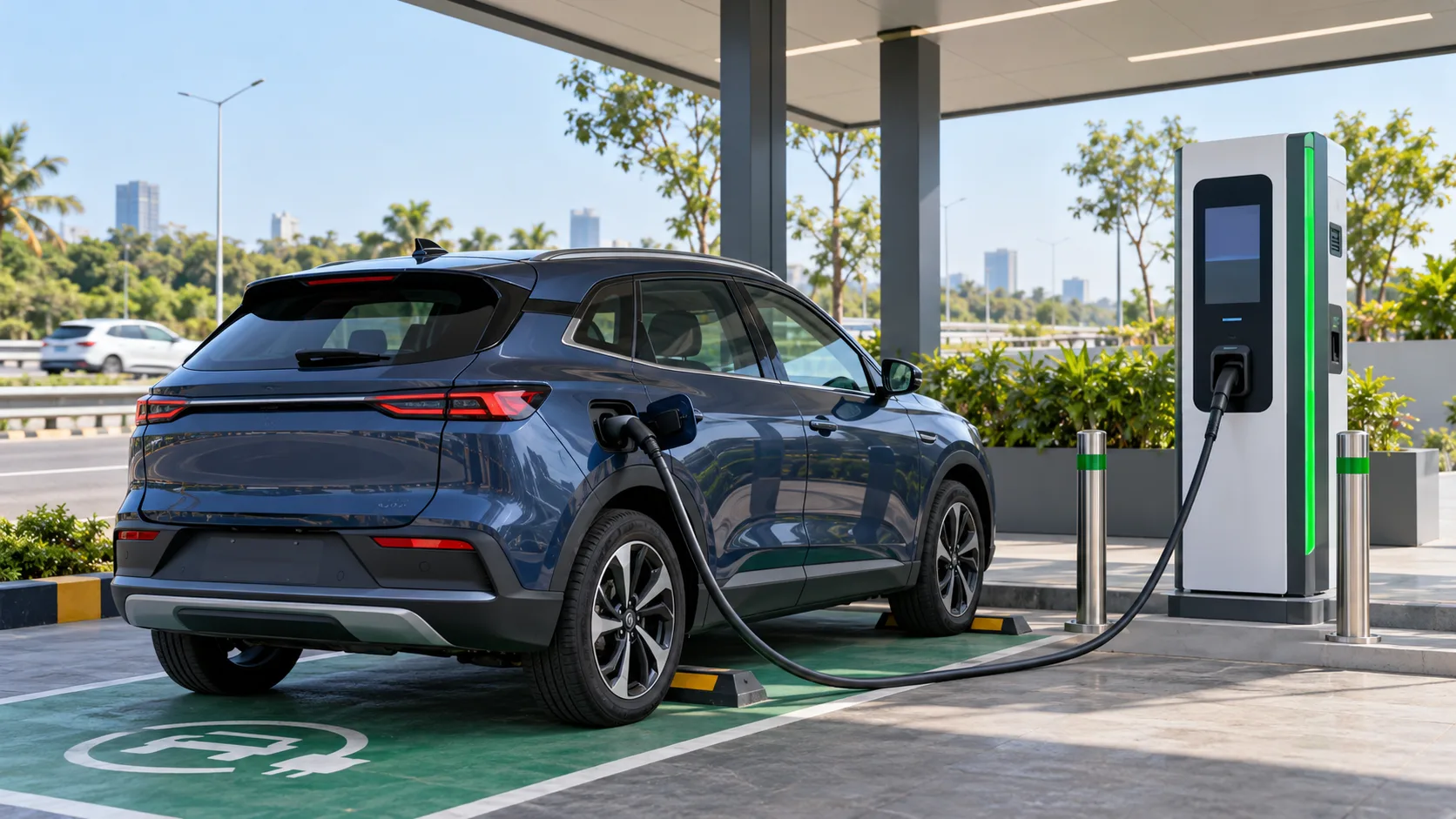
A charger’s advertised rating describes its available capability under the relevant conditions. It is not a promise that every connected vehicle will receive that power.
The vehicle’s charging limit, battery temperature, state of charge and the station’s available output all influence actual charging speed.
For example, an EV capable of accepting a maximum of 60 kW will not automatically receive 120 kW simply because it connects to a compatible 120 kW charger.
IONITY’s charging-speed guidance explains that a vehicle’s maximum charging speed may be lower than the charging station’s rating.
This also means that battery-health comparisons should not rely only on the number printed on the charger.
For more background, read our guide to AC versus DC EV chargers.
Why Charging Slows as the Battery Fills
Fast charging rarely operates at one constant power level from the beginning to the end of a session.
As the battery fills, the vehicle may reduce charging power. Temperature and battery condition can also affect the rate.
Ford’s charging guidance, for example, explains that charging can become significantly slower above 80% state of charge, with performance influenced by battery temperature, charge level and health.
This does not make 80% a universal limit for every EV. It explains why the last part of a charging session can take longer than drivers expect.
When planning a journey, compare the time needed to reach your next suitable charging stop with the time required to fill the battery completely. Keep an appropriate reserve for traffic, weather and route changes.
Our electric car charging-time guide explains the practical differences between charging methods.
Should You Avoid DC Fast Charging Completely?
Avoiding fast charging altogether is unnecessary for many drivers. Its purpose is to make longer journeys and time-sensitive travel practical.
The more useful approach is to choose charging that fits your schedule.
| Situation | Practical approach |
|---|---|
| The car is parked overnight and suitable AC charging is available | Use scheduled AC charging within the manufacturer’s recommended limits |
| You need a charging stop during a long journey | Use a compatible DC fast charger |
| The car remains parked at work for several hours | Consider whether lower-power charging meets the day’s needs |
| A commercial vehicle needs a quick turnaround | Balance charging speed, operating requirements and manufacturer guidance |
| The vehicle displays a charging or battery warning | Follow the vehicle’s instructions and seek appropriate support |
The Australian Government’s EV maintenance guidance recommends charging only as fast as needed and notes that frequent fast charging may accelerate degradation compared with lower-power charging.
Drivers without home charging should build a practical routine around the reliable infrastructure available to them. Battery-care advice should support everyday use, rather than make essential travel difficult.
Charging Habits That Matter for Indian EV Owners
Follow the Guidance for Your Exact Vehicle
Charging recommendations can differ by model, battery chemistry and software version.
Do not assume that a charging limit recommended for another car also applies to yours. Check the owner’s manual, vehicle display or official app.
For example, Tesla’s current charging instructions direct owners to the vehicle display or app for recommended daily and trip limits.
Use Battery Preconditioning Where Supported
Some vehicles can prepare the battery for fast charging by warming or cooling it towards an appropriate temperature.
This feature is model-dependent and may require selecting the charging destination through the vehicle’s navigation system.
Volvo’s India-specific charging guidance explains that battery preconditioning can improve charging performance.
Plan Around Heat Without Assuming a Fixed Waiting Period
Indian driving conditions vary widely by region and season. A battery’s temperature also depends on the journey and the vehicle’s cooling system.
Follow the vehicle’s displayed instructions rather than assuming that every EV needs the same waiting period before charging. A reduced charging rate may reflect the vehicle managing its battery conditions.
Avoid Unnecessary Time at Extreme Charge Levels
Follow the manufacturer’s storage and daily-use recommendations, particularly when leaving a vehicle unused.
Charging for a long trip and leaving a fully charged car parked for an extended period are different situations. Similarly, arriving with a sensible reserve is preferable to repeatedly planning journeys that end near empty.
Track Battery Condition Through Appropriate Diagnostics
Displayed driving range is influenced by recent driving, weather, speed and accessory use. A lower range estimate on one day does not, by itself, establish permanent battery degradation.
If capacity loss appears unusual, use the manufacturer’s diagnostic process or an authorised service assessment. Keep records of recurring warnings and charging problems.
What This Means for Charging-Station Operators
Operators can help customers understand charging performance without making promises about battery lifespan.
Useful practices include:
- Clearly displaying connector compatibility and charger ratings.
- Explaining that actual charging power also depends on the vehicle.
- Maintaining charging equipment and responding to faults.
- Helping drivers understand session status and billing.
- Avoiding claims that a particular charger guarantees zero battery degradation.
For fleet projects, the charging plan should consider departure times, daily travel and the available parking window. A vehicle parked for several hours may have different infrastructure needs from one returning briefly between trips.
Explore our guide to EV charging for logistics and fleet operators for the wider planning considerations.
Conclusion
DC fast charging is a useful part of EV ownership, especially for long journeys and vehicles with limited downtime.
Frequent high-power charging can contribute to faster battery ageing, but the outcome depends on the vehicle, its thermal management and how it is used. A single charging session cannot be used to predict long-term battery health.
Use suitable lower-power charging when it comfortably meets your needs, use DC charging when speed matters, and follow the recommendations for your exact vehicle.
For journeys that require public charging, explore EarthtronEV charging locations and plan suitable stops along your route.