Quick Answer: From 1 January 2027, only electric L5 three-wheelers can be newly registered in Delhi under the Delhi EV Policy 2026. Delhi already has a large e-rickshaw fleet, while legal, metered charging capacity remains limited compared with the scale of daily demand. That creates a real opportunity for safe parking-cum-charging hubs, daytime top-up points, battery swapping and fleet-depot charging. The economics depend far more on land cost, utilisation, power planning and repeat customers than on charger hardware alone.
Delhi’s three-wheelers are central to last-mile mobility. E-rickshaws connect residential colonies with metro stations and markets, while autos and light commercial three-wheelers move passengers and goods across the city. As electrification accelerates, these vehicles need reliable places to charge every day.
A significant share of charging still takes place through informal or unauthorised arrangements, creating concerns around power theft, fire safety and unsafe wiring. The business opportunity is therefore not simply “more chargers”; it is professionally managed, legal and conveniently located charging infrastructure.
This guide explains why 2027 matters, how the Delhi three-wheeler charging market works, which business models are practical, what a small charging hub may cost, how to estimate ROI, and what risks investors should check before committing capital.
Why 2027 Is the Turning Point
The Delhi EV Policy 2026 states that from 1 January 2027, only electric three-wheelers in the L5 category will be permitted for new registration in the NCT of Delhi. This makes 2027 a structural shift rather than a short-term demand spike. Official source: Delhi EV Policy 2026 (Transport Department, GNCTD)
Existing internal-combustion vehicles do not disappear overnight; replacement happens over time as permits and vehicles reach renewal or retirement points. That means charging demand should rise progressively rather than instantly. Passenger-auto permit limits also remain an important constraint, so investors should not build their business case on unlimited growth in new e-auto registrations.
| Planning takeaway | What it means for an operator |
| 2027 electric-only L5 new-registration rule | Supports a long-term shift toward electric three-wheelers. |
| Existing CNG autos remain in service until replacement | Demand growth is gradual, not immediate. |
| Passenger-auto permit constraints | Replacement demand matters more than assumptions of unlimited fleet expansion. |
| Goods and fleet electrification | Fleet and depot charging can add predictable commercial demand. |
How Big Is the Three-Wheeler Charging Market in Delhi?
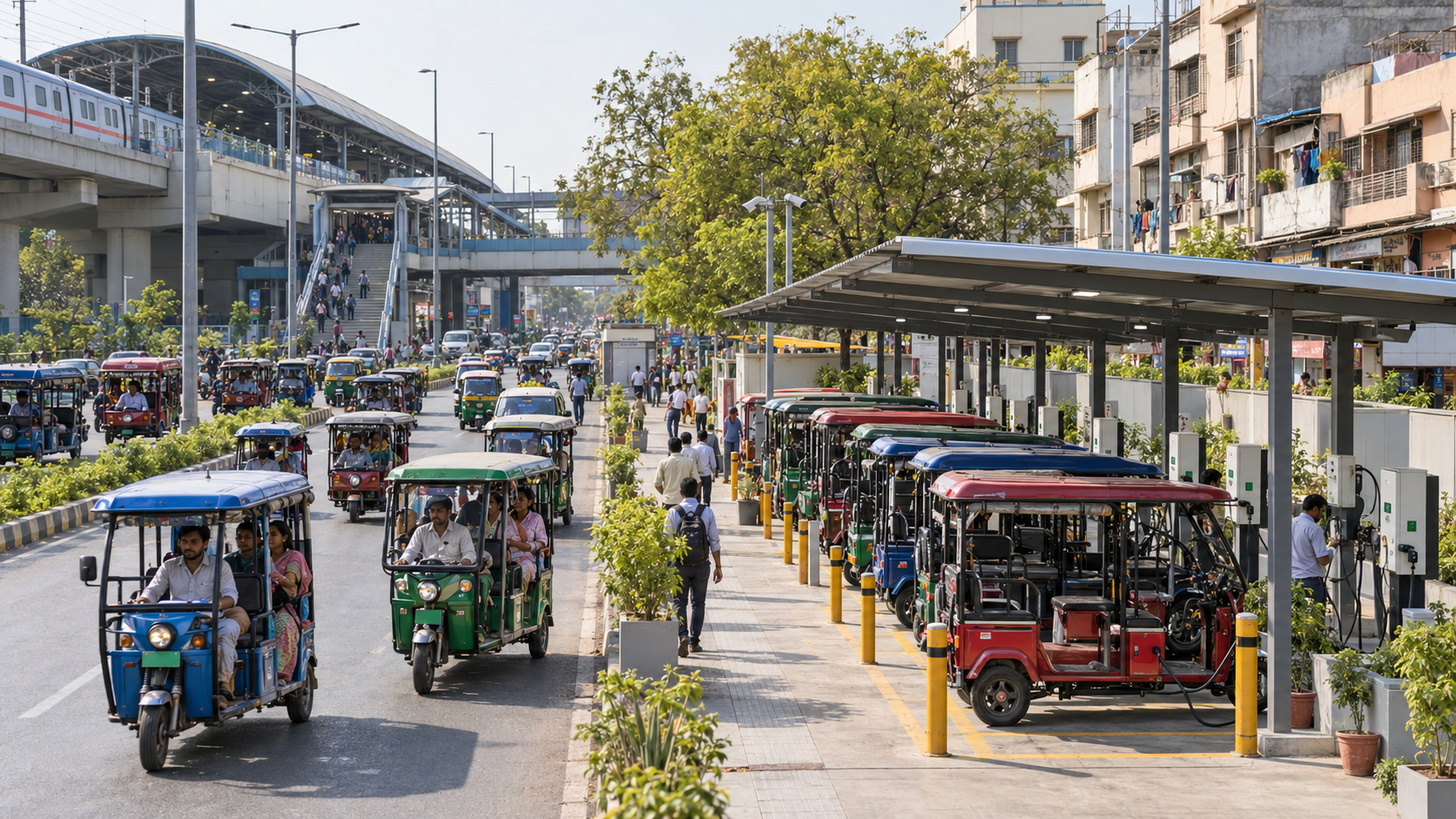
Delhi has a very large e-rickshaw ecosystem, but published estimates vary by year, registration status and whether informal vehicles are included. For that reason, this article avoids presenting an unverified “2 lakh+ registered” figure as a single official count. What is clear from transport and media reporting is that e-rickshaws already represent a major share of Delhi’s last-mile EV activity, while legal charging connections are far fewer than the number of vehicles that need to charge.
Reported DISCOM and police estimates have also highlighted widespread unauthorised charging and power theft. This points to unmet demand for safer, metered and professionally operated facilities, especially in dense neighbourhoods and fleet-heavy areas.
How much electricity can an e-rickshaw need?
Energy use varies by battery capacity, chemistry, charger efficiency and depth of discharge. A practical planning range for many e-rickshaws is roughly 5-8 kWh for a full charging session, while larger packs can consume more. Electric autos with larger lithium-ion batteries generally require more energy than low-speed e-rickshaws.
For financial modelling, use the actual battery sizes and charger data of the vehicles expected at your site. Do not assume one fixed kWh figure for every three-wheeler.
What Is an E-Rickshaw or E-Auto Charging Station?
An e-rickshaw or e-auto charging station is a legal, metered location where electric three-wheelers can park and charge safely. It is different from a passenger-car fast-charging station because many three-wheelers charge slowly over several hours, making parking space, weather protection, electrical safety and load management just as important as the charging hardware.
| Feature | E-rickshaw (typical L3 use) | E-auto (typical L5M use) |
| Typical operating pattern | Short-distance last-mile routes | Longer passenger or fleet duty cycles |
| Battery type | Lead-acid or lithium, depending on model | Usually lithium-ion/LFP |
| Charging method | External charger connected to a suitable socket or dedicated LEV charger | On-board charger via suitable AC supply; some platforms may support dedicated LEV charging |
| Typical charging duration | Several hours; varies by battery chemistry and charger | Several hours on AC; varies by vehicle and charger |
| Business implication | Overnight parking-cum-charging can work well | Daytime top-ups and fleet scheduling can be more valuable |
Three Ways to Charge Three-Wheelers
| Method | How it works | Best fit |
| Smart AC socket points | Metered, protected and optionally app-controlled sockets for overnight charging. | E-rickshaw and e-auto parking hubs. |
| LEV DC charging | Dedicated low-voltage EV charging equipment for compatible light EVs. | Daytime top-ups and controlled fleet use where compatibility is confirmed. |
| Battery swapping | A discharged removable battery is exchanged for a charged battery. | High-mileage drivers and controlled battery ecosystems. |
For a broader technology comparison, see Battery Swapping vs EV Fast Charging in India.
Business Models for an E-Rickshaw Charging Station
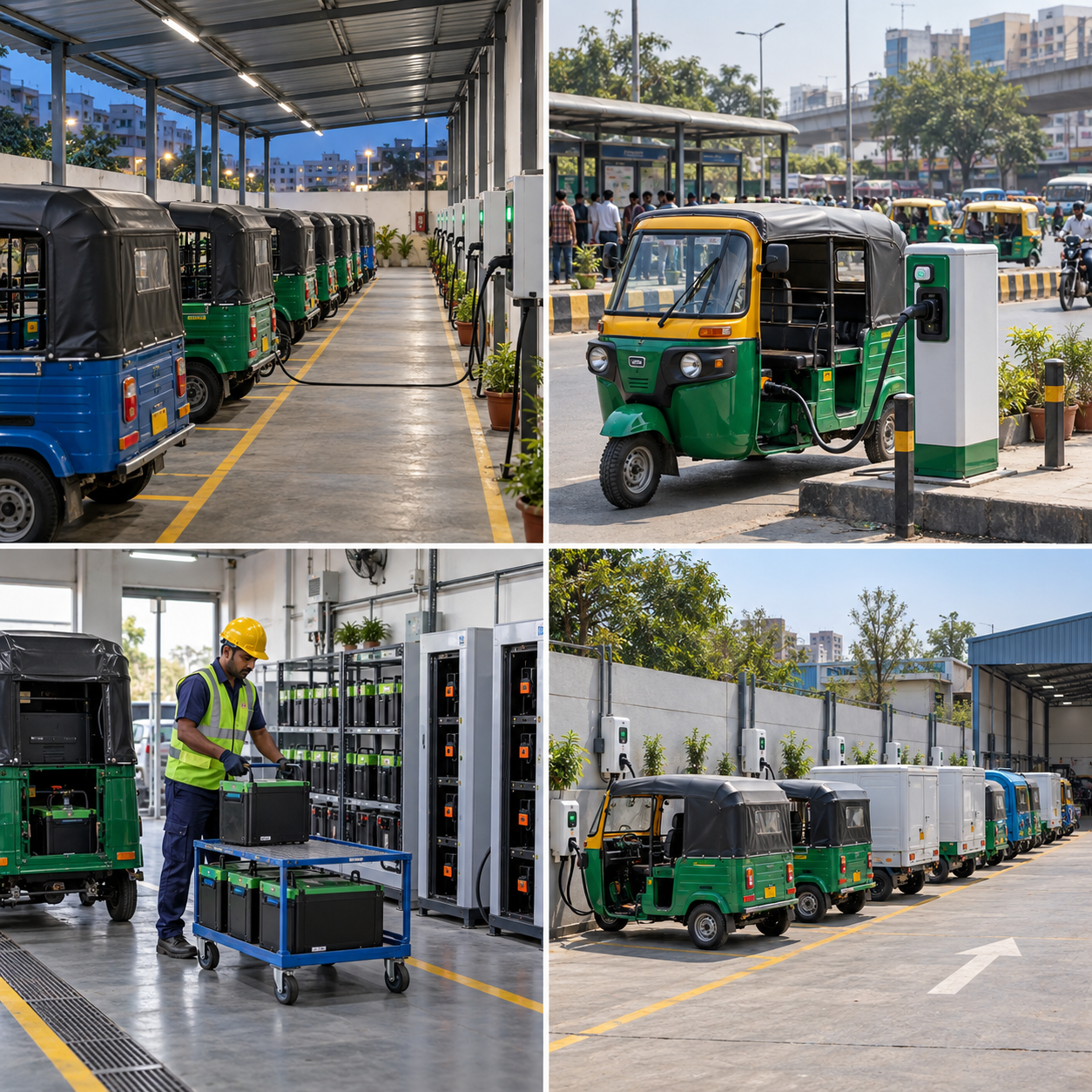
There is no single model that works everywhere. The right option depends on land availability, customer behaviour, daily vehicle volume and whether the operator can secure repeat demand.
1. Overnight parking-cum-charging hub
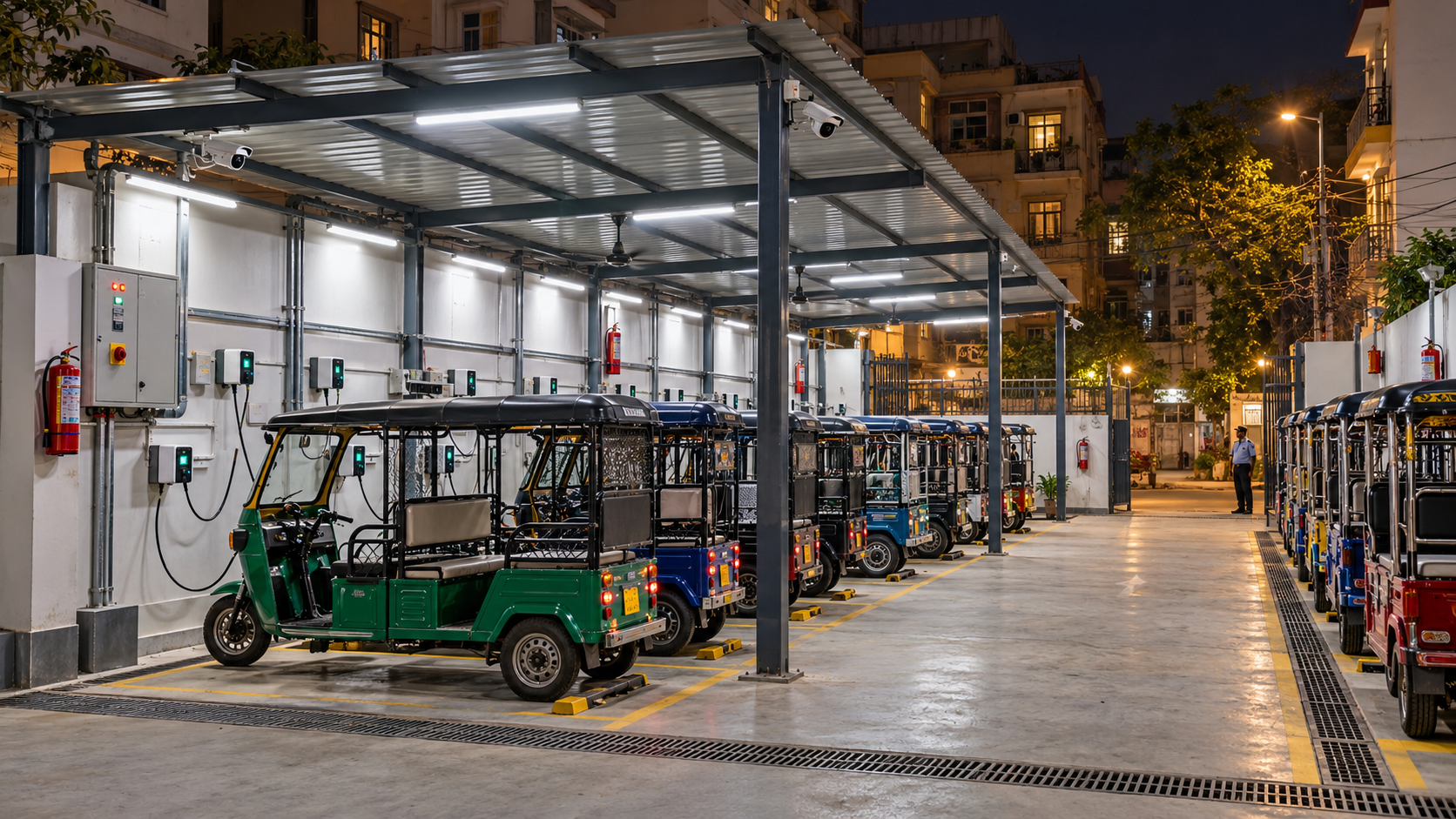
Drivers park overnight and charge from protected, metered points. Revenue can come from a per-night fee or monthly package. The model works best where drivers live or park nearby and where land cost is manageable.
2. Daytime top-up point
A small number of compatible faster charging points can serve drivers between trips near markets, stands or fleet zones. Revenue depends on rapid turnover and reliable daytime demand.
3. Battery swapping station
The operator hosts or runs a battery-swapping facility. It can reduce vehicle downtime but requires battery inventory, safe battery handling and compatibility with the chosen network.
4. Fleet depot charging
A fleet, leasing company or delivery operator commits regular vehicles to the site. Predictable utilisation can make this one of the lowest-risk models if the contract terms are sound.
5. Add-on to an existing business
Parking lots, warehouses, commercial plots, petrol pumps and other businesses with spare space can add three-wheeler charging as an additional revenue stream.
| Model | Investment tendency | Space need | Revenue predictability |
| Overnight parking-cum-charging | Low to medium | High | Medium to high if drivers are regular |
| Daytime top-up | Medium | Low to medium | Medium |
| Battery swapping | Medium to high | Low | Medium; network-dependent |
| Fleet depot charging | Low to medium | Medium | High if contracted |
| Add-on to existing business | Low to medium | Uses existing space | Low to medium |
How Much Does It Cost to Set Up an E-Rickshaw Charging Station?
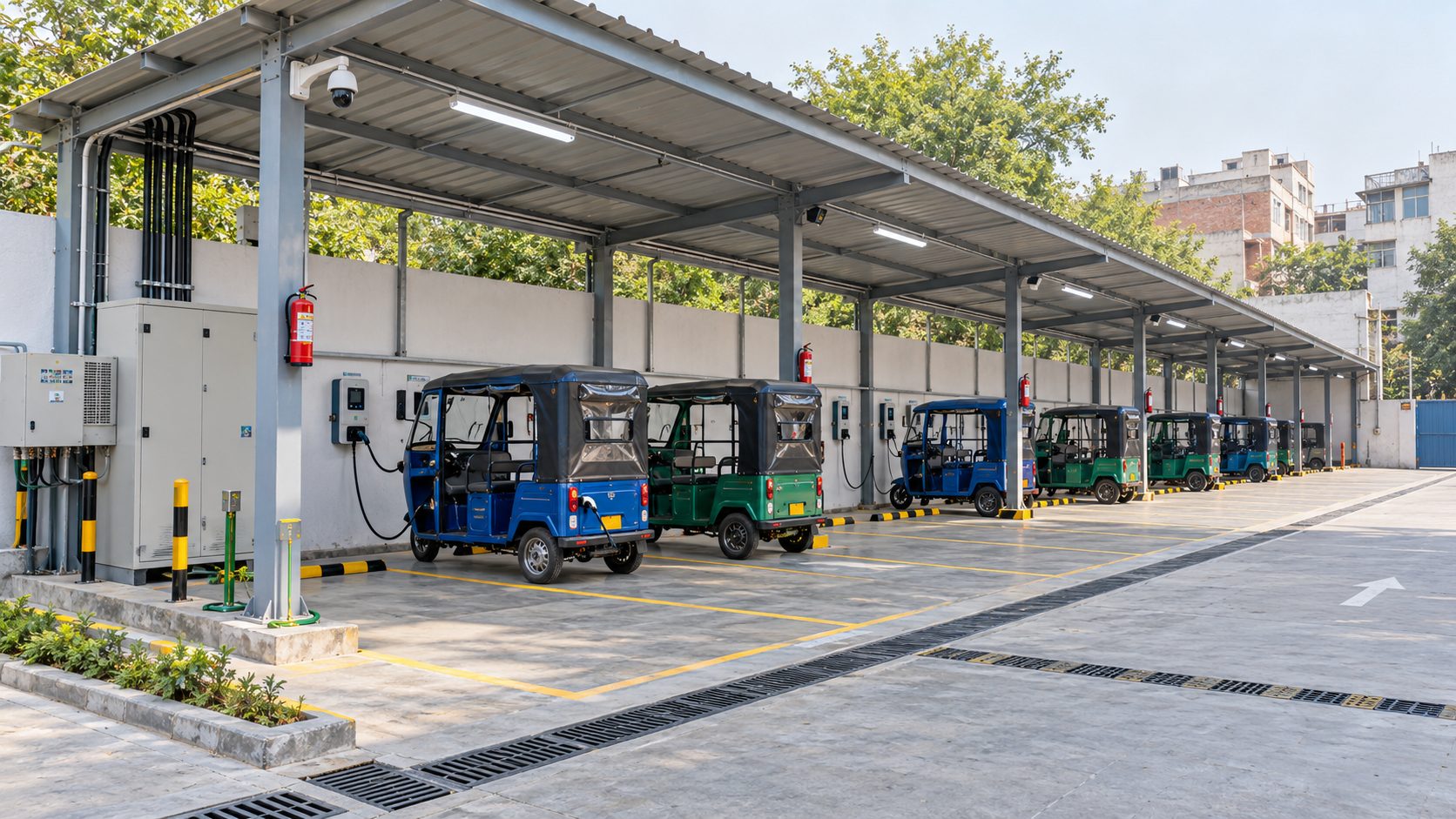
A three-wheeler hub can cost far less than a passenger-car DC fast-charging site because the charging hardware can be relatively inexpensive. In many projects, civil work, covered parking, electrical distribution, safety systems and land are the bigger cost drivers.
The budget below is an illustrative planning range for a 20-bay overnight hub on leased land. It is not a vendor quotation and should be replaced with site-specific electrical, civil and equipment quotes before investment.
| Cost item | Illustrative range | Planning note |
| 20 protected smart charging points | ₹1-3 lakh | Commercial-grade metering, protection and software increase cost. |
| Electrical panel, cabling, earthing and protection | ₹1.5-3 lakh | Depends heavily on meter location, sanctioned load and cable run. |
| Covered shed/canopy, flooring and drainage | ₹2-5 lakh | Important for weather protection and safe night operation. |
| Fire safety, CCTV and lighting | ₹0.5-1 lakh | Allow for extinguishers, emergency cut-off, surveillance and illumination. |
| EV electricity connection / deposit | Varies | Confirm the current DISCOM process and deposit at the actual site. |
| Optional LEV charging equipment | ₹1.5-3 lakh | Only where vehicle compatibility and daytime demand justify it. |
| Total setup excluding land | Approx. ₹6-15 lakh | Illustrative only; site conditions can move the number materially. |
| Land or parking lease | Monthly cost | Often the biggest recurring expense in Delhi. |
For a complete site-to-commissioning view, see EV Charging Station Installation in India.
How Much Can an E-Rickshaw Charging Station Earn?
There is no fixed profit figure. A pure overnight charging hub on expensive rented land can be a thin-margin business. Economics improve when the same infrastructure is used during the day, land is owned or inexpensive, or a fleet contract provides predictable utilisation.
Illustrative ROI Model – Not a Revenue Guarantee
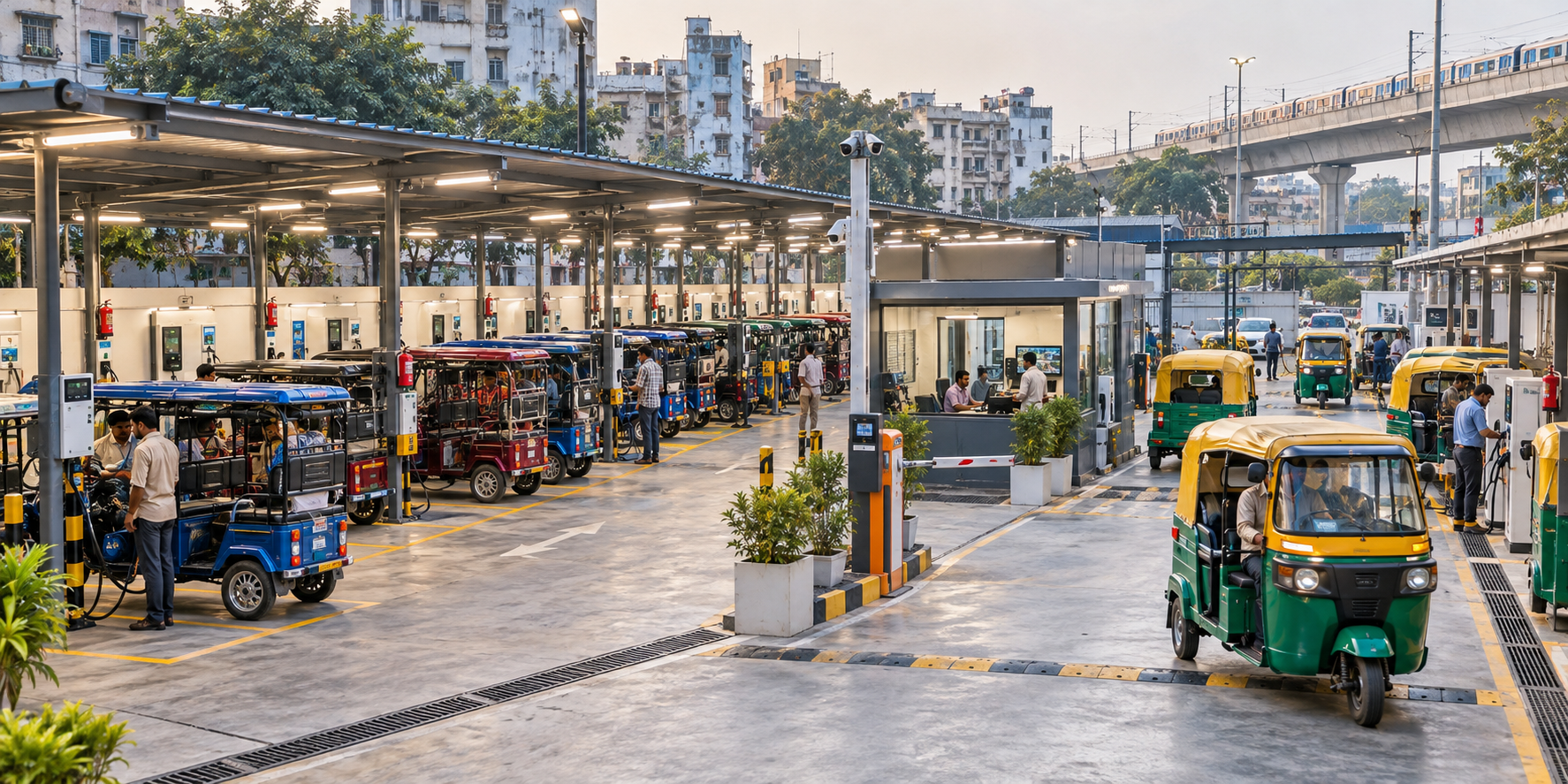
The following model is only for explaining how utilisation changes economics. Delhi land rents, labour, electricity surcharges, taxes, charging prices, equipment costs, financing and maintenance vary significantly by site.
- 20 charging bays.
- Illustrative overnight package: ₹110 per vehicle.
- Assumed energy use for this model: 8 kWh per overnight session.
- Illustrative effective electricity cost: ₹5.50 per kWh, including a buffer above the base EV tariff for applicable surcharges/taxes.
- Illustrative daytime top-up: 5 kWh at ₹15 per kWh.
- Illustrative fixed monthly costs: ₹30,000 (rent, staffing, software and maintenance).
- Illustrative setup cost: ₹10 lakh.
| Scenario | Monthly revenue | Electricity cost | Illustrative net result | Simple payback |
| A: 12 vehicles, overnight only | ₹39,600 | ₹15,840 | -₹6,240 loss | Not viable |
| B: 20 vehicles, overnight only | ₹66,000 | ₹26,400 | ₹9,600 | ~8.7 years |
| C: 20 overnight + 10 daytime top-ups | ₹88,500 | ₹34,650 | ₹23,850 | ~3.5 years |
| D: Scenario C on owned land | ₹88,500 | ₹34,650 | ₹38,850 | ~2.1 years |
Important: the simple payback above does not include GST, financing cost, insurance, battery-related liabilities, equipment replacement, unexpected downtime or major repairs. Build a model with real site quotes before investing.
What the ROI model teaches
- Use the charging assets in the daytime as well as overnight where local demand supports it.
- Land cost can decide whether the business is attractive or marginal.
- Repeat customers and fleet contracts are usually more important than charging the highest possible price.
- A smaller, well-utilised site can outperform a larger hub with poor occupancy.
Setup Requirements for an E-Rickshaw Charging Station in Delhi
Public EV charging is a de-licensed activity under India’s Ministry of Power framework, meaning a separate electricity-distribution licence is not required simply to operate a public charging station. Operators must still comply with applicable technical, electrical, fire, land-use, building and local requirements. Official reference: Ministry of Power – Guidelines for Installation and Operation of EV Charging Infrastructure 2024
Land and layout
- Provide enough parking space for the target number of three-wheelers plus safe circulation and walkways.
- Use covered, dry charging bays with drainage and weather protection.
- Check vehicle access before signing a lease, especially where local traffic restrictions affect e-rickshaws.
- Keep electrical equipment separated from vehicle movement and accidental impact zones.
Electricity connection and tariff
Apply through the DISCOM serving the site. BSES Rajdhani, BSES Yamuna and Tata Power-DDL cover different parts of Delhi. Current BSES tariff information lists EV/e-rickshaw charging on single-point supply at ₹4.50/kWh on LT supply and ₹4.00/kVAh on HT supply. Applicable taxes, surcharges and time-of-day provisions should be checked at the time of connection. Official reference: BSES tariff information for EV/e-rickshaw charging
Sizing the electrical load
Three-wheelers generally draw far less power per vehicle than passenger-car DC fast chargers, but simultaneous charging can still create a significant site load. Use the nameplate input of the actual chargers you plan to install and apply diversity/load-management assumptions conservatively.
| Vehicle / charging type | Illustrative draw | Example: 20 vehicles charging together |
| Low-power e-rickshaw charger | Around 1 kW each | ~20 kW before diversity |
| Higher-power AC charging for e-auto | Around 3 kW each | ~60 kW before diversity |
These are planning illustrations, not design values. Smart load management can stagger charging through the night and may reduce the peak connection size required for the same number of vehicles.
Safety Requirements
- Use compliant, metered charging equipment with suitable earth-leakage, overload and short-circuit protection.
- Provide proper earthing, emergency isolation and protected distribution panels.
- Install suitable fire extinguishers and clearly defined emergency procedures.
- Keep chargers, sockets and cable connections protected from rain, waterlogging and physical damage.
- Maintain adequate lighting, CCTV and safe spacing between parked vehicles.
- Inspect cables, connectors and charging points regularly and remove damaged equipment from service.
Use the EV Charging Station Safety Checklist in India before go-live and during periodic audits.
Best Locations for an E-Auto Charging Station in Delhi
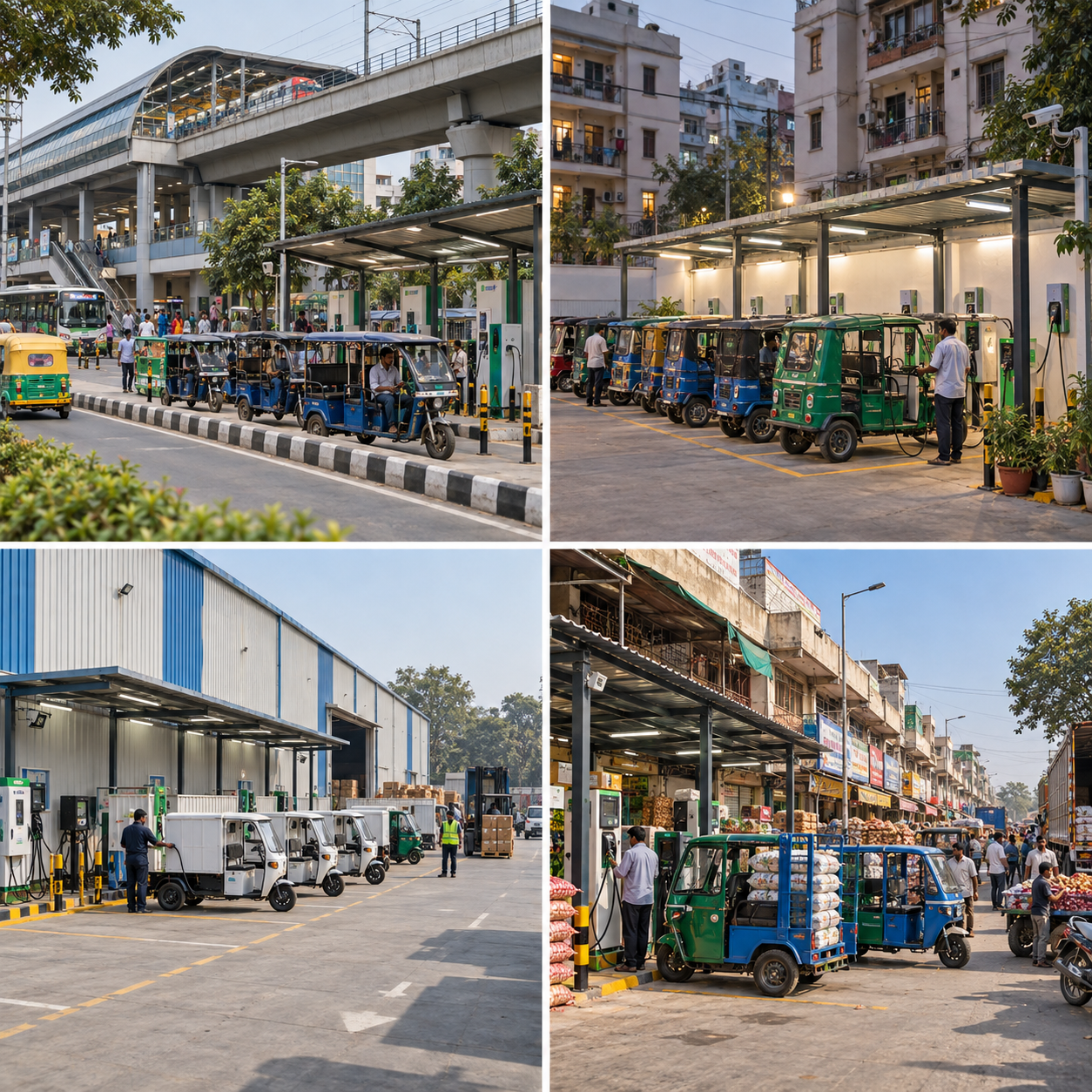
The best locations are where three-wheeler drivers already live, park, wait or return between trips. This is different from passenger-car fast charging, where highway visibility or premium retail destinations may matter more.
| Location type | Why it can work | What to verify |
| Near busy metro / last-mile zones | Regular e-rickshaw demand and repeat drivers. | Queuing space, legal access, local restrictions. |
| Dense residential colonies | Drivers often need safe overnight charging close to home. | Night access, neighbourhood compatibility, security. |
| Parking lots and vacant plots | Large usable area, often quiet at night. | Lease tenure, drainage, electricity connection. |
| Warehouses / commercial yards | Space plus existing power infrastructure. | Spare load, operating hours, vehicle access. |
| Fleet and delivery hubs | Predictable contracted demand. | Fleet size, shift timings, charging window. |
| Wholesale markets and mandis | High commercial three-wheeler movement. | Daytime dwell time and congestion. |
Locations to avoid
- Sites where e-rickshaw access is restricted or operationally difficult.
- Low-lying plots with repeated waterlogging or poor drainage.
- Locations with expensive rent but weak repeat demand.
- Sites next to heavily subsidised or free charging unless you offer a clear additional benefit such as secure parking, fleet contracts or better operating hours.
Risks and Common Mistakes
Key risks
- Passenger-auto permit constraints can limit the pace of e-auto fleet growth.
- Drivers are price-sensitive, so charging fees cannot be set independently of nearby alternatives.
- Rules and enforcement can change, affecting registration, access and informal charging activity.
- Concentrating many batteries in one location raises fire and electrical-safety responsibilities.
- Government or DISCOM-backed low-cost charging can increase competition in some areas.
Common mistakes
- Buying car-oriented charging hardware without checking three-wheeler connector and charging compatibility.
- Ignoring night operations, staffing, lighting and CCTV for overnight hubs.
- Underestimating the cost of sheds, drainage, civil work and electrical distribution.
- Relying only on overnight utilisation when the site could support daytime top-ups.
- Using an unsuitable electricity connection or informal wiring instead of a proper metered EV setup.
- Choosing a site before checking vehicle access, local restrictions and nearby competition.
Is an E-Rickshaw Charging Station a Good Business in 2027?
It can be a good business for the right site and operating model, but it is not automatically profitable. The 2027 electric-only registration rule for new L5 three-wheelers supports long-term charging demand, while the existing e-rickshaw ecosystem already creates a large base of daily energy demand.
The model is strongest when:
- You own the land or can secure it at a sustainable long-term cost.
- Drivers already park, queue or operate near the site.
- Charging points can be used both overnight and during the day.
- You can secure fleet, leasing-company or delivery-operator demand.
- The site has proper metering, weather protection, staff and safety systems.
It is weaker when expensive rented land is paired with low utilisation, or when the business case depends on aggressive assumptions about future vehicle growth.
For mixed-traffic sites, operators may also evaluate compatible charging for cars or commercial fleets, but the configuration should be chosen only after a site and vehicle-mix assessment. EarthtronEV provides fleet charging solutions and an EV charging station franchise programme for commercial charging projects.
FAQs
Do I need a licence to open an e-rickshaw charging station in Delhi?
Public EV charging is a de-licensed activity under the Ministry of Power framework, so a separate electricity-distribution licence is not required just to operate a public charging station. You still need the correct electricity connection and must comply with applicable technical, electrical, fire, land-use and local requirements.
How much does it cost to set up an e-rickshaw charging station?
A small protected parking-cum-charging hub can require several lakh rupees once electrical distribution, civil work, safety systems and weather protection are included. The illustrative 20-bay model in this guide uses roughly ₹6-15 lakh before land, but real costs should be based on site-specific quotations.
What is the EV charging electricity tariff in Delhi?
Current BSES tariff information lists ₹4.50/kWh for LT single-point EV/e-rickshaw charging and ₹4.00/kVAh for HT supply. Taxes, surcharges and time-of-day provisions can apply, so confirm the current tariff with the serving DISCOM.
How long does it take to charge an e-rickshaw?
Charging time varies substantially by battery chemistry, pack capacity and charger. Many conventional e-rickshaws take several hours to charge, which is why overnight parking-cum-charging remains an important business model.
How many units does an e-rickshaw use for a full charge?
A practical planning range for many e-rickshaws is roughly 5-8 kWh per full session, but larger batteries can use more. Use the actual vehicle battery and charger data for investment modelling.
When do only electric autos get registered in Delhi?
Under the Delhi EV Policy 2026, only electric L5 three-wheelers are permitted for new registration in Delhi from 1 January 2027.
Is battery swapping better than charging for e-rickshaws?
It depends on vehicle compatibility and operating pattern. Swapping can minimise downtime for high-mileage vehicles, while charging hubs can be economical for vehicles that already park for several hours.
Is an e-rickshaw charging station profitable?
It can be, but profitability depends heavily on land cost, utilisation, energy pricing, staffing and repeat demand. Fleet contracts, owned land and daytime use can improve the economics significantly.
Conclusion
The e-rickshaw and e-auto charging opportunity in Delhi is real, but the strongest business case is not simply “EV demand is growing.” The better case is a site where drivers already need to park, the electrical connection is practical, charging assets stay busy, and the operator can provide a safer and more reliable alternative to informal charging.
The 1 January 2027 electric-only rule for new L5 three-wheeler registrations strengthens the long-term direction of the market. For investors, the most important questions remain local: What will the land cost? How many vehicles will actually charge every day? Can the same infrastructure earn revenue in more than one time window? And can the site be operated safely and legally over the long term?
Answer those questions with real site data before investing, and the project can be evaluated as an infrastructure business rather than a speculative EV trend.
Sources & References
- Delhi EV Policy 2026 – Transport Department, GNCTD
- Ministry of Power – Guidelines for Installation and Operation of EV Charging Infrastructure 2024
- BSES tariff information – EV/e-rickshaw charging
- BSES Rajdhani – EV/e-rickshaw connection information
- EarthtronEV – EV Charging Station Installation in India
- EarthtronEV – Battery Swapping vs EV Fast Charging in India
- EarthtronEV – EV Charging Station Safety Checklist in India
- EarthtronEV – Fleet Charging Solutions
- EarthtronEV – EV Charging Station Franchise in India