Quick Answer
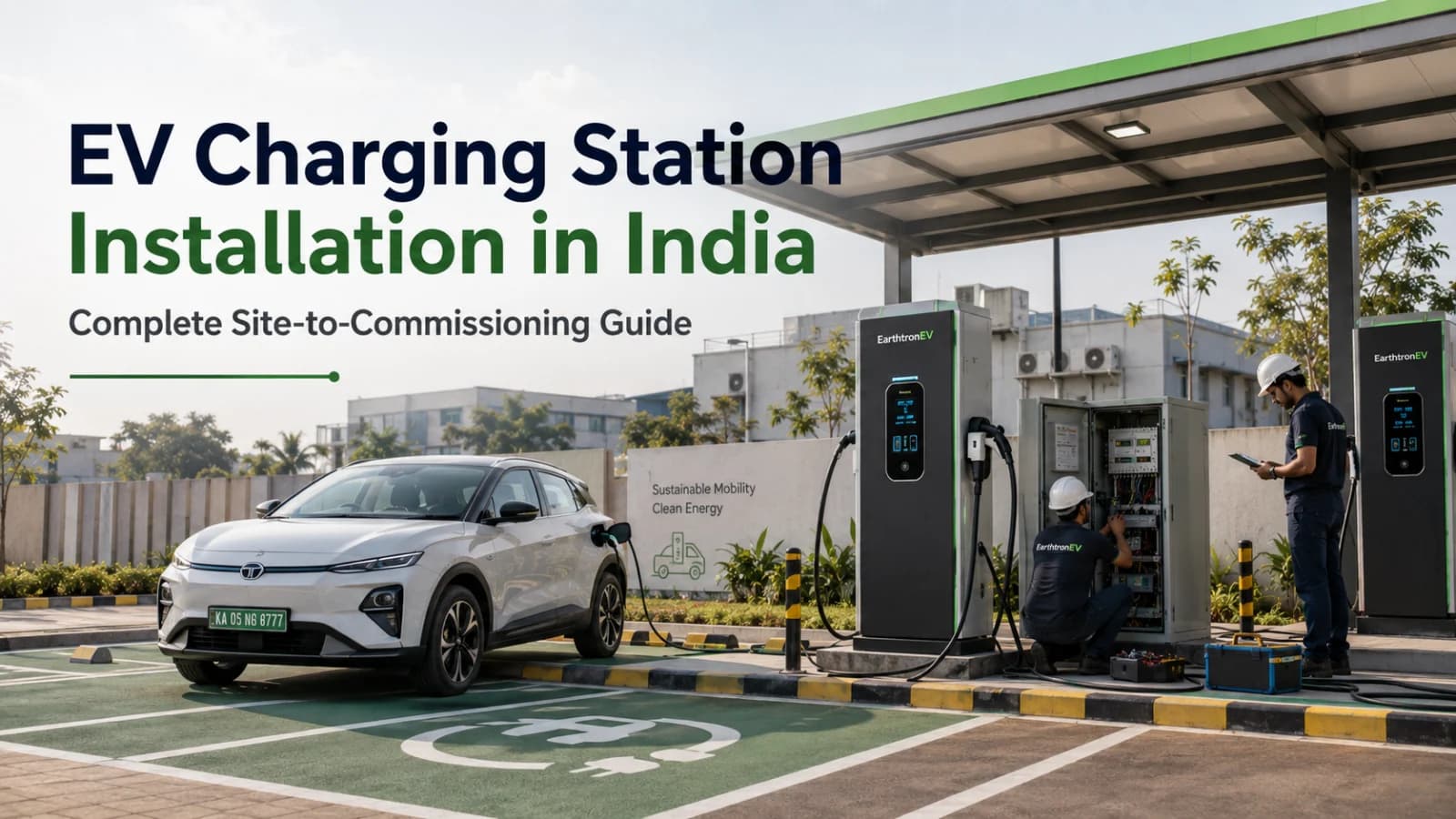
Installing a commercial EV charging station in India requires much more than buying a charger and connecting it to a power source. A dependable project starts with site feasibility, user-demand assessment and electrical planning, followed by charger selection, civil work, safety systems, software integration, testing and commissioning. The exact configuration changes with the location, vehicle mix and charging use case, but the sequence should remain structured from the first site survey to the first live charging session.
A well-planned installation is easier to operate, safer for users and more scalable. It also reduces the risk of expensive rework caused by insufficient power, poor parking geometry, weak cable routing, incompatible hardware or incomplete backend integration.
What does EV charging station installation include?
EV charging station installation is the complete process of converting a suitable location into a functioning charging site. The visible charger is only one component. A commercial installation normally brings together the charging hardware, incoming electrical supply, distribution equipment, protection systems, civil foundations, parking layout, networking, charger-management software, payment or access systems and final commissioning.
This is why two sites with the same charger rating can require very different installation work. A workplace site may already have suitable parking and electrical infrastructure, while a highway or standalone commercial site may require new power distribution, equipment foundations, lighting, directional signage and a more detailed vehicle-flow plan. The installation design must respond to the real site rather than follow a one-size-fits-all template.
Step 1: Define the charging use case before designing the site
The first question should be simple: who will use the station and how long will their vehicles typically remain parked? The answer determines the right charger mix, number of bays, power requirement and commercial layout.
A destination such as an office, hotel, campus or residential community usually has longer dwell times. A public corridor, highway stop or high-traffic commercial location has shorter dwell expectations and may need faster charging. A fleet site has a different priority again: predictable availability, operational scheduling and the ability to support repeated daily charging.
Before technical design begins, the project should identify the primary vehicle types, expected peak periods, average parking duration, public versus restricted access and the possibility of future expansion. This prevents overbuilding in some areas and underbuilding in others.
Step 2: Carry out a detailed site feasibility assessment
A site survey should confirm whether the location is physically and electrically practical. Visibility is useful, but it is not enough. A charging station must also allow safe vehicle movement, sufficient parking space, convenient cable reach, drainage, lighting and maintenance access.
During site assessment, the team should check where the incoming power is located, the route for power cables, the distance between electrical equipment and chargers, the condition of the parking surface and any constraints created by existing structures. The survey should also consider how users enter, queue, charge and exit without blocking other vehicles.
A strong feasibility assessment should document the present site and the intended future configuration. This becomes the reference for electrical design, civil drawings, equipment placement and cost estimation.
Key site checks before installation
Before approving a commercial charging location, the project team should review the following points:
- Available parking area and safe vehicle turning space
- Expected user demand and vehicle category
- Existing sanctioned electrical load and scope for augmentation
- Distance from electrical source to proposed charger locations
- Cable routing, trenching and equipment-mounting requirements
- Drainage, water exposure, heat, dust and other environmental conditions
- Lighting, signage, CCTV or other site-management needs
- Accessibility for maintenance and emergency response
- Space reserved for future chargers or electrical expansion
Step 3: Choose the right AC and DC charger mix
Charger selection should be based on the site use case rather than choosing the highest power rating available. AC charging can be well suited to locations where vehicles remain parked for longer periods. DC fast charging is more appropriate where users value faster turnaround and the site has the electrical capacity to support it.
A mixed commercial site may use both. For example, slower bays can serve long-stay users while faster bays support drivers who need a shorter stop. The correct mix can improve utilisation because different charging needs are served without forcing every customer into the same charging pattern.
When selecting hardware, operators should also consider connector compatibility, charger communication capability, remote monitoring, serviceability, cable length, screen usability, payment or access options and support for future network integration. Hardware decisions affect operations long after installation is complete.
Step 4: Prepare the civil layout and charging bays
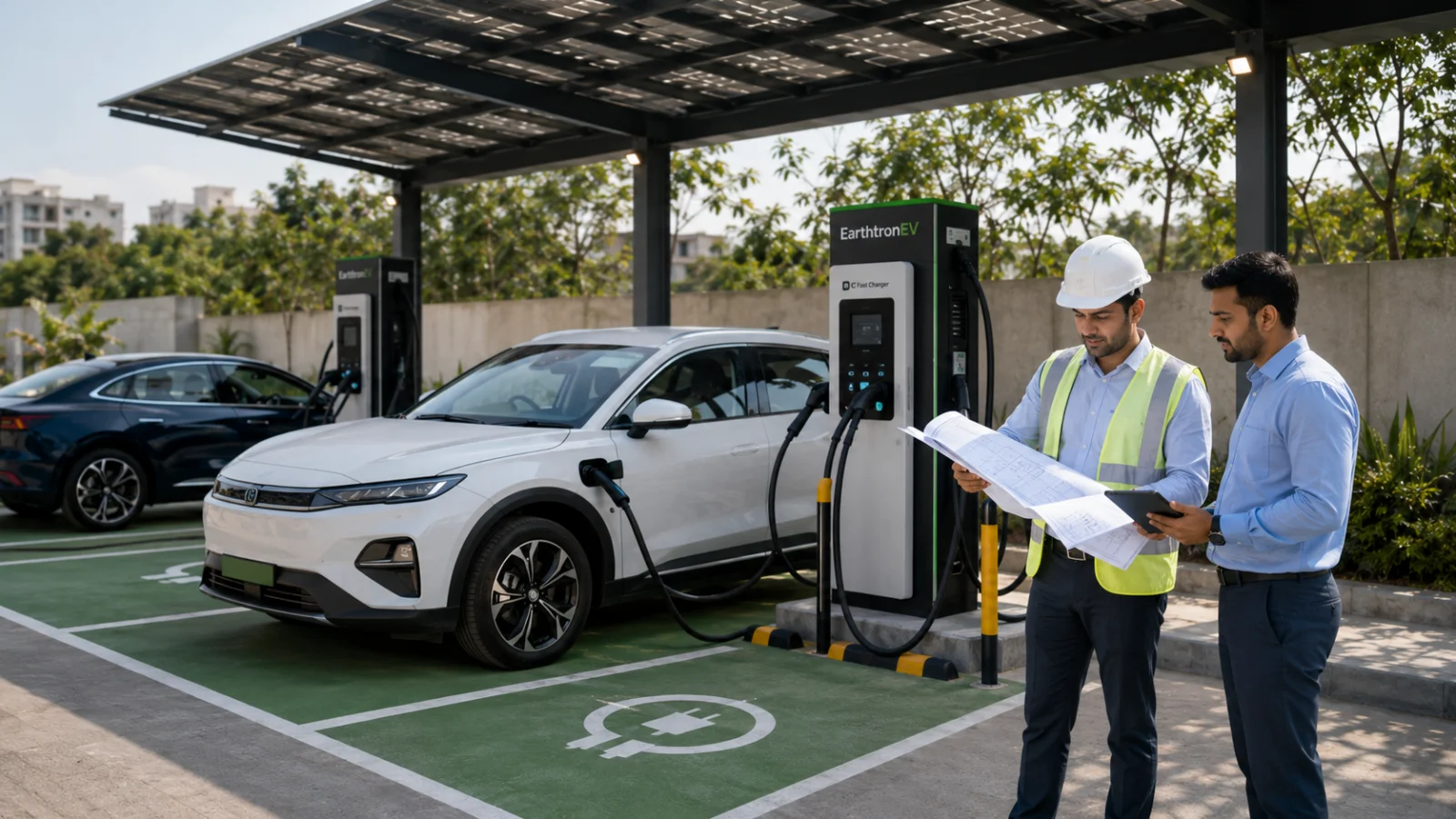
Civil design converts the technical plan into a practical charging site. The charger must be mounted securely, vehicles must be able to align with the connector, cables must not become trip hazards and critical equipment should be protected from accidental vehicle impact.
The layout should provide clearly marked EV bays, wheel stops where appropriate, bollards around exposed chargers or electrical cabinets, safe pedestrian movement and enough clearance for maintenance. Drainage and surface levels should prevent water from collecting around equipment. If the site needs a canopy, signage structure or lighting poles, these should be planned before the charger is installed rather than added later.
The best charging layout is simple for a first-time visitor to understand. A driver should be able to identify the charging area, park correctly, reach the connector and leave the site without unnecessary reversing or conflict with other vehicles.
Step 5: Design the electrical infrastructure correctly
Electrical infrastructure is the backbone of the charging station. The selected charger capacity must be matched with the available supply and with all upstream equipment required to distribute power safely. Depending on the project, this may involve distribution panels, protection devices, metering, earthing, cabling, isolation arrangements and additional electrical upgrades.
Load planning should account for the maximum simultaneous demand expected at the site. If several chargers can operate together, the electrical design must consider that combined load rather than only the rating of one charger. Where load management is used, the design should still provide a safe and clearly documented operating strategy.
Proper earthing, surge protection, fault protection and cable sizing are not optional details. They protect users, vehicles and equipment and reduce the likelihood of repeated faults once the station is live.
Step 6: Install chargers, panels and supporting equipment
Once civil and electrical preparation is complete, the charger units and associated equipment can be installed according to the approved layout. Installation should follow the equipment manufacturer’s requirements for mounting, clearances, ventilation, cable routing and environmental protection.
At this stage, attention to finishing quality matters. Exposed cables, poorly aligned foundations, unclear labels and difficult connector placement can make a technically functional station look unfinished and create maintenance problems later. Commercial charging infrastructure should be treated as public-facing equipment, so installation quality should be both technically sound and operationally clean.
Step 7: Connect the charging station to software and network systems
Modern commercial charging stations need reliable communication in addition to electrical power. The charger may need to connect with a charging-station management system for remote status monitoring, session control, pricing, user authentication, fault reporting and performance analytics.
Connectivity should be tested under normal site conditions. The charger must be able to communicate consistently with the backend, recover correctly after network interruption and report its status accurately. For networked operators, software integration is essential because a charger that cannot be monitored or controlled remotely can create avoidable downtime and service delays.
If the station supports app-based access, RFID, QR payment or other user flows, every step should be verified before launch.
Step 8: Test safety systems and complete commissioning
Commissioning is the final technical validation before the station goes live. It should confirm that the electrical installation, charger hardware, software communication and user journey all work as intended.
Testing should include charger startup, connector operation, vehicle charging, emergency stop where applicable, protection systems, earthing, communication with the backend, transaction flow and session termination. It is also useful to test more than one compatible vehicle where possible because real-world charging behaviour can reveal issues that are not visible during a basic power-on test.
Every identified defect should be closed before the station is opened to regular users. A commissioning record also gives the operator a clear baseline for future maintenance.
Step 9: Prepare the site for day-to-day operation
The first live charging session should not be the first time the operational team sees the station. Before launch, the operator should define who receives fault alerts, who handles user support, how maintenance is escalated, how the station is inspected and how performance is reviewed.
Basic operational readiness includes clear signage, user instructions, contact information, routine cleaning, cable inspection and a process for reporting damaged equipment. For a commercial network, the station should also be visible in the relevant digital systems so that users and the operations team can identify its status and availability.
Common installation mistakes to avoid
Many charging-site problems can be traced back to decisions made before commissioning. Avoiding the following mistakes can save both time and cost:
- Selecting a location without confirming electrical feasibility
- Choosing charger capacity without understanding user dwell time
- Ignoring future expansion while designing the initial electrical system
- Placing chargers where parked vehicles block circulation
- Using cable routes that are exposed to vehicle or pedestrian damage
- Treating software integration as an afterthought
- Launching the station without full charging and transaction tests
- Failing to define maintenance and support responsibilities after commissioning
How to make a charging site future-ready
EV charging demand can change quickly as more vehicles enter the market. A future-ready installation does not necessarily mean installing the maximum number of chargers on day one. It means creating a site that can expand without rebuilding the entire electrical and civil system.
Reserving space for additional bays, planning cable routes for expansion, using scalable distribution equipment and selecting network-capable chargers can reduce future disruption. Operators should also monitor actual utilisation after launch. Real station data is more useful than assumptions when deciding when to add charging capacity.
Conclusion
EV charging station installation in India is a complete infrastructure process that begins long before the charger arrives on site. The strongest projects define the use case first, verify location and power feasibility, select an appropriate charger mix, build the civil and electrical systems correctly and integrate hardware with dependable software and network connectivity.
Commissioning and operational planning are equally important. A charging station should open only after the full user journey and safety systems have been tested. When installation is approached from site evaluation to long-term operations, businesses and infrastructure partners can build charging sites that are safer, easier to use and ready to scale with future EV demand.
Prefer not to build and run a station yourself? With an EV charging station franchise from EarthtronEV, you invest in the station while we handle site assessment, approvals, installation and operations.
Related Reading
- EV Charging Station Setup Requirements in India
- EV Charging Station Equipment Guide: What You Need for a Commercial Charging Site
- EV Charging Station Safety Checklist in India
- EV Charging Station Maintenance Guide in India
Learn more about charging station management system (CSMS).