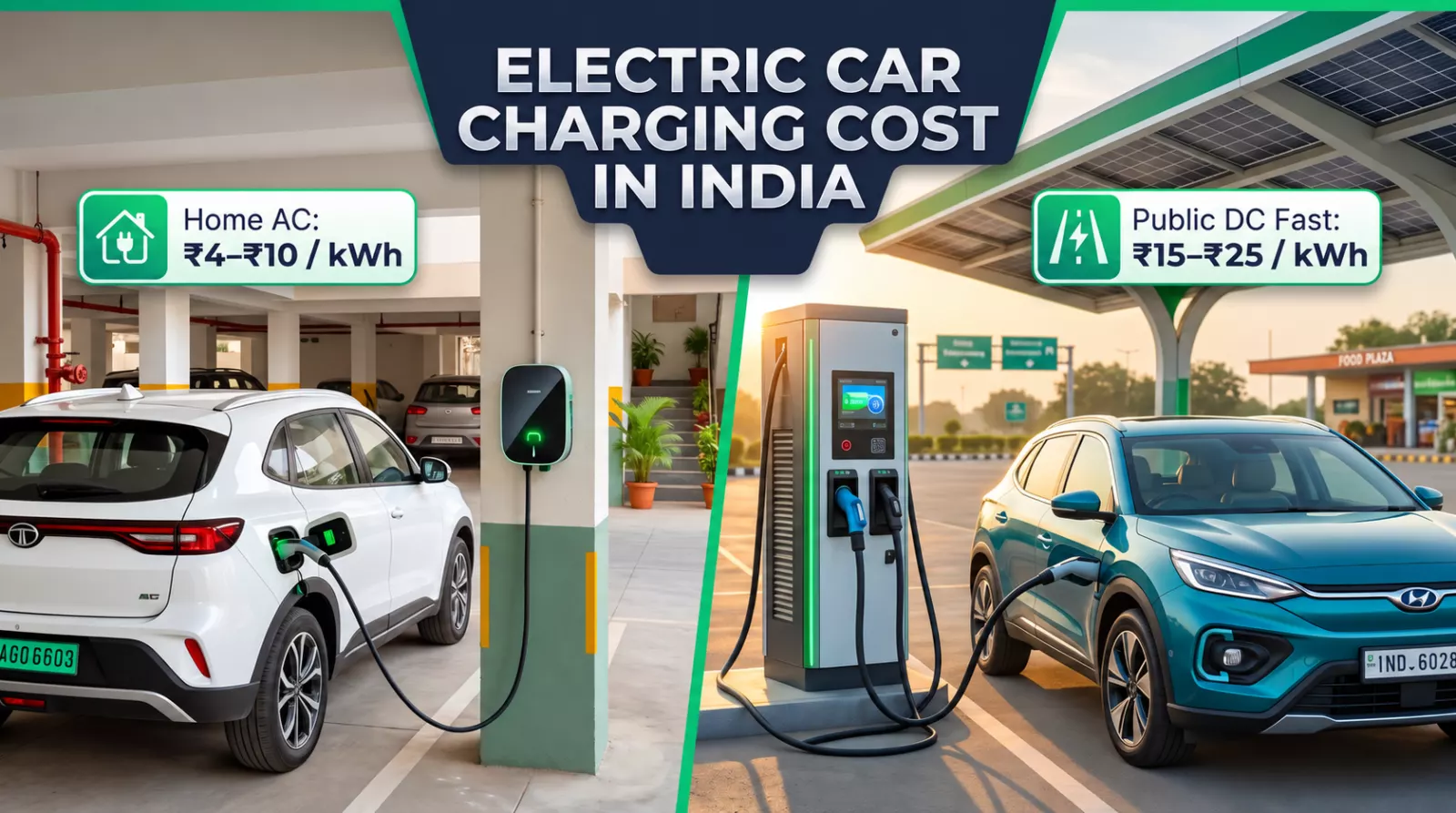
Quick Answer: In 2026, electric car charging cost in India ranges from ₹4 to ₹10 per unit (kWh) at home, ₹8 to ₹15 per kWh on public AC chargers, and ₹15 to ₹25 per kWh at public EV charging stations. Fully charging a popular 45 kWh electric SUV costs roughly ₹225 to ₹445 at home (₹0.70 to ₹1.40 per km) and ₹740 to ₹1,235 at a public DC fast charger (₹2.30 to ₹3.85 per km)—compared to ₹7.00 to ₹8.10 per km for a petrol SUV.
Ask any electric car owner in Delhi–NCR why they switched from petrol or diesel, and the answer almost always comes down to the monthly running bill. While a compact petrol SUV burns ₹6.50 to ₹8.00 for every kilometre it moves in bumper-to-bumper traffic, an electric car charged overnight at home covers the same distance for roughly ₹1.00 to ₹1.40 per kilometre.
Still, “EVs are cheap to charge” hides an important practical detail: where and when you plug in can change your bill by up to three times. Plugging into a 15A socket or 7.2 kW wallbox in your residential parking bay is billed very differently from topping up on a 60 kW or 120 kW highway DC fast charger during a lunch stop.
This guide breaks down the real-world electric car charging cost in India for 2026—covering per-unit tariffs across home setups and EarthtronEV’s fast-charging network, model-wise full-charge expenses, EV vs petrol running cost per km and for 100 km, why public station rates vary, and how property owners turn public charging tariffs into recurring monthly revenue.
What Is the EV Charging Cost Per Unit in India? (Home vs Public Stations)
Short answer: One unit of electricity equals 1 kilowatt-hour (kWh). In 2026, Indian EV drivers pay ₹4 to ₹10 per kWh for home AC charging, ₹8 to ₹15 per kWh at workplace or public AC chargers, and ₹15 to ₹25 per kWh at public DC fast-charging stations, inclusive of operator service fees and 5% GST.
India does not have a single fixed national retail rate for EV charging. What you pay per unit depends on whether you use a domestic meter, a dedicated state EV tariff line, or a commercial fast-charging network (see our Complete Guide to Electricity Tariffs for EV Charging by State in India):
| Charging Method | Typical Rate Per Unit (₹/kWh) | Full Charge Cost (45 kWh EV + 10% Loss) | Running Cost Per Km (~320 km Range) | Cost for 100 Km | What Is Included in the Bill |
|---|---|---|---|---|---|
| Home AC Charging (Dedicated EV Meter / Low Slab) | ₹4.00 – ₹6.50 / kWh | ₹198 – ₹322 | ₹0.62 – ₹1.00 / km | ₹62 – ₹100 | State EV tariff / base domestic slab |
| Home AC Charging (Standard Domestic Slab) | ₹6.50 – ₹10.00 / kWh | ₹322 – ₹495 | ₹1.00 – ₹1.55 / km | ₹100 – ₹155 | Standard household DISCOM slab |
| Workplace / Apartment Society AC (7.2–22 kW) | ₹8.00 – ₹15.00 / kWh | ₹396 – ₹743 | ₹1.24 – ₹2.32 / km | ₹124 – ₹232 | RWA / commercial tariff + maintenance fee |
| Public DC Fast Charging (30–60 kW CCS2) | ₹15.00 – ₹22.00 / kWh | ₹743 – ₹1,089 (₹520–₹762 for 10%–80%) | ₹2.32 – ₹3.40 / km | ₹232 – ₹340 | Energy tariff + CPO service charge + 5% GST |
| Highway Ultra-Fast DC Hub (120–240 kW CCS2) | ₹18.00 – ₹25.00 / kWh | ₹891 – ₹1,238 (₹624–₹866 for 10%–80%) | ₹2.78 – ₹3.87 / km | ₹278 – ₹387 | Highway hub tariff + service fee + 5% GST |
To see how charger output and plug types affect your stop duration alongside your bill, check our guide on types of EV chargers and connectors in India.
How to Calculate Your Electric Car Full Charge Cost (With Real-World Losses)
Short answer: Multiply your car’s battery capacity (kWh) by 1.10 to account for 10% heat and AC-to-DC conversion losses, then multiply by your per-unit electricity rate (₹/kWh). Divide that total by your realistic city or highway range (typically 75%–85% of ARAI claimed range) to get your true cost per kilometre.
Many first-time buyers simply multiply battery size by tariff—for example, 40 kWh × ₹8 = ₹320. In practice, 8% to 15% of the electricity drawn from the grid is lost as heat inside the charging cable, the car’s onboard charger (OBC), and the battery cooling loop. During peak North Indian summer afternoons (40°C–45°C), liquid-cooled batteries draw additional power to keep cell temperatures stable.
- Real Full Charge Cost (₹) = Battery Capacity (kWh) × 1.10 (Loss Factor) × Tariff Rate (₹/kWh)
- 10% to 80% Fast-Charge Cost (₹) = Battery Capacity (kWh) × 0.70 × 1.10 × DC Tariff Rate (₹/kWh)
- EV Running Cost Per Km (₹/km) = Real Full Charge Cost (₹) ÷ Real-World Range (km)
Full Charge Cost for Popular Electric Cars in India (2026 Model-Wise Breakdown)
Short answer: Including a 10% charging loss buffer, a full 0% to 100% home charge at ₹8/kWh costs roughly ₹169 to ₹211 for a Tata Tiago EV, ₹334 for an MG Windsor EV, ₹396 for a Tata Nexon EV 45, ₹443 for an MG ZS EV, and ₹519 to ₹695 for a Mahindra BE 6 or XEV 9e.
Here is what India’s bestselling electric cars actually cost to charge across a domestic home meter (₹8/kWh), a society or workplace AC Smart Charger (₹12/kWh), and public CCS2 DC fast charging (₹20/kWh for a standard 10% to 80% highway top-up):
| Electric Car Model | Battery Size | Realistic Range | Home AC Full Charge (@ ₹8/kWh + 10% Loss) | Public AC Full Charge (@ ₹12/kWh + 10% Loss) | Public DC 10%–80% Top-Up (@ ₹20/kWh + 10% Loss) | Home Cost Per Km |
|---|---|---|---|---|---|---|
| Tata Tiago EV (MR) | 19.2 kWh | ~150 km | ₹169 | ₹253 | ₹296 | ₹1.13 / km |
| Tata Tiago EV (LR) | 24.0 kWh | ~190 km | ₹211 | ₹317 | ₹370 | ₹1.11 / km |
| Tata Punch EV (LR) | 35.0 kWh | ~275 km | ₹308 | ₹462 | ₹539 | ₹1.12 / km |
| MG Windsor EV | 38.0 kWh | ~285 km | ₹334 | ₹502 | ₹585 | ₹1.17 / km |
| Tata Nexon EV (45) | 45.0 kWh | ~325 km | ₹396 | ₹594 | ₹693 | ₹1.22 / km |
| MG ZS EV | 50.3 kWh | ~350 km | ₹443 | ₹664 | ₹775 | ₹1.27 / km |
| Mahindra BE 6 / XEV 9e (Pack 1) | 59.0 kWh | ~430 km | ₹519 | ₹779 | ₹909 | ₹1.21 / km |
| Mahindra BE 6 / XEV 9e (Pack 2) | 79.0 kWh | ~550 km | ₹695 | ₹1,043 | ₹1,217 | ₹1.26 / km |
EV vs Petrol Running Cost in India: Cost Per Km, 100 Km & Monthly Savings
Short answer: Driving 100 km in an electric SUV costs ₹110 to ₹130 on home charging and ₹250 to ₹350 on public DC fast charging, compared to ₹715 to ₹770 for a petrol SUV (at ₹100/litre and 13–14 km/l). For a commuter driving 1,500 km a month, an EV saves ₹8,000 to ₹9,500 every month—or over ₹1 lakh a year.
Most Indian electric SUVs consume 15 to 17 units (kWh) per 100 km in mixed city and highway driving with the air conditioning on. Here is how monthly fuel and energy bills compare across three common driving profiles for a 45 kWh electric SUV versus a petrol SUV (13.5 km/l @ ₹100/litre) and a diesel SUV (16 km/l @ ₹90/litre):
| Driving Distance | EV Home Charging (@ ₹8/kWh) | EV Mixed (80% Home + 20% DC @ ₹20/kWh) | EV 100% Public DC (@ ₹20/kWh) | Petrol SUV (13.5 km/l @ ₹100/l) | Diesel SUV (16 km/l @ ₹90/l) |
|---|---|---|---|---|---|
| Cost Per 1 Km | ₹1.22 / km | ₹1.58 / km | ₹3.05 / km | ₹7.41 / km | ₹5.63 / km |
| Cost for 100 Km | ₹122 | ₹158 | ₹305 | ₹741 | ₹563 |
| 800 Km / Month (City Commuter) | ₹976 | ₹1,264 | ₹2,440 | ₹5,926 | ₹4,500 |
| 1,500 Km / Month (Daily Office + Weekend) | ₹1,830 | ₹2,370 | ₹4,575 | ₹11,111 | ₹8,438 |
| 2,500 Km / Month (Heavy Highway / Fleet User) | ₹3,050 | ₹3,950 | ₹7,625 | ₹18,519 | ₹14,063 |
| Annual Spend (15,000 Km / Year) | ₹18,300 | ₹23,700 | ₹45,750 | ₹1,11,110 | ₹84,375 |
Even if you live in a high-rise without a personal wallbox and rely entirely on society AC chargers or public DC stations, your annual energy bill remains 50% to 60% lower than running a petrol car. Commercial delivery and cab operators see even stronger per-kilometre economics when pairing depot charging with EV charging solutions for logistics and fleet operators.
Why Public EV Charging Rates Vary: The 4-Part Pricing Stack & Solar-Hour Rules
Short answer: Public EV charging stations price electricity higher than home meters because the retail tariff bundles four costs: the DISCOM electricity supply tariff, the operator’s service charge, commercial land/lease recovery, and 5% GST. Under Ministry of Power guidelines valid until 31 March 2028, daytime solar hours (9 AM–4 PM) carry a 0.7× ACoS power tariff, while non-solar hours carry 1.3× ACoS.
Drivers often wonder why two charging stations in the same city—or one in Noida versus another on the Murthal Highway (NH-44) or in Shimla—charge different per-kWh rates. Across India’s public charging network, every public charging bill is built from four layers:
1. Regulated DISCOM Supply Tariff (Solar vs Non-Solar Hours)
The Ministry of Power mandates a single-part electricity supply tariff for public EV charging stations that cannot exceed the utility’s Average Cost of Supply (ACoS) until 31 March 2028. To encourage daytime renewable energy use, distribution licensees bill stations at 0.7 × ACoS during solar hours (9:00 AM to 4:00 PM) and 1.3 × ACoS during non-solar hours (4:00 PM to 9:00 AM).
2. Charge Point Operator (CPO) Service Charge Ceilings
Unlike a home socket, a commercial fast-charging hub requires ARAI-certified DC chargers, dedicated 63 kVA to 500 kVA transformers, Central Station Management System (CSMS) software, dynamic load management, 24×7 uptime monitoring, and preventive maintenance. Under government guidelines, service-charge ceilings (excluding land cost and GST) are set at ₹3 to ₹4 per unit for AC slow charging and ₹11 to ₹13 per unit for DC fast charging depending on the time window.
3. Commercial Land and Highway Forecourt Economics
Prime highway wayside amenities, mall parking decks, and urban commercial hubs carry lease or revenue-share costs that are factored into the station’s retail tariff (EV charging for hotels, restaurants, and commercial properties).
4. 5% Goods and Services Tax (GST)
Public EV charging is billed as a service in India and attracts 5% GST, which is normally included in the per-unit rate displayed inside the charging app.
State-Wise EV Electricity Tariffs in India
Short answer: State Electricity Regulatory Commissions (SERCs) set dedicated EV charging electricity tariffs across India, starting at ₹4.10/kWh (LT) in Gujarat and ₹4.50/kWh (LT) in Delhi, and ranging from ₹5.00 to ₹6.96/kWh across Karnataka, Uttar Pradesh, Kerala, Maharashtra, Haryana, and Madhya Pradesh.
Based on State Electricity Regulatory Commission (SERC) tariff schedules, here is how base EV electricity supply rates compare across major Indian states in 2026:
| State / UT | Dedicated EV Tariff (₹/kWh) | Fixed / Demand Charge | Time-of-Use (ToU) / Special Provision |
|---|---|---|---|
| Delhi | ₹4.50 (LT) / ₹4.00 (HT) | Nil | Separate domestic & public EV meter across Delhi charging stations; off-peak ToU benefits |
| Gujarat | ₹4.10 (LT) / ₹4.00 (HT) | ₹25 / installation / month | Among India’s lowest base LT tariffs for EV stations |
| Karnataka | ₹5.00 | ₹70 – ₹170 / kW | Concessional EV tariff across BESCOM & state DISCOMs |
| Uttar Pradesh | ₹5.50 (LT / Public EV) | Varies by connection category | ToU rebates available across Noida & Ghaziabad |
| Kerala | ₹5.50 (LT) / ₹6.00 (HT) | ₹90 / kW | Solar-hour vs peak-hour tariff differentiation |
| Maharashtra | ₹6.08 (LT) / ₹6.90 (HT) | ₹75 / kW | Off-peak night rebates (10 PM–6 AM) lower effective cost |
| Haryana | ₹6.62 (LT) / ₹6.22 (HT) | Nil | Applies across Gurugram, Faridabad & Rohtak |
| Madhya Pradesh | ₹6.79 (LT) / ₹6.96 (HT) | Nil | Single-part EV tariff with zero fixed demand charge |
For Property Owners & Investors: How Public Charging Tariffs Create Recurring Franchise Revenue
Short answer: Commercial EV charging stations purchase power at regulated DISCOM EV tariffs (typically ₹4.00 to ₹8.00/kWh) and dispense fast DC power to drivers at ₹18 to ₹22/kWh. Under EarthtronEV’s FOCO franchise model—starting from ₹10–14 lakh for a 40 kW DC setup—investors earn monthly payouts from this per-unit energy margin without managing day-to-day operations.
India’s public charging network crossed 29,151 stations as of December 2025, backed by the Government of India’s ₹10,900 crore PM E-DRIVE EV charging subsidy scheme (which earmarks ₹2,000 crore specifically for public charging infrastructure). Yet India still needs at least 5,00,000 public charging points by 2030 to keep pace with EV adoption.
If you own or lease commercial parking at a highway restaurant, retail complex, hotel, fuel forecourt, or fleet hub, the per-kWh pricing spread is what powers an EV charging station franchise. Here is EarthtronEV’s illustrative monthly revenue model for a single 60 kW DC fast-charging station (₹18,00,000 full setup cost, 30 kWh average session, ₹20/kWh charging tariff, ₹8/kWh electricity cost, and ₹2,000/month maintenance):
| Station Usage Level | Sessions / Day | Energy Sold / Day | Utilisation | Monthly Gross Revenue (@ ₹20/kWh) | Monthly Net (Before Revenue Share)* | Simple Payback Estimate |
|---|---|---|---|---|---|---|
| Low Usage | 4 sessions | 120 kWh / day | ~8% | ₹72,000 | ₹41,200 | ~44 months |
| Moderate Usage | 8 sessions | 240 kWh / day | ~17% | ₹1,44,000 | ₹84,400 | ~21 months |
| High Usage | 12 sessions | 360 kWh / day | ~25% | ₹2,16,000 | ₹1,27,600 | ~14 months |
*Disclaimer: Figures are illustrative and not a guarantee of returns. Monthly net is shown at the station level before revenue-share split, taxes, and site-specific costs. Explore full setup packages and revenue projections on our EV charging station franchise partner page.
6 Practical Habits to Lower Your Electric Car Charging Cost
- Use home or workplace AC charging for 80% of your routine driving: Charging overnight on a 7.2 kW AC Smart Charger keeps your daily running cost around ₹1.00–₹1.25/km instead of ₹3.00+/km on highway DC chargers.
- Apply for a dedicated domestic EV meter: If your household already consumes 300+ units a month, adding an electric car to your regular meter can push your entire home bill into a ₹8–₹10/kWh slab. A separate EV meter locks in flat state EV tariffs (such as ₹4.50/kWh in Delhi). Follow our step-by-step guide on EV charging stations for home and apartments.
- Unplug highway DC fast chargers at 80%: Above 80% state of charge, the vehicle’s Battery Management System (BMS) tapers current sharply to prevent cell overheating, increasing both charging time and thermal energy losses.
- Charge during off-peak night windows or daytime solar hours: Schedule home charging between 10:00 PM and 6:00 AM where Time-of-Use (ToU) rebates apply, or top up at public stations during solar hours (9:00 AM to 4:00 PM) where 0.7× ACoS power rates apply.
- Pair home charging with rooftop solar: If you live in an independent house or builder floor with rooftop solar, daytime AC charging brings your effective energy cost close to zero after system payback.
- Check per-unit rates in the charging app before driving in: The EarthtronEV app displays live connector availability and exact per-kWh pricing upfront across all EarthtronEV charging station locations before you initiate a session, with instant payment via UPI or card.
Frequently Asked Questions (FAQs)
What is the cost of charging an electric car per unit in India in 2026?
In 2026, electric car charging in India costs ₹4 to ₹10 per unit (kWh) at home (commonly ₹6 to ₹9/kWh on standard domestic slabs), ₹8 to ₹15 per unit at public or society AC chargers, and ₹15 to ₹25 per unit at public DC fast-charging stations.
How much does it cost to fully charge a Tata Nexon EV in India?
A Tata Nexon EV 45 (45 kWh battery) requires roughly 49.5 units of electricity for a 0% to 100% charge after accounting for 10% charging efficiency loss. At a home tariff of ₹8/kWh, a full charge costs about ₹396 (or ~₹223 on Delhi’s ₹4.50/kWh dedicated EV meter). At a public DC fast charger billed at ₹20/kWh, a 10% to 80% fast charge (~34.6 units) costs roughly ₹693.
What is the running cost per km of an electric car vs a petrol car in India?
An electric car charged at home costs ₹0.70 to ₹1.40 per km to run (₹70 to ₹140 for 100 km), and ₹2.30 to ₹3.85 per km when using public DC fast chargers. By comparison, a petrol SUV delivering 13 to 15 km/l at ₹100/litre costs ₹6.65 to ₹7.70 per km (₹665 to ₹770 for 100 km).
Is public EV charging taxed under GST in India?
Yes. Public EV charging is classified as a service in India and attracts 5% GST, which is generally included in the per-kWh tariff shown in the charging app.
What is the cheapest time of day to charge an EV in India?
For home charging on a Time-of-Use (ToU) meter, overnight off-peak hours (10:00 PM to 6:00 AM) reduce per-unit rates by 20% to 30%. At public charging stations governed by Ministry of Power guidelines, daytime solar hours (9:00 AM to 4:00 PM) carry a lower base electricity tariff (0.7× ACoS) than non-solar hours (1.3× ACoS).
How do EV charging station franchise owners earn from per-unit charging tariffs?
Public charging stations draw electricity at regulated EV supply tariffs (₹4.00 to ₹8.00/kWh) and charge drivers ₹15 to ₹25/kWh for fast DC charging. Under EarthtronEV’s FOCO franchise model, electricity and operating costs are deducted from gross energy sales and the net return is settled monthly with the franchise investor along with a full session and kWh statement.