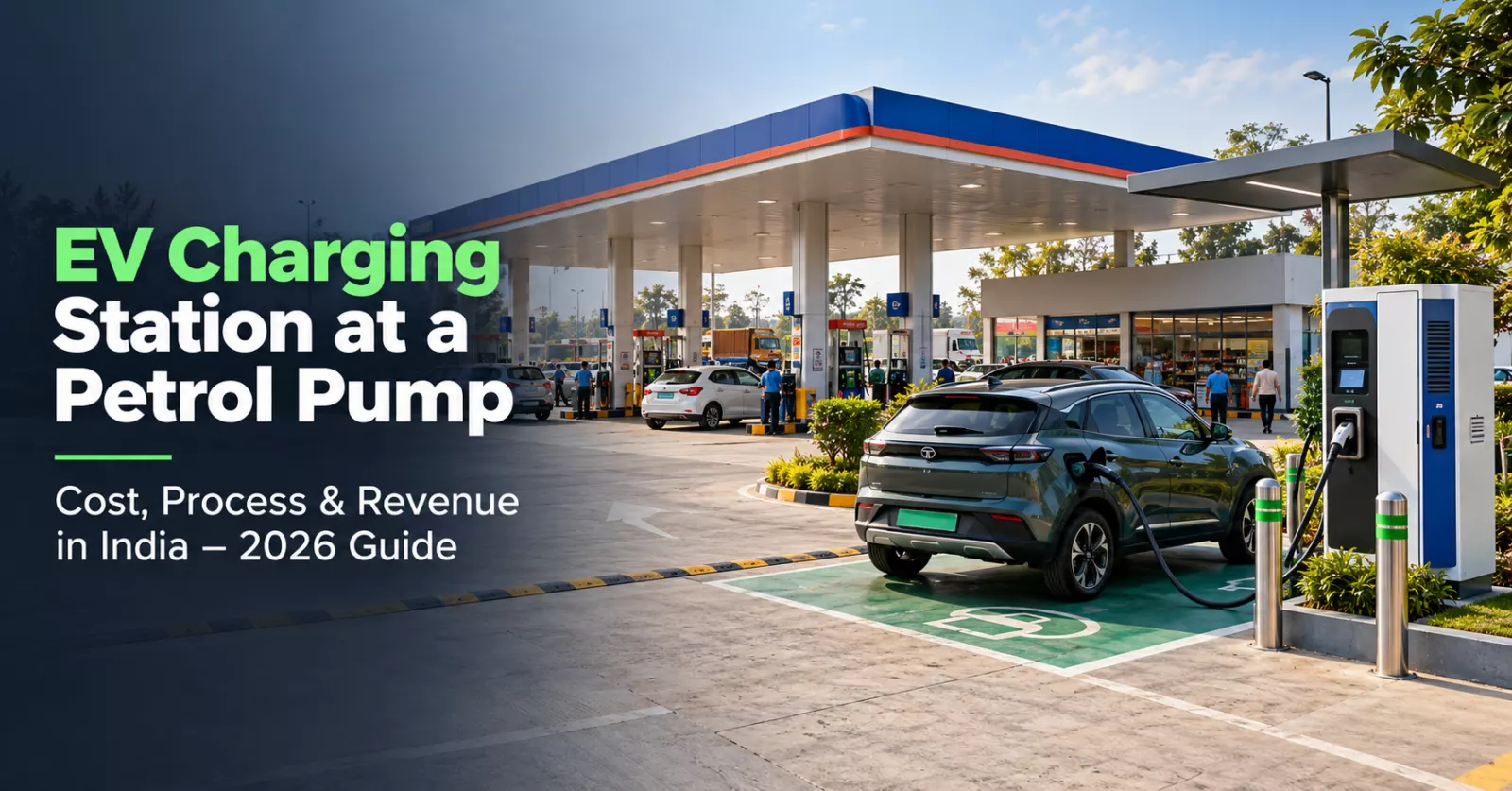
Quick Answer: A petrol pump can be a strong location for EV charging because it already has road frontage, established electricity infrastructure, staff, customer amenities and regular vehicle traffic. According to the Ministry of Petroleum & Natural Gas, 8,932 EV charging stations had been installed at retail outlets under FAME-II by the end of 2025, while Oil Marketing Companies had added more than 18,500 from their own resources. To add EV charging to a fuel retail outlet, the site must comply with PESO’s January 2025 safety guidelines, including locating the charger outside hazardous zones and maintaining prescribed separation distances from fuel infrastructure. OMC approval, electrical feasibility, charger selection and expected utilisation should all be assessed before investment.
As EV adoption increases, a growing share of road users will no longer buy petrol or diesel.
For fuel retailers, EV charging creates an opportunity to continue serving these customers rather than losing their stop entirely.
Petrol pumps already offer several advantages that a standalone charging-station operator may have to build from scratch:
- Visible road frontage
- Existing vehicle access
- Staff on site
- Customer amenities
- Established electrical infrastructure
- Parking and forecourt space
- Existing brand recognition
However, a petrol pump is also a regulated petroleum retail site.
EV charging equipment cannot simply be placed wherever convenient. Its location, electrical installation, parking area and relationship with fuel infrastructure need to comply with applicable safety requirements.
This guide explains how EV charging at petrol pumps works in India, what PESO requires, which charger capacity may suit different outlets, how much the setup may cost, and how to evaluate potential revenue and payback.
Why Petrol Pumps Are Strong Locations for EV Charging
A successful public EV charging station needs four basic things:
- A location drivers can find easily
- Reliable electricity
- Safe parking space
- Enough EV traffic to keep the charger utilised
Petrol pumps often already have several of these advantages.
| Advantage | Why It Matters for EV Charging |
| Road frontage and visibility | Drivers can identify and access the site easily |
| Existing electrical infrastructure | Load enhancement may be easier than developing a completely new site, subject to electrical feasibility |
| Owned or long-leased land | Can reduce or eliminate one of the biggest recurring costs |
| Staff already on site | Someone can assist customers and report charger faults |
| Toilets, shop and food | Longer EV dwell time can create secondary revenue |
| Highway and arterial-road locations | Useful for drivers who need reliable fast charging during longer journeys |
The Ministry of Petroleum & Natural Gas reported that 8,932 EV charging stations had been installed at retail outlets under FAME-II, while OMCs had added more than 18,500 additional stations from their own resources by the end of 2025.
The same government review said public-sector OMCs are developing 4,000 Energy Stations between 2024-25 and 2028-29, combining conventional and alternative fuels. As of 1 November 2025, 1,064 such Energy Stations had been set up.
This shows that fuel retail outlets are already becoming part of India’s broader EV charging network.
EV Charging at Petrol Pumps in India: What Is Changing in 2026?
OMCs Are Expanding Charging Partnerships
In March 2026, Charge_iN by Mahindra announced a strategic partnership with HPCL to develop EV charging infrastructure at selected HPCL retail outlets.
The collaboration can leverage HPCL’s network of more than 24,400 retail outlets, while HPCL already operates more than 5,400 EV charging stations under HP e-Charge.
The new Charge_iN sites use 180kW dual-gun fast chargers and are being developed primarily along important travel corridors.
This does not mean every HPCL outlet will receive a 180kW charger.
It shows that fuel-station charging is increasingly being evaluated at network and corridor level rather than as isolated installations.
PESO Has Issued Specific Retail-Outlet Guidelines
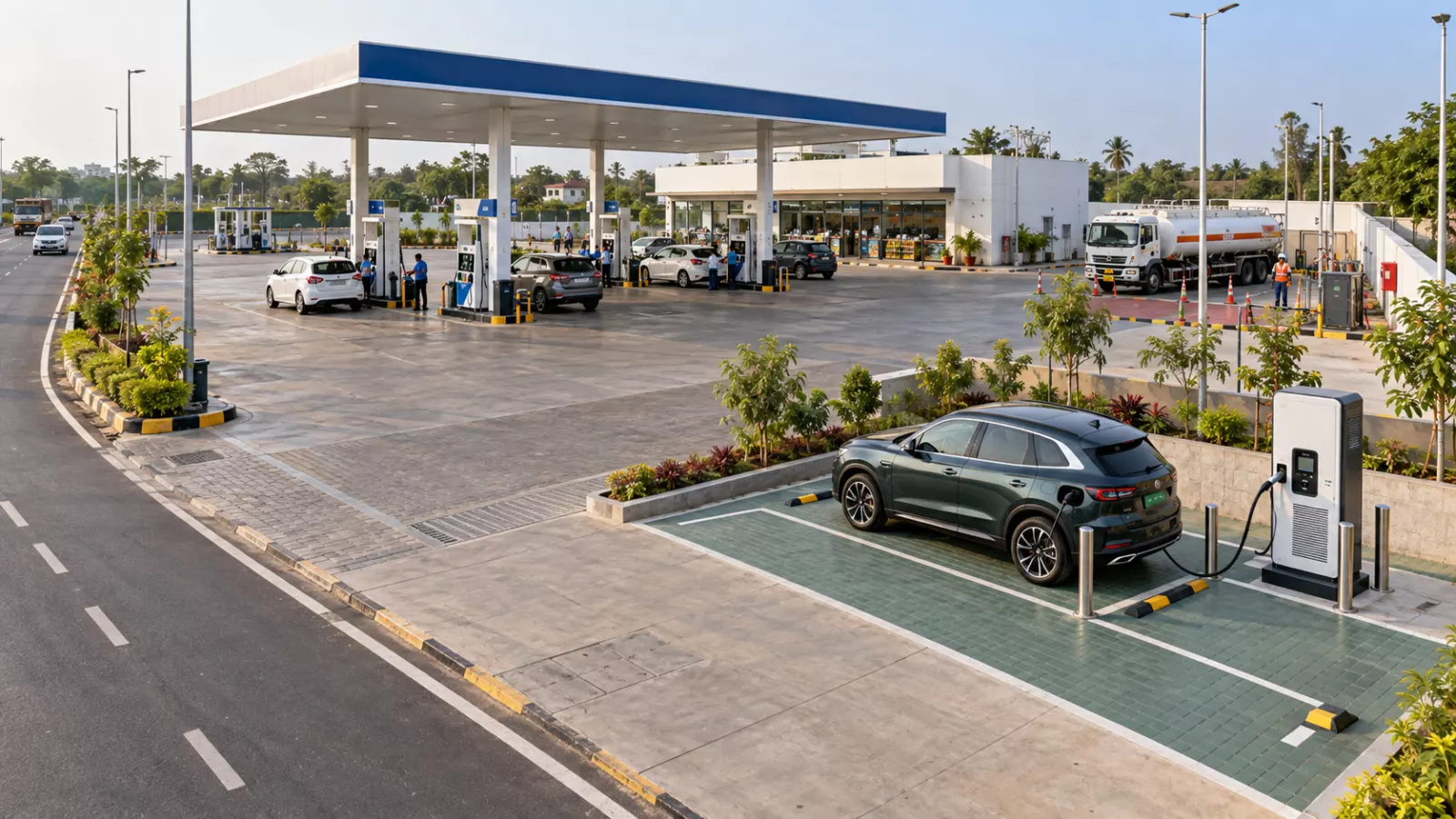
PESO issued final guidelines for installing EV charging and battery-swapping facilities at petroleum retail outlets on 20 January 2025.
These guidelines provide clearer requirements on:
- Hazardous zones
- Parking
- Traffic movement
- Underground tanks
- Minimum safety distances
For a petrol-pump owner, this makes the site-layout survey one of the first steps in project planning.
Who Can Set Up an EV Charger at a Petrol Pump?
Most petrol pumps in India operate under a dealership or retail agreement with an Oil Marketing Company such as IndianOil, Bharat Petroleum, Hindustan Petroleum or a private fuel retailer.
Before buying charging hardware, a dealer should check the relevant OMC agreement and obtain the approvals required under that arrangement.
Land ownership alone should not be assumed to give a dealer the right to modify a branded petroleum retail outlet independently.
The exact commercial structure varies by company and site.
Common Ownership Models
| Model | Who Invests? | Who Operates? | Suitable For |
| OMC-led installation | OMC / charging partner | OMC or charging network | Dealers wanting low direct capital commitment |
| Dealer-invested charger | Dealer | Dealer or charging partner | Owners wanting greater control over economics |
| Managed charging / franchise | Dealer, investor or site owner | Charging company | Owners who want professional operations and technology support |
| Revenue-share model | Depends on agreement | Charging network | Owners prioritising lower operational responsibility |
Before signing with a charger company, clarify:
- Who owns the charger?
- Who pays for electrical upgrades?
- Who pays maintenance?
- Who sets the charging tariff?
- Who bears downtime risk?
- What revenue share applies?
- Who manages customer support?
- What happens when the agreement ends?
PESO Safety Rules for EV Charging at Petrol Pumps
PESO’s January 2025 guidelines allow EV charging and battery-swapping facilities at petroleum retail outlets provided adequate space is available and safety is not compromised.
The guidelines require that:
- Charging or swapping equipment must not be inside a hazardous zone
- A dedicated vehicle parking area must be marked in the site layout
- Parking must also remain outside the hazardous zone
- Charging equipment must not obstruct incoming or outgoing vehicle movement
- Equipment must not be installed above underground petroleum storage tanks
Minimum PESO Safety Distances
| Facility / Reference Point | Minimum Distance |
| Underground petroleum tank fill point | 3 metres |
| Underground petroleum tank vents | 4 metres |
| MS/HSD/ALDS/CNG/LNG dispensing units | 6 metres |
| CNG installation from fencing | 6 metres |
| ALDS installation from fencing | 9 metres |
| LNG installation from fencing | 9 metres |
| LPG unloading point / tank-truck unloading platform | 9 metres |
| LNG unloading point / tank-truck unloading platform | 9 metres |
These distances can directly determine whether a petrol pump has enough usable space for charging.
A small forecourt may appear to have an empty corner but still fail after hazardous-zone and separation-distance mapping.
Why a Site Survey Should Come First
Before selecting charger capacity, map:
- Fuel dispensers
- Underground tanks
- Tank filling points
- Tank vents
- CNG/LNG/LPG installations
- Tanker movement
- Customer vehicle movement
- Existing electrical panels
- Available parking
Only after identifying a compliant charging zone should charger size and bay layout be finalised.
For broader charging-site precautions, see the EV Charging Station Safety Checklist in India.
Which EV Charger Should a Petrol Pump Install?
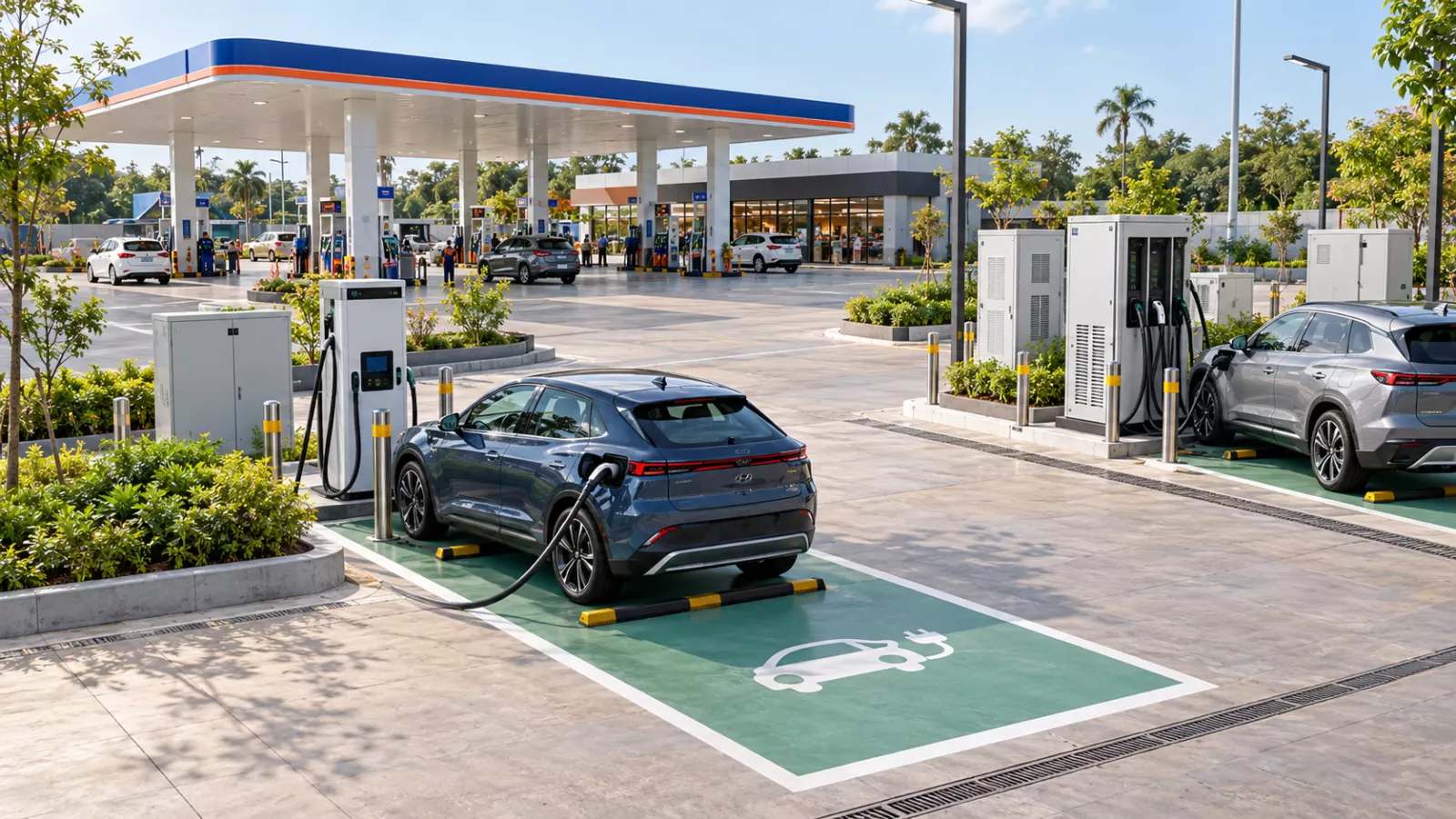
There is no single charger capacity that is automatically best for every petrol pump.
The correct charger depends on:
- Daily EV traffic
- Vehicle type
- Typical dwell time
- Electrical capacity
- Route type
- Number of charging sessions expected
- Vehicles’ own maximum charging rates
- Competition nearby
| Petrol-Pump Type | Typical Customer | Practical Charger Direction |
| Highway petrol pump | Intercity EVs, fleets, travellers | 60kW DC for moderate demand; 120kW+ where traffic and grid capacity justify it |
| Busy city pump | Cabs, delivery vehicles, private cars | 40–60kW DC |
| Pump near commercial/fleet hub | Cabs and fleet vehicles | 60kW+ depending on fleet duty cycle |
| Pump near e-auto / e-rickshaw activity | Light electric vehicles | Suitable AC or LEV charging where layout permits |
| Large mixed-use forecourt | Mixed traffic | DC fast charging plus selected slower charging points |
Most four-wheeler customers at a petrol pump are likely to value faster turnaround, making DC charging a natural fit at many locations.
But installing the highest-capacity charger available is not automatically the best investment.
A well-utilised 60kW charger can outperform a poorly utilised 120kW or 180kW charger financially.
For a detailed comparison, see AC vs DC EV Chargers.
Step-by-Step Process to Install an EV Charger at a Petrol Pump
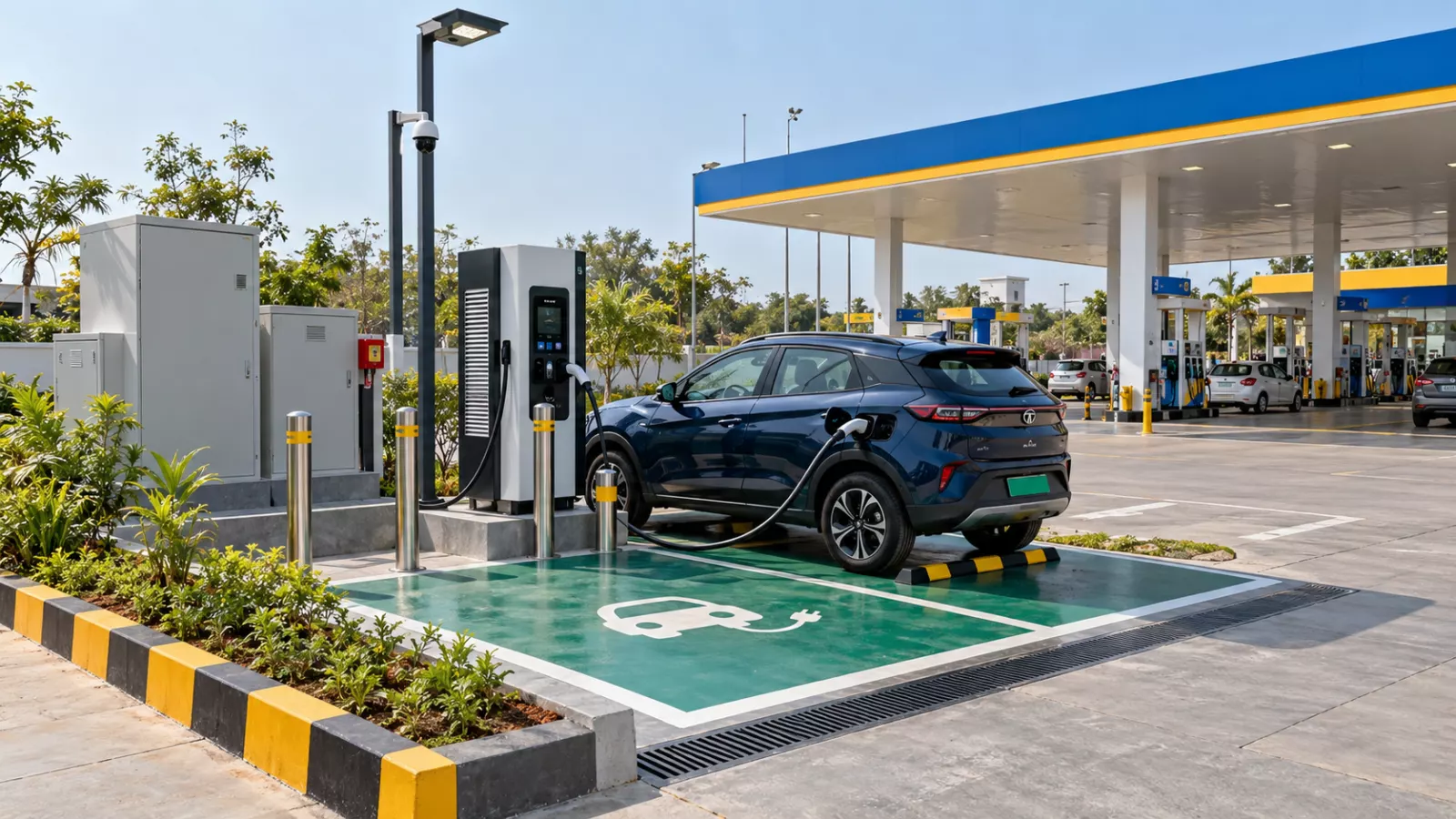
Step 1: Review the Dealership Agreement
Check what your OMC permits and whether it already has an EV charging programme, approved charging partner, standard commercial terms or approved charger specifications.
Step 2: Discuss the Project with the OMC
Obtain the approvals required for adding EV charging to the branded retail outlet.
Clarify the preferred commercial model before spending on hardware.
Step 3: Conduct a PESO-Compliant Site Survey
Map hazardous zones, fuel dispensers, tank vents, tank filling points, underground tanks, CNG/LPG/LNG infrastructure and vehicle movement.
Identify a compliant EV parking and charger location.
Step 4: Check Electrical Feasibility
Review existing sanctioned load, spare electrical capacity, supply voltage, cable route, distance from distribution infrastructure, transformer capacity and load-enhancement requirements.
Step 5: Select Charger Capacity
Choose the charger based on actual demand rather than headline charging speed.
Step 6: Finalise the Charging Partner and Software
Commercial charging equipment should ideally support OCPP, remote monitoring, user authentication, digital payment, session reporting, fault alerts, remote restart and energy metering.
Step 7: Finalise Layout and Approvals
Ensure the charging bay, cables, parking area and supporting equipment match approved site plans and applicable safety conditions.
Step 8: Install and Test
Complete civil work, electrical panels, earthing, cabling, charger foundation, bollards, lighting, networking, signage and safety equipment.
The installation should be inspected and tested before commercial operation.
Step 9: Go Live and Improve Discoverability
List the station on relevant charging platforms and navigation systems where supported.
Monitor sessions, kWh delivered, uptime, failed sessions, peak charging hours and repeat customers.
For a wider installation overview, see EV Charging Station Installation in India.
Electricity Load and Transformer Requirements
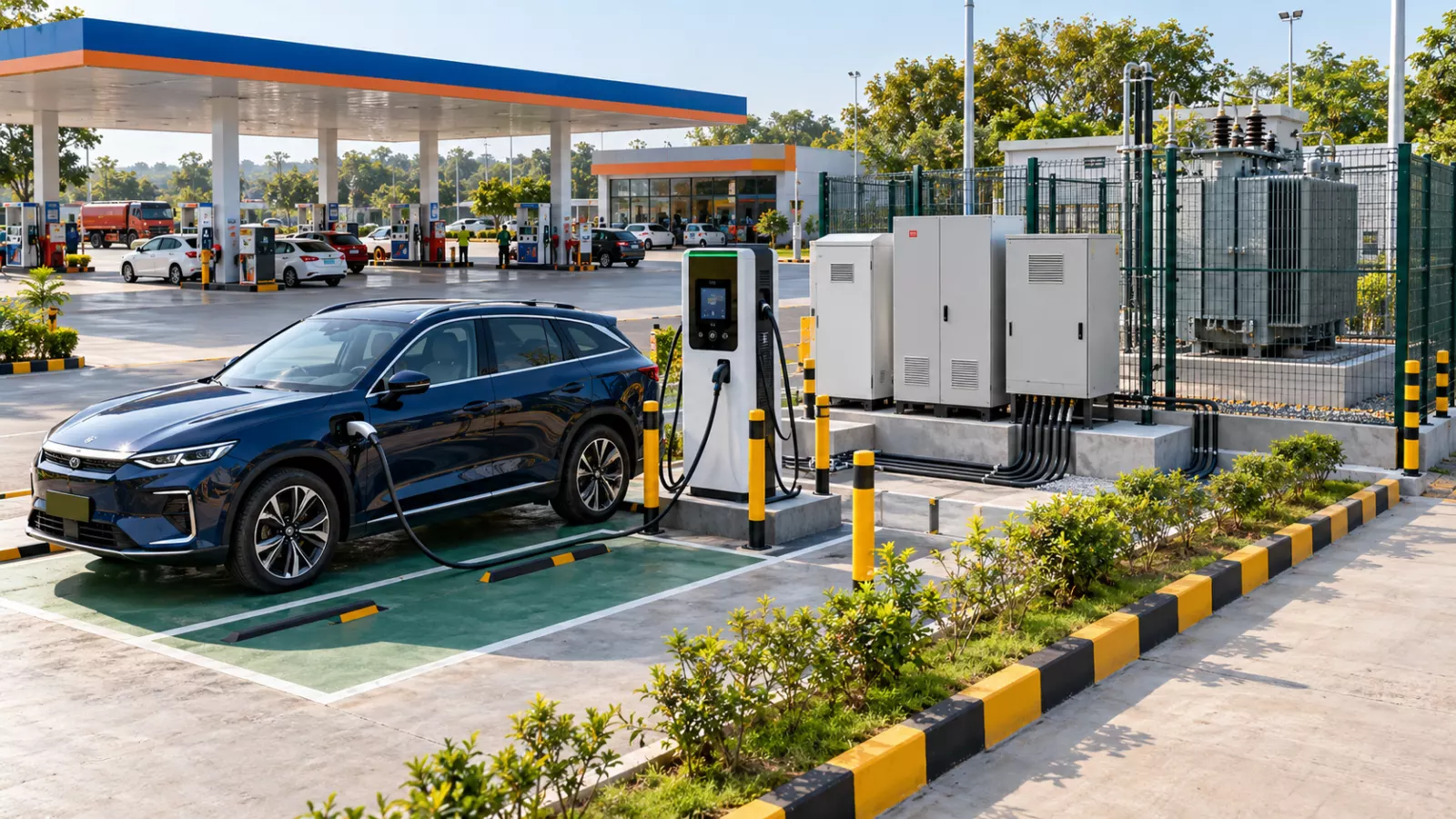
The existing electricity connection at a petrol pump does not automatically mean there is enough spare capacity for DC fast charging.
Electrical feasibility should be checked before ordering the charger.
Existing Sanctioned Load
Start by identifying:
- Current sanctioned load
- Existing maximum demand
- Spare capacity
- Supply type
- Other large loads at the outlet
A charger should not be added simply by calculating its rated kW against the headline sanctioned load. The site’s simultaneous operating demand also matters.
LT Connection
The Ministry of Power’s EV Charging Infrastructure Guidelines 2024 state that EV charging-station owners may opt for an LT connection for loads up to 150kW, subject to the applicable distribution utility framework.
This can make 40kW and 60kW projects relatively practical at some locations, although the actual utility design depends on the site.
When Might a Transformer Be Required?
A transformer or upstream electrical augmentation may become necessary where:
- Existing capacity is insufficient
- Charger capacity is high
- Several chargers operate simultaneously
- Utility infrastructure requires it
- Voltage-drop or cable-run constraints become significant
High-power 120kW, 150kW, 180kW or multi-charger sites should be assessed particularly carefully.
Do not assume that every 60kW installation needs a new transformer or that every petrol pump can support one without upgrades.
The DISCOM and electrical feasibility study should determine the final solution.
How Much Does an EV Charging Station at a Petrol Pump Cost?
Project cost depends on:
- Charger capacity
- Charger manufacturer
- Existing electricity infrastructure
- Load enhancement
- Transformer requirement
- Civil work
- Cabling distance
- Forecourt modification
- Safety requirements
- Number of charging bays
EarthtronEV’s current published franchise/project figures provide one indicative commercial benchmark.
| Charger | Typical Use | Approx. Space | Indicative Full Setup Cost* |
| 40kW DC | Small commercial locations | ~100–150 sq ft | ₹10–14 lakh |
| 60kW DC | Commercial hubs and moderate fast-charging demand | ~150–200 sq ft | ₹14–20 lakh |
| 150kW DC | Highway and fleet fast charging | ~250–350 sq ft plus electrical infrastructure | ₹28–45 lakh |
| 180kW DC | Premium highway / fleet sites | ~300–400 sq ft | ₹40–55 lakh |
*These are EarthtronEV’s current published indicative ranges, not universal market prices. Site-specific cost can change substantially.
EarthtronEV also currently lists a standard 60kW DC configuration at around ₹18 lakh for a complete standard installation, while final costs can change with site conditions.
Costs That May Be Lower at a Petrol Pump
- Land
- Basic road access
- Staff presence
- Customer amenities
- Some existing electrical infrastructure
Costs That May Be Higher
- Forecourt redesign
- Longer underground cable routes
- Electrical upgrades
- Safety separation
- Bollards and impact protection
- Dedicated EV parking
- Additional power infrastructure
Do not calculate viability from charger hardware cost alone. Use a final site-specific quotation.
For broader project economics, see EV Charging Franchise Cost vs Revenue & Break-Even.
How Much Can a Petrol Pump Earn from EV Charging?
Revenue depends much more on utilisation than charger capacity alone.
A high-powered charger that receives only a few sessions per day can perform worse financially than a smaller charger at a busy location.
Charging Revenue = Sessions per Day × Average kWh per Session × Charging Price × Operating Days
But gross revenue is not profit.
Expenses can include:
- Electricity
- Maintenance
- Software
- Connectivity
- Payment-gateway fees
- Revenue share
- Insurance
- Repairs
- Equipment replacement
Illustrative Revenue & Payback Model — Not a Revenue Guarantee
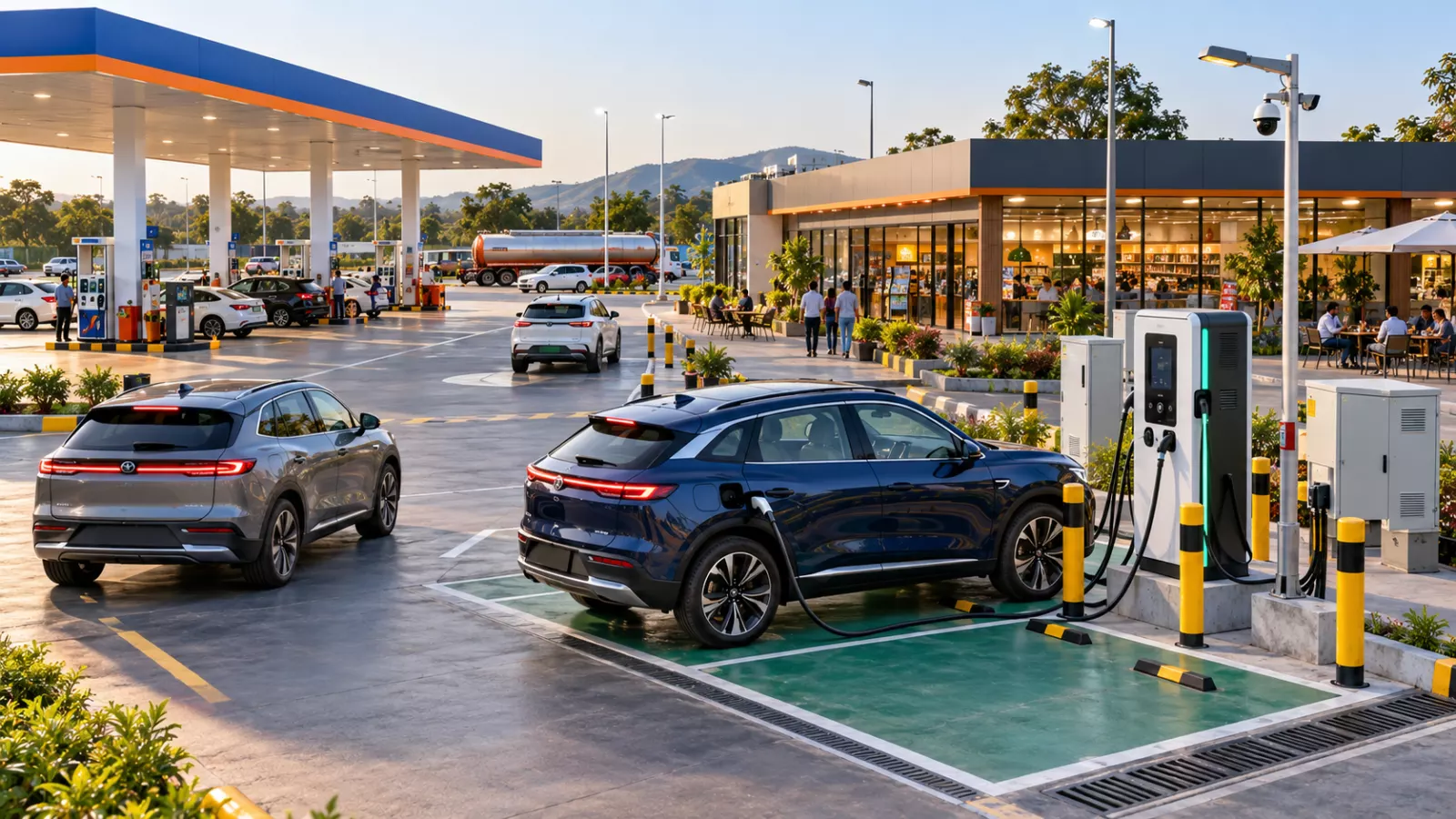
Assume one 60kW DC charger at an existing petrol pump.
Illustrative Assumptions
- 25 kWh delivered per charging session
- ₹20/kWh customer charging price
- ₹8/kWh effective electricity cost
- ₹12/kWh energy margin before other costs
- ₹2 lakh annual maintenance/software/connectivity/payment cost
- No separate land rent
- ₹17 lakh initial setup cost
- Stable charger uptime and successful session completion
| Sessions per Day | Approx. Energy per Year | Energy Margin per Year | Illustrative Net After Listed Running Costs | Simple Payback |
| 4 | ~36,500 kWh | ~₹4.38 lakh | ~₹2.38 lakh | ~7.1 years |
| 8 | ~73,000 kWh | ~₹8.76 lakh | ~₹6.76 lakh | ~2.5 years |
| 12 | ~1,09,500 kWh | ~₹13.14 lakh | ~₹11.14 lakh | ~1.5 years |
These figures are illustrative only.
They exclude items such as:
- GST treatment
- Financing
- Insurance
- Major repairs
- Replacement reserve
- OMC revenue share
- Charging-network revenue share
- Unexpected downtime
- Demand charges where applicable
The biggest lesson is not that a petrol-pump charger has a fixed payback period. It is that utilisation determines economics.
A busy petrol pump can justify substantial charging infrastructure. A quiet location may take many years to recover the same investment.
Additional Revenue Beyond Charging
Charging revenue is only one part of the commercial opportunity.
A conventional fuel customer may remain at a petrol pump for only a few minutes.
An EV customer may stay considerably longer while charging.
That dwell time may generate secondary sales through:
- Convenience store
- Café
- Restaurant
- Food counter
- Vending
- Washroom facilities
- Fleet services
- Advertising
These revenues should not be assumed in the core charger ROI unless they can be measured reliably. But they can improve the overall economics of a well-designed retail outlet.
Common Mistakes to Avoid
1. Buying a Charger Before Checking OMC Requirements
Do not commit to hardware before understanding what your dealership arrangement permits.
2. Ignoring PESO Safety Distances
A technically good charger is useless if there is no compliant place to install it.
3. Choosing Charger Capacity Only by Speed
A 150kW or 180kW charger does not automatically earn more than a 60kW charger. Demand needs to justify the added investment.
4. Skipping Electrical Feasibility
Available land does not mean available power. Check sanctioned load and grid infrastructure first.
5. Blocking Existing Fuel Operations
EV parking should not obstruct fuel customers, tanker movement, entry or exit lanes, or emergency access.
6. Ignoring Downtime
A charger that is regularly offline loses revenue and customer trust. Monitoring, preventive maintenance and service response time should be part of partner selection.
7. Ignoring Vehicle Charging Capability
A high-power charger cannot force a vehicle to accept more power than its onboard charging system allows.
Is EV Charging at a Petrol Pump Worth It in 2026?
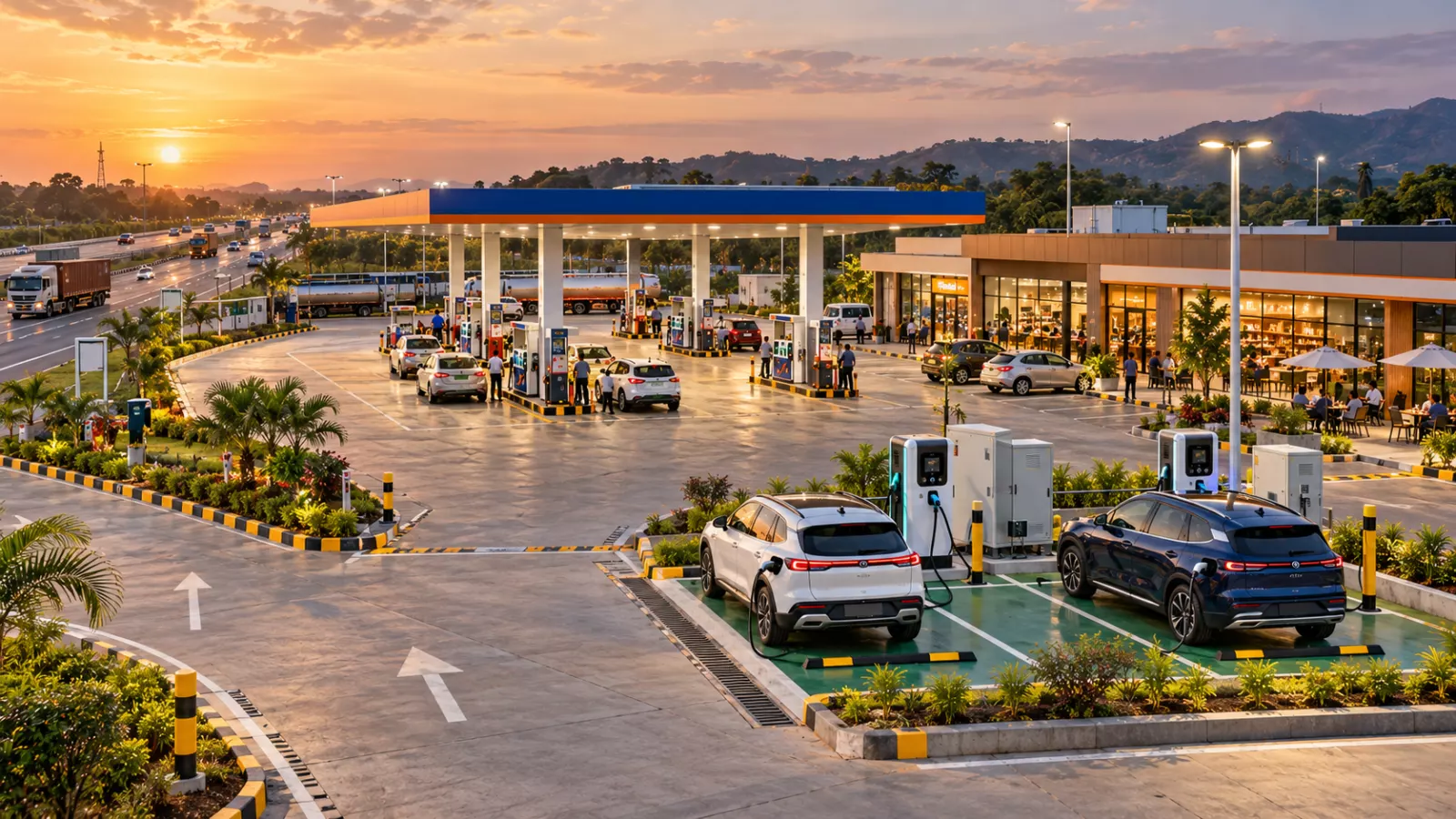
It can be a strong business extension for the right petrol pump.
Fuel stations have several structural advantages:
- Existing land
- Vehicle traffic
- Visibility
- Staff
- Customer amenities
- Established operating hours
But those advantages do not guarantee profitability.
A petrol-pump EV charging project makes more sense when:
- There is measurable EV traffic nearby
- The site has a PESO-compliant location
- Electrical capacity is practical
- The charger matches the customer mix
- Utilisation can justify the investment
- OMC commercial terms are workable
It makes less sense when:
- The forecourt is too constrained
- Electrical upgrades are disproportionately expensive
- Nearby charging supply already exceeds demand
- EV traffic is too low
- A large charger is selected mainly for marketing rather than actual usage
For owners who do not want to independently manage charger procurement, software, maintenance and operations, a managed charging or franchise structure may also be considered.
EarthtronEV’s current EV charging station franchise programme uses a managed operating model, but commercial viability should still be evaluated using a site-specific quotation and demand assessment.
FAQs
Can I Install an EV Charger at My Petrol Pump?
Yes, provided the site has a compliant charging location and the project meets applicable OMC, electrical and PESO requirements. PESO’s January 2025 guidelines specifically provide for EV charging and battery-swapping facilities at petroleum retail outlets where adequate space is available and safety is not compromised.
What Is the Minimum Distance Between an EV Charger and a Fuel Dispenser?
PESO’s January 2025 guidelines require EV charging or battery-swapping facilities to remain at least 6 metres from MS/HSD/ALDS/CNG/LNG dispensing units. Other required distances include 3 metres from underground tank fill points and 4 metres from underground tank vents.
How Much Does It Cost to Set Up an EV Charger at a Petrol Pump?
Cost depends on charger capacity and site work. As one current commercial benchmark, EarthtronEV publishes 40kW DC at approximately ₹10–14 lakh, 60kW DC at approximately ₹14–20 lakh, and 150kW DC at approximately ₹28–45 lakh. These figures are indicative and should not be treated as universal prices.
Does a Petrol Pump Need a Separate EV Charging Licence?
Under India’s national electricity framework, public EV charging is a de-licensed activity. However, the petrol pump remains a regulated petroleum retail site, so the project still needs to comply with applicable OMC, PESO, electrical, building and local requirements.
Does Every Petrol Pump Need a New Transformer for EV Charging?
No. The requirement depends on existing sanctioned load, spare electrical capacity, charger size, number of chargers and utility infrastructure. The final requirement should come from a site-specific electrical assessment.
Which Charger Is Best for a Highway Petrol Pump?
A 60kW DC charger can suit many highway sites with moderate EV demand. Busy corridors with high utilisation and vehicles capable of accepting higher charging rates may justify 120kW, 150kW or greater capacity. The correct choice depends on traffic, grid capacity and customer charging behaviour.
Can a Petrol Pump Charge E-Rickshaws and Electric Two-Wheelers?
Yes, where a compliant area can be provided. These vehicles may require different charging equipment from four-wheelers, so connector and voltage compatibility must be checked before installation.
How Many EV Charging Stations Are Already Installed at Fuel Retail Outlets?
The Ministry of Petroleum & Natural Gas reported 8,932 EV charging stations installed at retail outlets under FAME-II by the end of 2025, with OMCs installing more than 18,500 additional stations using their own resources. That means the combined figure was already above 27,400 charging stations at retail outlets.
Is an EV Charging Station at a Petrol Pump Profitable?
It can be, but there is no universal profitability figure. The most important variables are daily charging sessions, average energy delivered, electricity cost, charging tariff, uptime, revenue share, capital cost and electrical-upgrade cost. A high-utilisation station can achieve a much faster payback than an underused charger at an otherwise similar petrol pump.
Conclusion
EV charging gives petrol-pump owners a practical way to participate in the transition from conventional fuels to electric mobility.
Petrol pumps already have several valuable assets for public charging: road visibility, vehicle access, staff, customer amenities and often long-term control over the location.
But a successful petrol-pump charging project starts with feasibility, not charger procurement.
First confirm the compliant charging area under PESO’s January 2025 guidelines. Then assess OMC requirements, sanctioned electrical load, customer demand and the charger capacity that the location can realistically utilise.
The strongest petrol-pump EV charging projects will not necessarily be the sites with the largest chargers.
They will be the sites where safe layout, power availability, EV traffic, station uptime and commercial terms work together to keep the charging infrastructure consistently utilised.
Sources & References
- Petroleum and Explosives Safety Organisation (PESO) — Guidelines for Installation of Electric Vehicle Charging/Battery Swapping Facilities in a Retail Outlet, January 2025
- Ministry of Petroleum & Natural Gas / Press Information Bureau — Year End Review 2025
- Ministry of Power — Guidelines for Installation and Operation of Electric Vehicle Charging Infrastructure 2024
- Mahindra — Charge_iN and HPCL EV Charging Infrastructure Partnership, March 2026
- EarthtronEV — EV Charging Station Franchise in India
- EarthtronEV — EV Charging Franchise Cost vs Revenue & Break-Even
- EarthtronEV — EV Charging Station Installation in India
- EarthtronEV — EV Charging Station Safety Checklist in India