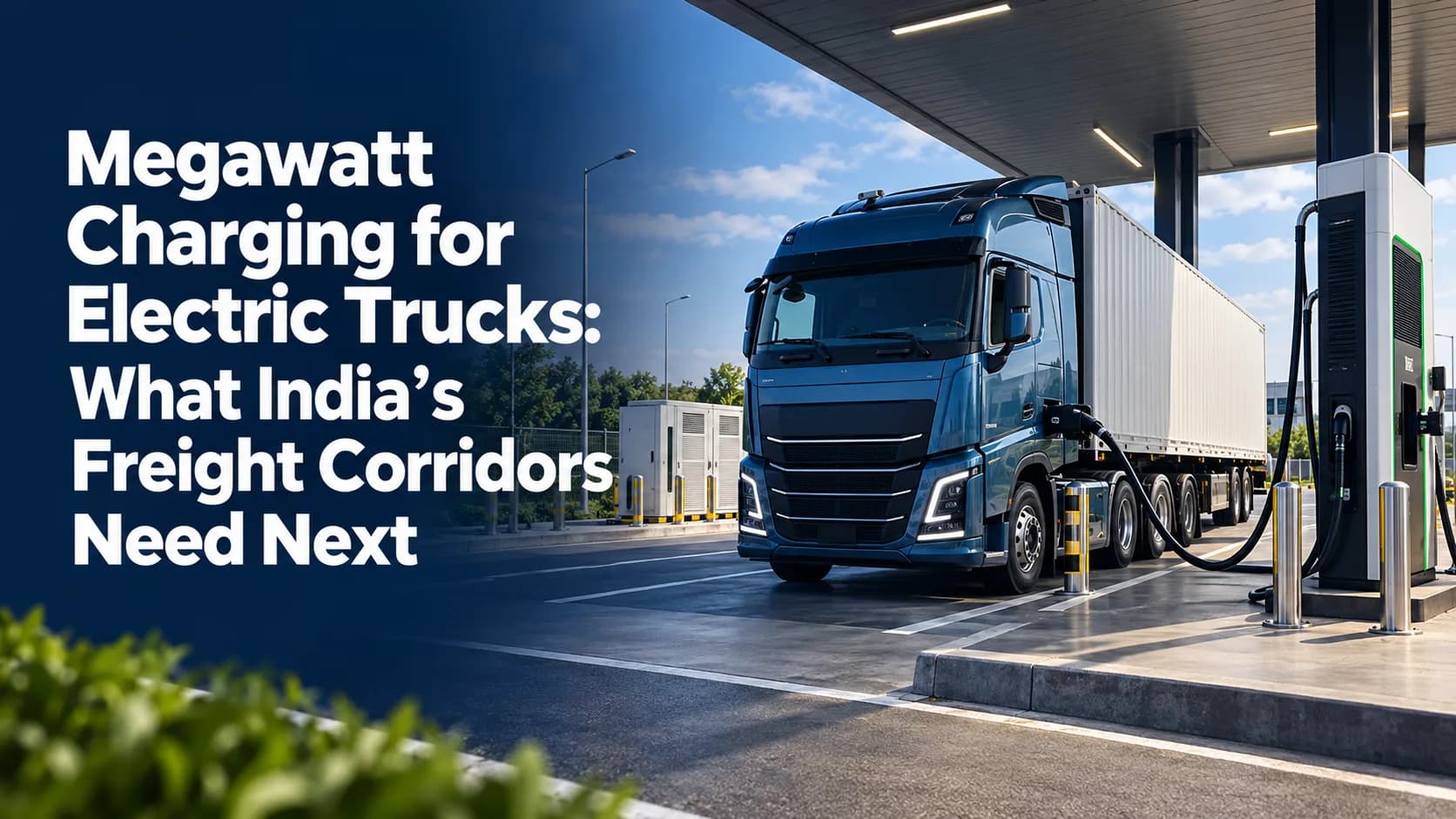
An electric truck charging overnight at a warehouse has a different requirement from a truck that needs to continue a long-distance delivery after a short stop. Both need reliable energy, but their available charging time can be very different.
This is where megawatt charging becomes relevant.
For compatible heavy-duty electric trucks, it offers the possibility of replenishing substantial energy during shorter stops. However, installing a powerful charger is only one part of the solution. Freight operators also need suitable vehicles, sufficient electricity supply, accessible charging bays and a network that fits their routes.
For India, the practical question is how to combine these requirements into dependable freight operations.
What Is Megawatt Charging?
A megawatt is a unit of power equal to 1,000 kilowatts. Charging power describes how quickly energy can be transferred; battery capacity, usually expressed in kilowatt-hours, describes how much energy can be stored.
The Megawatt Charging System, or MCS, is a charging system developed for high-power applications such as heavy-duty electric trucks.
CharIN’s MCS programme brings together vehicle manufacturers, charging companies and other stakeholders to develop a common approach to heavy-duty charging.
However, “megawatt charging” and “MCS compatibility” should not be treated as interchangeable purchasing specifications. A power rating alone does not confirm the connector, communication system or compatibility with a particular truck.
Before selecting equipment, operators should verify:
- The charging interface supported by the truck.
- The vehicle’s voltage and current requirements.
- Its supported charging curve.
- Compatibility between the vehicle and charger.
- The power available when multiple vehicles charge simultaneously.
A charger’s maximum rating is a capability, not a promise that every connected truck will receive that power throughout its session.
Why Every Electric Truck Does Not Need Megawatt Charging
Charging infrastructure should match the vehicle’s working schedule.
A truck parked for several hours may be able to recover its required energy at a lower power level. A vehicle with a short turnaround and a demanding next journey may need much higher power.
| Operating situation | Charging approach to evaluate |
|---|---|
| Truck returns to a depot overnight | Depot charging sized around available parking time |
| Regional truck stops at a distribution centre | Charging during loading, unloading or scheduled downtime |
| Long-distance truck has a short planned stop | High-power charging, potentially MCS if compatible |
| Fleet operates across multiple shifts | A combination of depot and opportunity charging |
The starting point should be the daily energy requirement and the time available to replace it.
For broader operational planning, explore EarthtronEV’s guide to EV fleet charging for logistics in India.
What Recent Developments Tell Us
Megawatt charging has moved beyond concept discussions into real-world demonstration projects.
In September 2025, Germany’s HoLa research project opened a public MCS charging installation at Lipperland Süd. Fraunhofer ISI’s announcement describes the project’s role in testing heavy-duty charging under real operating conditions.
India is also participating in technical discussions about this technology.
According to the Press Information Bureau, the India–EU EV charging workshop held in March 2026 included international standards and implementation pathways for MCS for heavy-duty vehicles.
These developments show growing technical activity. They do not, by themselves, establish that India already has a widely available, interoperable MCS network.
For Indian fleet operators, the useful next step is to evaluate specific routes, vehicles and sites rather than assume that international demonstrations can be replicated without local planning.
How Much Difference Can Higher Charging Power Make?
Consider an illustrative truck that needs to add 300 kWh before continuing its journey.
The basic calculation is:
Charging time in hours = Energy added in kWh ÷ Average charging power in kW
| Average net power into the battery | Calculated time to add 300 kWh |
|---|---|
| 250 kW | 72 minutes |
| 500 kW | 36 minutes |
| 1,000 kW | 18 minutes |
These figures are simplified calculations, not charging-time claims for a particular truck.
They assume the stated average net power into the battery across the session. Actual performance depends on the vehicle, battery temperature, starting charge level, charging curve and available site power.
Connection time, payment or authorisation, queuing and manoeuvring add to the total stop.
This distinction matters commercially. A short charging session may provide limited benefit if a truck spends a long time waiting for a suitable bay.

Grid Capacity Must Be Planned Before Charger Procurement
A freight hub with several high-power chargers can create substantial electricity demand.
For example, two chargers simultaneously delivering 1 MW each would provide 2 MW of charging output. Without support from on-site generation or storage, the electricity supply must also account for conversion losses and other site loads.
This is not a complete transformer-sizing calculation. Electrical design must consider factors such as equipment characteristics, power factor, protection, operating limits and future expansion.
Early discussions with the electricity distribution company should establish:
- Available supply capacity.
- Connection requirements and expected delivery timelines.
- Whether network upgrades are necessary.
- Applicable electricity charges.
- The site’s allowable simultaneous demand.
- Space and access requirements for electrical infrastructure.
EarthtronEV’s guide to DISCOM electricity connections for EV charging stations provides related planning context.
Can Battery Storage Help?
A stationary battery can support brief periods when charging demand exceeds the site’s grid connection capacity.
However, storage must be recharged, and its usable energy is finite. Repeated truck arrivals can exhaust the buffer if demand consistently exceeds replenishment.
Storage should therefore be evaluated against an actual arrival schedule and energy model. It should not be assumed to replace the need for adequate electricity supply.
Freight Charging Sites Need Truck-Specific Layouts
A charging station that works for passenger cars may be unsuitable for articulated trucks.
The layout must accommodate vehicle length, turning movements, trailer clearance and the position of the charging inlet.
A practical design review should consider:
Pull-through access: Can the truck enter, charge and leave without difficult reversing or trailer disconnection?
Cable reach: Can the connector reach supported vehicle inlet positions without stretching across traffic routes?
Waiting space: Can arriving trucks queue without blocking chargers or the main access road?
Equipment protection: Are chargers and electrical cabinets protected from vehicle impacts while remaining accessible for maintenance?
Driver facilities: Are toilets, lighting and rest areas available during the hours fleets operate?
Safe circulation: Can pedestrians move between trucks and facilities without crossing unnecessary vehicle movements?
These are operational requirements. A technically functional charger can still be commercially ineffective if trucks cannot use it conveniently.
Which Freight Locations Should Be Evaluated First?
A prominent highway location is not enough to justify a megawatt charging investment.
A stronger starting point is a location where identifiable fleets have a recurring energy requirement and a predictable reason to stop.
Candidate site types include:
- Distribution centres serving repeat routes.
- Logistics parks with committed fleet partners.
- Port-linked freight facilities.
- Industrial transport hubs.
- Highway stops that match actual fleet schedules.
Each candidate should be tested against route data.
How many compatible electric trucks are expected? When will they arrive? How much energy will each require? What happens if several arrive together? Can the next charging location be reached with an appropriate reserve?
A corridor should be evaluated as a connected operating system. One well-equipped site cannot compensate for an unreliable onward charging plan.
Utilisation Matters as Much as Installed Power
A large power rating can look impressive while generating little useful activity.
For a commercial assessment, operators should examine expected energy sales, charging demand throughout the day, equipment costs, electricity charges, maintenance and financing.
An anchor fleet with repeat routes can help establish a more predictable demand profile. However, its forecasts should still be tested against realistic vehicle deployment schedules.
Useful operational measures include:
- Energy delivered each day.
- Successful charging-session rate.
- Average waiting time.
- Average charging power during sessions.
- Equipment availability.
- Cost per delivered kilowatt-hour.
- Missed or delayed fleet departures.
The objective is to understand whether the station supports freight movement reliably and at a sustainable cost.
A Practical Approach to Building MCS-Ready Sites
A phased rollout can help align investment with vehicle availability and demand.
First, establish the operating requirement using route distance, payload, energy consumption and available stopping time.
Next, confirm the capabilities of the vehicles that will actually use the site. Procurement should be based on documented compatibility rather than anticipated future features.
Then assess electricity supply and complete a truck-specific site design.
Where future expansion is justified, reserve appropriate space for additional charging bays, electrical equipment and cable routes. However, avoid assuming that an existing charger can later become MCS-compatible through a simple connector replacement.
Finally, test the selected vehicle and charger combination before scaling. Commissioning should include simultaneous charging, site power limits, communication failures and recovery procedures.

Conclusion
Megawatt charging could support electric freight routes where trucks need substantial energy within short stopping windows. Its value depends on much more than the maximum number printed on a charger.
India’s freight corridors need compatible vehicles, dependable electricity connections, truck-friendly sites and charging locations chosen around real operating patterns.
For fleet owners and infrastructure developers, the most useful starting point is a route-level charging assessment. Identify the energy requirement, available stopping time and expected demand before deciding how much charging power to install.
To discuss your project requirements, contact EarthtronEV.