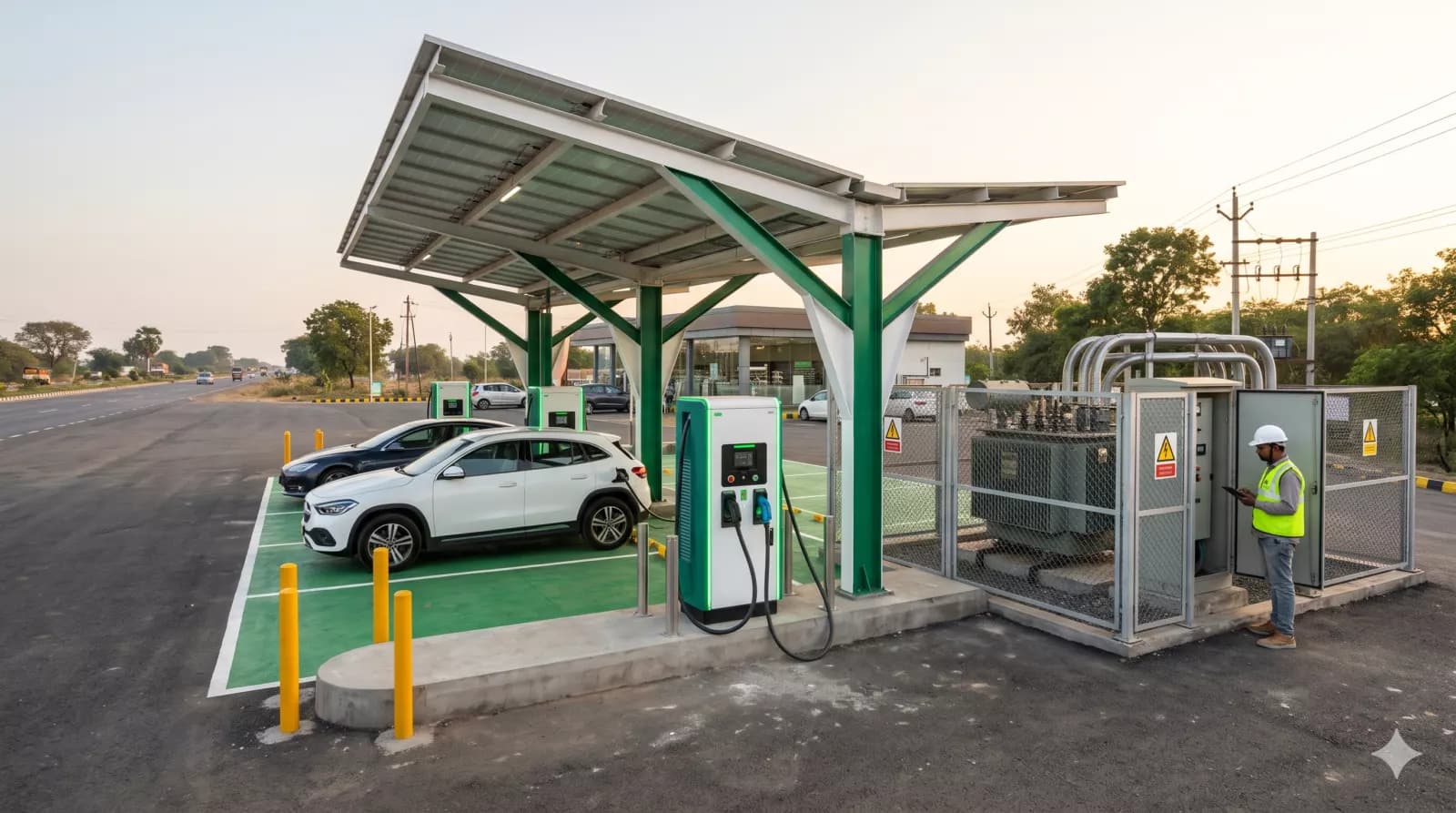
Quick Answer: Setting up an EV charging station in India is a de-licensed activity under Ministry of Power guidelines, but every commercial site requires a dedicated DISCOM EV electricity connection or sanctioned load enhancement. Stations up to 40 kW–60 kW DC typically operate on a 3-phase Low Tension (LT, 415V) supply, whereas highway and fleet hubs rated 120 kW–480 kW DC require a High Tension (HT, 11 kV or 33 kV) connection with a dedicated step-down transformer, Single-Line Diagram (SLD) approval, and Central Electricity Authority (CEA) safety clearance.
Why Grid Infrastructure Dictates EV Charging Station Viability
When investors and property owners evaluate a commercial charging site, charger hardware is usually the first number on the spreadsheet. In practice, the underlying electrical connection determines both your upfront capital expenditure and how quickly your station goes live.
Two sites installing identical 60 kW or 150 kW chargers can face completely different budgets and commissioning timelines depending on one question: Does the site already have sufficient three-phase sanctioned load on a Low Tension (LT) feeder, or does it require a High Tension (HT) connection with a dedicated distribution transformer?
Across India’s fast-growing highway corridors and urban commercial hubs, grid readiness directly impacts:
- Total Turnkey Capital Cost: While a 40 kW DC charger hardware unit costs ₹6 lakh to ₹9 lakh, full turnkey installation ranges from ₹10 lakh to ₹14 lakh once cabling, metering, earthing, and electrical panels are included. For 150 kW+ highway setups, transformer and HT bay infrastructure represent a major share of the ₹28 lakh to ₹45 lakh project budget.
- Commissioning Speed: Hardware installation and civil foundation work typically take 3 to 5 days once a site is ready, whereas DISCOM load sanctioning, feasibility inspection, and meter energisation govern the overall launch calendar.
- Long-Term Payback: Unexpected transformer upgrades or improper feeder sizing can delay break-even by months. Reviewing a realistic EV charging franchise cost vs revenue and break-even timeline before signing a site lease protects investors from hidden electrical upgrade costs.
LT vs HT Electricity Connection for EV Charging Stations in India
Indian electricity distribution companies (DISCOMs) classify commercial and public EV charging connections into Low Tension (LT) and High Tension (HT) supply based on your total contracted load (measured in kW or kVA). While state Electricity Regulatory Commissions (SERCs) set exact state-level thresholds—typically switching from LT to HT between 45 kW and 100 kW (or 50 kVA to 112 kVA)—the operational differences follow a clear technical pattern.
| Parameter | Low Tension (LT) EV Connection | High Tension (HT) EV Connection |
|---|---|---|
| Supply Voltage | 230V (Single-Phase) or 415V (Three-Phase, 4-Wire) | 11 kV or 33 kV (Three-Phase, stepped down to 415V AC) |
| Typical Sanctioned Load Range | Up to 45 kW – 100 kW (state DISCOM dependent) | Above 50 kVA – 100 kVA up to several MW |
| Best Charger Configurations | 3.3 kW–22 kW AC wallboxes, 40 kW DC, and single 60 kW DC chargers | Dual 60 kW DC (120 kW total), 150 kW–240 kW highway hubs, 360 kW–480 kW depots |
| Transformer Requirement | Draws from existing public distribution transformer (if feeder capacity exists) | Requires a dedicated on-site step-down transformer (e.g., 160 kVA, 250 kVA, or 500 kVA) |
| Upfront Electrical CapEx | Lower (service cable, four-pole MCCB, CT/PT meter panel, earthing pits) | Higher (HT VCB/RMU panel, step-down transformer, plinth, HT cabling, CEIG inspection) |
| Voltage Stability & Uptime | Subject to local distribution feeder load fluctuations during peak summer hours | Dedicated 11 kV/33 kV line minimises voltage drop and nuisance charger tripping |
| Tariff & Billing Structure | Dedicated public EV single-part LT tariff (energy charges per kWh) | Dedicated public EV HT tariff, often with lower per-kWh base energy rates |
For highway hubs operating 120 kW to 240 kW of total fast-charging capacity, transitioning from LT to an 11 kV HT line is standard engineering practice. Although HT infrastructure increases upfront setup cost, it unlocks lower per-unit energy charges and prevents voltage-drop faults during simultaneous dual-gun charging. To compare how state utilities bill LT and HT public charging connections—including the 0.8x solar-hour Time of Day (ToD) discount between 9:00 AM and 4:00 PM—see our state-wise EV charging electricity tariffs guide.
Charger Capacity to Sanctioned Load & Transformer Sizing Matrix (2026)
Every EV charger experiences minor conversion losses (typically 94% to 96% power conversion efficiency in DC fast chargers) and operates at a power factor between 0.95 and 0.99. In addition, stations require auxiliary power for cooling fans, LED canopy lighting, CCTV cameras, and routers.
As a rule of thumb, electrical engineers size the contracted apparent power (kVA) at 1.15x to 1.25x the rated DC output (kW) of the chargers. The table below maps EarthtronEV’s standard charger configurations to their required electrical load, space footprint, and indicative setup costs.
| Charger Capacity | Recommended kVA Load | Connection & Transformer | Space Required | Indicative Hardware Cost | Full Turnkey Setup Cost* |
|---|---|---|---|---|---|
| 3.3 kW – 7.4 kW AC | 4 kVA – 9 kVA | 1-Phase / 3-Phase LT (No dedicated transformer) | 1 parking bay (~80–100 sq ft) | Site-specific | Residential / workplace scope |
| 11 kW – 22 kW AC | 13 kVA – 26 kVA | 3-Phase LT (415V existing building load) | 1–2 bays (~100–150 sq ft) | Site-specific | Commercial amenity scope |
| 40 kW DC Fast | 48 kVA – 50 kVA | 3-Phase LT (or LT load enhancement) | ~100–150 sq ft (1–2 bays) | ₹6L – ₹9L | ₹10L – ₹14L |
| 60 kW DC Fast | 70 kVA – 75 kVA | 3-Phase LT (or 100 kVA transformer if feeder full) | ~150–200 sq ft (2 bays) | ₹7L – ₹15L | ₹14L – ₹20L |
| 150 kW DC Ultra-Fast | 175 kVA – 185 kVA | 11 kV HT + Dedicated 200–250 kVA Transformer | ~250–350 sq ft (2–3 bays + transformer) | ₹12L – ₹40L | ₹28L – ₹45L |
| 180 kW DC Ultra-Fast | 210 kVA – 225 kVA | 11 kV HT + Dedicated 250 kVA Transformer | ~300–400 sq ft | ₹28L – ₹42L | ₹40L – ₹55L |
| 240 kW DC Hub | 280 kVA – 300 kVA | 11 kV HT + Dedicated 315–400 kVA Transformer | ~400–600 sq ft | ₹35L – ₹55L | ₹55L – ₹75L |
| 360 kW DC Depot | 420 kVA – 450 kVA | 11 kV / 33 kV HT + 500 kVA Transformer | ~600–900 sq ft | ₹55L – ₹80L | ₹80L – ₹95L |
| 480 kW DC Mega-Depot | 560 kVA – 600 kVA | 11 kV / 33 kV HT + 630 kVA+ Transformer | ~800–1,200+ sq ft | ₹70L – ₹95L+ | ₹95L – ₹1Cr+ |
*Note: Indicative full setup figures cover civil foundation work, electrical connection/transformer upgrades, CMS software integration, and permits under EarthtronEV’s published project ranges (updated September 2026). Exact quotations vary by local DISCOM schedule and cable trenching distance.
For offices, hotels, and shopping centres where vehicles remain parked for 2 to 8 hours, deploying smart AC EV chargers from 3.3 kW to 22 kW frequently avoids new transformer capital expenditure because the load can be accommodated within the building’s existing LT connection. Conversely, highway wayside amenities, fuel station forecourts, and logistics hubs should evaluate high-speed DC fast charging projects engineered with dedicated HT switchgear and multi-standard CCS2 dual-gun dispensers.
Dedicated Transformer Upgrade vs Dynamic Load Management (DLM)
What happens if your commercial building, hotel, or roadside site has 90 kW of spare sanctioned electrical capacity, but you want to install two 60 kW DC fast chargers (120 kW total rated output) to serve four parking bays?
You have two engineering paths:
- Physical Grid & Transformer Upgrade: Apply to your state DISCOM for a load enhancement from 90 kW to 120 kW+ (which may push the site across the threshold from LT into a mandatory 11 kV HT connection with a new transformer plinth).
- Software-Controlled Dynamic Load Management (DLM): Keep your existing 90 kW connection and deploy an OCPP-enabled load controller integrated with a Central Station Management System (CSMS). When only one vehicle is plugged in, it receives the full 60 kW. If two vehicles plug in simultaneously and both request maximum power, the controller dynamically caps total station draw at 90 kW (for example, allocating 45 kW to each charger, or 50 kW and 40 kW based on battery state of charge).
| Decision Factor | Upgrade Sanctioned Load & Transformer | Deploy Dynamic Load Management (DLM) |
|---|---|---|
| Best Scenario | High-throughput highway hubs and fleet depots with back-to-back peak sessions | Offices, hotels, apartment societies, and retail sites with staggered charging demand |
| Upfront CapEx Impact | Adds transformer, HT metering, and cabling costs | Minimal software/controller setup cost; defers or eliminates transformer CapEx |
| Commissioning Speed | 4 to 12 weeks for HT line and CEIG clearances | Immediate commissioning within existing sanctioned load limit |
| Peak-Hour Charging Speed | Full rated speed on all guns simultaneously | Power is shared safely across active guns during rare simultaneous peak draws |
Before committing to an expensive transformer upgrade on a constrained urban site, review our technical breakdown of dynamic load management for EV charging stations in India to see how site meters, OCPP 1.6J/2.0.1 power-cap profiles, and fail-safe limits work in practice.
Step-by-Step Process to Get a Dedicated DISCOM EV Charging Connection in India
Under the Ministry of Power’s consolidated Guidelines and Standards for Charging Infrastructure for Electric Vehicles, setting up a public charging station is a de-licensed activity. Any individual, business, or franchise partner can apply for a dedicated EV charging electricity connection by following a structured seven-step workflow:
Step 1: Site Electrical Survey & Feasibility Check
A licensed electrical engineer inspects the property to measure the distance to the nearest DISCOM distribution transformer or 11 kV overhead/underground feeder, checks existing building load logs, evaluates earthing soil resistivity, and maps cable trenching routes to the proposed parking bays.
Step 2: Single-Line Diagram (SLD) & Load Calculation
Your project engineering team prepares a certified Single-Line Diagram (SLD) showing the complete protection chain: incoming utility supply, four-pole MCCB/ACB or HT Vacuum Circuit Breaker (VCB), surge protection devices (SPD), residual current devices (RCCB Type B for DC fault protection), armoured underground cable cross-sections, and charger input terminals.
Step 3: Documentation & Online DISCOM EV Portal Application
Submit the application under the Public EV Charging Station / Commercial EV Tariff category (not standard commercial/non-domestic tariff, which carries heavy fixed demand charges). Standard documents required across Indian DISCOMs (such as BSES, Tata Power-DDL, DHBVN, UHBVN, NPCL, and PVVNL) include:
- Identity & Entity Proof: PAN card, Aadhaar/authorised signatory ID, and GST registration or company incorporation certificate (for commercial entities).
- Property Right-to-Use Proof: Registry deed, registered lease agreement, or formal land-host permission letter.
- No Objection Certificate (NOC): Required from the Resident Welfare Association (RWA) for housing societies, municipal body, or petroleum company (for fuel retail outlets).
- Technical Pack: Licensed contractor Wiring Completion / Test Report, Single-Line Diagram (SLD), and ARAI/BIS charger certification data sheets.
For residential societies and shared condominium basements, EarthtronEV manages the complete RWA NOC workflow, DISCOM load enhancement filing, and per-flat billing setup—covered in detail on our EV charging stations for home and apartments page.
Step 4: Joint DISCOM Site Inspection & Demand Note
The local Sub-Divisional Officer (SDO) or DISCOM junior engineer conducts a physical inspection to verify right-of-way, transformer loading, and safety clearances. The utility then issues an official Demand Note itemising security deposit, service line charges, and meter fees.
Step 5: Civil Foundation, Earthing & Transformer Installation
Once the demand note is paid, certified electrical contractors construct the charger RCC foundations, install dual chemical/maintenance-free earthing pits (separating power earth, body earth, and communication earth to prevent OCPP communication noise), lay armored XLPE cables, and—for HT sites—erect the compact substation or two-pole/four-pole transformer structure.
Step 6: CEA Safety Compliance & CEIG Inspection (For HT Sites)
All public charging stations must comply with the Central Electricity Authority (Measures Relating to Safety and Electric Supply) Regulations. High Tension installations (typically above 650V or above state-specified kVA limits) require an inspection and energisation approval certificate from the Chief Electrical Inspector to Government (CEIG) along with fire safety equipment (CO2/dry chemical extinguishers, emergency stop pushbuttons, and crash bollards).
Step 7: Smart Meter Energisation & OCPP Commissioning
The DISCOM installs a dedicated EV tariff smart meter (or ToD-capable trivector meter), energises the line, and seals the metering cubicle. Project engineers then test voltage phase sequence, insulation resistance, and earth loop impedance before bringing the charger live on the OCPP 2.0 cloud platform.
Ministry of Power Connection Timelines & Green Open Access Rules
To eliminate administrative bottlenecks, the Ministry of Power has mandated strict connection timelines for public EV charging stations across India:
| Location Category | Maximum DISCOM Connection Timeline |
|---|---|
| Metropolitan Areas | Within 3 days of complete application and fee payment |
| Other Municipal Areas | Within 7 days of complete application and fee payment |
| Rural Areas | Within 15 days of complete application and fee payment |
| Rural / Highway Sites Requiring New Distribution Network or Transformer | Up to 30–90 days (depending on HT line extension and civil works scope) |
| Green Energy Open Access (For 1 MW+ Charging Hubs) | Mandatory approval within 15 days for renewable energy procurement |
Note: Statutory timelines apply where existing distribution network capacity is available at the connection point. When an 11 kV feeder extension, road-cutting permit, or new distribution transformer erection is required, project schedules should allow 4 to 8 weeks for physical execution.
5 Costly Electrical Mistakes That Delay EV Station Approvals
- Applying Under Standard Commercial Tariff Instead of EV Tariff: Standard commercial (NDS) connections impose fixed monthly kVA demand charges (
₹/kVA/month) regardless of how many cars charge. Always apply under your state’s dedicated EV Charging Tariff, which uses a single-part tariff (energy-only billing) or waived fixed charges under Ministry of Power norms. - Ignoring Voltage Drop Over Long Cable Runs: Placing a 60 kW or 120 kW DC charger 120 metres away from the main electrical panel just to reach a front parking bay significantly increases armoured cable cost and causes under-voltage fault trips during peak summer loads.
- Inadequate Earthing Separation: Modern DC fast chargers contain sensitive power modules and OCPP communication boards. If earth resistance exceeds manufacturer limits (typically
< 1 to 2 ohms) or neutral-to-earth voltage fluctuates, chargers will refuse to initiate CCS2 handshakes with electric vehicles. - Over-Sizing Charger Power Without Grid Feasibility: Buying a 120 kW charger for a site that only has 50 kW of spare LT capacity forces you into an unplanned HT transformer upgrade.
- Underestimating Civil Safety Clearances: Installing transformers or fast-charging dispensers in low-lying areas prone to monsoon waterlogging or without wheel stoppers and crash bollards leads to CEIG rejection and higher maintenance downtime.
How EarthtronEV Handles Grid Approvals Under the FOCO Model
Navigating DISCOM load applications, Single-Line Diagrams, transformer procurement, and CEIG safety sign-offs does not need to fall on the investor or property owner.
Under EarthtronEV’s Franchise-Owned, Company-Operated (FOCO) programme, technical feasibility and electrical approvals are managed end-to-end before your station goes live:
- 48-Hour Site Feasibility & Load Assessment: EarthtronEV engineers inspect your location (or source a high-traffic site on your behalf), verify feeder availability, and recommend the right 40 kW to 480 kW charger configuration.
- Complete DISCOM & Permit Filing: Our electrical team prepares the Single-Line Diagram, submits the dedicated EV connection or load enhancement application, coordinates transformer installation, and secures utility sign-offs.
- Turnkey Commissioning & 99.5% Uptime SLA: Every station uses ARAI-certified, OCPP/OCPI-compliant hardware backed by remote OTA firmware updates, automated monthly revenue settlements, and 24/7 operational support.
Explore our EV charging station franchise partner programme to view itemised package costs starting from ₹10 lakh, or submit your site details on our business inquiry page to request a site-specific electrical feasibility and ROI assessment.
Frequently Asked Questions (FAQs)
1. How much sanctioned electrical load is required for a 60 kW DC fast charger in India?
A 60 kW DC fast charger typically requires 70 kVA to 75 kVA (roughly 65 kW to 70 kW) of sanctioned electrical load on a 3-phase, 415V AC supply. This accounts for 94%–96% AC-to-DC power conversion efficiency, power factor, and auxiliary loads such as cooling fans, lighting, and network equipment.
2. When does an EV charging station require an 11 kV HT connection and dedicated transformer?
An EV charging station generally requires an 11 kV High Tension (HT) connection and a dedicated step-down transformer when total site demand exceeds the state DISCOM’s Low Tension (LT) ceiling—typically between 45 kW and 100 kW (50 kVA to 112 kVA)—or when the local public distribution transformer lacks spare capacity. All 120 kW, 150 kW, 240 kW, and 480 kW highway or fleet hubs use HT connections.
3. Do I need a separate government licence to get a DISCOM connection for an EV charging station?
No. Under the Ministry of Power’s national guidelines, operating a public EV charging station in India is a de-licensed activity. You do not need a power distribution licence; you only need a sanctioned EV electricity connection from your local DISCOM and compliance with Central Electricity Authority (CEA) technical and safety standards.
4. What is the difference between a commercial electricity connection and a dedicated EV charging connection?
A standard commercial (non-domestic) connection bills high fixed monthly demand charges (₹/kVA) plus tiered energy rates. A dedicated public EV charging connection qualifies for the Ministry of Power’s single-part EV tariff, where fixed demand charges are waived or capped and operators pay primarily for actual energy consumed (₹/kWh), along with a 20% discount during solar hours (9:00 AM to 4:00 PM).
5. Can I install a fast EV charger if my building does not have enough spare sanctioned load?
If your building has limited spare capacity, you can either apply to your DISCOM for a load enhancement or deploy Dynamic Load Management (DLM) software. DLM monitors total building consumption in real time and automatically adjusts EV charger output so total site draw never exceeds your approved limit.
6. How long does it take to get a DISCOM electricity connection for an EV charging station?
Under Ministry of Power guidelines, DISCOMs are mandated to provide EV charging connections within 3 days in metropolitan areas, 7 days in other municipal areas, and 15 days in rural areas where distribution network capacity already exists. If the site requires a new 11 kV HT line extension or a dedicated transformer installation, end-to-end civil and electrical execution typically takes 4 to 8 weeks.
7. Who handles DISCOM approvals and transformer setup in an EarthtronEV franchise?
Under EarthtronEV’s Franchise-Owned, Company-Operated (FOCO) model, EarthtronEV handles the entire electrical approval process—including site load assessment, Single-Line Diagram (SLD) preparation, DISCOM EV connection filing, transformer installation, testing, and commissioning—so franchise investors do not need electrical engineering expertise.