An EV owner may have a parking space without a charging connection. A fleet may receive electric vehicles before its depot chargers are ready. Another driver may need a small energy top-up to reach a working public charging station.
These situations share a common problem: the vehicle needs electricity where suitable charging infrastructure is unavailable.
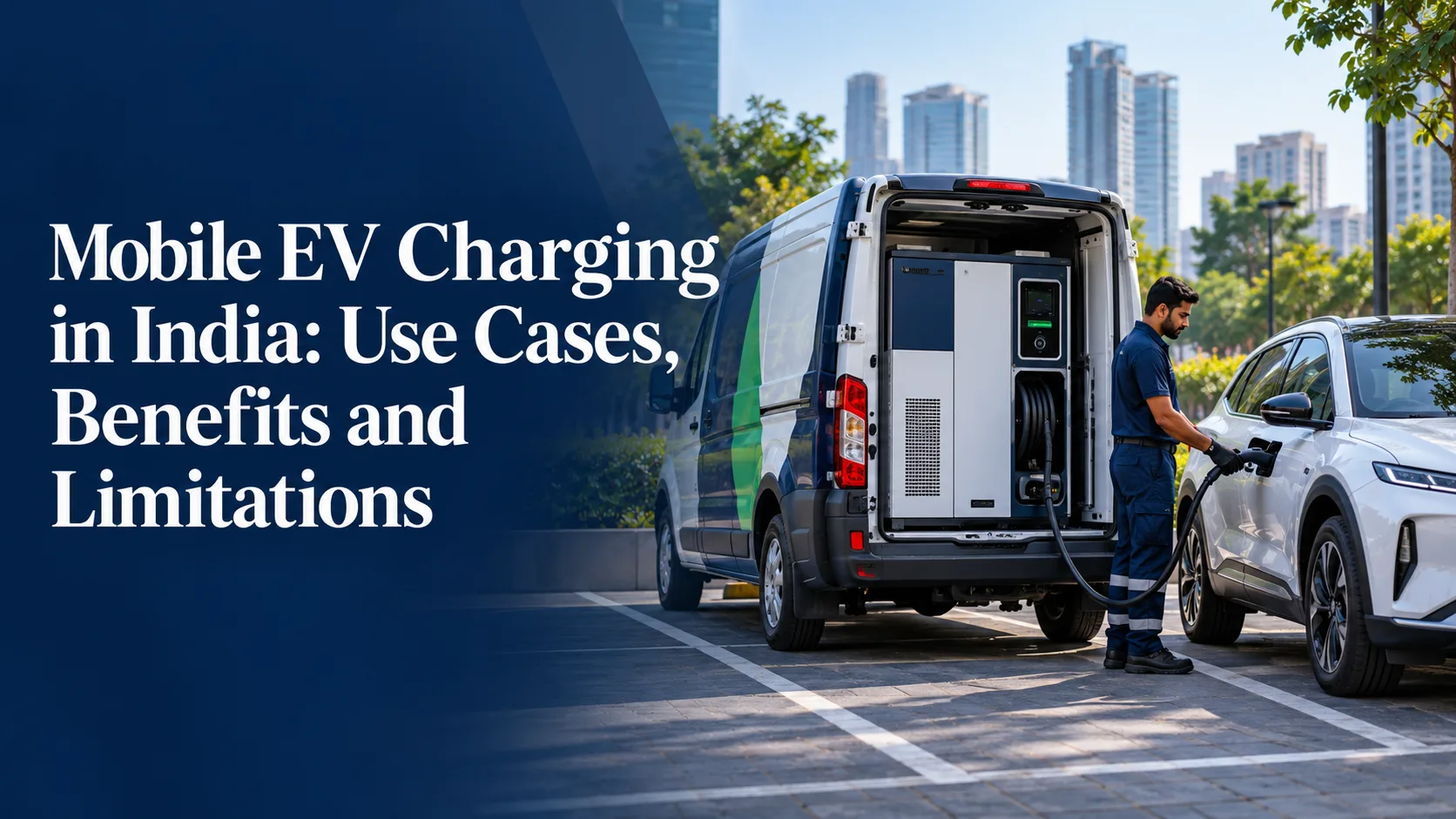
Mobile EV charging brings charging equipment to the parked vehicle. Depending on the system, it can support scheduled doorstep charging, temporary fleet operations or emergency assistance.
However, convenience depends on more than having a charger on wheels. Service coverage, vehicle compatibility, available energy and dispatch time determine whether it solves the customer’s problem.
What Is Mobile EV Charging?
Mobile EV charging uses equipment that can be transported to the vehicle instead of requiring the vehicle to visit a permanently installed charger.
The equipment may be carried in a service van, mounted on a trailer or moved within a controlled parking area.
It is useful to distinguish between different arrangements:
| Arrangement | Where the energy comes from | Main consideration |
|---|---|---|
| Battery-powered mobile charger | Stored energy carried by the unit | Available energy and replenishment time |
| Transportable grid-connected charger | A suitable electricity connection at the destination | Supply capacity and electrical compatibility |
| Generator-powered charging equipment | Fuel-powered electricity generation | Fuel use, noise, emissions and operating conditions |
A portable charging cable is different again. It can connect a compatible vehicle to a suitable electricity supply, but it does not carry energy itself.
Before booking or procuring a mobile service, establish which arrangement is being offered.
Is Mobile EV Charging Available in India?
Doorstep charging is already being offered commercially in parts of India.
For example, Hopcharge advertises scheduled and on-demand charging at locations where vehicles are parked. Its Tata.ev collaboration page describes doorstep charging for Tata.ev users in Delhi NCR.
These examples demonstrate an operating service model. They should not be interpreted as evidence of nationwide availability.
Customers still need to confirm their exact location, vehicle eligibility, parking access and available booking slots. Coverage and subscription conditions can change, so these details should be checked directly before relying on a service.
For charging infrastructure planners, the broader lesson is that mobile charging can address specific access gaps while permanent charging networks continue to develop.
Where Can Mobile Charging Be Useful?
1. Homes Without an Accessible Charging Connection
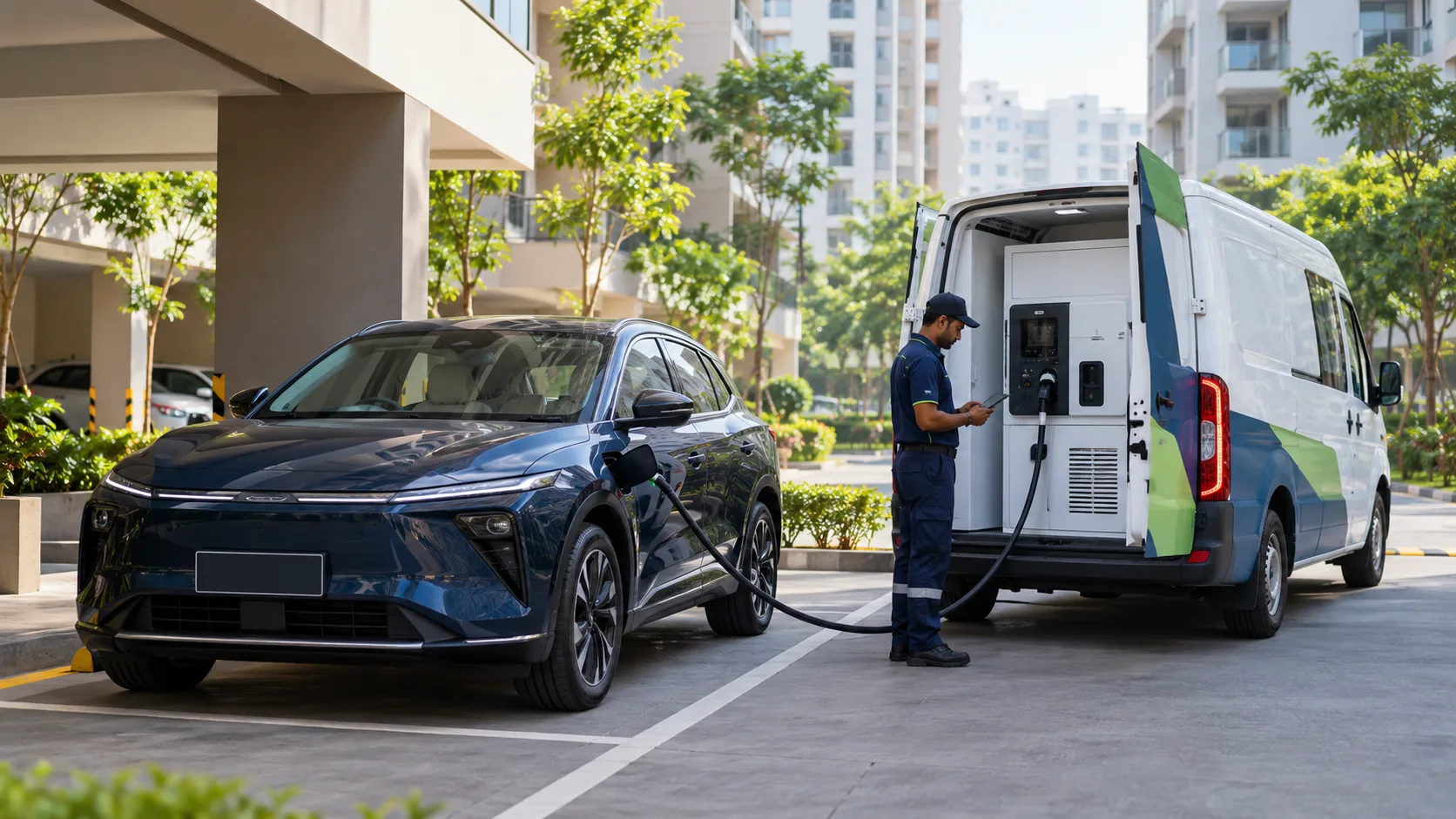
Some EV owners cannot immediately install a home charger because of tenancy restrictions, parking arrangements or pending electrical work.
A scheduled mobile service may provide another option if the service vehicle can reach the parked car and charging is permitted at the location.
However, mobile charging still requires suitable access. A narrow lane, restricted basement or unavailable adjacent space may prevent service.
2. Emergency Energy Top-Ups
A mobile unit may supply enough energy for a compatible vehicle to reach a suitable charging station.
The objective does not have to be a full battery charge. A smaller top-up can be sufficient when the next working charger is reasonably close.
Internationally, Agero’s SparkCharge service-provider programme illustrates the use of mobile charging equipment within roadside assistance.
Whether charging or vehicle recovery is appropriate depends on the vehicle’s condition, location and service availability. Mobile charging cannot resolve every breakdown.
3. Temporary Fleet Support
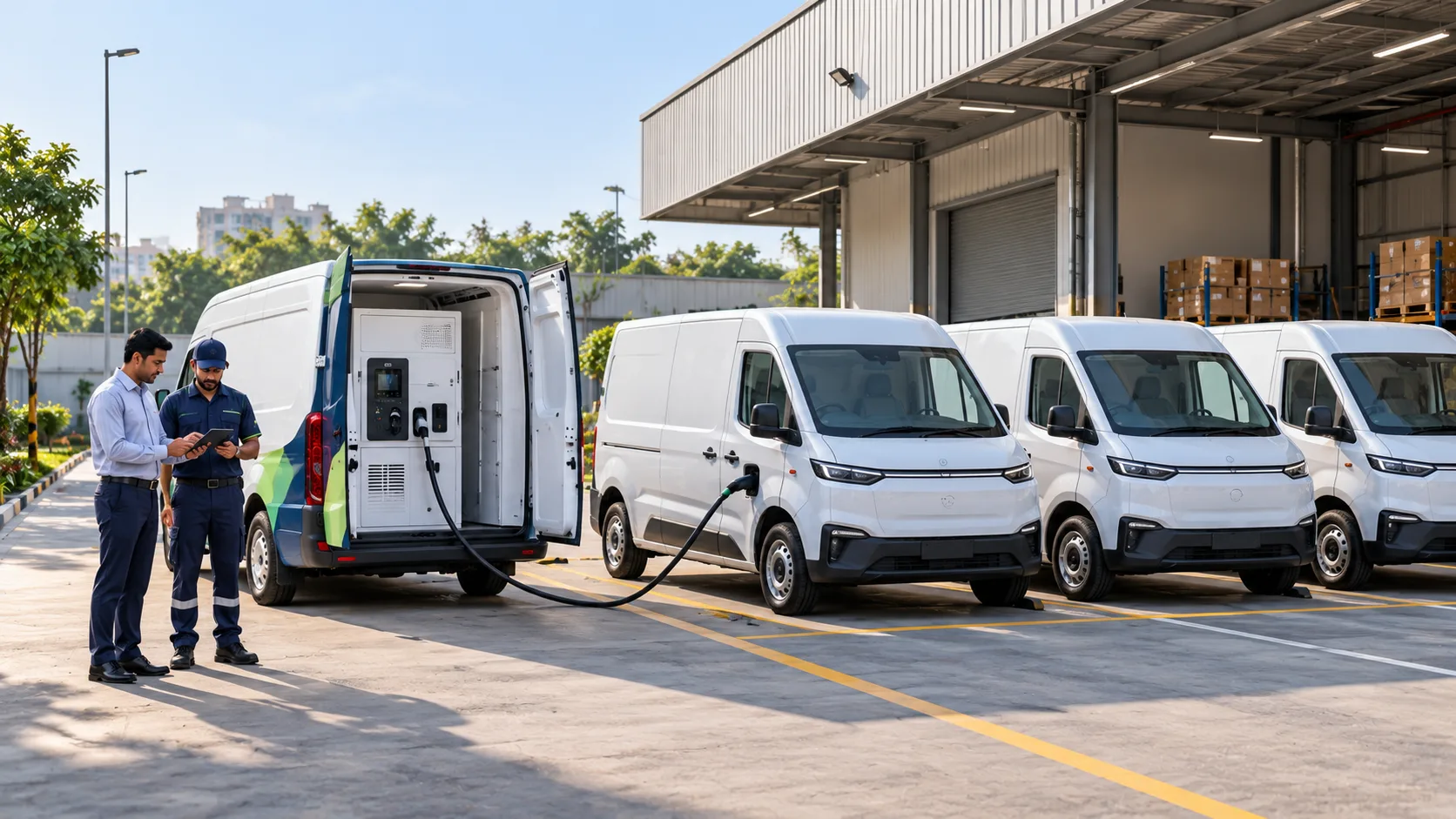
A fleet may need a temporary charging arrangement while permanent equipment is being installed, upgraded or repaired.
Mobile charging can be evaluated as a bridge during this period. The operator must still establish how many vehicles need energy, their departure times and the mobile unit’s replenishment schedule.
For longer-term planning, read EarthtronEV’s guide to EV fleet charging for logistics in India.
4. Events and Short-Term Locations
Exhibitions, vehicle demonstrations and temporary operating sites may need charging for a limited period.
Transportable equipment can offer flexibility where a permanent installation is difficult to justify. Its suitability depends on the expected number of sessions and the energy required throughout the event.
Charging Time and Arrival Time Are Different
A mobile charger’s power rating does not describe the complete customer experience.
The total service time can include:
- Waiting for an available unit.
- Travel to the customer.
- Site access and equipment setup.
- Vehicle checks and connection.
- Charging.
- Disconnection and departure.
Consider an illustrative session that adds 10 kWh to a vehicle battery.
At an average net charging power of 20 kW, the charging portion would take:
10 kWh ÷ 20 kW = 0.5 hours, or 30 minutes
This calculation excludes travel, waiting and setup. It also assumes the vehicle accepts an average of 20 kW across the session.
Actual charging power depends on the vehicle, battery temperature, state of charge and the mobile equipment.
Drivers should therefore ask for both an estimated arrival window and an estimated charging duration.
How Much Driving Range Will a Top-Up Add?
Added range depends on energy consumption.
For illustration, 10 kWh would correspond to approximately 67 km at a consumption rate of 0.15 kWh per kilometre.
That is a calculation, not a range guarantee. Traffic, speed, terrain, weather, air-conditioning and vehicle efficiency can change the result.
For an emergency top-up, the service plan should include an appropriate energy reserve rather than targeting the next charger with no margin.
A Mobile Charger Also Needs to Recharge
Battery-powered mobile equipment has a finite energy supply.
Once its usable energy is depleted, the operator must recharge it or replenish its battery capacity through the system’s supported process.
This creates an operational cycle: load energy, travel, deliver charging, then replenish.
For example, a hypothetical unit with 100 kWh available for delivery after losses and operating reserves could provide five 20 kWh sessions before replenishment. That does not establish how many sessions it can complete in a day.
Daily output also depends on travel distances, customer access, session duration and turnaround time.
This is why clustered bookings at a workplace or fleet yard may be operationally easier to serve than widely separated individual requests.
Mobile charging moves energy delivery to the customer; it does not eliminate the need for upstream electricity infrastructure.
What Does Research Highlight?
A Pacific Northwest National Laboratory review of second-life batteries for mobile charging examines technical considerations including battery chemistry, state-of-health assessment, differences between used batteries, battery management systems and safety.
Its relevance extends beyond the idea of putting batteries into a van. A mobile charging system needs an energy source whose condition and controls match the intended duty.
The findings do not establish that every mobile charger uses second-life batteries or that second-life equipment is always the most economical choice.
Operators should assess the complete system, including delivered energy, supported vehicles, thermal management, maintenance and replenishment requirements.
Benefits and Limitations Compared With Fixed Charging
Mobile and fixed charging address different operating needs.
| Factor | Mobile charging | Fixed charging |
|---|---|---|
| Location | Equipment can serve multiple accessible sites | Vehicles travel to the installed equipment |
| Customer-site installation | Battery-powered service may avoid a permanent charging connection | Usually requires site electrical installation |
| Availability | Depends on dispatch, bookings and stored energy | Depends on access, occupancy and equipment uptime |
| Energy supply | Limited by the mobile system and replenishment plan | Determined by the connection and any on-site storage |
| Operating activity | Includes travel, setup and energy delivery | Focuses on operating the charging location |
| Suitable application | Access gaps, temporary needs and selected assistance services | Predictable, recurring demand at established locations |
For a busy site with reliable long-term demand, permanent infrastructure deserves a direct comparison. For dispersed or temporary requirements, mobility may offer useful flexibility.
Neither option should be selected solely on its advertised charging power.
What Should Customers and Fleet Owners Check?
Before booking a service or signing a contract, confirm the following:
Vehicle compatibility: Does the equipment support the exact vehicle model, connector and charging requirements?
Service boundary: Is the parking location within coverage, and can the unit physically reach it?
Energy entitlement: Is the booking based on kilowatt-hours, time, a target charge level or a session allowance?
Total price: Are travel, parking, waiting, cancellation or minimum-service charges included?
Arrival commitment: Is the stated response time an estimate or a contractual service commitment?
Operating restrictions: Are there limitations related to weather, basement access, vehicle condition or site permission?
Fallback arrangements: What happens if charging cannot begin or the mobile unit cannot reach the vehicle?
For equipment compatibility background, see EarthtronEV’s guide to EV chargers, connectors and plugs.
Is Mobile Charging Automatically Emission-Free?
A battery-powered charging unit does not need to burn fuel while transferring stored electricity to an EV.
However, the full environmental impact also depends on how that electricity was generated, how the equipment is transported and the losses involved in storing and delivering energy.
A battery-powered charger carried by a fuel-powered vehicle still involves transport emissions. Generator-powered charging has a different operating emissions profile again.
Environmental claims should therefore describe the actual system and energy source rather than assume that every mobile service has the same footprint.
Conclusion
Mobile EV charging can help address specific charging gaps in India, including inaccessible home charging, temporary fleet requirements and selected emergency situations.
Its usefulness depends on reliable dispatch, sufficient delivered energy, vehicle compatibility and practical site access.
For customers, the key is to understand what a booking includes. For fleet owners, it is to compare the complete operating cost and service capability with permanent infrastructure.
To discuss charging infrastructure requirements for your site or fleet, contact EarthtronEV.