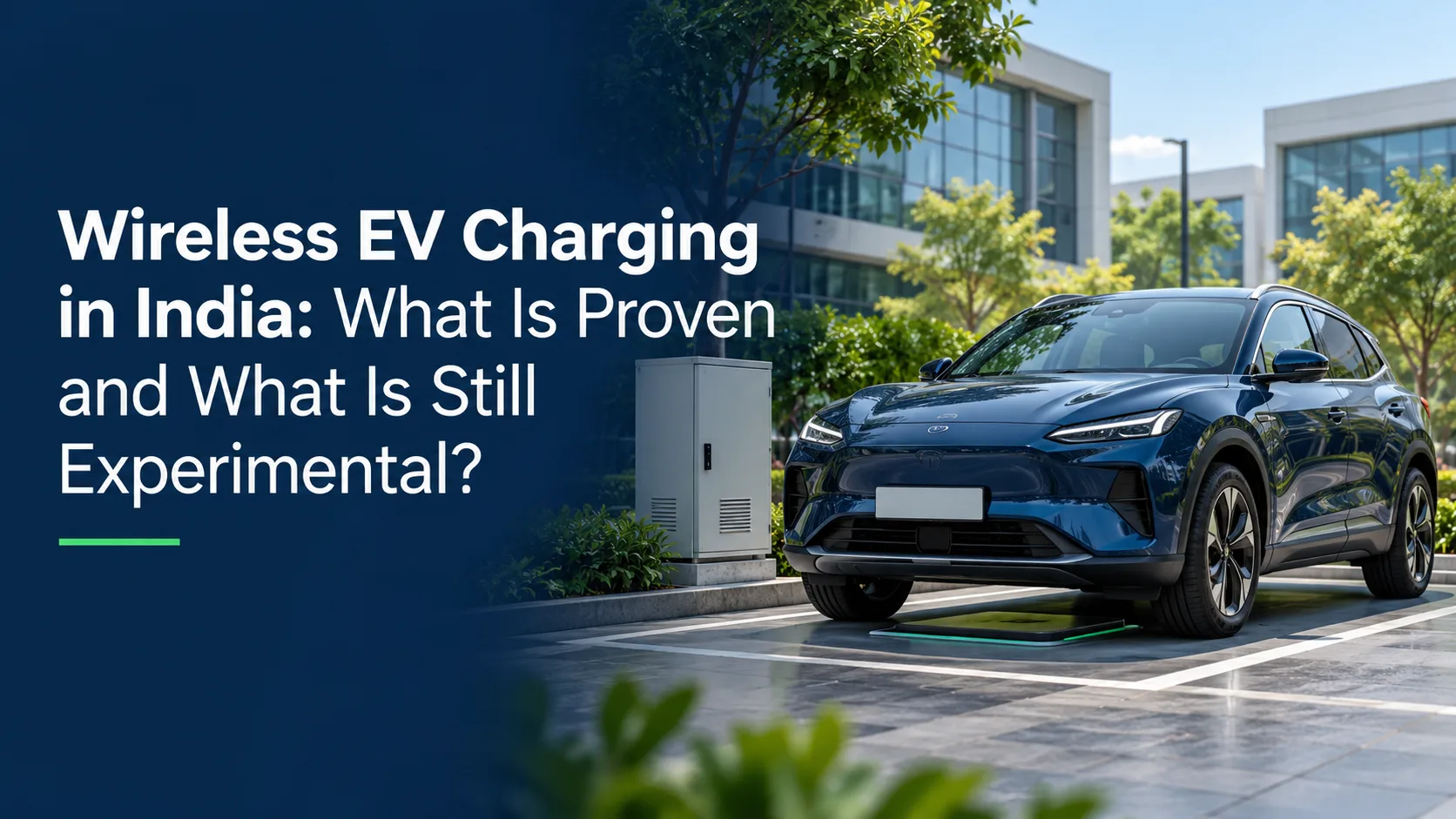
Imagine parking an electric car and starting a charging session without handling a cable. Now imagine a bus receiving energy during a scheduled stop, or a vehicle gaining energy while travelling along a specially equipped road.
These are different applications of wireless EV charging, and they are at different stages of development.
Wireless power transfer has been demonstrated in research facilities and real-world projects. Standards also exist for certain applications. However, these developments do not mean that every electric car can charge wirelessly or that charging roads are ready for widespread installation across India.
Understanding the distinction helps EV owners, fleet operators and infrastructure developers evaluate the technology realistically.
How Does Wireless EV Charging Work?
Wireless EV charging transfers electrical energy across an air gap using magnetic coupling.
In a typical stationary system, a transmitting assembly sits on or within the ground. A compatible receiving assembly is installed underneath the vehicle.
Power electronics energise the transmitter. The receiver captures energy through the magnetic field, and the vehicle-side equipment converts it into electricity suitable for charging the battery.
The system also needs communication and controls to manage alignment, charging permission, power transfer and fault conditions.
The driver may not need to connect a cable, but the ground equipment still needs an electricity supply. The vehicle also needs compatible hardware.
A standard electric car cannot gain wireless charging capability simply by parking above a charging pad.
Stationary and Dynamic Charging Are Different
“Wireless charging” covers more than one operating arrangement.
| Application | How it operates | Main planning question |
|---|---|---|
| Stationary parking | Vehicle remains parked above a charging pad | Is the vehicle compatible and correctly positioned? |
| Charging during scheduled stops | Vehicle receives energy during a short stationary stop | Is the stop long enough to deliver useful energy? |
| Dynamic charging | Vehicle receives energy while moving over equipped road sections | Does the route justify road infrastructure and vehicle integration? |
A fleet bus charging while stationary at a terminal is not using the same operating model as a car charging while travelling along a road.
Power requirements, installation costs, controls and utilisation can differ substantially.
What Has Already Been Demonstrated?
Standards for Stationary Light-Duty Charging
SAE J2954 addresses wireless charging and alignment for stationary light-duty vehicles.
Its scope includes criteria relating to interoperability, electromagnetic compatibility, performance, safety and testing.
This is an important sign of technical maturity within its defined application. It does not establish that all wireless charging equipment works with all vehicles or that one standard covers every heavy-duty and dynamic application.
High-Power Research Demonstrations
In June 2024, Oak Ridge National Laboratory reported a 270 kW wireless power-transfer demonstration involving a Porsche Taycan.
The result demonstrates the potential of specialised high-power wireless technology.
It should not be read as a specification for an ordinary production Taycan or a guarantee that a commercially available pad can deliver that performance to any EV. The demonstration involved research equipment and vehicle integration.
Roads That Transfer Energy to Moving Vehicles
The Michigan Department of Transportation describes a quarter-mile wireless charging roadway in Detroit, operational since November 2023.
The project uses road-embedded equipment and vehicles fitted with compatible receivers. It supports testing of both the technology and its operating performance.
This demonstrates that dynamic charging can function in a real road environment. It does not, by itself, establish the cost or practicality of deploying the technology across an entire national highway network.
Where Does India Stand?
Wireless charging is part of India’s ongoing technical discussions on future EV infrastructure.
According to the Press Information Bureau, the India–EU workshop held in March 2026 included pre-standardisation research on wireless power transfer systems.
That is evidence of technical engagement. It is not an announcement of a nationwide public wireless charging network.
For an Indian project, readiness should be assessed at the level of the proposed vehicle, equipment supplier and installation. A global demonstration is useful context, but local compatibility, support and operating conditions still need verification.
Which Applications Could Be Worth Evaluating?
Fleets With Repeated Parking Positions
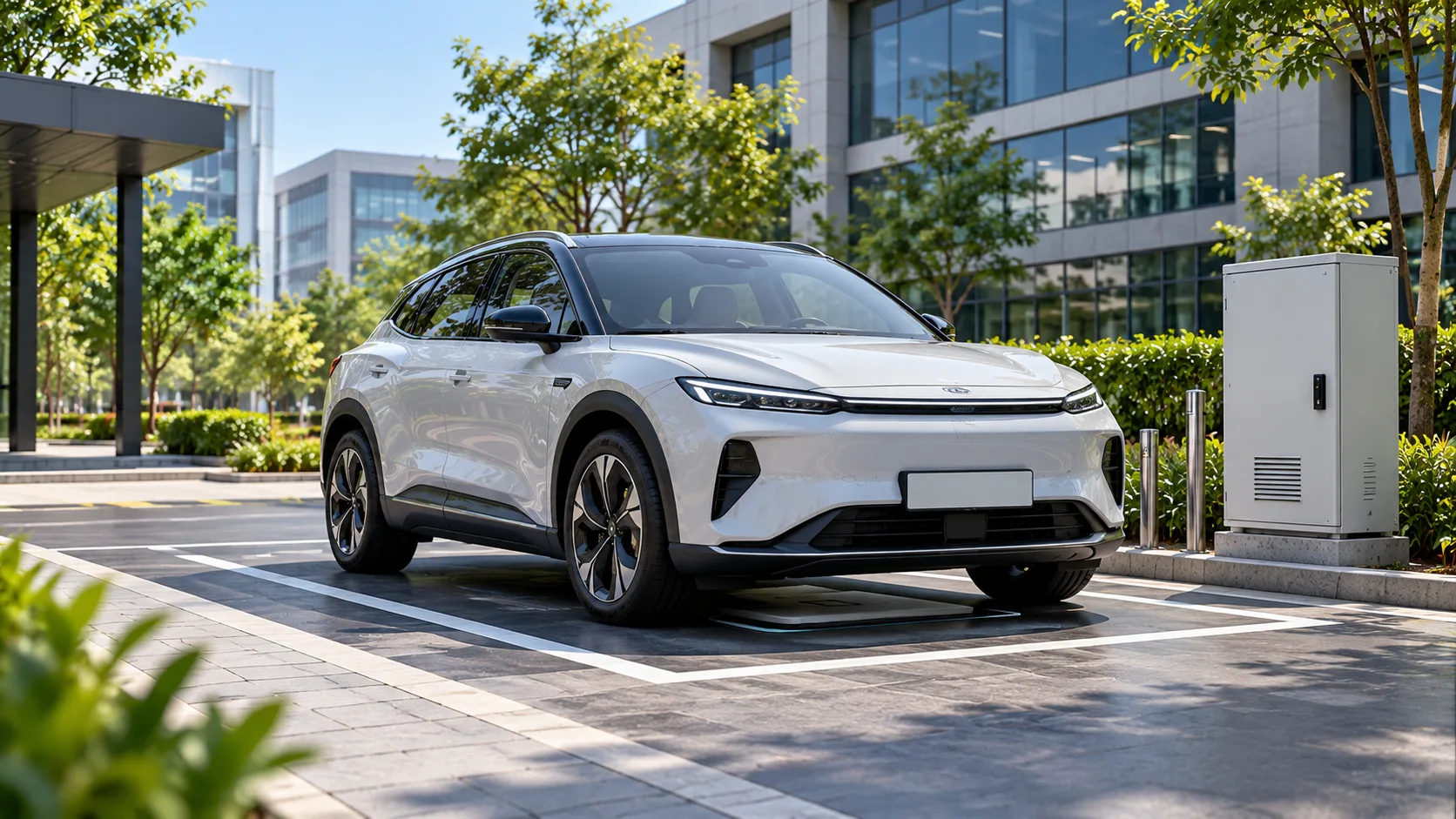
A fleet that regularly uses the same parking spaces may offer a controlled environment for evaluating wireless charging.
Known vehicles, repeatable positioning and predictable schedules can make it easier to measure performance.
However, the value must exceed the costs of vehicle integration, ground equipment and maintenance.
Vehicles With Frequent Scheduled Stops
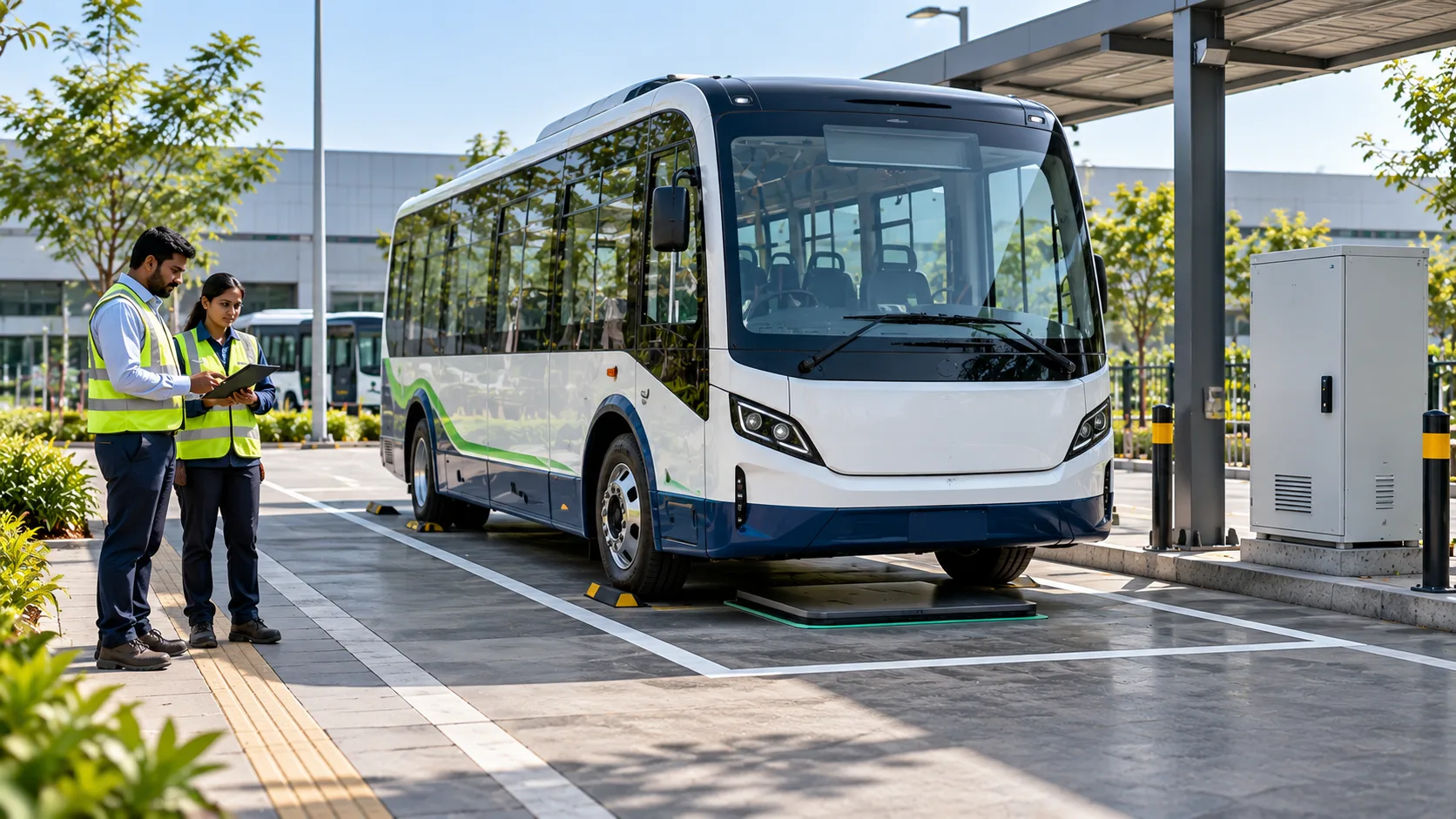
Some shuttle or transit operations have repeated stopping points.
If enough energy can be transferred during these stops, wireless charging could contribute to the route’s energy requirement.
The assessment must use actual stopping times. A nominal charging-power figure has limited value if the vehicle spends only a short period correctly aligned over the equipment.
Drivers Who Find Cable Handling Difficult
Removing the need to lift and connect a cable could improve convenience for some users, including people with limited strength or mobility.
The complete charging experience still matters. Parking guidance, payment, status information and assistance must also be accessible.
These are potential applications to investigate, rather than proof that wireless charging is the best solution for every site.
Efficiency Claims Need a Clear Measurement Boundary
Wireless charging performance is often summarised using a single efficiency percentage. That number can be misleading without knowing what was measured.
A reported figure might describe energy transfer between two assemblies or a wider path that includes additional conversion equipment.
A useful comparison should identify:
- Where input energy is measured.
- Where output energy is measured.
- Charging power during the test.
- Vehicle alignment and ground clearance.
- Standby and auxiliary consumption.
- Performance across the expected operating conditions.
For a station owner, electricity purchased and useful energy delivered both matter.
A strong result under one test condition does not establish identical performance with a different vehicle, parking position or power level. Compare wireless and plug-in systems using equivalent measurement boundaries.
Why Charging Roads Are More Complex Than Charging Pads
A stationary pad serves a defined parking position. Dynamic charging requires coordination between moving vehicles and equipment distributed along a road.
Project planning therefore extends beyond the charger itself.
It must consider road construction, electricity connections, vehicle receivers, activation controls, energy metering and maintenance access.
Road repairs also need to account for the installed equipment. A commercially useful project must establish how faults are detected and repaired without creating disproportionate disruption.
Vehicle utilisation is another central question. A road section used by many compatible vehicles has a different business case from one used mainly by vehicles without receivers.
For India, any proposal would need route-specific assessment of traffic, compatible fleet demand, road ownership, maintenance responsibilities and electricity supply.
Wireless Charging Still Requires Grid Planning
Removing the charging cable does not remove the electrical load.
If several vehicles charge simultaneously, the site must supply their combined demand within its operating limits.
For an illustrative example, ten vehicles receiving an average of 10 kW each would require 100 kW of delivered charging power. Electricity drawn upstream would also need to account for conversion losses and other equipment loads.
This is a simplified calculation, not a connection or transformer specification.
Charging schedules and power management remain relevant. For related planning, explore EarthtronEV’s guide to dynamic load management for EV charging.
What Should an Indian Pilot Measure?
A useful pilot should answer practical questions before wider investment.
Vehicle compatibility: Which exact models and receiver configurations are supported?
Alignment: How consistently can drivers position the vehicle within the operating range?
Delivered energy: How much energy reaches the vehicle during real parking or stopping periods?
Operating conditions: How does the installation perform under the site’s expected temperature, dust, rain and drainage conditions?
Protection: What evidence supports foreign-object detection, electromagnetic compatibility and other protective functions?
Availability: How often does charging begin successfully, and how quickly can faults be resolved?
Maintenance: Who supports the ground equipment, vehicle hardware and software?
Economics: What is the total cost compared with a suitable plug-in alternative over the same operating period?
Testing should include unsuccessful sessions and maintenance events, not only the best-performing charging demonstrations.
Can Existing EVs Be Retrofitted?
A retrofit should not be assumed to be simple or universally available.
Wireless charging requires vehicle-side receiving equipment, suitable power electronics, controls and integration with the battery charging system.
Any proposal needs vehicle-specific engineering and a clear explanation of approval, warranty, ground-clearance and service implications.
Before purchasing ground equipment, obtain written confirmation of the supported vehicle configuration and the party responsible for integration.
For an overview of established charging arrangements, see EarthtronEV’s guide to EV chargers, connectors and plugs.
Conclusion
Wireless EV charging is supported by working demonstrations, defined standards for certain applications and ongoing research. Its potential includes convenient stationary charging and specialised fleet operations.
Dynamic charging roads have also been demonstrated, but widespread deployment requires evidence on cost, maintenance, compatible vehicle demand and long-term performance.
For India, the strongest next step is a clearly scoped pilot with measurable operating goals. Decisions should follow verified vehicle compatibility and real site data, rather than assume that every research achievement is already a ready-to-install commercial solution.
To discuss charging infrastructure requirements for your site or fleet, contact EarthtronEV.