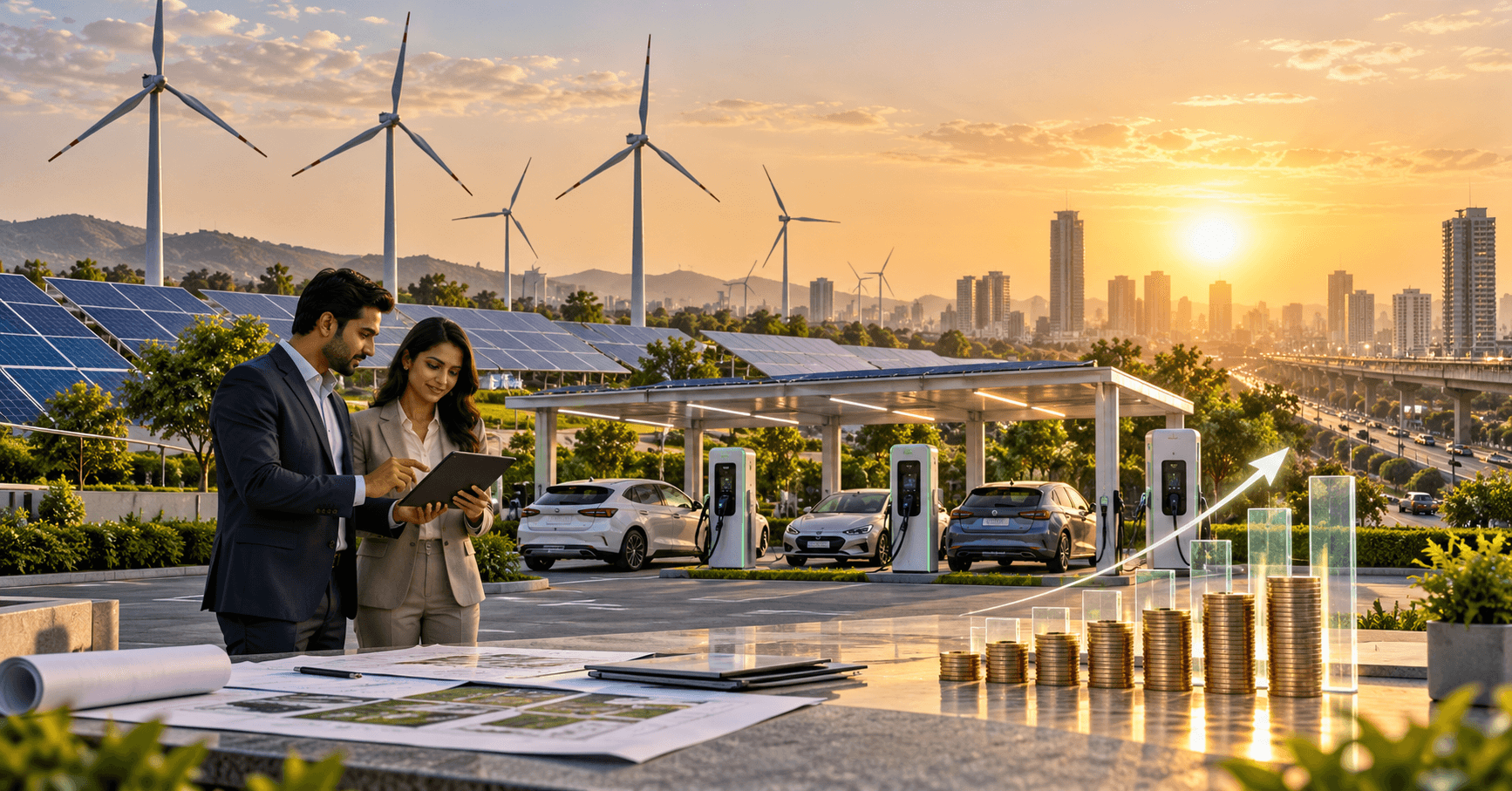
Clean energy is now one of India’s largest investment themes. Non-fossil power capacity reached 304.33 GW in August 2026, and the IEA expects India to invest about $170 billion in energy in 2026, with roughly three dollars going to renewables and nuclear for every dollar in fossil power. For a business or private investor, the main routes are utility-scale solar and wind, battery storage, rooftop and open-access solar for your own operations, EV charging station franchise, and clean-tech manufacturing. They differ sharply in ticket size, control, and risk. EV charging is one of the few with a small entry ticket, starting at about ₹10–14 lakh with EarthtronEV.
Why clean energy investment is accelerating in India
India has moved from clean energy promise to clean energy scale. In FY 2025–26, the country added a record 55.3 GW of non-fossil capacity, and capacity has kept climbing through 2026. Three forces are pulling capital in: rising electricity demand, falling technology costs, and a policy framework built around the 500 GW non-fossil target for 2030.
| Indicator | Latest figure | Source |
| Non-fossil installed capacity | 304.33 GW (31 Aug 2026) | MNRE |
| Solar capacity | 168.04 GW (31 Aug 2026) | MNRE |
| Wind capacity | 58.52 GW (Aug 2026) | MNRE |
| Non-fossil capacity added in FY 2025–26 | 55.3 GW, a record | MNRE statement, Apr 2026 |
| Non-fossil share of generation, FY 2025–26 | 29.2% | MNRE statement, Apr 2026 |
| India’s energy investment, 2026 | About $170 billion; about $3 in renewables and nuclear per $1 in fossil power | IEA World Energy Investment 2026 |
| Renewable FDI, FY 2026 | $3.02 billion; $45.72 billion cumulative since FY 2014 | DPIIT / MNRE via PIB |
| Domestic financing, FY 2014–FY 2026 | ₹12.32 lakh crore | MNRE reply to Rajya Sabha, Jul 2026 |
| Household rooftop solar (PM Surya Ghar) | Over 33 lakh systems and 12 GW installed by May 2026 | IBEF / MNRE |
Capacity figures change monthly. Figures for different dates come from MNRE releases and are rounded.
Five ways a business can invest in clean energy
“Investing in clean energy” can mean anything from buying shares to installing a charger. These five routes differ most in how much capital they need and how much control you have.
| Route | What it involves | Typical investor | Entry ticket | Main risk |
| Utility-scale solar and wind | Building or owning large generation projects that sell power to utilities or corporates | Large developers, funds, strategic investors | Institutional scale | Offtake, PPA delays, curtailment |
| Battery storage (BESS) | Grid-scale or behind-the-meter batteries that shift and firm up power | Developers, utilities, large power users | Large for grid-scale; smaller for on-site | Tender pricing, revenue model, technology |
| Rooftop and open-access solar for your own use | Cutting your own power bill through on-site or contracted clean power | Factories, malls, warehouses, businesses | Varies with load and site | Site suitability, regulation by state |
| EV charging station franchise | Owning or hosting public charging stations | Entrepreneurs, property owners, fleet operators, investors | From about ₹10–14 lakh (EarthtronEV 40 kW) | Site utilisation, tariff, operating costs |
| Clean-tech manufacturing and hydrogen | Making modules, cells, batteries, electrolysers or components | Industrial groups, strategic and PLI-eligible players | Large to very large | Technology, scale, policy dependence |
Ticket sizes are qualitative except for EV charging, where costs are published by EarthtronEV. Other routes vary widely by project and are best confirmed with an advisor or developer.
The routes in more detail
1. Utility-scale solar and wind
This is where most headline money is. Developers such as NTPC Green, Adani Green, JSW Energy and Avaada have announced multi-gigawatt portfolios, with Avaada alone planning about ₹1 lakh crore of investment over five years toward 30 GW by 2030. For most businesses, direct ownership is out of reach, but there are indirect routes through listed developers, infrastructure funds and yield vehicles.
2. Battery storage
Storage has gone from a niche to a boom. India installed 8.2 GWh of battery storage in the first half of 2026, compared with just 98.4 MWh in the same period of 2025. The government cleared a ₹5,400 crore viability gap funding (VGF) scheme in May 2026 to support 30 GWh of grid-scale storage, with support of up to about ₹18 lakh per MWh. Those funds go to utility-scale standalone projects won through competitive bidding, not to a typical business site. Tender volumes are high, but auctions lag: about 28 GW of storage was tendered in H1 2026, while only roughly 9 GW was auctioned.
3. Rooftop and open-access solar for your own operations
For a factory, warehouse, mall or commercial building, the simplest clean energy investment is often cutting your own electricity cost. Behind-the-meter solar, with or without batteries, can lower peak charges and exposure to grid tariffs. Forecasts suggest commercial and industrial storage deployments in India could exceed 31 GWh by 2032. Rules for captive and open-access power vary by state, so check your state regulator and discom terms before committing.
4. EV Charging Station Franchise
EV charging is the clean energy route with the smallest entry ticket. India registered a record 3,33,571 EVs in September 2026, yet there are only about 52,718 public charging stations, and just 16,561 DC fast chargers for cars. That gap, roughly one public charger for every 175–190 EVs, is the demand case for new stations. EarthtronEV’s franchise starts at about ₹10–14 lakh for a 40 kW charger and goes to ₹1 crore or more for a 480 kW depot, under a Franchise-Owned, Company-Operated (FOCO) model with monthly settlements.
See the franchise cost breakdown and the best locations for EV charging stations.
5. Clean-tech manufacturing and hydrogen
Policy is pushing hard on domestic manufacturing. In July 2026 the government opened bidding for a further 10 GWh tranche of the Advanced Chemistry Cell production-linked incentive, carved out for grid-scale storage. Manufacturing and green hydrogen are capital intensive, technology sensitive, and policy dependent, which makes them suited to industrial groups and strategic investors rather than small investors.
Policy tailwinds businesses can use
- 500 GW non-fossil target by 2030: the anchor for most national programmes and state renewable obligations.
- PM E-DRIVE: a ₹10,900 crore scheme extended to March 2028, with ₹2,000 crore earmarked for public EV charging. Check current eligibility with the Ministry of Heavy Industries.
- Battery storage VGF and PLI: capital support for grid-scale storage and for domestic cell manufacturing.
- PM Surya Ghar: rooftop solar for households, which has built a large installer and supply chain that also serves businesses.
- Infrastructure Risk Guarantee Fund: announced in the 2026–27 Budget to provide partial guarantees that help lenders finance infrastructure.
Read the PM E-DRIVE subsidy guide for charging-specific support.
Risks to weigh honestly
Strong growth does not remove risk. The biggest ones in India’s clean energy market right now are:
- Offtake and PPA delays. Between 40 GW and 45 GW of awarded renewable capacity still lacked signed power purchase agreements as of April 2026, according to a rating agency assessment.
- Transmission and curtailment. Generation can be built faster than the grid. Peak curtailment reached about 8,617 MW in western India on 6 August 2026, and more than 150 GW of projects were under construction at the end of June.
- Distribution company finances. Payment delays from state discoms remain a counterparty concern for projects that sell to them.
- Utilisation risk. For EV charging and storage, returns depend on how heavily an asset is used, which depends on site and market, not just on sector growth.
- Technology and policy change. Costs, subsidy levels and rules can shift, as the step-down in battery VGF support shows.
These risks hit large developers hardest. Smaller, asset-light routes such as on-site solar or a managed EV charging franchise face a different set of risks, mostly about the quality of the site and the partner.
Six questions to ask before investing in any clean energy project
- Who buys the output? Is there a signed offtake agreement, or does revenue depend on market demand?
- How much capital is required, including working capital, grid connection and a buffer for delays?
- How much control do I have? Do I operate the asset, or rely on a partner?
- What drives returns? A fixed tariff, a utilisation level, or a share of revenue?
- How exposed am I to policy change? Does the case still hold if a subsidy is reduced?
- What is the exit? Can I sell, renew, or transfer the asset, and on what terms?
Which route suits which investor?
A small business owner, entrepreneur, or property owner
Routes with smaller tickets and local control fit best: rooftop solar for your own site, or an EV charging franchise on a suitable plot or parking area. If you do not have land, EarthtronEV can help assess or arrange a site, where applicable.
A factory, hotel, mall, or logistics operator
Start with your own load. On-site solar, storage for peak management, and EV charging for staff, customers or fleets can all reduce costs or add revenue from assets you already control.
A high-net-worth individual or family office
Consider a mix: listed clean energy developers or infrastructure vehicles for scale, plus asset-backed, operated models such as charging stations for steady, monthly cash flow visibility, while recognising that returns are not guaranteed.
A corporate or institutional investor
Utility-scale projects, storage and manufacturing offer scale, but need deep due diligence on offtake, transmission and counterparty risk.
Why EV charging is an accessible way in
EV charging sits at the intersection of two trends: rising EV adoption and thin public infrastructure. It also offers something rare in clean energy: a small, modular starting point. Under EarthtronEV’s FOCO model, you fund the station, and EarthtronEV handles site assessment, approvals, installation, operations, billing and maintenance, with returns settled monthly. A 40 kW charger needs about 100–150 sq ft and costs roughly ₹10–14 lakh in total setup, while a 480 kW depot costs ₹1 crore or more.
As with any investment, returns depend on utilisation, tariff, operating costs, and revenue-sharing terms, and are not guaranteed. EarthtronEV’s team prepares a site-specific projection before you commit.
Model a site with the EarthtronEV Revenue Calculator, or compare options in EV charging franchise for small investors.
The bottom line
India’s clean energy opportunity is real and large, and it is no longer reserved for utilities. The right route depends on how much capital you have, how much control you want, and how much risk you can carry. Large projects offer scale but carry offtake and grid risks. Smaller, operated assets such as on-site solar or EV charging offer lower entry tickets and clearer local control, with returns that depend on execution and site quality. Whichever route you choose, insist on a site- or project-specific projection and test it against conservative assumptions.
Frequently asked questions
How much clean energy capacity does India have?
India had 304.33 GW of non-fossil capacity as of 31 August 2026, including 168.04 GW of solar and 58.52 GW of wind, according to MNRE.
How much is India investing in clean energy?
The IEA expects India to invest about $170 billion in its energy sector in 2026, with roughly $3 going to renewables and nuclear for every $1 in fossil power generation.
Can a small business invest in clean energy in India?
Yes. Common routes include rooftop solar for your own operations and EV charging franchises, which start from about ₹10–14 lakh with EarthtronEV.
What are the biggest risks in clean energy investment?
Unsigned power purchase agreements, transmission constraints and curtailment, discom payment delays, low asset utilisation, and changes in policy or technology costs.
Is battery storage a good investment in India?
Storage is growing fast, with 8.2 GWh installed in H1 2026, but returns depend on tender pricing and revenue models. Government VGF support is aimed at utility-scale standalone projects, not typical business sites.
What government support exists for clean energy and EV charging?
Schemes include PM E-DRIVE (₹2,000 crore for public EV charging), VGF and PLI support for storage and cells, and PM Surya Ghar for rooftop solar. Eligibility rules vary, so check with the relevant ministry.
Why is EV charging considered a clean energy investment?
It builds the infrastructure that lets electric vehicles replace petrol and diesel, and its value rises with EV adoption and with the share of clean power on the grid.
Are returns from clean energy investments guaranteed?
No. Returns depend on the project type, offtake, utilisation, tariffs, costs and policy, and must be assessed case by case.
Ready to explore EV charging as a clean energy investment?
Write to the franchise team at franchise@earthtronev.com or visit the EarthtronEV franchise page to request a site-specific projection.
Disclaimer: General information only, not financial, tax or legal advice. Market data is drawn from government and public sources as of early October 2026 and is subject to revision. Clean energy and EV charging returns depend on location, utilisation, tariffs, taxes, financing, and policy, and are not guaranteed.