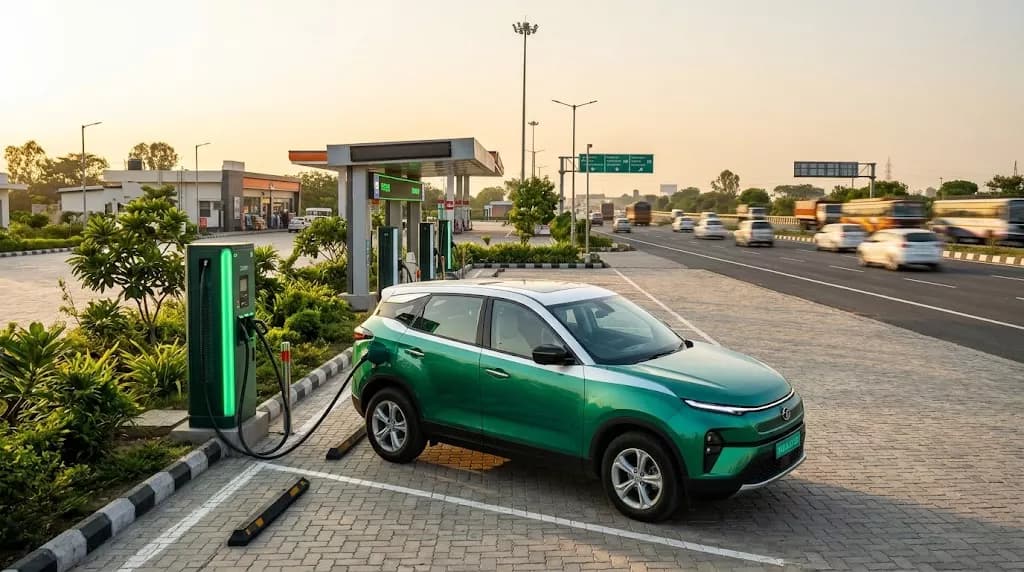
Quick Answer: Heading into 2027, an electric car in India costs ₹1.00 to ₹1.35 per km when charged at home (at ₹7–₹9/kWh) and ₹2.60 to ₹3.40 per km on public DC fast chargers (at ₹18–₹22/kWh). By comparison, a factory-fitted CNG car costs ₹3.20 to ₹3.80 per km, a strong hybrid costs ₹4.20 to ₹4.80 per km, and a conventional petrol SUV or hatchback costs ₹6.50 to ₹8.50 per km. Thanks to 100% road-tax waivers in states like Delhi and narrower upfront price gaps, most Indian EV buyers recover any upfront price premium within 25,000 to 45,000 km (2 to 3.5 years of daily commuting).
Why the EV vs Petrol vs CNG vs Hybrid Math Has Changed for 2027 Buyers
Three years ago, buying an electric car in India required paying ₹4 lakh to ₹5 lakh more upfront than an equivalent petrol automatic, then driving 70,000+ km just to break even. As we head into 2027, three structural shifts have rewritten that equation for Indian car buyers:
- Price Parity in Mainstream Segments: With models like the Tata Tiago EV (from ₹6.99 lakh), Tata Punch EV (from ₹9.79 lakh), Tata Nexon EV (from ₹12.49 lakh), and MG Windsor EV, the on-road price gap between an electric car and a comparable petrol automatic or strong hybrid has shrunk to ₹1.2 lakh–₹2.5 lakh—and in several variants, Battery-as-a-Service (BaaS) brings the upfront sticker price below petrol models.
- Road Tax & Registration Waivers: While petrol, CNG, and strong hybrid cars attract 8% to 15% state road tax plus 28%–43% GST (including cess), electric cars attract just 5% GST and enjoy 100% road-tax exemptions in major markets. Under the Delhi EV Policy 2026 subsidy and road tax waiver rules, electric cars priced up to ₹30 lakh receive a full waiver of road tax and registration fees, whereas hybrid and strong-hybrid cars do not qualify.
- Lower Maintenance & Expanding Highway Fast Charging: Electric cars have no engine oil, spark plugs, timing belts, clutch plates, or gearbox fluid, cutting scheduled servicing bills by 45% to 55% over five years.
Running Cost Per Km in India (2027): EV vs Petrol vs CNG vs Strong Hybrid
To make an apples-to-apples comparison for 2027 car buyers, the table below uses real-world Indian city-plus-highway efficiency for a compact/mid-size SUV (such as the Nexon/Punch/Windsor/Creta segment) across all four powertrains, using current retail energy prices (Petrol at ₹95–₹102/litre, CNG at ₹76–₹85/kg, Home AC electricity at ₹8/kWh, and Public DC Fast Charging at ₹20/kWh).
| Powertrain Type | 2027 Fuel / Energy Rate | Real-World City Efficiency | Running Cost Per Km | Monthly Fuel Bill (1,200 km/month) | Annual Fuel Bill (15,000 km/year) |
|---|---|---|---|---|---|
| Electric Car (100% Home AC Charging) | ₹7.00 – ₹9.00 / kWh | 6.5 – 7.5 km / kWh | ₹1.05 – ₹1.30 / km | ₹1,380 | ₹17,250 |
| Electric Car (80% Home AC + 20% Highway DC) | ₹8/kWh Home · ₹20/kWh DC | 6.5 – 7.2 km / kWh | ₹1.45 – ₹1.65 / km | ₹1,860 | ₹23,250 |
| Electric Car (100% Public DC Fast Charging) | ₹18.00 – ₹22.00 / kWh | 6.5 – 7.2 km / kWh | ₹2.65 – ₹3.25 / km | ₹3,480 | ₹43,500 |
| CNG Car (Factory-Fitted Twin-Cylinder) | ₹76.00 – ₹85.00 / kg | 21 – 24 km / kg | ₹3.30 – ₹3.85 / km | ₹4,260 | ₹53,250 |
| Strong Hybrid SUV / Sedan | ₹95.00 – ₹102.00 / litre | 21 – 23 km / litre | ₹4.30 – ₹4.75 / km | ₹5,400 | ₹67,500 |
| Petrol Automatic SUV / Hatchback | ₹95.00 – ₹102.00 / litre | 12 – 14 km / litre | ₹7.00 – ₹8.10 / km | ₹9,000 | ₹1,12,500 |
Key Takeaway: Even if you live in an apartment without a home wallbox and rely 100% on public DC fast charging, an electric car (₹2.65–₹3.25/km) is still cheaper per kilometre than a CNG car (₹3.30–₹3.85/km), a strong hybrid (₹4.30–₹4.75/km), and less than half the running cost of a petrol automatic (₹7.00–₹8.10/km). If you charge at home 80% of the time and use public fast chargers on weekend highway trips, you save roughly ₹89,000 per year on fuel alone compared to a petrol SUV.
5-Year Total Cost of Ownership (TCO): 75,000 km Real-World Comparison
Per-kilometre fuel cost is only half the story. To see which car actually leaves more money in your bank account after five years (assuming 15,000 km driven per year / 75,000 km total), we must include on-road registration taxes, scheduled maintenance, insurance, and charging setup costs for a typical ₹13–₹16 lakh compact SUV in Delhi-NCR:
| Cost Component (5 Years / 75,000 km) | Electric SUV (40–45 kWh) | Petrol Automatic SUV | CNG SUV (Manual/AMT) | Strong Hybrid SUV |
|---|---|---|---|---|
| Ex-Showroom Price (Indicative) | ₹13,99,000 | ₹12,80,000 | ₹12,20,000 | ₹16,80,000 |
| Road Tax & Registration (Delhi-NCR) | ₹0 (100% Waived) | ₹1,28,000 | ₹1,22,000 | ₹1,68,000 |
| 5-Year Insurance & Fastag/Misc | ₹1,35,000 | ₹1,30,000 | ₹1,25,000 | ₹1,55,000 |
| Total On-Road Acquisition Cost | ₹15,34,000 | ₹15,38,000 | ₹14,67,000 | ₹20,03,000 |
| 5-Year Fuel / Charging Cost (75,000 km)* | ₹1,16,250 | ₹5,62,500 | ₹2,66,250 | ₹3,37,500 |
| 5-Year Scheduled Service & Consumables | ₹28,000 | ₹65,000 | ₹72,000 | ₹60,000 |
| 5-Year Total Cash Outflow (Before Resale) | ₹16,78,250 | ₹21,65,500 | ₹18,05,250 | ₹24,00,500 |
| Net 5-Year Savings with EV | Baseline Winner | Saves ₹4,87,250 | Saves ₹1,27,000 | Saves ₹7,22,250 |
*Note: EV charging cost assumes an 80% home AC charging (₹8/kWh) and 20% public DC fast charging (₹20/kWh) split. Petrol calculated at ₹7.50/km, CNG at ₹3.55/km, and Strong Hybrid at ₹4.50/km.
Notice what happens once road tax is factored in: in states with EV road-tax waivers, a well-equipped electric SUV has the same on-road price on Day 1 as a mid-spec petrol automatic SUV—meaning your break-even point is 0 km, and you save nearly ₹4.87 lakh over five years. Even in states where EVs pay partial registration fees or where the EV costs ₹1.5 lakh more on-road, the ₹6.00/km fuel-plus-maintenance advantage recovers that ₹1.5 lakh gap in just 25,000 km (about 20 months of regular driving).
Comparing models across price brackets? Browse our updated buyer guides to the best electric cars under ₹10 lakh in India (including the Tata Tiago EV, MG Comet EV, and base Tata Punch EV) and the 10 best electric cars under ₹20 lakh in India (covering the Nexon EV, MG Windsor EV, Tata Curvv EV, Hyundai Creta Electric, and Maruti Suzuki e Vitara).
How Many Kilometres Do You Need to Drive Per Day to Justify an EV?
Use this quick daily-commute matrix to see which powertrain fits your monthly usage and parking setup:
| Your Daily Driving | Monthly Distance | Annual Savings (EV vs Petrol) | Best Powertrain Recommendation |
|---|---|---|---|
| Under 15 km / day | < 450 km / month | ~₹30,000 / year | Petrol or Compact City EV: Low annual mileage means fuel bills are small; choose a compact EV (Tiago EV / Comet EV) for smooth city driving or a basic petrol hatchback. |
| 25 – 50 km / day | 750 – 1,500 km / month | ₹55,000 – ₹1,10,000 / year | Electric Car (Sweet Spot): Cuts monthly running bills from ₹6,000–₹11,000 down to ₹1,000–₹2,000. Only needs home charging twice a week. |
| 60 – 100+ km / day | 1,800 – 3,000+ km / month | ₹1,35,000 – ₹2,25,000+ / year | Long-Range EV (40–55 kWh): Beats CNG by avoiding 20-minute fuel-pump queues every second day and saves ₹6.5–₹10+ lakh over 5 years vs petrol. |
| 100% Unmapped Rural Touring | Variable long-haul routes | Depends on route | Strong Hybrid or EV + DC Fast Network: Ideal if you frequently drive into remote interior districts without public DC fast chargers; on mapped national highways, a 45–60 kWh EV handles 300–380 km legs effortlessly. |
Beyond the Spreadsheet: EV vs CNG vs Strong Hybrid in Daily Indian Traffic
Numbers tell only part of the ownership story. Here is how the four options compare in everyday Indian driving conditions:
- Refuelling Queues vs Charging While You Sleep or Dine: A CNG car has a real-world tank range of 180 to 240 km, forcing high-mileage commuters to wait 15 to 25 minutes in CNG station queues two or three times a week. With an electric car, installing one of our EV charging stations for home and apartments lets you plug in for 10 seconds at night and wake up to 300+ km of range every morning.
- Boot Space & Cabin Comfort: Even modern twin-cylinder CNG cars sacrifice a significant portion of luggage space, and most CNG variants are sold with manual transmissions or basic AMTs. Dedicated electric cars like the MG Windsor EV, Tata Punch EV, and Nexon EV offer flat rear floors, full 350–400+ litre boots, silent single-speed automatic drive, and remote cabin pre-cooling via smartphone app during 45°C Indian summers.
- Highway Fast-Charging Turnaround: On intercity trips from Delhi-NCR toward Chandigarh, Shimla, Agra, Jaipur, or Rohtak, plugging into a 60 kW to 240 kW CCS2 DC fast charger during a 30-minute meal break tops up your battery from 20% to 80%. You can check exact model-by-model recharge speeds in our electric car charging time in India (AC vs DC) guide.
- Seamless Digital Payments: Unlike cash-heavy fuel stops, starting and paying for a public charge takes seconds—see our step-by-step walkthrough on how to pay for EV charging in India using apps, QR codes, and UPI.
Where to Charge Your Electric Car Across Delhi-NCR & Major Highways
Whether you commute daily between Delhi, Gurugram, Noida, Faridabad, and Ghaziabad, or take weekend family road trips up the NH-44 Murthal–Chandigarh corridor, NH-9 toward Rohtak, or the hills of Shimla, EarthtronEV’s high-speed CCS2 DC and Type 2 AC network keeps your journey effortless.
- For EV Drivers: Explore all live EarthtronEV charging station locations in Delhi NCR and highways to view connector types, 60 kW to 240 kW DC fast-charging hubs, and Google Maps directions.
- For Property Owners & Investors: As lakhs of Indian drivers switch from ₹7.50/km petrol cars to ₹1.20/km electric vehicles, highway restaurants, hotels, malls, and commercial hubs are turning parking bays into high-margin charging destinations. Learn how you can partner with us through the EarthtronEV charging station franchise programme starting from ₹10 lakh under our Franchise-Owned, Company-Operated (FOCO) model.
Frequently Asked Questions (FAQs)
1. What is the running cost per km of an electric car vs a petrol car in India in 2027?
An electric car charged at home (at ₹7–₹9 per kWh) costs ₹1.00 to ₹1.35 per km to run, while charging on a public DC fast charger (at ₹18–₹22 per kWh) costs ₹2.60 to ₹3.40 per km. A comparable petrol car delivering 12–14 km/litre at ₹96–₹102/litre costs ₹7.00 to ₹8.10 per km—making home-charged EVs roughly 6 times cheaper to run than petrol cars.
2. Is an electric car cheaper to run than a CNG car in India?
Yes. A factory-fitted CNG car costs roughly ₹3.30 to ₹3.85 per km (at ₹76–₹85/kg and 21–24 km/kg mileage) and requires more frequent servicing, spark-plug replacements, and hydro-testing. An electric car charged at home costs ₹1.05 to ₹1.30 per km—cutting running costs by more than 60% compared to CNG while offering automatic transmission convenience and full boot space.
3. Should I buy an electric car or a strong hybrid in India in 2027?
Buy an electric car if you drive 25+ km daily in the city or along mapped national highways and want the lowest running cost (₹1.05–₹1.65/km), zero road tax in states like Delhi, and ₹5–₹7 lakh lower 5-year ownership cost. Buy a strong hybrid only if you frequently drive 600+ km into remote rural interiors without charging infrastructure and are willing to pay higher upfront GST/road tax and ₹4.30–₹4.75/km in petrol costs.
4. How many years or kilometres does it take for an electric car to break even against petrol?
In states with 100% road-tax waivers (such as Delhi-NCR under the Delhi EV Policy 2026), many 2026–2027 electric SUVs and hatchbacks match the on-road price of equivalent petrol automatic models from Day 1—meaning immediate break-even (0 km). Where an EV carries a ₹1.5 lakh to ₹2.5 lakh on-road premium, the ₹6/km fuel and maintenance savings recover the difference in 25,000 to 42,000 km (roughly 2 to 3 years for a 40 km/day commuter).
5. Is an electric car still worth buying if I only use public fast charging?
Yes. Even if you do not have a home charger and use public DC fast charging (₹18–₹22/kWh) for 100% of your driving, your running cost sits at ₹2.65 to ₹3.25 per km—which is still 55% to 60% cheaper than a petrol automatic car (₹7.00–₹8.10/km) and cheaper than both CNG and strong hybrid vehicles.
6. How much does EV battery replacement cost, and is it covered under warranty in India?
Every mainstream electric car sold in India for 2027 comes with an 8-year / 1,60,000 km battery warranty (with several manufacturers offering lifetime or 15-year high-voltage battery warranties to the first owner). Modern LFP (Lithium Iron Phosphate) batteries used in Indian EVs are engineered for 2,000 to 3,000+ charge cycles—translating to 4,00,000+ km of usable life without requiring a battery replacement during normal ownership.