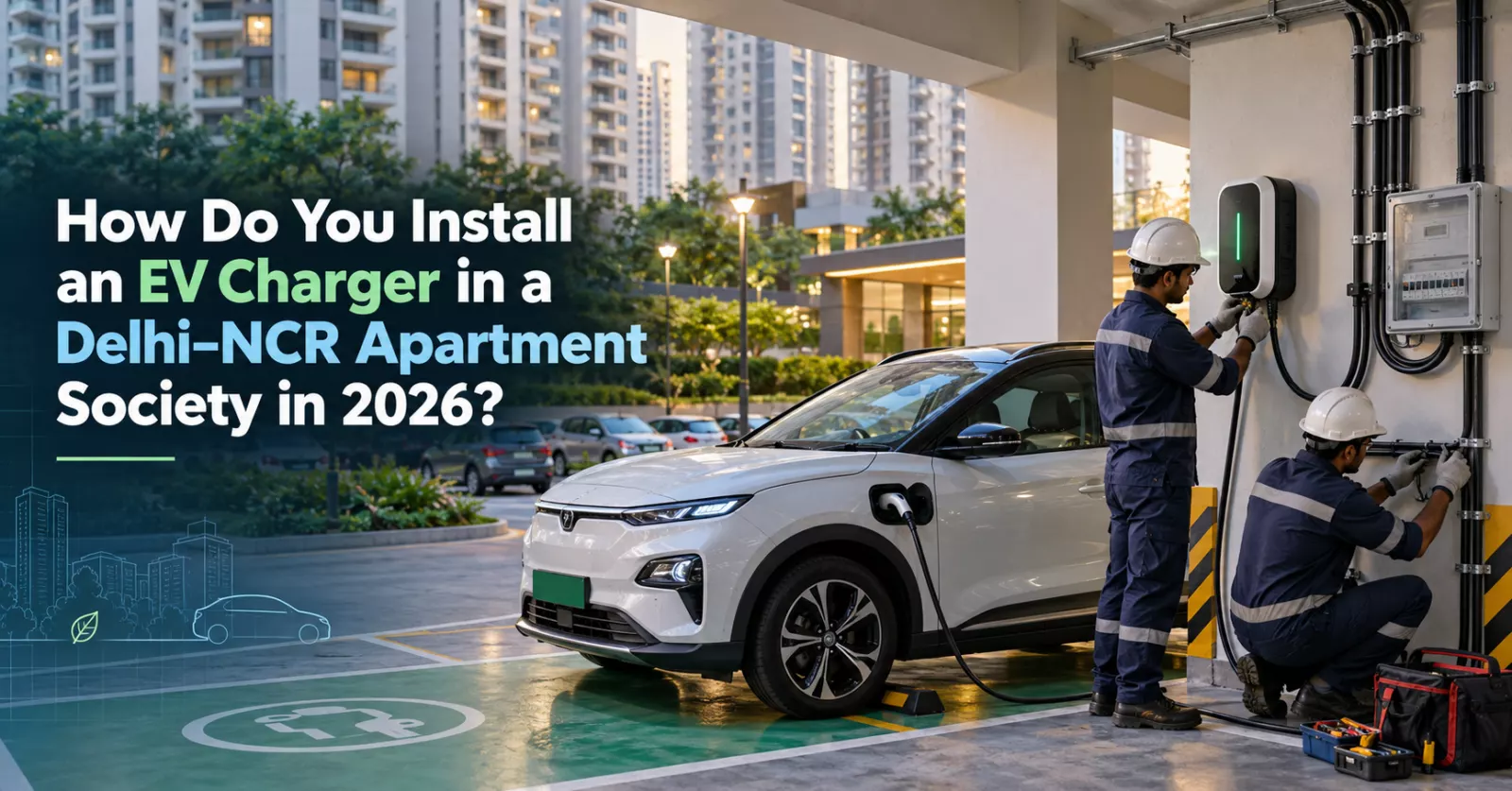
Quick Answer: First, get a signed No Objection Certificate (RWA NOC) for your allotted parking slot. Next, have a licensed electrical contractor mount an ARAI or BIS-certified AC Smart Charger (3.3 kW to 7.4 kW) and issue a Wiring Test Report. Finally, apply online through your local DISCOM portal (BSES E-Mobility, Tata Power-DDL Switch Delhi, DHBVN, or NPCL/UPPCL Jhatpat) for a separate EV meter or society load upgrade. If your RWA prefers a hands-off setup, EarthtronEV Home & Apartment Charging handles the RWA paperwork, DISCOM coordination, load balancing, and per-flat billing for you.
What Actually Happens When You Buy an EV in a Delhi–NCR High-Rise?
Buying an electric car in Delhi, Gurugram, or Noida is the easy part. The headache usually starts two days before delivery, when the dealership asks where to mount the wallbox and your estate manager says, “RWA permission nahi hai.”
Most Resident Welfare Associations aren’t trying to block electric vehicles out of spite. They’re worried about three very specific things: basement fire hazards from loose wiring, somebody accidentally tapping into the society’s diesel generator (DG) backup line, and 20 cars plugging in at 9 PM and tripping the main building transformer.
Those concerns aren’t imaginary. In Delhi, EVs accounted for 12.6% of all new vehicle registrations in FY2025–26, with electric cars reaching 8.4% market share. Across India, annual electric car sales crossed 100,000 units alongside 1.4 million electric two-wheelers (Haryana EV Charging Mandate Analysis). And under the Delhi EV Policy 2026 (which runs from 1 July 2026 to 31 March 2030), battery electric cars up to ₹30 lakh ex-showroom get a 100% road tax and registration fee waiver plus a ₹1 lakh scrappage bonus for retiring an old BS-IV car. More residents in your tower are going to buy EVs every quarter.
Public fast chargers across Delhi, Gurugram, Noida, and Faridabad are great when you need a quick top-up during the day. Still, nobody wants to sit at a commercial plaza at 11 PM twice a week when their car sits parked downstairs for nine hours every night.
Plus, the math on electricity bills is brutal if you wire a charger the wrong way. Plugging a 45 to 60 kWh electric SUV into your regular flat meter adds 250 to 450 units a month. In Delhi–NCR, that extra load pushes your household consumption straight into the highest domestic tariff slab, adding ₹2,500 to ₹6,500 to your monthly bill. A separate EV meter—or a dedicated multi-storey society EV connection—drops your cost per unit to between ₹4.50 and ₹6.20.
Can Your RWA Legally Refuse an EV Charger in 2026?
No. An RWA cannot enforce a blanket ban on EV chargers if your setup follows electrical and fire safety rules. Under the Ministry of Power’s revised Guidelines for Installation and Operation of Electric Vehicle Charging Infrastructure, EV charging is a de-licensed activity across India. Both individual flat owners and RWAs have the legal right to install chargers using either an existing domestic meter or a separate DISCOM EV connection.
What the RWA can do is dictate how the cable is routed, require certified hardware, and verify fire safety compliance. Because rules differ across state borders in NCR, here is what applies to your building in 2026:
- Delhi (Dwarka, Rohini, Vasant Kunj, Patparganj & South/East/West Delhi): Delhi’s amended Unified Building Bye-Laws require all new multi-storey residential and commercial buildings to make at least 20% of their parking capacity EV-ready, and existing commercial/institutional complexes with 100+ bays must reserve at least 5% of bays for EVs with chargers rated at 3.3 kW or higher. The Delhi EV Policy 2026 appoints Delhi Transco Limited (DTL) as the nodal agency for single-window clearances and backs community charging stations inside Cooperative Group Housing Societies (CGHS).
- Gurugram & Faridabad (Haryana’s June 2026 Building Code Update): On 5 June 2026, the Haryana Town and Country Planning Department (TCPD) amended the Haryana Building Code 2017, requiring all new and renovated group housing societies to provide one active EV charging spot for every five parking slots (20%) and 100% EV-ready conduit infrastructure across all parking bays, while exempting EV equipment from Floor Area Ratio (FAR) calculations. In addition, the Haryana Fire Department’s 2026 notification explicitly allows EV chargers in stilt parking and first basement levels as long as they use BIS (IS 17017) certified wallboxes, armored cabling, proper ventilation, and safe spacing from combustible items.
- Noida, Greater Noida & Ghaziabad (Uttar Pradesh LMV-11 & GRAP Rules): Under the UPERC FY2026–27 tariff order, multistoried residential buildings in Noida, Greater Noida West, and Indirapuram get a dedicated LMV-11 slab at ₹6.20/kWh (LT) and ₹5.90/kWh (HT)—cheaper than the ₹7.70/kWh public charging rate—provided the RWA or builder takes a separate LMV-11 EV connection, and winter GRAP rules require phase isolation so chargers never draw power when the building switches to diesel generator backup.
Two Ways to Set It Up: Private Bay Wallbox vs. Shared Society Chargers
When we inspect residential buildings for EarthtronEV Home & Apartment Charging, societies usually pick one of two approaches—or combine both:
| What to Compare | Option 1: Individual Charger at Your Parking Slot | Option 2: Shared Society Charging Bays (RWA Hub) |
|---|---|---|
| Who It Works Best For | Flat owners with a fixed stilt or first-basement slot within 15–40 meters of the meter room | High-rise towers with long cable runs, single-point society meters, or tight transformer capacity |
| Charger Hardware | 3.3 kW AC Home Charger (15A socket) or 7.4 kW AC Smart Charger (single-phase Type-2 wallbox) | 7.4 kW–11 kW AC Smart Chargers, 15 kW AC Hybrid Dual Chargers, or 22 kW–60 kW fast chargers (AC vs DC EV Chargers) |
| How the Meter Works | Connected to your existing flat meter (if you have spare sanctioned load) or a separate DISCOM EV meter | Connected to a single dedicated society EV meter (DERC EV category in Delhi, DHBVN EV in Haryana, or LMV-11 in UP) |
| How Residents Pay | Billed directly on your monthly electricity bill; locked via your RFID card or phone app | Residents book a slot on the app and pay per kWh via UPI, RFID, or QR code |
| Effect on Building Load | Fine for the first 10–15 cars, but uncoordinated installs can push total building load past the 100 kW transformer limit | Dynamic Load Management splits available power across active chargers so the main breaker never trips |
| Upfront Cost to RWA | ₹0 for the RWA (₹15,000–₹35,000 paid by the flat owner) | Installed as a society amenity or managed end-to-end by EarthtronEV Home & Apartment Charging |
2026 DISCOM EV Tariffs, Meter Deposits & Hidden Rules in Delhi–NCR
Before you or your RWA secretary file an application, check the exact tariff and deposit rules for your local power utility:
| Area / City | Power Utility (DISCOM) | 2026 EV Energy Rate | Fixed / Demand Charges | Key Rule You Need to Know |
|---|---|---|---|---|
| South, West, East & Central Delhi | BSES Rajdhani (BRPL) & BSES Yamuna (BYPL) | ₹4.50/kWh (LT) / ₹4.00/kVAh (HT) + PPAC & DERC surcharges (BSES EV Connection FAQ) | ₹0 | You must apply after your car is delivered and the charger is mounted, with a contractor’s Wiring Test Report + RWA NOC (BSES EV Connection FAQ) |
| North & North-West Delhi | Tata Power-DDL (TPDDL) | ₹4.50/kWh (LT) / ₹4.00/kVAh (HT) + PPAC & DERC surcharges. | ₹0 | TPDDL’s single-window portal advertises installation within 7 working days via empanelled vendors. |
| Gurugram & Faridabad (Haryana) | DHBVN | ~₹6.00/unit flat EV station rate (or ₹4.50–₹7.10/unit domestic slabs) (DHBVN Tariff Rates 2026) | ₹0 on LT EV station; 5% rebate on energy & fixed charges for prepaid smart meters (Times of India) | RWAs can add a service fee capped at ₹3/kWh (9 AM–4 PM solar hours) and ₹4/kWh (non-solar) on AC slow chargers |
| Noida & Ghaziabad (UP) | PVVNL / UPPCL | ₹6.20/kWh (LT) / ₹5.90/kWh (HT) under LMV-11 Multistoried Building slab. | ₹0 demand charge (₹150/kVA/month penalty only if load exceeds contracted limit) | The RWA or builder must take a separate LMV-11 connection; common-area chargers cannot piggyback on the building’s main domestic meter. |
| Greater Noida & Greater Noida West | NPCL (Noida Power Company Ltd) | LMV-11 Multistoried rate (₹6.20/kWh LT / ₹5.90/kWh HT) minus an extra 10% NPCL discount . | ₹0 demand charge | Apply directly on noidapower.com; a major money-saver for large high-rise societies in Greater Noida West |
Three Fine-Print Details That Catch Flat Owners Off Guard
- Pick a Prepaid EV Meter in Delhi to Save up to ₹22,000 Upfront: Under the BSES EV Connection Schedule of Charges, a postpaid EV meter requires a security deposit of ₹2,500 per kW, while a prepaid EV meter has a flat ₹3,000 security deposit regardless of charger size (plus Service Line & Development [SLD] charges of ₹3,000 up to 5 kW, and ₹500 per extra kW). For a 3.3 kW charger, you pay ₹6,000 total on prepaid versus ₹10,500 on postpaid; for a 10 kW Bharat AC 001 Charger, you pay ₹8,500 total on prepaid versus ₹30,500 on postpaid; and for a 15 kW charger, prepaid costs ₹11,000 versus ₹45,500 on postpaid.
- Avoid the 100 kW Transformer Space Trap: Under DERC Supply Code Regulation 6(1) and BSES FAQ Q.12, once cumulative Low Tension (LT) demand across all floors/bays in a plot crosses 100 kW (108 kVA)—or if the plot is 600 sq m+ / 2,000 sq m+ built-up area—the DISCOM requires space for a distribution transformer (DT) substation, and High Tension (HT) supply above 100 kW switches from kWh to kVAh billing. Using Dynamic Load Management through EarthtronEV Home & Apartment Charging keeps your building’s active draw below that threshold.
- Don’t Budget Around the Old ₹6,000 Delhi Charger Grant: Under Delhi’s old 2020 policy, the first 30,000 private charging points got a ₹6,000 grant, whereas the Delhi EV Policy 2026 (in force since 1 July 2026) focuses on road-tax waivers, scrappage incentives, and the central PM E-DRIVE EV Charging Subsidy Scheme without renewing that per-point residential grant. Apply through the single-window portal to lock in the ₹4.50/kWh tariff, and treat any legacy portal discount as a bonus rather than a guarantee.
Step-by-Step: How to Get Your Apartment Charger Approved and Installed
Here is the exact sequence we use at EarthtronEV Home & Apartment Charging to take a resident or RWA from initial inquiry to a live charger:
Step 1: Match the Charger to Your Car’s On-Board Charger
Buying a 22 kW wallbox won’t speed up your charging if your car’s internal on-board charger only accepts 7.2 kW AC. All six EarthtronEV AC Smart Charger variants come with IP54 weather protection, OCPP support, and App/RFID/QR locking:
| EarthtronEV Model | Power & Phase | Connector | 0–100% Charge Time | Where It Fits Best |
|---|---|---|---|---|
| AC Home Charger | 3.3 kW (Single-Phase) | Type 2 / Bharat AC | 6–8 hours | Two-wheelers, compact city EVs, and existing domestic flat meters |
| AC Smart Charger (Best Seller) | 7.4 kW (Single-Phase) | Type 2 / Bharat AC | 2.5–4 hours | Standard overnight wallbox for individual apartment slots and society bays |
| Bharat AC 001 Charger | 10 kW (Single-Phase) | Bharat AC / Type 2 | 2–3 hours | Ministry of Power Bharat AC 001 compliant unit for shared society & fleet bays |
| AC 3-Phase Charger | 11 kW (3-Phase) | Type 2 | 1.5–2.5 hours | Larger 50–80 kWh electric SUVs and shared visitor bays |
| AC Hybrid Dual Charger | 15 kW (Dual Gun) | Hybrid / Type 2 (2 EVs) | 1–2 hours | Common RWA bays where two cars share a single pillar simultaneously |
| AC High-Power Charger | 22 kW (3-Phase + Dynamic Load Mgmt) | Type 2 | 45–90 minutes | High-turnover society clubhouses and Corporate Office Parking |
(Not sure which plug your car uses? Check our guide on EV Charger & Connector Types in India: Type 2, CCS2 (2026).)
Step 2: Get a Site Survey Before You Talk to the RWA
Never walk into an RWA meeting empty-handed. Have an engineer from EarthtronEV (011-40164881) inspect your meter room and parking pillar first so we can measure the exact cable run along existing overhead trays, check earthing resistance, verify spare load on your meter or transformer, and map out a clean installation path.
Step 3: Hand the RWA a Complete Safety File
Under BSES FAQ Q.10, any resident living in an RWA or society needs a signed NOC confirming wall or pillar space for the charger and meter. Attach these five items to your application so the committee has every technical answer upfront:
- Car Booking Receipt / RC & Parking Allotment Proof: Shows the bay is legally allotted to your flat.
- ARAI / BIS (IS 17017) Charger Certificate: Confirms the EarthtronEV wallbox has built-in surge, over-current, earth-leakage, and thermal cut-off protection.
- FRLS Armored Cable Plan: Confirms you are using Flame Retardant Low Smoke (FRLS) armored copper cable inside overhead trays, paired with a dedicated MCCB/RCCB breaker and an emergency stop button.
- DG Backup Isolation Note: Confirms the charger line is wired strictly to grid power so it automatically cuts off during power outages and never drains the society’s diesel generator.
- Separate Billing Proof: Confirms electricity will be billed either to your separate DISCOM EV meter or per flat through EarthtronEV’s automated billing app.
Step 4: Copy-Paste RWA NOC Request Letter
To: The President / Secretary, Resident Welfare Association (RWA)
Subject: Request for No Objection Certificate (NOC) to Install a Certified EV Charger at My Allotted Parking Slot
Dear Management Committee,
I am a flat owner/resident in our society and have purchased a Battery Electric Vehicle. In line with the Ministry of Power Consolidated EV Charging Guidelines, state EV policies, and DISCOM EV metering rules, I request a No Objection Certificate (NOC) to mount an AC EV charger at my allotted parking space along with a dedicated EV meter / domestic load connection.
To ensure complete electrical and fire safety in the parking area, I confirm the following:
- Certified Equipment: I am installing an ARAI/BIS-certified smart wallbox (EarthtronEV AC Smart Charger) with IP54 weather protection, RCCB earth-leakage protection, thermal cut-off, and RFID/App lock so unauthorized vehicles cannot use it.
- Licensed Cabling & Test Report: A licensed electrical contractor will route FRLS armored copper cable neatly along the overhead cable tray and provide a formal Wiring Test Report before the line is energized.
- Zero Load on Society DG Backup: The circuit will be isolated from the society’s Diesel Generator (DG) backup line and will operate only on grid electricity.
- Zero Cost to the Society: I will bear 100% of the hardware, cabling, metering, and monthly electricity charges.
I have attached the site layout report from EarthtronEV, the charger’s safety datasheet, my flat ownership proof, and vehicle details.
Sincerely,
Resident Signature, Flat Number & Parking Slot Number
Step 5: Mount the Charger and Get the Wiring Test Report
Under BSES FAQ Q.2 & Q.3, you cannot apply for a BSES EV connection before your vehicle is delivered and your charger is physically mounted at your parking slot, and you also need a Wiring Test Report signed by a licensed electrical contractor before the DISCOM will energize the meter. When EarthtronEV installs your unit, our licensed team completes the mounting, FRLS cabling, earthing check, and Wiring Test Report in one visit.
Step 6: Submit the Online DISCOM Application
Upload your ID proof, PAN card, flat ownership/allotment proof, signed RWA NOC, and Wiring Test Report on BSES E-Mobility, DHBVN, NPCL, or UPPCL’s Jhatpat portal (BSES EV Connection FAQ). Once submitted, DISCOM meter installation across metro NCR circles typically takes 3 to 7 working days (Delhi EV Charger Installation Guide, Times of India).
Real 2026 Costs: What You Will Spend to Install and Run an Apartment Charger
| Cost Item | Individual 3.3 kW–7.4 kW Private Bay | Shared RWA Community AC Bay (7.4 kW–22 kW) | Shared RWA / Commercial DC Fast Charger (40 kW–60 kW) |
|---|---|---|---|
| Charger Unit | ₹15,000 – ₹30,000 (often bundled with car) | ₹35,000 – ₹90,000 per AC Smart / Dual Charger | ₹6,00,000 – ₹15,00,000 (EarthtronEV Franchise Cost Guide) |
| FRLS Armored Cable, Tray, Breaker Box & Labor | ₹5,000 – ₹20,000 (depends on distance from meter room) | ₹15,000 – ₹60,000 (includes load management wiring) | ₹3,00,000 – ₹5,00,000 (civil work, cabling & switchgear) |
| DISCOM EV Meter Deposit & SLD (Delhi Example) | ₹6,000 – ₹8,500 (Prepaid) or ₹10,500 – ₹30,500 (Postpaid) (BSES EV Connection FAQ) | ₹8,500 – ₹11,000 (Prepaid LT) or society load upgrade | Site-specific LT/HT connection & transformer upgrade |
| Total Setup Cost | ₹20,000 – ₹50,000 | ₹50,000 – ₹1,50,000 per bay | ₹10,00,000 – ₹20,00,000 (or ₹0 RWA CapEx via franchise partner model) (EarthtronEV Franchise) |
| Running Cost per Km (45–60 kWh Car) | ₹0.75 – ₹1.20/km on EV tariff (vs. ₹7–₹9/km on petrol) | ₹1.00 – ₹1.50/km (with ₹3–₹4/kWh RWA service fee) | ₹2.20 – ₹3.00/km (at ₹16–₹20/kWh fast-charging rate) |
If your complex has outside visitor parking, a commercial market block, or club bays, your RWA—or an individual investor living in the society—can also look at the EarthtronEV Charging Station Franchise (FOCO Model). Investments start at ₹10–14 lakh for a 40 kW DC fast charger or ₹14–20 lakh for a 60 kW unit, where EarthtronEV handles the electricity connection, civil setup, app listing, and day-to-day maintenance and sends a monthly payout based on the units sold (EV Charging Franchise Cost vs Revenue & Break-Even).
Why RWAs Across Delhi–NCR Bring In EarthtronEV
Committee members are volunteers with day jobs—nobody on the RWA wants to spend their weekends chasing DISCOM linemen, reading sub-meters in the basement, or splitting electricity bills on spreadsheets. Through EV Charging Stations for Home & Apartments, our team takes over the entire process across Delhi, Gurugram, Noida, and Faridabad:
- Complete RWA & Fire-Safety Paperwork: Prepares the wiring diagrams, IS 17017/ARAI safety certificates, FRLS cabling specs, and DG isolation undertaking so your committee can sign off with confidence.
- Direct DISCOM Coordination: Handles the new EV meter filing or society load upgrade with BSES, Tata Power-DDL, DHBVN, PVVNL/UPPCL, or NPCL.
- Dynamic Load Balancing: Uses our OCPP-based CSMS software to automatically throttle and balance power across active 7.4 kW, 11 kW, 15 kW Dual, and 22 kW AC Smart Chargers so your building transformer never overloads during peak evening hours.
- Automated Slot Booking & UPI Billing: Lets residents book a slot on the EarthtronEV app, tap their RFID card or scan the QR code, and pay per kWh via UPI (How to Pay for EV Charging in India).
Frequently Asked Questions (FAQs)
- Can my RWA in Delhi–NCR legally stop me from installing an EV charger in my allotted parking bay? No. Under Ministry of Power guidelines, the Delhi EV Policy 2026, and the June 2026 Haryana Building Code amendment, EV charging is a de-licensed right, and an RWA cannot impose a blanket ban if you use BIS/ARAI-certified equipment, licensed FRLS armored cabling, and isolate the line from the society’s diesel generator.
- Is EV charging allowed in basement parking in Gurugram, Noida, and Delhi societies? Yes, in stilt parking and first basement levels, provided your installation follows the 2026 Haryana Fire Department notification and Delhi safety guidelines using IS 17017-certified AC Smart Chargers, proper ventilation, dedicated MCCB/RCCB breakers, and safe distance from combustible materials.
- What is the electricity rate for EV charging in Delhi apartments in 2026? BSES Rajdhani, BSES Yamuna, and Tata Power-DDL bill dedicated EV connections at ₹4.50 per kWh on Low Tension (LT) supply and ₹4.00 per kVAh on High Tension (HT) supply with zero fixed charges, plus standard PPAC and DERC surcharges on a separate EV meter.
- How do Noida and Greater Noida societies get the cheaper ₹6.20/kWh LMV-11 tariff? Under UPERC’s FY2026–27 tariff order, multistoried residential societies in Uttar Pradesh get a reduced ₹6.20/kWh (LT) / ₹5.90/kWh (HT) common-use EV charging slab—and NPCL consumers in Greater Noida get an extra 10% discount on top—when the RWA or builder applies for a separate LMV-11 connection.
- Should I apply for a prepaid or postpaid EV meter in Delhi and Haryana? Go with a prepaid EV meter: in Delhi, a prepaid EV connection requires a flat ₹3,000 security deposit instead of ₹2,500 per kW on postpaid, and in Haryana (DHBVN/UHBVN), prepaid smart meter users also get a 5% bill rebate.
- How much does it cost to install an EV charger in an apartment parking slot? For an individual flat owner installing a 3.3 kW or 7.4 kW AC wallbox, all-in setup costs run ₹20,000 to ₹50,000, covering the charger unit, FRLS armored cabling, breaker box, and DISCOM prepaid meter deposit, while shared society AC bays cost ₹50,000 to ₹1.5 lakh per point.
- How does dynamic load management stop a society’s transformer from tripping? When several cars plug in at night, dynamic load management on EarthtronEV’s CSMS platform automatically splits the building’s spare sanctioned load across active AC Smart Chargers, preventing main breaker trips and keeping total building demand below the 100 kW transformer-space limit.