Quick Answer: Solar panels and battery storage can be useful for an EV charging station when there is suitable space for solar generation, sufficient charging demand, and a clear reason to store electricity. That reason might be evening demand, a constrained grid connection or a meaningful difference between electricity prices at different times. However, adding a battery does not automatically make a charging station more profitable. Its benefits must justify its installation cost, energy losses, maintenance and eventual replacement.
For someone planning an EV charging station in India, installing solar panels can seem like an obvious next step. The station needs electricity, and sunlight offers an opportunity to generate some of it on-site.
The more difficult question is whether the project also needs a battery.
A workplace with vehicles parked through the afternoon may use solar electricity directly. A highway station with short bursts of heavy demand may need stored energy to supplement its grid connection. These locations have different requirements, even if they install identical chargers.
The right decision starts with understanding when vehicles arrive, how much energy they need and what the electricity connection can deliver.
How Solar, Battery Storage and EV Charging Work Together
A solar-integrated charging station combines several systems, each with a different role.
| Component | Main purpose |
|---|---|
| Solar photovoltaic panels | Generate electricity during daylight hours |
| Battery energy storage system, or BESS | Store electricity for use at another time |
| Grid connection | Supply electricity when on-site generation and storage are insufficient |
| EV chargers | Deliver electricity to compatible vehicles |
| Inverters and power-conversion equipment | Convert electricity into the form required by connected systems |
| Energy management system | Coordinate solar generation, battery operation and grid imports |
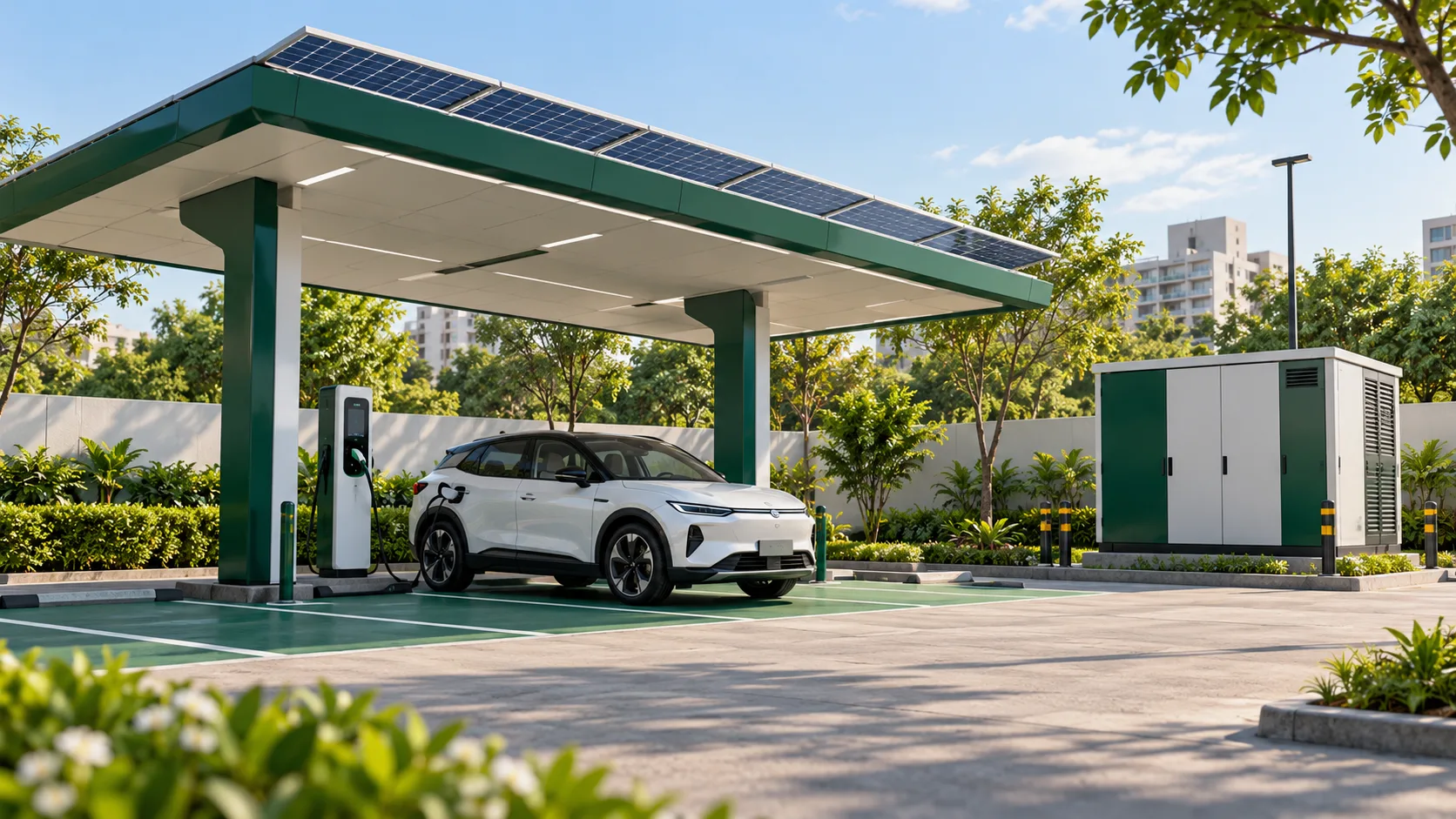
During sunny hours, solar electricity can serve charging demand directly. Surplus generation may charge the battery, subject to its available capacity and the system’s operating settings.
Later, the battery can discharge to support charging. The grid supplies the remaining requirement.
Storage shifts electricity between different times; it does not generate additional electricity. Some energy is also lost during storage and conversion. The US Department of Energy’s solar and storage guidance explains this time-shifting role.
Why This Combination Is Relevant to India
Solar and battery-supported charging is already appearing in equipment developed for the Indian market.
At Bharat Mobility Global Expo 2025, Exicom showcased a solution combining solar generation, grid electricity, battery storage and charging dispensers. This demonstrates that integrated systems are available for evaluation; it does not establish that every site will achieve the same financial outcome.
The International Energy Agency has also highlighted the opportunity to co-locate rooftop solar and EV charging in India. When electricity production and vehicle demand align, on-site solar can help reduce the pressure that charging places on the local grid.
For operators, the practical question is specific: which combination of solar, storage and grid supply suits this location?
When Solar Without a Battery May Be Enough
A battery should be evaluated as an additional investment, rather than treated as an automatic part of every solar charging project.
Solar without storage may be a sensible starting point when:
- Vehicles regularly charge during daylight hours.
- The grid can already support the required charging power.
- Other daytime loads can consume unused solar generation.
- There is little financial benefit from shifting electricity to another time.
- The project needs to limit its initial investment.
For example, an office building may have employees charging vehicles while its lighting, cooling and other equipment also consume electricity. Solar generation can serve these overlapping loads without first passing through a battery.
This makes the timing of demand important. Annual solar generation alone does not show how much electricity the charging station can actually use.
When Adding Battery Storage Deserves a Closer Look
1. The Grid Connection Cannot Support Short Charging Peaks
A site may have enough electricity available across the day but insufficient power for several vehicles charging simultaneously.
A battery can supplement grid power during those busy periods, provided it has sufficient discharge capability and stored energy.
NREL’s battery-buffered charging guidance evaluates storage against both an initial surge in demand and a full design day. This distinction matters: a system that handles the first group of vehicles may struggle with repeated arrivals if it cannot recharge between sessions.
Before choosing storage, compare it with the cost and timing of a stronger electricity connection for an EV charging station.
2. Solar Generation and Charging Demand Occur at Different Times
A location may generate most of its solar electricity around midday but receive more charging customers in the evening.
Storage can move some of that generation into later hours. However, the battery must be used often enough for the value of the shifted electricity to justify its cost.
Occasional evening demand alone may not support a large storage investment.
3. The Applicable Electricity Bill Rewards Peak Reduction
Storage may reduce electricity costs where the tariff structure makes it valuable to reduce certain grid imports or measured demand peaks.
The actual benefit depends on the connection category, billing rules and battery dispatch schedule. Savings established for a site in another state—or another country—should not be copied into an Indian project estimate.
Start with the applicable tariff and use the state-wise EV charging electricity tariff guide as an introduction to the questions that need checking.
4. The Site Requires a Designed Backup Function
A battery may support selected loads during an outage, but backup operation is not automatic.
The system must be designed for the intended outage mode, including appropriate controls, protection, isolation and compatible equipment. A battery installed primarily to manage electricity costs should not be assumed to keep every charger running during a power cut.
Specify the required backup power and duration before equipment selection.
A Practical Sizing Example: Power and Energy Are Different
The following figures are illustrative assumptions, not a recommended equipment specification.
Suppose a charging site has:
| Parameter | Assumed value |
|---|---|
| Total site electrical demand during a busy interval | 100 kW |
| Permitted grid import | 60 kW |
| Solar output during that interval | 20 kW |
| Remaining power required from storage | 20 kW |
| Duration of the interval | 30 minutes |
The battery must supply:
100 kW − 60 kW − 20 kW = 20 kW
Over half an hour, that represents:
20 kW × 0.5 hours = 10 kWh
These are two separate requirements:
- 20 kW is the discharge power required.
- 10 kWh is the energy delivered during the interval.
The installed battery would need additional allowance for conversion losses, usable capacity limits, operating reserves and degradation.
Now consider the same interval after sunset. With no solar contribution, the battery requirement rises to 40 kW and 20 kWh.
This demonstrates why selecting a battery from charger nameplate capacity alone is insufficient. The design must consider simultaneous demand, solar variability, other site loads and opportunities to recharge.
How Much Solar Capacity Does the Station Need?
Start with an estimate of daily energy consumption, then examine its timing.
Consider another illustrative planning scenario:
- 20 charging sessions per day.
- Average delivery of 20 kWh per session.
- Total energy delivered to vehicles: 400 kWh per day.
Assume, purely for this example, a solar system produces 4 kWh per installed kWp per day after its modelled system losses.
A 50 kWp installation would then generate:
50 kWp × 4 kWh/kWp/day = 200 kWh per day
That equals half the energy delivered to vehicles in this simplified example. It does not mean solar automatically supplies half the station’s electricity requirement.
The final result also depends on:
- Charger and storage losses.
- Cooling, lighting and other auxiliary consumption.
- Whether solar output coincides with charging demand.
- Seasonal generation changes and shading.
- Any unused or exported electricity.
Use location-specific generation estimates and time-based demand data before deciding the final solar capacity.
Compare Three Configurations Before Investing
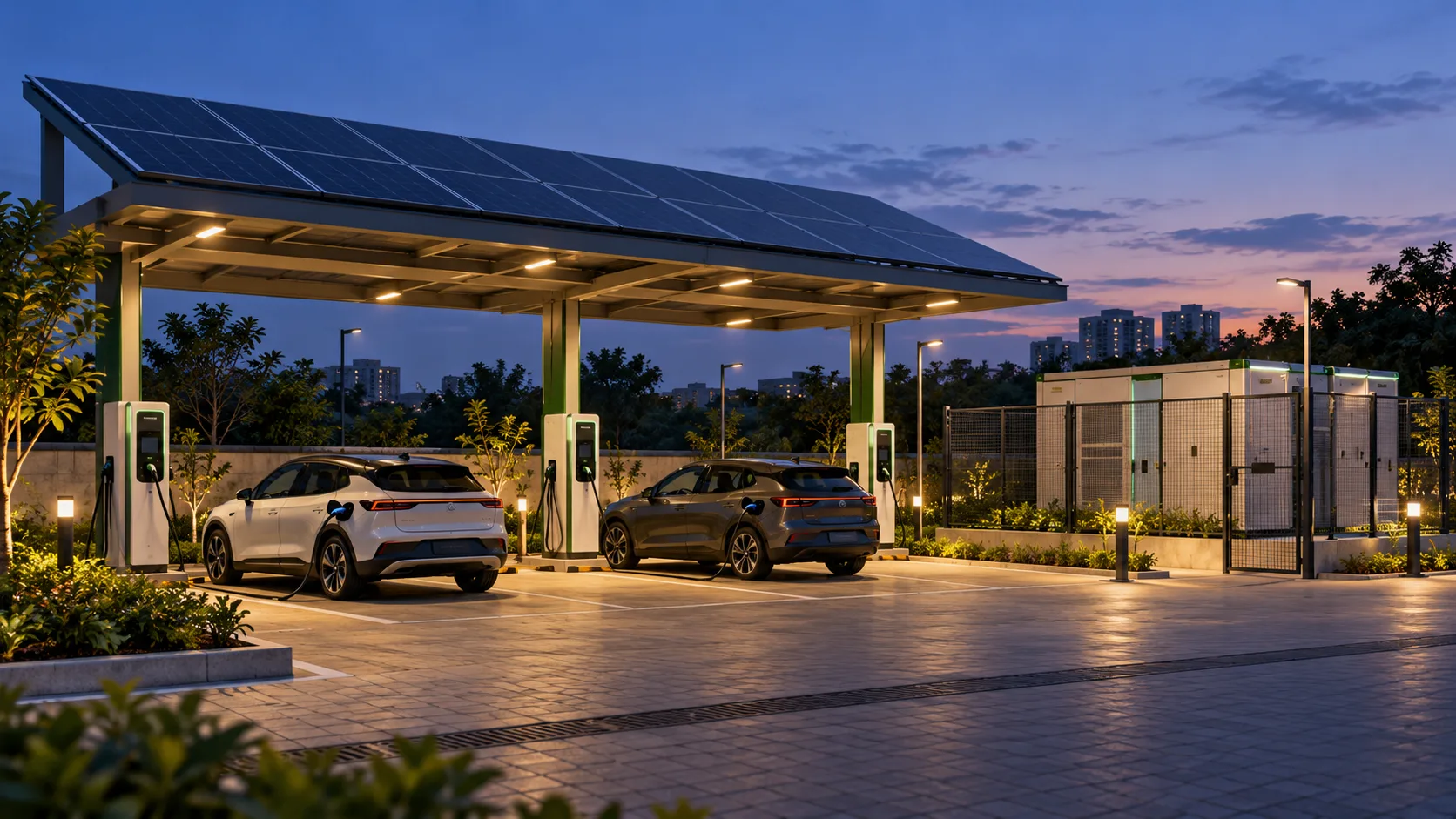
A useful feasibility assessment should compare the same charging demand under three alternatives.
| Configuration | What to evaluate |
|---|---|
| Grid-powered charging | Connection capacity, electricity charges and supply reliability |
| Grid plus solar | Direct solar consumption, usable roof or canopy space and seasonal output |
| Grid plus solar and storage | Additional savings or capacity benefits against battery costs and losses |
Research published through Sandia examines solar and storage sizing as a combined technical and economic problem. The appropriate configuration depends on the site rather than a universal solar-to-battery ratio.
The project estimate should include equipment, civil work, electrical integration, monitoring, maintenance, financing and replacement allowances.
For the battery, request written information on usable capacity, continuous discharge power, efficiency, operating temperature limits, warranty conditions and expected capacity retention.
Avoid calculating returns from electricity savings alone while ignoring the equipment required to achieve them.
Which Locations Should Evaluate This Option?
Workplaces and commercial properties: Daytime demand can support direct solar consumption. Storage requires a separate justification.
Highway charging sites: Solar canopies may use parking space productively, while batteries may help with short demand peaks. Repeated busy periods still require careful modelling.
Fleet facilities: Predictable schedules can make energy planning easier, although overnight charging may require substantial storage if the aim is to use daytime solar.
Grid-constrained locations: Battery buffering may help bridge some power limitations, but it cannot compensate indefinitely for inadequate daily energy supply.
For a broader comparison of site types, explore locations for EV charging station investment.
What to Check Before Finalising the Design
Collect actual charging-session data where available, or build clearly labelled demand scenarios for a new location.
Ask the project team to assess:
- A normal operating day and a busy day.
- Daytime and nighttime charging peaks.
- Low-solar conditions.
- Battery recharge time between busy periods.
- The effect of battery degradation.
- Future charger expansion.
- Site-specific electrical, structural and fire-safety requirements.
Energy-system modelling tools can compare grid-only, solar and solar-plus-storage configurations using time-based operation and economic assumptions. This is more useful than selecting equipment from a single average daily consumption figure.
Conclusion
Solar and battery storage can strengthen an EV charging project when they solve a clearly identified energy or power problem.
Solar may be sufficient where vehicles charge during daylight hours. Storage deserves closer evaluation where charging demand arrives later, short peaks exceed the available grid capacity, or the applicable electricity tariff provides a measurable benefit.
The best starting point is a comparison of grid-only, solar-only and solar-plus-storage options using the same demand assumptions. Equipment selection should follow that assessment.
Planning a charging location? Contact EarthtronEV to discuss the site and its charging requirements before finalising the infrastructure investment.