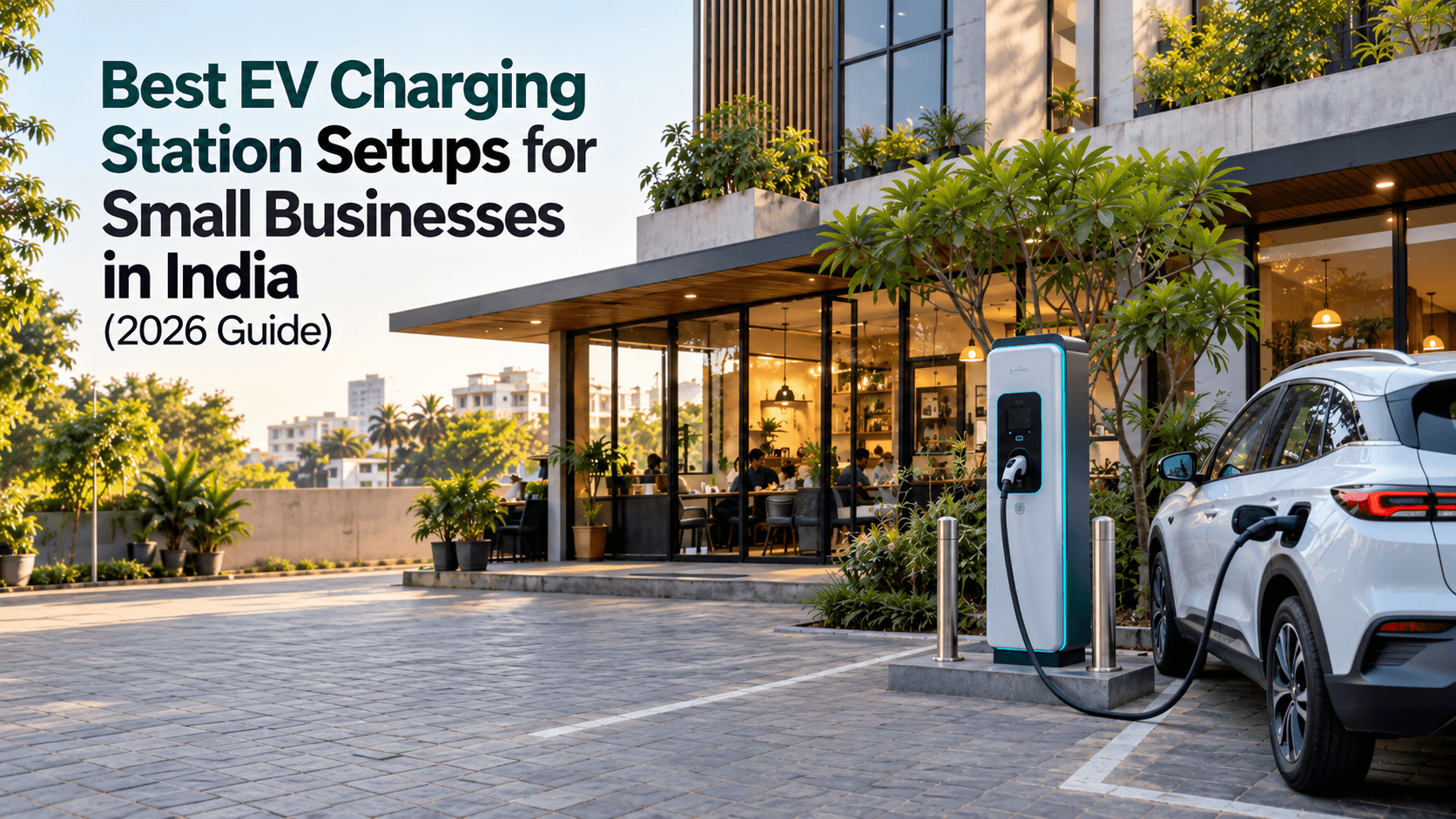
Quick Answer: The best EV charging station setup for a small business in India depends mainly on how long vehicles stay at the location, daily EV traffic, available electrical load, and whether the business wants to offer charging as an amenity or operate it commercially.
For offices, hotels, clinics, and businesses where vehicles remain parked for a few hours, a 7.4 kW to 22 kW AC charging setup can be practical. For restaurants, retail outlets, fuel stations, busy commercial locations, and sites serving travellers or fleets, a 60 kW DC fast charger may be more suitable.
For businesses exploring EarthtronEV’s franchise model, the company currently lists its franchise investment from ₹18 lakh onwards, with a 60 kW DC setup at ₹18 lakh and a 120 kW setup at ₹30 lakh. Final costs depend on location, electrical infrastructure, power availability, and site requirements.
Why Small Businesses Are Considering EV Charging in 2026
EV charging is no longer limited to highway charging hubs, large fuel retailers, or fleet depots.
Restaurants, hotels, offices, retail outlets, clinics, business parks, and other commercial properties already have something valuable for EV charging: parking space and people who spend time at the location.
That creates two possible benefits.
First, EV charging can be offered as an additional facility for existing customers, employees, or guests.
Second, depending on the location and commercial model, a charging station can attract EV drivers who may also spend money at the business while their vehicle charges.
The opportunity is growing alongside India’s charging network. EarthtronEV cites Ministry of Heavy Industries data showing 52,718 public charging stations in India as of July 2026, including 16,561 stations equipped with fast EV chargers for cars.
But simply installing the largest charger available is not necessarily the right approach.
For a small business, the better question is:
How long do customers normally stay at my location, and how quickly do they actually need to charge?
Best EV Charging Setup by Small Business Type
1. Retail Shops, Clinics and Small Offices
Recommended starting point: 7.4 kW–22 kW AC charging
A customer visiting a clinic, office, salon, retail store, or similar business may leave their vehicle parked for one or several hours.
That makes AC charging a practical option because the vehicle does not necessarily need to receive a large amount of energy in 20–30 minutes.
EarthtronEV currently offers smart AC charging solutions ranging from 3.3 kW to 22 kW, including 7.4 kW, 11 kW, and 22 kW deployments. Its 22 kW systems are positioned for locations such as offices and commercial properties where vehicles remain parked for longer periods.
A good fit when:
- Customers stay for one or more hours
- Employees park throughout the working day
- Fast vehicle turnover is not essential
- Existing electrical infrastructure can support the planned charger
- Charging is primarily an amenity rather than a high-throughput charging business
A site survey and electrical load assessment should still be carried out before selecting the final charger capacity.
2. Restaurants, Cafes and Dhabas
Recommended setup: AC charging or 60 kW DC, depending on traffic and dwell time
Restaurants are different from offices because customers usually stay for a shorter period.
If most customers stay for several hours — for example, at a destination restaurant or hotel restaurant — AC charging may be enough.
But at busy restaurants, highway eateries, cafes on intercity routes, and locations where EV drivers may stop specifically to charge, a DC fast charger can make more sense.
EarthtronEV currently positions its 60 kW DC fast charger for use cases including retail outlets, fuel stations, and highway rest stops.
For a restaurant owner, the decision should therefore be based on actual traffic rather than charger capacity alone.
A 60 kW charger at a location with consistent EV movement can be more commercially relevant than a much larger charger installed where very few EVs stop.
For a deeper comparison, see EarthtronEV’s guide on AC vs DC EV chargers.
3. Small Hotels, Resorts and Guesthouses
Recommended setup: 7.4–22 kW AC for overnight guests, with DC charging where transit demand exists
Hotels have one major advantage over many other businesses: long vehicle dwell time.
An overnight guest may leave a vehicle parked for six, eight, or even twelve hours. In such cases, high-power DC charging may not always be necessary.
A smart AC charger can allow guests to charge while they sleep and continue their journey the next morning.
Hotels located near highways, airports, tourist corridors, or major intercity routes may have a different opportunity. They may also serve travellers who are not staying overnight and only want a fast charging stop.
For these locations, a combination of AC charging for guests and DC fast charging for transit users may be worth evaluating.
EarthtronEV already provides commercial charging solutions for hotels and other commercial properties, making this a different use case from simply investing in a standalone charging franchise.
Read more: EV Charging Stations for Hotels, Malls and Commercial Properties in India.
4. Offices and Business Premises
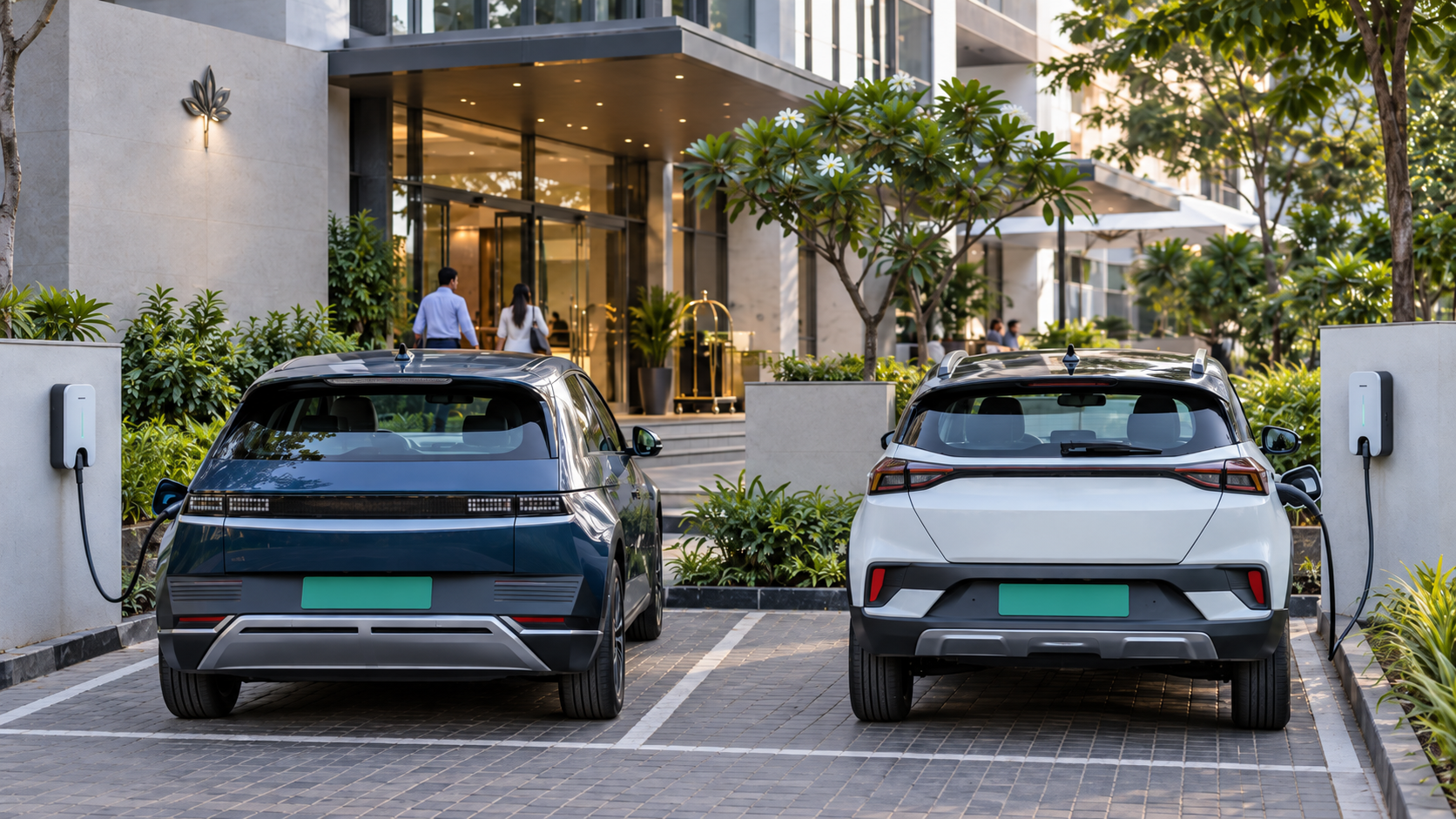
Recommended setup: 7.4 kW, 11 kW or 22 kW AC
Offices are among the clearest use cases for AC charging.
An employee may park for six to nine hours, which gives the vehicle plenty of time to charge without requiring high DC power.
Depending on the number of users and the building’s electrical capacity, an office can install one charger initially or create several managed charging bays.
Features such as:
- Load management
- Individual user billing
- RFID access
- App-based authentication
- Charging schedules
- Usage monitoring
can become more important than pure charging speed.
EarthtronEV’s commercial and AC charging systems support applications such as employee charging, commercial parking, billing, load management, and remote monitoring.
5. Cab Stands, Fleet Locations and High-Usage Commercial Hubs
Recommended setup: 60 kW DC or higher after demand assessment
Fleet vehicles operate differently from private cars.
A taxi or commercial EV makes money while it is moving, so long charging stops can reduce productive time.
For these locations, faster DC charging is generally more relevant than slow AC charging.
A 60 kW DC charger can be a starting point for a smaller commercial charging site, while higher capacities may be justified where vehicle volumes, electrical infrastructure, and charging demand support them.
EarthtronEV currently offers DC fast chargers from 60 kW upwards, with different configurations intended for retail, highway, fleet, commercial, and high-throughput applications.
The important point is not to install a higher-power charger simply because it is available.
Utilisation should justify the capacity.
6. Fuel Stations and Highway-Side Businesses
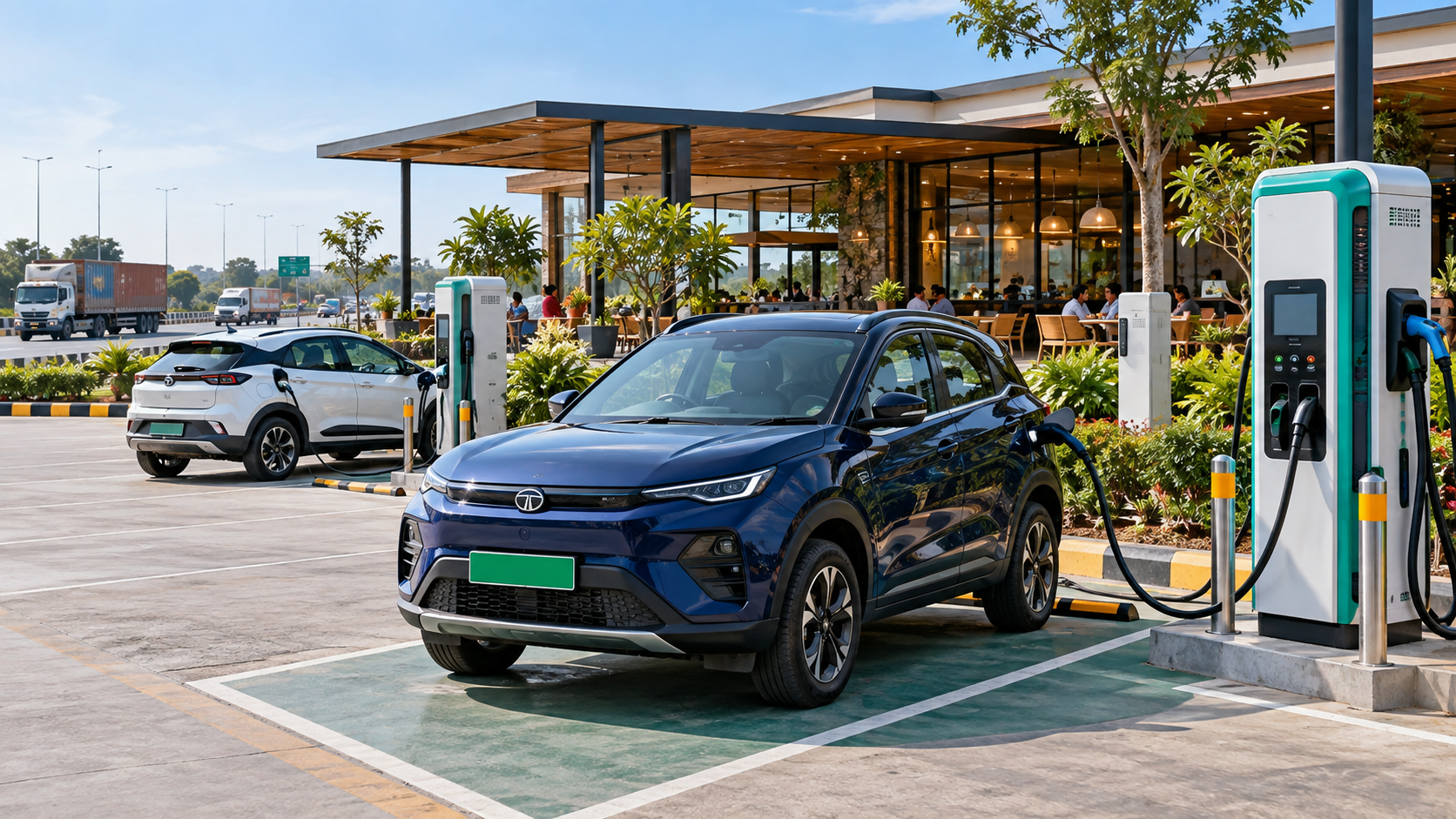
Recommended setup: 60 kW DC and above depending on traffic
Fuel stations, highway restaurants, convenience stores, and other roadside businesses can be strong EV charging locations because drivers are already accustomed to stopping there.
Unlike offices or hotels, however, travellers generally want to continue their journey quickly.
This makes DC fast charging more appropriate.
EarthtronEV lists its 60 kW DC charger for retail outlets, fuel stations, and highway rest stops, while 120 kW and higher-powered equipment is positioned for locations requiring greater charging throughput.
Before selecting capacity, businesses should examine:
- Daily EV traffic
- Highway or road visibility
- Ease of entry and exit
- Parking space
- Nearby charging competition
- Sanctioned electrical load
- Transformer requirements
- Expected charger utilisation
Small Business EV Charging Setup Comparison
| Business Type | Typical Parking Time | Setup to Evaluate | Main Reason |
|---|---|---|---|
| Retail shop / clinic | 30 min–2+ hours | 7.4–22 kW AC | Customers already park during visits |
| Small office | 4–9 hours | 7.4–22 kW AC | Long employee dwell time |
| Restaurant / cafe | 30–90 minutes | AC or 60 kW DC | Depends on customer turnover and EV traffic |
| Hotel / guesthouse | Several hours / overnight | 7.4–22 kW AC | Overnight charging suits guest stays |
| Highway hotel / dhaba | 30–90 minutes | 60 kW DC or above | Travellers need faster charging |
| Cab / commercial hub | Short turnaround | 60 kW DC or above | Vehicles need to return to service quickly |
| Fuel station | Short turnaround | 60–120 kW+ DC | High-throughput charging use case |
These are planning guidelines rather than fixed rules. The right configuration should be confirmed through a site-specific electrical and demand assessment.
AC vs DC: Which Is Better for a Small Business?
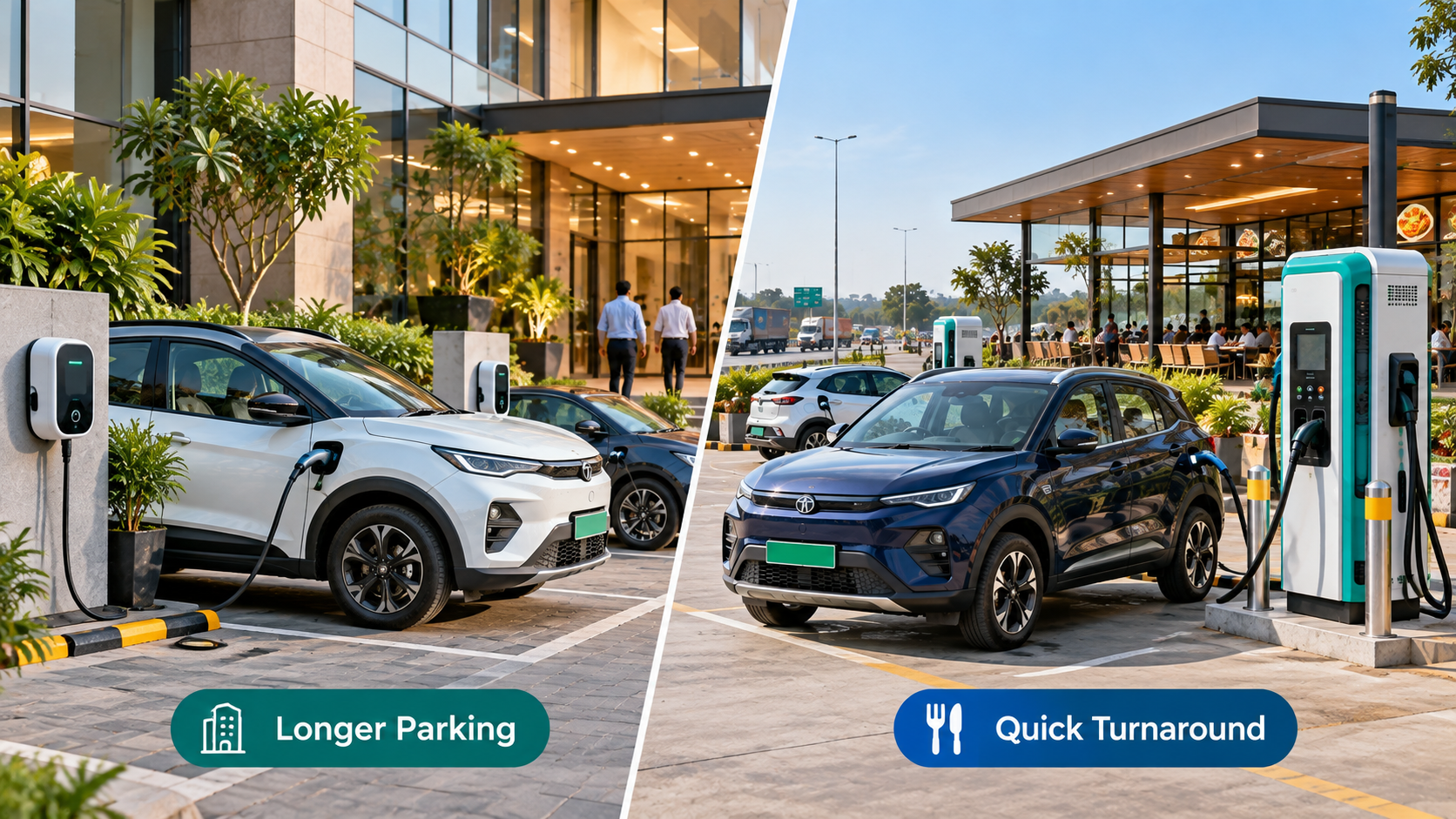
Neither charger type is automatically better.
The correct choice depends on customer behaviour.
Choose AC charging when:
Vehicles remain parked for a long time.
This is commonly suitable for:
- Offices
- Hotels
- Clinics
- Employee parking
- Apartment or mixed-use parking
- Businesses using charging primarily as a customer amenity
AC charging typically requires less charging power than fast DC infrastructure, although the site’s available electrical load must still be checked.
Consider DC fast charging when:
Vehicle turnaround matters.
Typical locations include:
- Highway restaurants
- Fuel stations
- Cab hubs
- Busy commercial properties
- Public charging locations
- Intercity travel corridors
The faster charger should solve an actual customer need rather than simply make the station look more powerful.
How Much Does an EarthtronEV EV Charging Franchise Cost in 2026?
This is an important area where small-business owners should distinguish between installing EV charging equipment at their existing property and investing in an EV charging franchise.
They are not necessarily the same commercial model.
For its current franchise programme, EarthtronEV publishes the following starting points:
| Franchise Setup | Current Published Investment |
|---|---|
| Minimum franchise investment | ₹18 lakh onwards |
| 60 kW DC setup | ₹18 lakh |
| 120 kW setup | ₹30 lakh |
| Minimum space | Approx. 150 sq. ft. |
EarthtronEV notes that final costs can vary depending on charger capacity, site conditions, existing electrical infrastructure, power availability, transformer requirements, cabling, and other connection work.
For a detailed cost breakdown, read EV Charging Franchise Cost in India 2026.
If you already own a restaurant, hotel, office, retail outlet, or another commercial property and only want EV charging added to that property, you should request a site-specific commercial charging proposal rather than assuming the standard franchise package automatically applies.
Franchise Setup vs EV Charging at Your Existing Business
This distinction is particularly important for small businesses.
Existing Business + EV Charger
You already operate a hotel, office, restaurant, retail store, clinic, or commercial property.
Your primary objective may be to:
- Offer charging to customers
- Improve the customer experience
- Attract EV drivers
- Add charging to employee parking
- Generate additional charging revenue
- Make better use of existing parking
In this case, a customised commercial charging deployment may be more relevant.
EV Charging Franchise
Your objective is specifically to invest in and participate in an EV charging station business.
EarthtronEV’s current franchise materials state that its operator-supported model includes assistance with equipment installation, licensing and approvals, marketing, station operations, automated billing, and settlements. The exact commercial responsibilities and settlement structure should be verified in the final franchise agreement.
This can reduce the operational burden for an investor who does not want to independently build and manage the entire charging operation.
Read more about EarthtronEV’s EV charging franchise model.
Don’t Choose a Charger Based on kW Alone
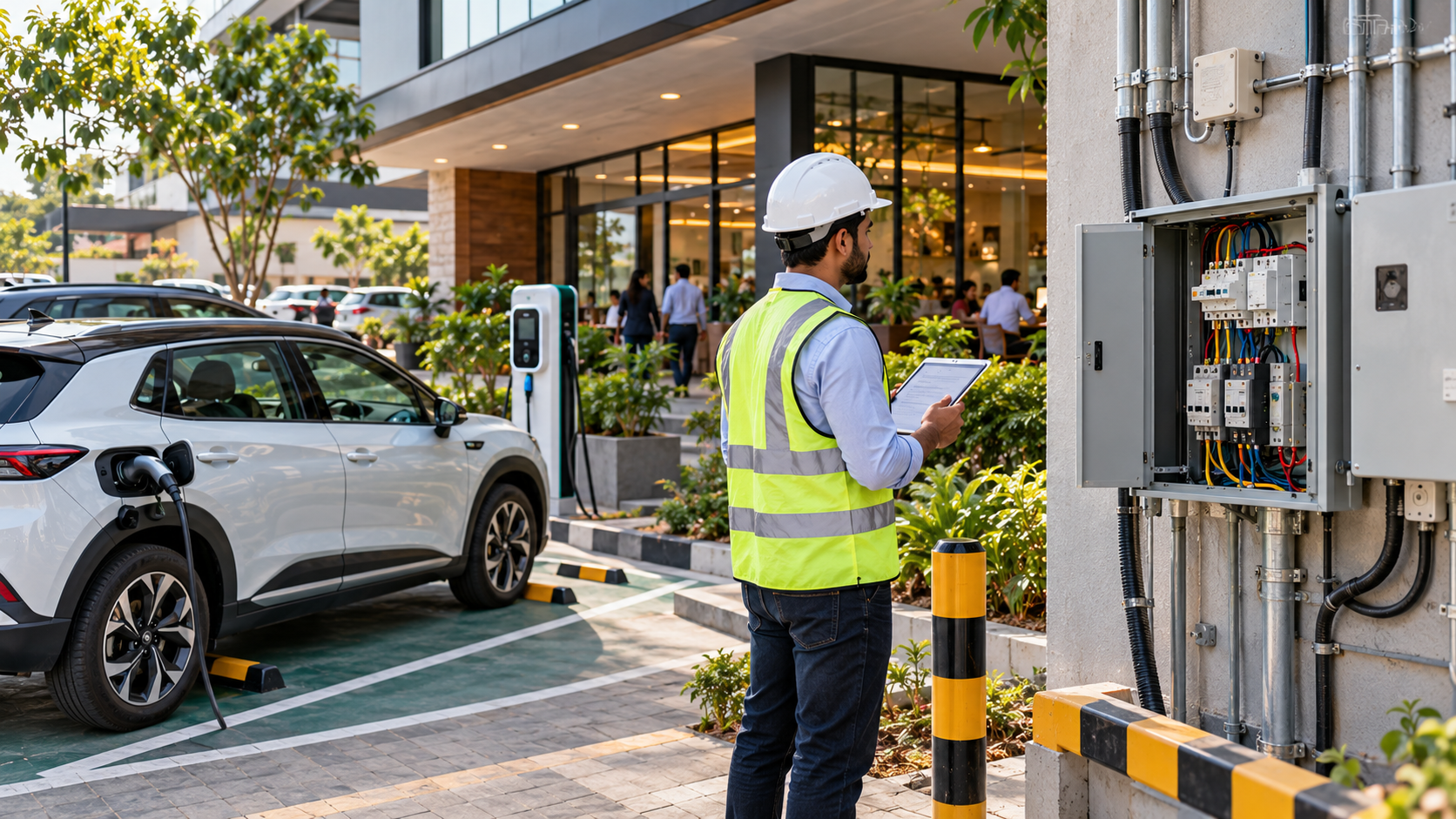
One of the most common mistakes when planning an EV charging station is assuming that a higher-capacity charger automatically creates a better business.
It does not.
A charging station only creates meaningful usage when EV drivers actually need and use it.
A small business should evaluate at least five factors before choosing the charger.
1. Vehicle Dwell Time
How long do customers already stay?
Long dwell time generally makes AC charging more practical. Short dwell time can make DC charging more relevant.
2. Expected EV Traffic
A fast charger at a site with almost no EV traffic may remain underutilised.
Study both current and expected traffic around the location.
3. Available Electrical Load
The site’s power connection can significantly affect the project.
A higher-capacity charger may require load enhancement, new cabling, transformer infrastructure, or other electrical work.
4. Parking and Accessibility
Drivers should be able to locate, enter, use, and exit the charging bay conveniently.
A technically good charger at a difficult-to-access location can still perform poorly.
5. Charger Utilisation
The commercial value of a station depends heavily on how often it is actually used.
EarthtronEV’s own published guidance highlights utilisation, charging sessions, energy delivered, uptime, and location quality as important factors affecting charging-station economics.
What About Government Subsidy Under PM E-DRIVE?
The Government of India’s PM E-DRIVE scheme includes ₹2,000 crore for public EV charging infrastructure as part of the scheme’s broader ₹10,900 crore outlay.
However, a small private business should not assume that it can directly claim a PM E-DRIVE subsidy simply by installing a charger.
The Ministry of Heavy Industries has stated that entities eligible to submit proposals and receive subsidy funding for EV public charging stations under the scheme include Government of India ministries, CPSEs/autonomous bodies, States and Union Territories, and their PSUs, which appoint nodal agencies for implementation.
Therefore, subsidy availability for a particular project depends on the applicable programme, implementing agency, location, approvals, and project structure.
Businesses should confirm eligibility through the relevant government or nodal authority instead of including subsidy in their investment calculation automatically.
What Technology Should a Business Look For?
Charging power is only one part of the setup.
For a commercially operated charger, businesses should also consider interoperability, remote monitoring, billing, charger status, payment systems, and maintenance.
EarthtronEV’s current charging platform supports OCPP 1.6 and OCPP 2.0.1, while its network also supports OCPI 2.2 for interoperability and roaming. Its DC charger range uses CCS2 and is described by EarthtronEV as BIS-certified and ARAI-aligned.
These capabilities allow charging equipment to communicate with charging-management systems for functions such as:
- Remote monitoring
- Session tracking
- Charger status
- User authentication
- Billing
- Fault monitoring
- Smart charging
- Usage analytics
For a small-business owner, this means the software and operating system behind the charger can be almost as important as its headline kW rating.
So, What Is the Best Setup for Most Small Businesses?
There is no single charger that is best for every small business.
A useful starting framework is:
Office, clinic or business with long parking time → evaluate 7.4–22 kW AC
Hotel or guesthouse → evaluate AC charging first; add DC if there is significant traveller demand
Restaurant or retail property with moderate dwell time → evaluate AC vs 60 kW DC based on EV traffic
Highway restaurant, fuel station or busy transit location → evaluate 60 kW DC or higher
Taxi, fleet or high-turnover commercial hub → evaluate DC fast charging based on vehicle volume
For businesses considering a dedicated EarthtronEV franchise investment rather than simply installing charging at an existing property, the current published starting point is ₹18 lakh onwards, including a 60 kW configuration listed at ₹18 lakh.
The final decision should follow a location-specific feasibility assessment covering traffic, parking, electrical infrastructure, charger utilisation, and expected customer behaviour.
FAQs
What is the minimum investment for an EarthtronEV EV charging franchise?
EarthtronEV’s current published franchise investment starts from ₹18 lakh onwards. Its current franchise information lists a 60 kW DC charging setup at ₹18 lakh and a 120 kW setup at ₹30 lakh. Final cost can vary according to location and electrical infrastructure.
Which EV charger is best for a small retail shop?
If customers remain parked for one or more hours, a 7.4–22 kW AC charger may be sufficient. If the location has significant public EV traffic and customers expect faster charging, a DC charging setup may be worth evaluating.
Which EV charger is best for a restaurant?
It depends on dwell time and traffic. Restaurants where customers stay longer may benefit from AC charging, while highway restaurants and high-traffic locations may be better suited to a 60 kW DC fast charger.
Is a 60 kW charger suitable for a small commercial property?
It can be. EarthtronEV currently positions its 60 kW DC charger for locations such as retail outlets, fuel stations, and highway rest stops. The site’s EV demand, electrical capacity, parking, and expected utilisation should be assessed before installation.
Do hotels need DC fast chargers?
Not always. Overnight guests provide enough parking time for AC charging to be useful. Hotels near highways or serving significant numbers of transit EV drivers may also benefit from DC fast charging.
Do I need electrical or EV charging expertise to start a franchise?
Under EarthtronEV’s current operator-supported model, the company lists support for areas including installation, approvals, operations, billing, and settlements. The exact responsibilities should be confirmed in the final franchise agreement.
Can a small business get a PM E-DRIVE subsidy for installing an EV charger?
Businesses should not assume direct eligibility. PM E-DRIVE has ₹2,000 crore allocated for public EV charging infrastructure, but the Ministry of Heavy Industries identifies government ministries, eligible public-sector/autonomous bodies, States/UTs and their PSUs as entities that submit proposals and receive funding under the scheme. Project-specific eligibility should be confirmed with the relevant implementing authority.
Is a bigger EV charger always better for business?
No. Charger utilisation, EV traffic, vehicle dwell time, electricity infrastructure, station uptime, and location quality are more important than charger capacity alone. Installing more power than the location can realistically use can increase infrastructure requirements without automatically increasing charging demand.
Conclusion
For a small business in India, the best EV charging setup is the one that matches how customers already use the location.
Businesses with long parking periods — such as offices, hotels, clinics, and workplaces — can start by evaluating AC charging.
Businesses serving travellers, taxis, highway users, or customers who need a quick turnaround should evaluate DC fast charging, with 60 kW providing a practical commercial starting point for many use cases.
Most importantly, businesses should avoid selecting an EV charger based only on price or maximum charging power.
Location + dwell time + EV traffic + electrical capacity + utilisation should determine the final setup.
For businesses considering an EarthtronEV franchise, the company’s current published programme starts from ₹18 lakh onwards. For businesses that already have their own commercial property and simply want to add charging, a customised site assessment can help identify the appropriate charging capacity and commercial model.