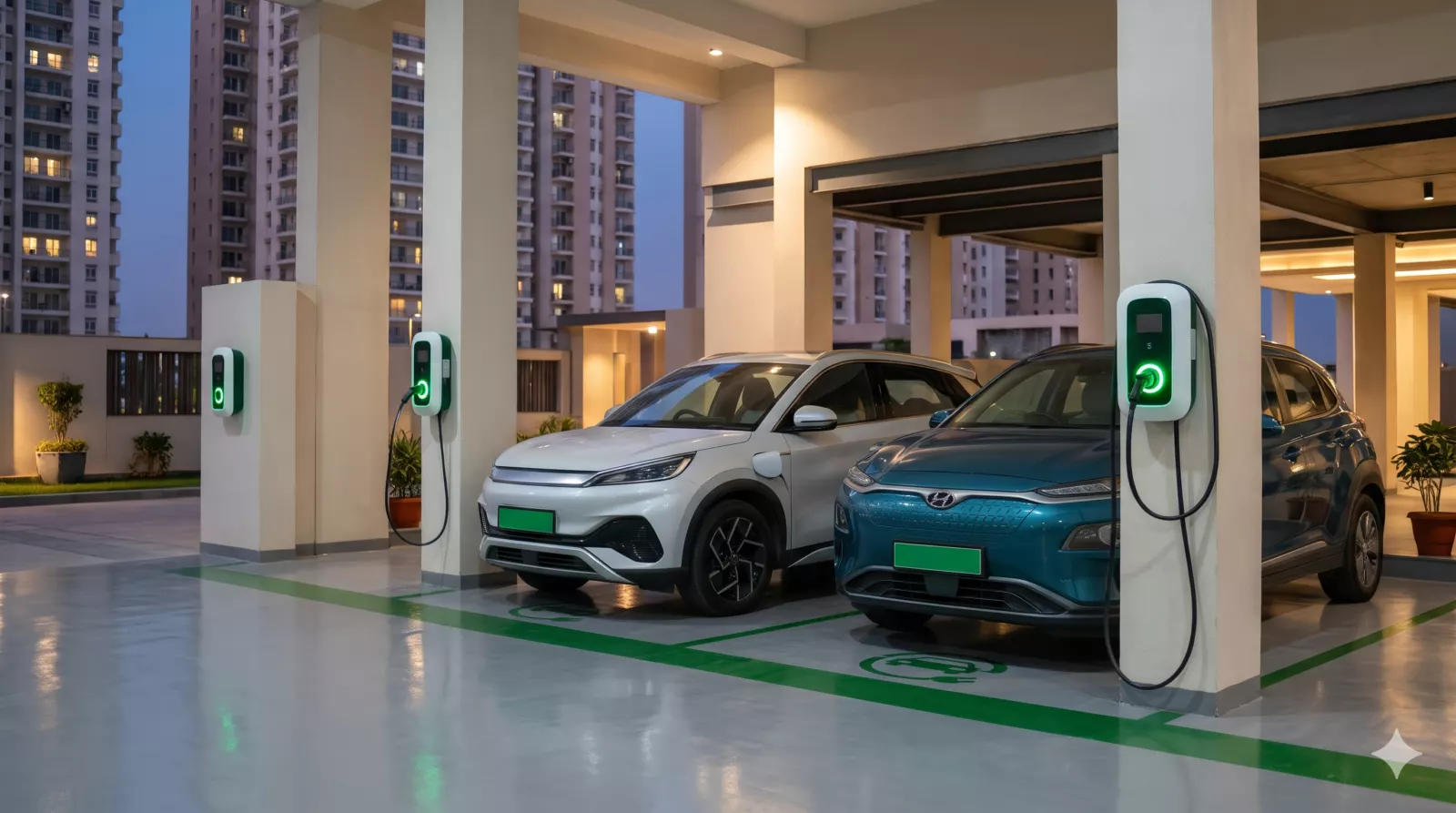
Quick Answer: Under the Ministry of Power (MoP) Consolidated EV Charging Guidelines and state building bye-laws heading into 2027, apartment owners and tenants in India have the right to install a private EV charger in their allotted parking bay—either wired directly from their existing flat electricity meter (usually up to 3.3 kW–7.4 kW within sanctioned load limits) or via a separate DISCOM domestic EV sub-meter after obtaining a standard No Objection Certificate (NOC) from the Resident Welfare Association (RWA). A Resident Welfare Association cannot arbitrarily ban EV charging if the installation follows Central Electricity Authority (CEA) safety norms, uses armoured FRLS copper cabling, and includes an RCCB + MCB protection box. For a typical 30–60 metre basement cable run, full resident-funded installation costs ₹12,000 to ₹22,000 for a 3.3 kW setup and ₹25,000 to ₹45,000 for a 7.4 kW smart wallbox, while societies can also deploy shared OCPP-enabled community chargers with RFID/app per-flat billing.
Why Apartment & RWA EV Charging Is the #1 Hurdle for Urban EV Buyers in 2027
More than 65% of electric car buyers in Delhi-NCR (Gurugram, Noida, Greater Noida, Ghaziabad, Faridabad, and Delhi), Mumbai, Pune, Bengaluru, Hyderabad, and Chennai live in high-rise apartments or gated group housing societies. While independent house owners can mount a wallbox right next to their meter box, apartment residents face three recurring questions from their Resident Welfare Association (RWA) or Apartment Owners Association (AOA):
- Electrical Transformer & Single Point Delivery (SPD) Limits: Will dozens of private 7.4 kW chargers overload the society’s main distribution transformer or common backup diesel generator (DG) set?
- Basement Fire Safety & Cable Routing: How should cables run 30 to 90 metres from the ground-floor meter room to a B1 or B2 basement pillar without violating fire-safety clearances?
- Billing Transparency: How does the society ensure that electricity consumed by an individual EV owner’s charger is never billed to the common area maintenance (CAM) meter?
Designing turnkey EV charging stations for home and apartments solves all three concerns simultaneously by pairing CEA-compliant armoured wiring, automatic DG-supply cut-off relays, and OCPP-backed per-flat metering.
Government Rules & Ministry of Power (MoP) Guidelines for Apartment EV Charging (2027)
Both individual flat owners and RWA managing committees should understand the national and state regulatory framework governing residential EV charging in India:
- Ministry of Power (MoP) Right-to-Charge Framework: The Ministry of Power’s revised consolidated guidelines on EV charging infrastructure explicitly direct state DISCOMs and housing societies to facilitate private charging in residential complexes. Residents may charge EVs in their designated parking slot using their existing domestic meter connection or apply for a separate domestic EV meter connection.
- Model Building Bye-Laws (MBBL) & RERA Norms: Under the Ministry of Housing and Urban Affairs (MoHUA) amendments to the Model Building Bye-Laws, new group housing projects are mandated to allocate at least 20% of total parking capacity as EV-ready bays with dedicated power distribution conduits.
- Single-Part Green EV Tariffs for Residents & RWAs: Most major state electricity regulators—covered in our state-wise EV charging electricity tariffs guide—allow either individual residents or the RWA collectively to obtain a dedicated EV charging meter with zero or low fixed demand charges and subsidised per-unit energy rates (such as ₹4.50–₹5.50/kWh in Delhi and competitive domestic EV slabs across Maharashtra, Karnataka, UP, and Haryana).
- Mandatory Automatic DG Cut-Off (Changeover Contactor): To protect society diesel generators during power cuts, RWA technical guidelines require every apartment EV charger to be wired exclusively on the Main Grid (Raw Power) busbar or fitted with an automatic DG-sensing contactor so EV chargers pause automatically whenever the building switches to backup generator power.
3 Approved Metering & Wiring Models for Apartment Societies in India
Depending on whether your high-rise society uses individual DISCOM meters (multi-point connection) or a single bulk HT connection (Single Point Delivery / SPD), there are three proven ways to set up apartment EV charging:
| Parameter | Model 1: Direct Wiring from Flat’s Existing Meter | Model 2: Separate Individual DISCOM EV Meter | Model 3: RWA Shared Community Chargers (CPO / Society Owned) |
|---|---|---|---|
| How It Works | An armoured copper cable runs from the resident’s existing flat meter in the tower meter room to their allotted parking pillar. | The resident applies to the local DISCOM (with RWA NOC) for a second dedicated EV meter installed in the society meter room. | The RWA installs 7.4 kW–22 kW AC or 30–60 kW DC chargers in common visitor/shared bays managed via OCPP software. |
| Best Charger Power Rating | 3.3 kW (or 7.4 kW if flat sanctioned load is 7–10 kW) | 7.4 kW (1-Phase) or 11 kW (3-Phase) | 7.4 kW – 22 kW AC + 30 kW – 60 kW DC |
| Electricity Tariff Billed | Resident’s existing domestic slab rate (₹5.50 – ₹8.50/kWh) | Dedicated state Domestic EV Tariff (₹4.50 – ₹7.50/kWh) | RWA/CPO per-kWh tariff via mobile app or RFID wallet (₹10 – ₹16/kWh) |
| Effect on Flat’s Sanctioned Load | Counts toward flat’s existing load; requires load upgrade or DLM if running 7.4 kW | Completely separate meter; zero impact on flat’s domestic load | Drawn from society’s common EV feeder or dedicated DISCOM EV connection |
| Ideal For | Owners with fixed parking slots and daily drives under 80 km | High-mileage EV owners (45–79 kWh SUVs) in multi-point metered societies | Single-Point Delivery (SPD) societies, tenants, and towers with limited transformer headroom |
Step-by-Step Process to Get RWA NOC for Your Apartment EV Charger
Most RWAs reject EV charger requests only when residents propose informal, uncertified wiring through stairwell shafts. When you submit a structured technical proposal following the DISCOM electricity connection and sanctioned load approval process, RWA approval is smooth and predictable:
- Step 1: Verify Your Flat’s Sanctioned Load & Meter Type: Check your latest electricity bill or society prepaid meter app. As explained in our guide on how much power is required for EV charging in India, a 3.3 kW charger draws ~15A and usually works within an existing 4–6 kW flat load when used after 11:00 PM, whereas a 7.4 kW wallbox draws 32A and requires either a 7–10 kW load sanction or a smart load balancer.
- Step 2: Joint Technical Survey with Society Facility Electrician: Walk the cable route from your tower’s meter panel room to your basement/stilt parking bay with the society’s maintenance engineer. Measure the exact cable length along existing overhead GI cable trays (avoiding fire exits, lift shafts, and water pipelines).
- Step 3: Submit the Formal RWA NOC Application Pack: Submit a written request to the RWA Secretary / Estate Manager enclosing:
- Copy of vehicle booking receipt or RC and parking slot allotment letter.
- Charger datasheet showing BIS/CE certification, IP65 weatherproofing, and RFID access lock (from EarthtronEV’s AC smart EV chargers from 3.3 kW to 22 kW range).
- Written undertaking that all cabling will use IS-1554 / IS-7098 XLPE armoured FRLS copper cable, a dedicated MCB + Type-B RCCB box, and an automatic DG cut-off relay so the charger never runs on society backup generator power.
- Step 4: Armoured Cable Laying & Earthing Verification: Have a licensed electrical contractor lay the armoured cable along approved overhead trays with colour-coded identification tags every 10 metres stating the flat number, and verify that earth resistance at the meter panel is below 2 ohms.
- Step 5: Final Safety Inspection & Commissioning Test Report: Demonstrate the RCCB trip test, RFID lock (so unauthorized vehicles cannot draw power), and DG cut-off operation to the society estate manager, and file the signed Wiring Completion Certificate.
Mandatory Basement Fire Safety & CEA Wiring Checklist for Housing Societies
To satisfy both Chief Electrical Inspector to Government (CEIG) / Central Electricity Authority (CEA) safety norms and municipal fire audit requirements in basement parking levels, every apartment EV charger installation must include six non-negotiable engineering safeguards:
- XLPE Insulated, FRLS Armoured Copper Cable Only: Never use flexible household PVC wire in a shared basement. Use 3-Core × 4.0/6.0 sq mm (for 3.3 kW) or 3-Core × 6.0/10.0 sq mm (for 7.4 kW) or 5-Core × 6.0 sq mm (for 11 kW) XLPE-insulated, Flame Retardant Low Smoke (FRLS) steel-strip/wire armoured copper cable.
- Double-End Protection (At Meter Room + At Parking Pillar): Install a primary isolating MCB at the meter-room outgoing point so facility staff can isolate the line in an emergency, plus an IP65 lockable distribution box at the parking pillar containing a Curve-C MCB, 30mA Type-A/Type-B RCCB (Residual Current Circuit Breaker), and Type-2 Surge Protection Device (SPD).
- Automatic DG Power Interlock Relay: Wire a 230V/415V contactor interlocked with the society’s DG changeover signal so the EV charger circuit opens automatically during grid outages.
- RFID / App Authentication Lock: Open stilt and basement bays are accessible to everyone. Using an RFID-locked or mobile-app-locked smart wallbox ensures the socket remains completely de-energised (0V on pins) until the flat owner taps their authorised RFID card and completes the Type-2 control-pilot handshake.
- Dedicated Portable Fire Extinguisher & Wheel Stopper: Mount a 4.5 kg CO2 or ABC dry-chemical fire extinguisher on the pillar and install rubber wheel stoppers so reversing cars cannot strike the wallbox enclosure.
- Dynamic Load Management for Multi-EV Towers: When more than 10–15% of flats in a tower install 7.4 kW chargers, deploying dynamic load management for EV charging stations in India allows the society to cap total simultaneous EV draw below the building transformer’s spare nighttime capacity without paying crores for a new substation.
Cost of Installing an EV Charger in an Apartment Parking Bay in India (2027)
Unlike an independent house where the meter is 5–10 metres away, an apartment installation typically requires a 35-metre to 70-metre armoured cable run from the ground-floor meter room down to the basement or stilt bay. Here is the realistic 2027 itemised cost for a typical 45-metre apartment cable run:
| Cost Item (45-Metre Apartment Basement Run) | 3.3 kW AC Charger Setup | 7.2 kW / 7.4 kW Smart Wallbox | 11 kW 3-Phase Smart Wallbox |
|---|---|---|---|
| 1. XLPE FRLS Armoured Copper Cable (45m) | 3C × 4.0 sq mm (~₹165/m) ₹7,400 |
3C × 6.0 / 10.0 sq mm (~₹260–₹360/m) ₹11,700 – ₹16,200 |
5C × 6.0 sq mm (~₹370/m) ₹16,650 |
| 2. Dual DB Enclosures, MCB, RCCB, SPD & DG Cut-Off Contactor | ₹3,200 – ₹4,800 | ₹5,800 – ₹8,500 | ₹7,500 – ₹11,000 |
| 3. GI Saddles, Brass Cable Glands, Lugs, Tags & Certified Labour | ₹2,800 – ₹4,200 | ₹3,500 – ₹5,500 | ₹4,200 – ₹6,500 |
| 4. Sanctioned Load Enhancement / Sub-Meter Deposit (If Required) | ₹0 – ₹3,000 (Often zero on 4–6 kW flat meters) |
₹4,500 – ₹12,000 (Or ₹0 if society uses DLM / spare load) |
₹7,000 – ₹16,000 |
| Total Installation Cost (When Charger Unit Is Bundled with EV) | ₹13,400 – ₹19,400 | ₹25,500 – ₹42,200 | ₹35,350 – ₹50,150 |
| Total Cost Including Standalone Smart Wallbox Hardware | ₹21,000 – ₹32,000 | ₹49,500 – ₹76,000 | ₹65,000 – ₹92,000 |
Frequently Asked Questions (FAQs)
1. Can an RWA legally deny permission to install an EV charger in my allotted apartment parking slot?
Under the Ministry of Power (MoP) Consolidated EV Charging Guidelines and state EV policies (including Delhi, Maharashtra, Karnataka, Uttar Pradesh, and Haryana), an RWA cannot arbitrarily refuse a resident’s request to install an EV charger in their own allotted parking bay if the resident agrees to follow Central Electricity Authority (CEA) safety norms, use FRLS armoured cabling, install an RCCB/MCB protection box, and bear the full cost of wiring from their flat meter or dedicated EV sub-meter.
2. What if my apartment society has a Single Point Delivery (SPD) bulk electricity connection?
In Single Point Delivery (SPD) societies (common in Noida, Greater Noida, Gurugram, and parts of Mumbai/Bengaluru), the RWA or facility management company operates internal sub-meters for each flat. You can either request the RWA to connect a 3.3 kW or 7.4 kW charger to your flat’s prepaid sub-meter (with an automatic DG cut-off contactor so it only operates on grid power) or have the RWA apply to the DISCOM for a dedicated bulk EV charging feeder serving shared OCPP-billed society chargers.
3. Will my apartment EV charger run when there is a power cut and the society is on Diesel Generator (DG) backup?
No, and it should never be wired to run on DG power. Standard society installations wire the EV charger exclusively to the grid-side busbar or include an automatic DG-interlock contactor that pauses EV charging the instant the building switches to backup generator power, preventing DG overload and costly diesel consumption.
4. Is a 3.3 kW charger enough for apartment parking, or should I push for a 7.4 kW wallbox?
For 80% of apartment dwellers who drive under 60 km daily and park overnight for 9 to 10 hours, a 3.3 kW smart AC charger (which adds 18–22 km of range per hour, or 180–200 km in 10 hours) is more than enough and wins instant RWA approval because it requires zero transformer or sanctioned load upgrades. Upgrade to a 7.4 kW wallbox only if you drive 80–150 km daily or own a 50–79 kWh electric SUV.
5. How do I stop other residents from stealing electricity from my basement EV charger?
Never install a bare 16A 3-pin plug socket without an access lock in a shared basement. Always install a smart AC charger with RFID card tap and mobile app authentication (or a key-locked IP65 metal enclosure around an industrial socket) so zero current flows unless you authorise the session.
6. Who pays for the armoured cable from the meter room to the basement parking slot?
For an individual private charger in an allotted bay, the flat owner pays 100% of the armoured copper cable, conduit/tray clamping, MCB/RCCB protection box, and licensed installation labour. If you are a tenant, using a detachable smart wallbox lets you unbolt the charger unit when moving out while leaving the safe