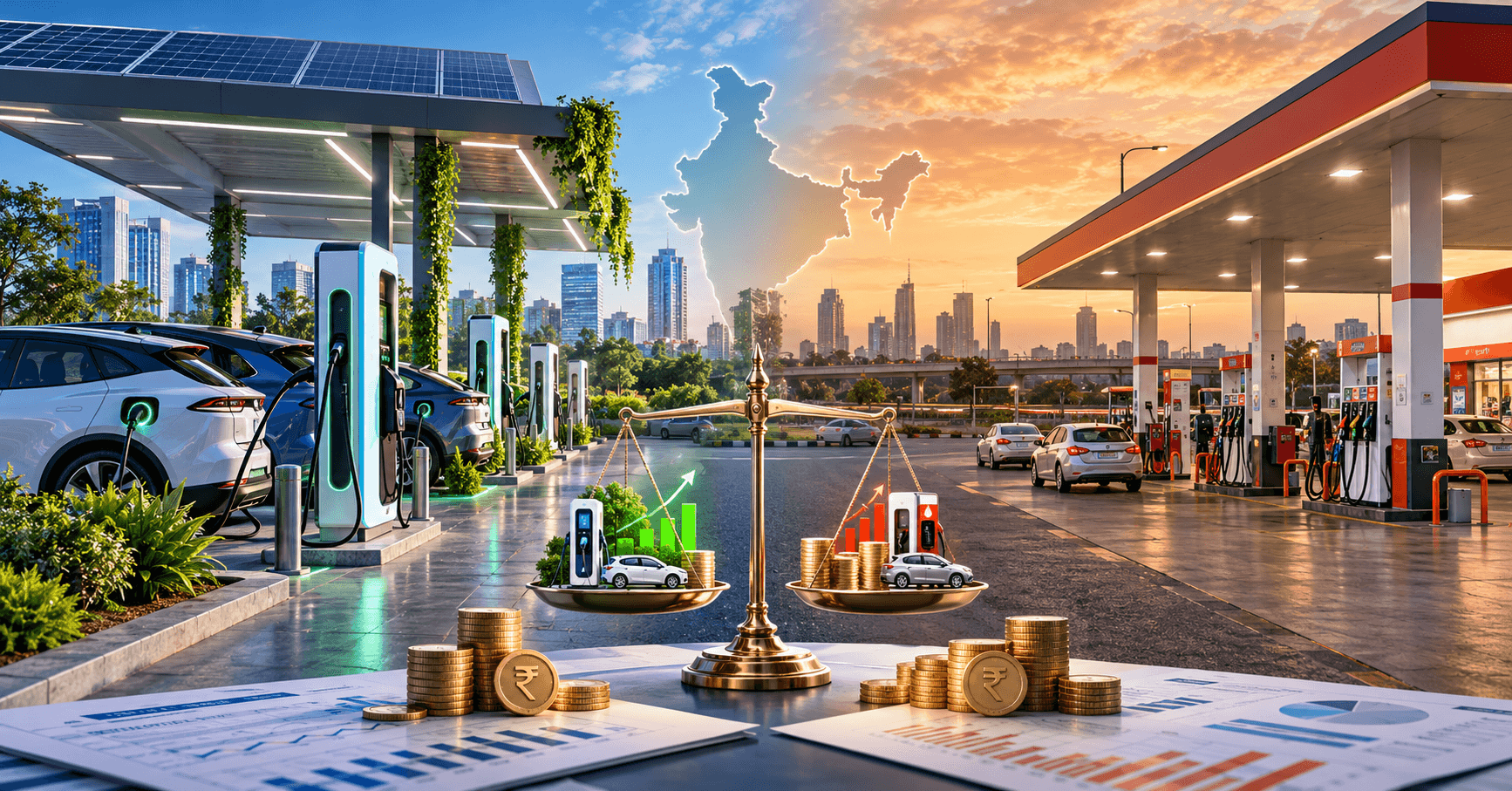
A petrol pump dealership is a high-capital, regulated, commission-based business that is won through an oil company’s selection process and typically needs ₹50 lakh to ₹3 crore plus suitable land. An EV charging franchise is a lower-ticket, technology-led business: EarthtronEV’s starts at about ₹10–14 lakh for a 40 kW charger, needs as little as 100–150 sq ft per charger, and is operated for you under the FOCO model. Petrol demand is still growing, so this is not a case of one replacing the other. The right choice depends on your capital, land, appetite for risk and how involved you want to be.
Two very different businesses
On the surface, both businesses sell energy to vehicles. In practice they work almost nothing alike. A petrol pump dealer is appointed by an oil marketing company (OMC) such as IndianOil, BPCL or HPCL, retails fuel under that company’s brand and earns a fixed commission set by the OMCs. An EV charging franchise partner invests in a charging station that runs on an established network’s software, brand and operations, and earns from the energy sold at that station.
The EV vs petrol question is also being asked at a particular moment. Petrol consumption rose 7.88% year on year in August 2026, according to provisional PPAC data, and electric vehicles hit a record 3,33,571 registrations in September 2026. Both demand curves are rising at the same time.
EV charging franchise vs petrol pump dealership: side-by-side
EV charging franchise (EarthtronEV FOCO) Petrol pump dealership (OMC) Typical investment ₹10–14 lakh (40 kW) up to ₹1 crore+ (480 kW), full setup cost ₹50 lakh to ₹3 crore+, depending on site type, brand and urban or highway location Land needed About 100–150 sq ft for a 40 kW charger; 800–1,200+ sq ft for a 480 kW depot Typically 800–1,200 sq m in urban areas and 1,800–2,000 sq m on highways, per industry guides, and exact size is set by each advertisement Do you need your own land? No. EarthtronEV can assess your site or help find one on lease, where applicable Land must be owned or on long-term lease (minimum 19 years 11 months, or as advertised), or backed by a firm offer, depending on the category How you get in Inquiry, site and revenue assessment, agreement, installation, go-live Apply to an advertised location; selection by draw of lots or bidding, then land evaluation, construction and licensing Who operates it EarthtronEV (company-operated) You, as the dealer, expected to manage the outlet full time How you earn Revenue from energy sold, under revenue-sharing terms agreed for the site A fixed commission per litre set by the OMCs, roughly ₹3.7–4 on petrol and ₹2.5–2.9 on diesel Who sets your margin Utilisation, tariff, operating costs and agreed terms The oil companies Demand trend EV registrations at records; fast-charging supply still thin Petrol demand growing, but with a long-term transition risk Payouts Monthly settlement with a statement of sessions and energy Commission earned on each sale, with working capital tied up in stock and operations EV figures are from EarthtronEV’s franchise page (costs updated September 2026). Petrol pump figures come from OMC selection guidelines and industry summaries of them, and vary by company, location and site type. Always confirm against the current OMC brochure.
Investment and land: where the two models differ most
What a petrol pump dealership costs
Industry guides put total petrol pump project cost at roughly ₹50 lakh to ₹3 crore, with highway and urban sites at the top of that range. Shell’s dealership page, for example, lists an indicative investment of about ₹75 lakh to ₹3 crore excluding land, and a Jio-bp guide puts the build at roughly ₹1.2 crore to ₹3.2 crore, also excluding land. On top of that, dealer-owned sites in the OMC selection scheme carry a fixed fee, reported at ₹15 lakh for regular outlets and ₹5 lakh for rural ones, along with application fees and working capital for fuel stock.
What an EV charging franchise costs
Charger Typical use Space Full setup cost 40 kW Small commercial sites, 2W/3W hubs, offices ~100–150 sq ft ₹10L – ₹14L 60 kW Commercial hubs, cab-aggregator stations ~150–200 sq ft ₹14L – ₹20L 150 kW Highway corridors, fleet fast-charging ~250–350 sq ft ₹28L – ₹45L 240 kW High-traffic, multi-gun highway hub ~400–600 sq ft ₹55L – ₹75L 480 kW Large multi-vehicle ultra-fast depot ~800–1,200+ sq ft ₹95L – ₹1Cr+ Full setup cost includes civil work, electrical connection or transformer upgrade, land (leased or annualised), CMS software and permits. Indicative figures, as published by EarthtronEV in September 2026.
The takeaway is flexibility. An EV charging franchise lets you start small and scale, while a petrol pump is a single large commitment tied to one specific plot.
How each business earns money
Petrol pump: a fixed commission on volume
Dealers do not set fuel prices. They earn a commission set by the oil companies, which was revised in October 2024 for the first time in nearly eight years. A PPAC-based summary puts the current petrol commission at ₹3,144.03 per kilolitre plus 0.870% of the billable price, which works out to roughly ₹3.7–4 per litre, and diesel at about ₹2.5–2.9 per litre.
Illustrative arithmetic: a pump selling 100 kilolitres (1 lakh litres) of petrol a month at about ₹3.7 per litre earns roughly ₹3.7 lakh in gross monthly commission. That is before staff wages, electricity, stock losses, financing and the cost of the land and construction, so it is not profit. Because the commission is fixed, a dealer’s income rises mainly with volume, which depends on location.
EV charging: revenue from energy sold
A charging station earns on every unit of energy it dispenses. EarthtronEV states that partner returns depend on station utilisation, tariff, operating costs, revenue-sharing terms and site performance, and provides a site-specific commercial projection before you commit. There is no fixed commission to rely on, which means more upside from a well-placed site and more variability from a poorly placed one. Returns are not guaranteed.
You can model a specific site with the EarthtronEV Revenue Calculator, or read the franchise cost vs revenue and break-even guide.
How you get started
EV charging franchise Petrol pump dealership 1. Share your investment level and location 1. Watch for an advertisement for your area on the oil companies’ joint dealer-selection portal 2. Site and revenue assessment of traffic, EV demand and viability 2. Check eligibility, including age, education and the land specified in the advertisement 3. Technical survey and charger selection 3. Apply online with the application fee 4. Agreement and charger procurement 4. Selection by draw of lots or bidding 5. Electrical connection and installation, coordinated end to end 5. Land evaluation and field verification by the OMC, then construction to OMC standards 6. CMS integration and commissioning 6. Final inspection, licences and start of fuel supply 7. Go-live and monthly settlements 7. Ongoing operations by you, as the full-time dealer
Two practical points stand out. First, petrol pump selection is competitive and location-specific: you cannot simply apply when you are ready. A secondary summary dated September 2026 noted that the live advertisement set on the official portal was still from the 2023 cycle, with no fresh nationwide round open at that time. Second, you should only ever pay fees through the official portal, and treat any promise of a guaranteed dealership as a red flag. EV charging franchises, by contrast, are open for inquiry any time, though you should compare offers carefully.
Demand outlook: both are growing, at different speeds
- Petrol is still growing. Petrol consumption rose 7.88% year on year to 3.82 million tonnes in August 2026 and 6.48% in the first five months of FY27, according to provisional PPAC data.
- EVs are growing faster, from a smaller base. India registered 3,33,571 EVs in September 2026. Electric two-wheelers reached 11.6% of two-wheeler sales and electric cars about 8.5% of car and cab sales.
- Fuel stations are already adding chargers. PPAC’s tracker shows EV charging at 29,503 retail outlets as of 1 July 2026, which tells you that forecourts see charging as part of their future.
- Public charging is still thin. India has roughly one public charger for every 175–190 EVs, against an international benchmark of about 1 per 6–20, and fast chargers are the biggest gap.
For a new entrant, that mix matters. Petrol demand is a mature, regulated market with a limited number of new outlets. EV charging is a younger market where supply still trails demand, but where utilisation at each site is less certain.
Risks to weigh honestly
Petrol pump dealership
- High capital and a long lead time before income starts.
- A fixed margin you cannot negotiate, while dealer associations say costs have risen faster than commission.
- Working capital tied up in stock, and exposure to sudden price or duty changes.
- Selection is by draw of lots or bidding, so there is no guarantee of winning a location.
- Long-term exposure to the shift to electric and alternative fuels.
EV charging franchise
- Returns depend on utilisation, which depends heavily on site selection.
- Revenue is not fixed, so projections should be tested against realistic assumptions.
- Electricity connection, transformer needs and tariffs affect the economics.
- Franchise terms vary widely, so the agreement matters: payment model, uptime responsibility, exit and renewal.
- A younger market, so reliability of the network and hardware matters.
Which one suits you?
An EV charging franchise may suit you if you:
- Have ₹10–50 lakh to invest and want to start with a smaller, scalable commitment.
- Own or can lease a small plot, parking area or commercial property, or want help finding a site.
- Prefer a hands-off, investor role rather than running a 24-hour outlet.
- Are comfortable with revenue that varies with utilisation.
A petrol pump dealership may suit you if you:
- Have a large, suitable plot and ₹1 crore or more of capital.
- Want a regulated, brand-backed retail business and can manage a full-time operation.
- Are willing to compete in a selection process and wait for the right advertised location.
- Value a predictable per-litre commission and can handle working capital.
It does not have to be either-or
The smartest move for many property owners and dealers is to combine the two. A forecourt already has footfall, parking and power, which is why EarthtronEV lists fuel station forecourts among the best-performing EV charging locations. If you already hold a petrol pump dealership, check your dealership agreement and OMC approval requirements before adding third-party chargers. If you own land near a highway, an EV charging hub can be a faster and cheaper way to monetise it than competing for a fuel dealership.
See the best locations for EV charging stations and franchise opportunities in Tier 2 and Tier 3 cities.
Six questions to ask before choosing
- What is my total capital, including working capital and a buffer for delays?
- Do I have suitable land, and on what tenure (ownership or lease length)?
- How involved do I want to be day to day?
- Am I comfortable with a fixed margin or variable revenue?
- What are the exit and renewal terms in the agreement?
- Can I get a site-specific projection and test it against conservative assumptions?
For EV franchises, use the checklist on questions to ask before buying an EV charging franchise.
The bottom line
A petrol pump dealership is a large, regulated, volume-driven business that rewards deep pockets, good land and patience through a competitive selection. An EV charging franchise is a smaller, faster and more flexible entry into a market where demand is outpacing supply, with returns that depend on how well the site performs. Neither is risk-free. Compare total cost, land, control and cash flow honestly, and ask for a site-specific projection before you commit.
Frequently asked questions
Is an EV charging franchise cheaper than a petrol pump dealership?
Generally, yes. EarthtronEV’s franchise starts at about ₹10–14 lakh for a 40 kW charger, while industry guides put a petrol pump project at roughly ₹50 lakh to ₹3 crore.
How much land does a petrol pump need compared with an EV charging station?
Industry guides put urban petrol pumps at about 800–1,200 sq m, while a single 40 kW EV charger needs roughly 100–150 sq ft.
How much commission does a petrol pump dealer earn?
Dealers earn a fixed commission set by the oil companies, summarised at roughly ₹3.7–4 per litre on petrol and ₹2.5–2.9 on diesel. It is gross income, not profit.
How are petrol pump dealers selected?
Oil companies advertise locations on the joint dealer-selection portal and choose dealers by draw of lots or bidding among eligible applicants.
Do I have to run an EV charging station myself?
Not with EarthtronEV’s FOCO model. You invest, and EarthtronEV handles operations, billing, maintenance and monthly settlements.
Can a petrol pump have EV chargers?
Yes. PPAC data shows EV charging available at 29,503 retail outlets as of 1 July 2026. A dealer should check the dealership agreement and OMC approval before adding chargers.
Is petrol demand falling because of EVs?
Not yet. Petrol consumption rose 7.88% year on year in August 2026, even as EV registrations hit records.
Are returns guaranteed in either business?
No. Petrol commission is fixed but profit depends on volume and costs. EV returns depend on utilisation, tariff, operating costs and revenue-sharing terms.
Ready to explore EV charging?
Write to the franchise team at franchise@earthtronev.com or visit the EarthtronEV franchise page to request a site-specific projection.
Disclaimer: General information only, not financial or legal advice. Petrol pump figures are drawn from oil company selection guidelines and industry summaries and vary by company, location and date. Confirm current terms with the oil marketing companies. EV charging returns depend on location, utilisation, tariffs, taxes and financing, and are not guaranteed.
 EV Charging Station12 min read
EV Charging Franchise vs Petrol Pump Dealership: Which Is the Better Investment in India?
08 Oct 2026superadmin