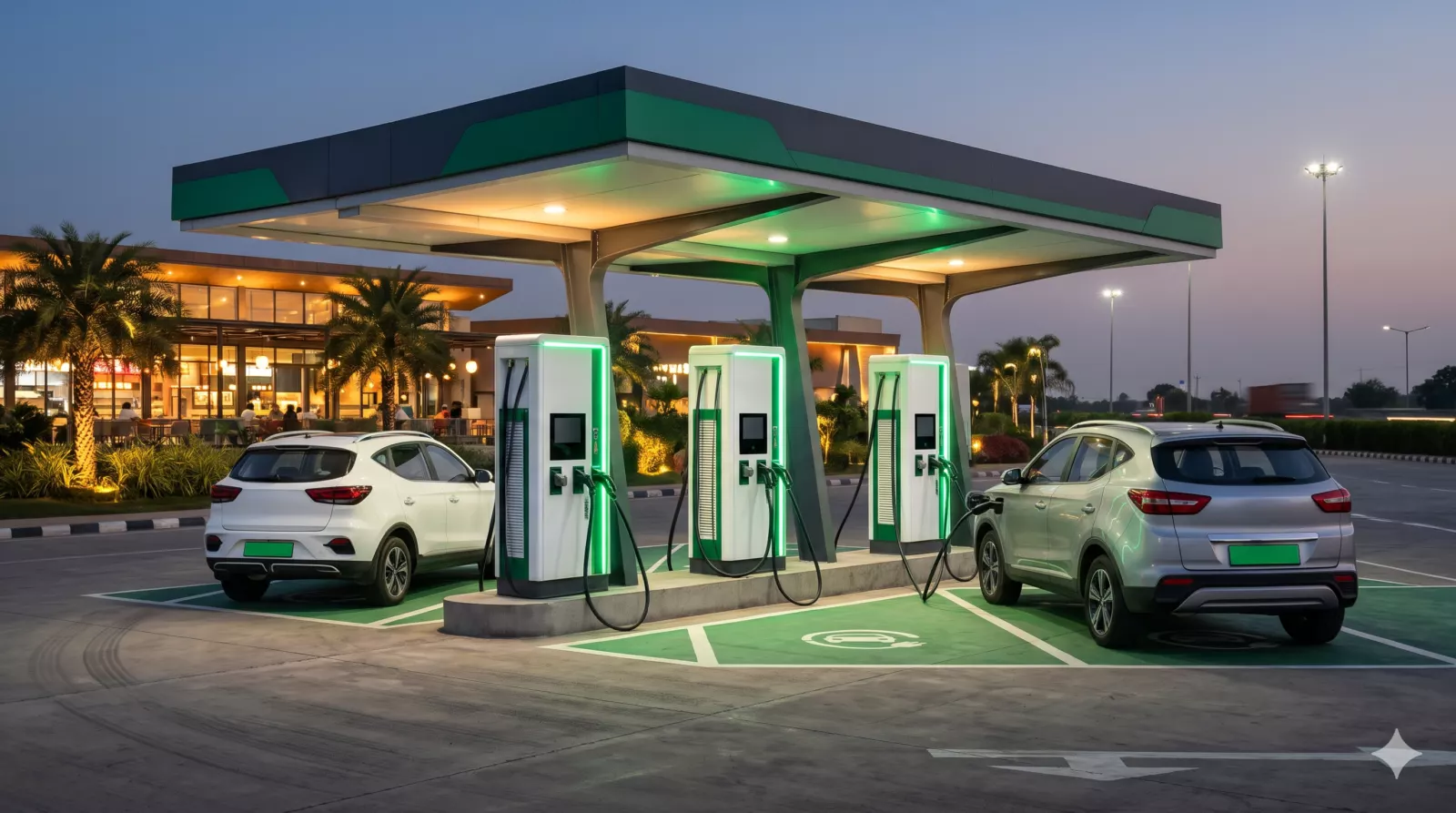
Quick Answer: Choosing between a 60 kW, 120 kW, and 240 kW DC fast charger in India for 2027 comes down to your site’s vehicle dwell time, sanctioned electricity supply, and daily session volume. A 60 kW Dual-Gun CCS2 DC Fast Charger (full turnkey setup: ₹14 lakh to ₹20 lakh; 70–75 kVA LT load) is the highest-ROI choice for urban commercial hubs, malls, offices, and city petrol pumps, charging a 45 kWh EV from 10% to 80% in 35 to 50 minutes. A 120 kW Dual-Gun DC High-Power Charger (turnkey setup: ₹28 lakh to ₹35 lakh; 140–150 kVA HT supply) is built for national highway corridors and busy ride-hailing fleets, delivering 60 kW simultaneously to two cars or 18–30 minute rapid top-ups to 800V/high-voltage EVs. A 240 kW Ultra-Fast DC Hub (turnkey setup: ₹55 lakh to ₹75 lakh; 280–300 kVA HT + dedicated transformer) is engineered for flagship expressway plazas, electric bus depots, and high-throughput multi-bay fleet hubs.
Why Picking the Right DC Charger Capacity Decides Your Station’s Profitability in 2027
When property owners, petrol pump dealers, highway hotel operators, and franchise investors evaluate EarthtronEV’s BIS-certified, ARAI-aligned DC fast chargers, the most common mistake is assuming that buying the biggest kilowatt cabinet automatically guarantees higher profits.
In reality, EV charging station profitability depends on capital efficiency and charger utilisation:
- Under-Sizing Causes Queues & Lost Drivers: Installing a single 30 kW or 40 kW unit on a busy national highway forces 60–79 kWh electric SUVs (such as the Mahindra BE 6, Mahindra XEV 9e, BYD Atto 3, and Hyundai Creta Electric) to wait 60+ minutes—pushing drivers to rival stations.
- Over-Sizing Inflates Transformer & Fixed Demand Costs: Installing a 120 kW or 240 kW ultra-fast dispenser at a low-traffic urban site forces you to pay for an 11 kV HT connection, a dedicated 250–400 kVA distribution transformer, and higher monthly fixed kVA demand charges before local demand catches up.
60 kW vs 120 kW vs 240 kW DC Fast Charger: 2027 Master Comparison Table
The table below compares EarthtronEV’s core commercial CCS2 DC fast-charging configurations across hardware output, dual-gun power sharing, electrical infrastructure, space requirements, and indicative 2027 turnkey setup costs in India:
| Parameter (2027 India Benchmark) | 60 kW DC Fast Charger | 120 kW DC High-Power Charger | 240 kW DC Ultra-Fast Hub |
|---|---|---|---|
| Connector Configuration | Dual-Gun CCS2 (Dynamic Power Sharing) | Dual-Gun CCS2 (Dynamic Power Sharing) | Dual / Quad-Gun CCS2 (Liquid-Cooled / High-Current) |
| Power Output (1 Car Plugged In) | Up to 60 kW | Up to 120 kW | Up to 240 kW |
| Power Output (2 Cars Simultaneously) | 30 kW + 30 kW (Dynamic split) | 60 kW + 60 kW (Dynamic split) | 120 kW + 120 kW (or 60 kW × 4 bays) |
| 0% to 80% Charging Time (45–60 kWh EV) | 35 – 50 minutes | 18 – 30 minutes | 12 – 20 minutes (on 150 kW+ compatible EVs) |
| Recommended Sanctioned Load (kVA) | 70 kVA – 75 kVA | 140 kVA – 150 kVA | 280 kVA – 300 kVA |
| DISCOM Connection & Transformer | 3-Phase 415V LT (or 100 kVA transformer if feeder full) | 11 kV HT + Dedicated 160–200 kVA Transformer | 11 kV HT + Dedicated 315–400 kVA Transformer |
| Minimum Parking Space Required | ~150 – 200 sq ft (2 car bays) | ~200 – 250 sq ft (2 car bays + transformer) | ~400 – 600 sq ft (3–4 bays + HT yard) |
| Conversion Efficiency & Protection | >94% Efficiency | IP54/IP55 | BIS IS 17017 & ARAI AIS 138 | >95% Efficiency | IP55 | BIS IS 17017 & ARAI AIS 138 | >95% Efficiency | IP55 | BIS IS 17017 & ARAI AIS 138 |
| Indicative Turnkey Setup Cost (2027) | ₹14 lakh – ₹20 lakh | ₹28 lakh – ₹35 lakh | ₹55 lakh – ₹75 lakh |
| Best Commercial Site Type | City hubs, malls, fuel stations, offices, urban fleet points | National highways, expressway food courts, high-volume cab hubs | Flagship expressway plazas, e-bus depots, heavy commercial fleets |
The Dual-Gun Dynamic Load Sharing Advantage: Why 60 kW & 120 kW Outperform Single-Gun Units
Modern EarthtronEV DC chargers are built with modular power electronics and Dynamic Load Sharing across two CCS2 guns. Understanding how dual-gun splitting works is essential before selecting your cabinet rating:
- On a 60 kW Dual-Gun Charger: When one car plugs in, it receives the full 60 kW (capped only by the car’s BMS limit). When a second EV pulls into the adjacent bay, the charger automatically splits output into 30 kW + 30 kW. Because popular Indian EVs like the Tata Nexon EV, Punch EV, and Tiago EV accept 25 kW to 50 kW peak DC input, two cars charge comfortably at once with zero waiting queue.
- On a 120 kW Dual-Gun Charger: Even when two 60–79 kWh electric SUVs (Mahindra BE 6, XEV 9e, BYD Seal, Hyundai Ioniq 5, or Kia EV6) plug in simultaneously on a highway, each vehicle still receives a full 60 kW—cutting turnaround times in half during peak weekend rush hours.
- Smart Power Balancing Across Multi-Charger Hubs: When scaling a site with multiple DC dispensers, pairing EarthtronEV hardware with dynamic load management for EV charging stations in India ensures total station draw never breaches your sanctioned kVA demand limit.
DISCOM Electricity Connection & Transformer Requirements: LT vs HT Supply
Electrical infrastructure is the second-largest capital cost after the DC charger itself. Before ordering equipment, review our complete DISCOM electricity connection and transformer sizing guide:
- 60 kW DC Charger (Fastest Approval via LT Supply): In most Indian states (Delhi, Haryana, UP, Maharashtra, Karnataka, Gujarat), a 60 kW charger requiring 70–75 kVA falls within the Low Tension (LT) 415V 3-phase threshold (up to 100 kVA–150 kVA depending on the state DISCOM). That means you often avoid the ₹6 lakh–₹12 lakh expense and 45–90 day CEIG approval timeline of a dedicated 11 kV HT transformer.
- 120 kW & 240 kW DC Chargers (HT Supply & Dedicated Transformer): Once your total station load crosses your state’s LT ceiling (typically 100–150 kVA), the DISCOM mandates an 11 kV High Tension (HT) connection with a dedicated 160 kVA–400 kVA distribution transformer, VCB/RMU switchgear, and Chief Electrical Inspector (CEIG) safety clearance.
Monthly Revenue & Break-Even Math: 60 kW vs 120 kW DC Fast Charging Station (2027)
As explained in our deep-dive on EV charging franchise cost vs revenue and break-even in India, actual cash flow depends on daily sessions, average kWh dispensed per session (typically 25 to 30 kWh), and your net energy margin (typical public charging tariff of ₹19–₹22/kWh minus dedicated EV electricity tariff of ₹7–₹9/kWh = ~₹11–₹13/kWh gross margin).
| Financial Metric (Illustrative 2027 Model) | 60 kW DC Station (Moderate City Site) | 60 kW DC Station (High-Traffic Site) | 120 kW DC Station (Busy Highway Hub) |
|---|---|---|---|
| Indicative Turnkey Investment | ₹18.0 lakh | ₹18.0 lakh | ₹30.0 lakh |
| Average Daily Sessions (Across 2 Guns) | 10 sessions / day | 16 sessions / day | 24 sessions / day |
| Average Energy Dispensed Per Session | 25 kWh | 25 kWh | 28 kWh |
| Monthly Energy Dispensed (kWh) | 7,500 kWh / month | 12,000 kWh / month | 20,160 kWh / month |
| Gross Energy Margin (@ ₹12/kWh net of power) | ₹90,000 / month | ₹1,44,000 / month | ₹2,41,920 / month |
| Less O&M, CSMS Software, Sim & Site Upkeep | ~₹18,000 / month | ~₹20,000 / month | ~₹30,000 / month |
| Estimated Monthly Net Operating Cash Flow | ~₹72,000 / month | ~₹1,24,000 / month | ~₹2,11,920 / month |
| Estimated Simple Payback Period | ~25 months (2.1 yrs) | ~14.5 months (1.2 yrs) | ~14.2 months (1.2 yrs) |
Note: Projections exclude land lease rent (assuming host-owned parking bays) and vary based on local EV density, station uptime, and state EV electricity tariffs.
Which EarthtronEV DC Charger Should You Install? (Site-by-Site Guide)
- Choose a 60 kW Dual-Gun DC Fast Charger if you operate:
- An urban retail mall, commercial plaza, or city petrol pump EV charging station where drivers stop for 30 to 45 minutes.
- A mid-sized city hub or metro-adjacent parking lot (similar to EarthtronEV’s live 60 kW deployments in South Delhi and Dwarka listed on our DC fast charging projects portfolio).
- Your first commercial charging station under the EarthtronEV EV charging station franchise partner programme, where keeping initial CapEx under ₹18–₹20 lakh accelerates break-even.
- Choose a 120 kW Dual-Gun DC High-Power Charger if you operate:
- A highway dhaba, food court, or expressway rest stop along high-traffic corridors (like NH-44, NH-19, NH-48, or expressway interchanges) where intercity EVs demand 20–30 minute meal-break turnarounds.
- A high-utilisation ride-hailing or commercial cab depot—see our EV charging solutions for logistics and fleet operators—where two cabs must charge at 60 kW each between shifts.
- Choose a 240 kW Ultra-Fast DC Hub if you operate:
- A flagship expressway charging plaza, electric intercity bus depot, or multi-bay commercial fleet hub requiring 12–20 minute ultra-fast turnarounds and centralized OCPP monitoring via EarthtronEV’s Charging Station Management System (CSMS).
Frequently Asked Questions (FAQs)
1. How much does a 60 kW vs 120 kW DC fast EV charging station cost in India in 2027?
A complete turnkey 60 kW Dual-Gun CCS2 DC fast charging station typically costs ₹14 lakh to ₹20 lakh (including charger hardware, civil foundation, LT cabling, protection switchgear, and commissioning). A 120 kW Dual-Gun DC setup typically costs ₹28 lakh to ₹35 lakh, depending on whether a dedicated 11 kV HT transformer is required at the site.
2. Can a 60 kW DC fast charger charge two electric cars at the same time?
Yes. EarthtronEV’s 60 kW dual-gun CCS2 DC fast charger supports dynamic power sharing—delivering up to 60 kW when one car is connected, and automatically splitting into 30 kW + 30 kW when two vehicles charge simultaneously.
3. Do I need a separate transformer for a 60 kW DC fast charger?
In many urban and commercial locations, a 60 kW DC charger (requiring 70–75 kVA sanctioned load) can run on a 3-Phase 415V LT supply without installing a private HT transformer, provided the local DISCOM feeder has spare capacity. If the local feeder is full—or if you install a 120 kW or 240 kW station—a dedicated distribution transformer is required.
4. Which is more profitable for a first-time EV charging franchise: 60 kW or 120 kW?
For most first-time franchise investors in Tier-1 and Tier-2 cities, a 60 kW Dual-Gun DC fast charger delivers faster payback because of its lower ₹14–₹20 lakh upfront investment and lower fixed DISCOM demand charges. A 120 kW charger outperforms 60 kW on busy national highways and cab hubs where daily utilisation exceeds 18–20 sessions.
5. Are EarthtronEV DC fast chargers compatible with all electric cars in India?
Yes. All EarthtronEV DC fast chargers (60 kW, 80 kW, 120 kW, and 240 kW) use the universal CCS2 connector, are BIS IS 17017 certified and ARAI AIS 138 aligned, and safely charge every mainstream Indian electric car—including Tata, MG, Mahindra, Hyundai, Kia, Maruti Suzuki, BYD, and luxury EVs.
6. How is billing and uptime managed on a commercial EarthtronEV DC station?
Every EarthtronEV DC charger connects via 4G/Ethernet using OCPP 1.6J / 2.0.1 to the EarthtronEV CSMS platform, enabling automated UPI/card app payments, remote diagnostics, real-time kWh tracking, and transparent monthly revenue settlement for franchise partners.